
A toolbox for benchmarking and applying machine learning
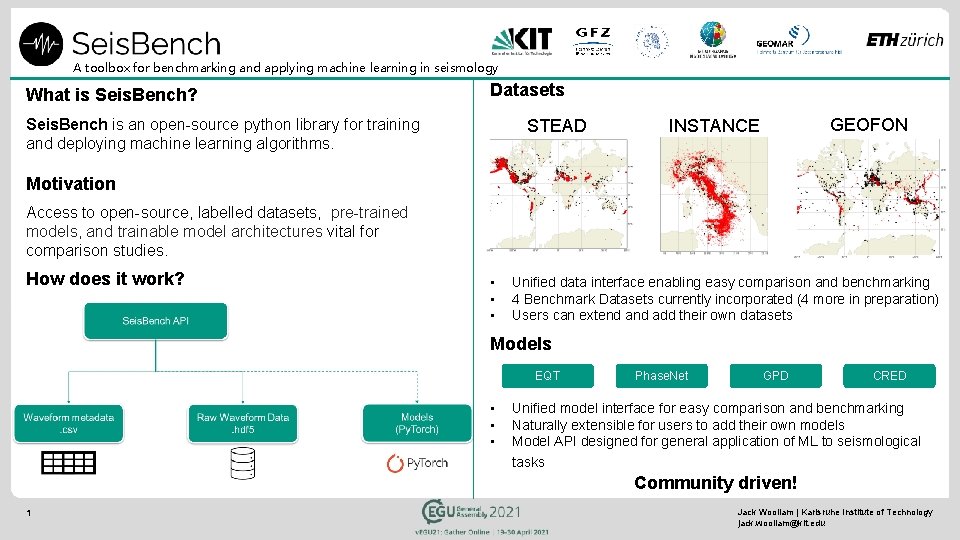
A toolbox for benchmarking and applying machine learning in seismology What is Seis. Bench? Datasets STEAD Seis. Bench is an open-source python library for training and deploying machine learning algorithms. GEOFON INSTANCE Motivation Access to open-source, labelled datasets, pre-trained models, and trainable model architectures vital for comparison studies. How does it work? • • • Unified data interface enabling easy comparison and benchmarking 4 Benchmark Datasets currently incorporated (4 more in preparation) Users can extend add their own datasets Models EQT • • • Phase. Net GPD CRED Unified model interface for easy comparison and benchmarking Naturally extensible for users to add their own models Model API designed for general application of ML to seismological tasks Community driven! 1 Jack Woollam | Karlsruhe Institute of Technology House of Participation jack. woollam@kit. edu
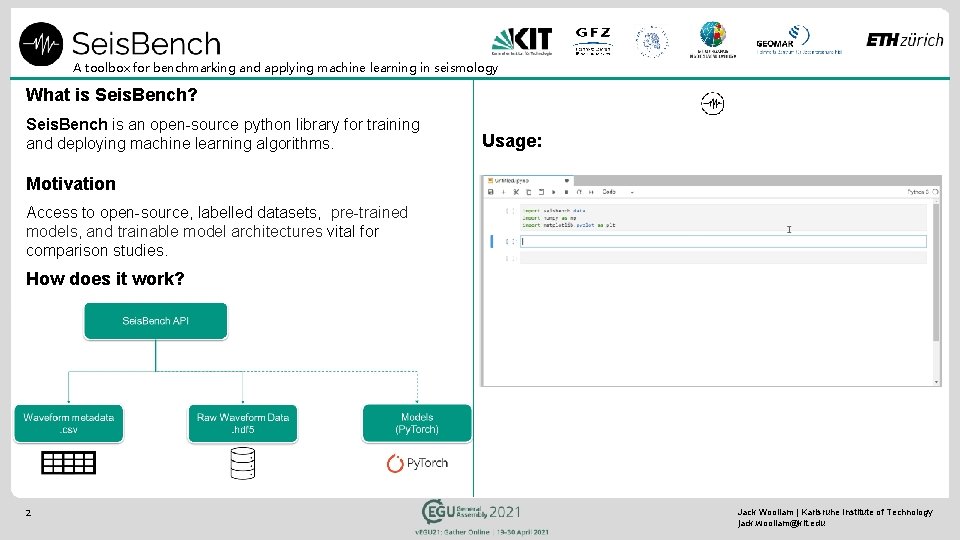
A toolbox for benchmarking and applying machine learning in seismology What is Seis. Bench? Seis. Bench is an open-source python library for training and deploying machine learning algorithms. Usage: Motivation Access to open-source, labelled datasets, pre-trained models, and trainable model architectures vital for comparison studies. How does it work? 2 Jack Woollam | Karlsruhe Institute of Technology House of Participation jack. woollam@kit. edu
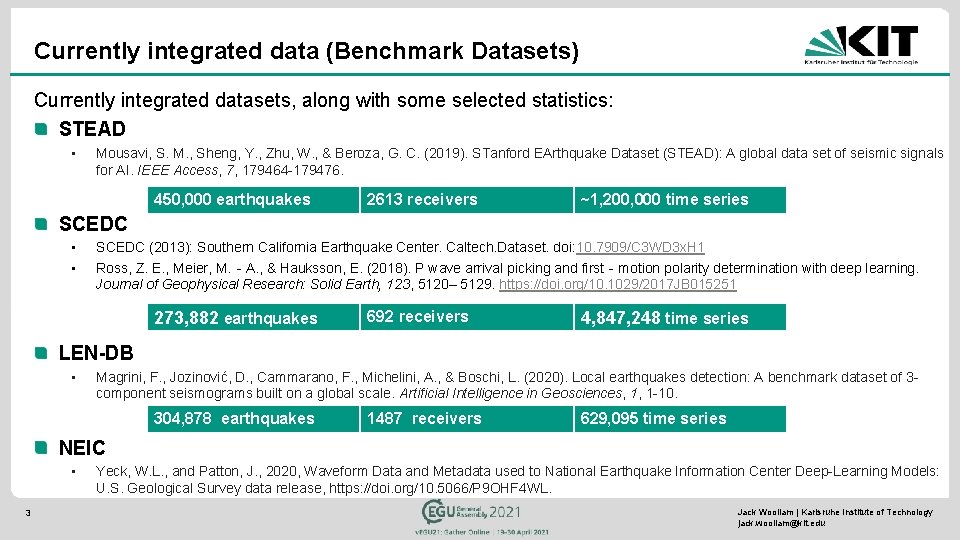
Currently integrated data (Benchmark Datasets) Currently integrated datasets, along with some selected statistics: STEAD • Mousavi, S. M. , Sheng, Y. , Zhu, W. , & Beroza, G. C. (2019). STanford EArthquake Dataset (STEAD): A global data set of seismic signals for AI. IEEE Access, 7, 179464 -179476. 450, 000 earthquakes 2613 receivers ~1, 200, 000 time series SCEDC • • SCEDC (2013): Southern California Earthquake Center. Caltech. Dataset. doi: 10. 7909/C 3 WD 3 x. H 1 Ross, Z. E. , Meier, M. ‐A. , & Hauksson, E. (2018). P wave arrival picking and first‐motion polarity determination with deep learning. Journal of Geophysical Research: Solid Earth, 123, 5120– 5129. https: //doi. org/10. 1029/2017 JB 015251 273, 882 earthquakes 692 receivers 4, 847, 248 time series LEN-DB • Magrini, F. , Jozinović, D. , Cammarano, F. , Michelini, A. , & Boschi, L. (2020). Local earthquakes detection: A benchmark dataset of 3 component seismograms built on a global scale. Artificial Intelligence in Geosciences, 1, 1 -10. 304, 878 earthquakes 1487 receivers 629, 095 time series NEIC • 3 Yeck, W. L. , and Patton, J. , 2020, Waveform Data and Metadata used to National Earthquake Information Center Deep-Learning Models: U. S. Geological Survey data release, https: //doi. org/10. 5066/P 9 OHF 4 WL. Jack Woollam | Karlsruhe Institute of Technology House of Participation jack. woollam@kit. edu
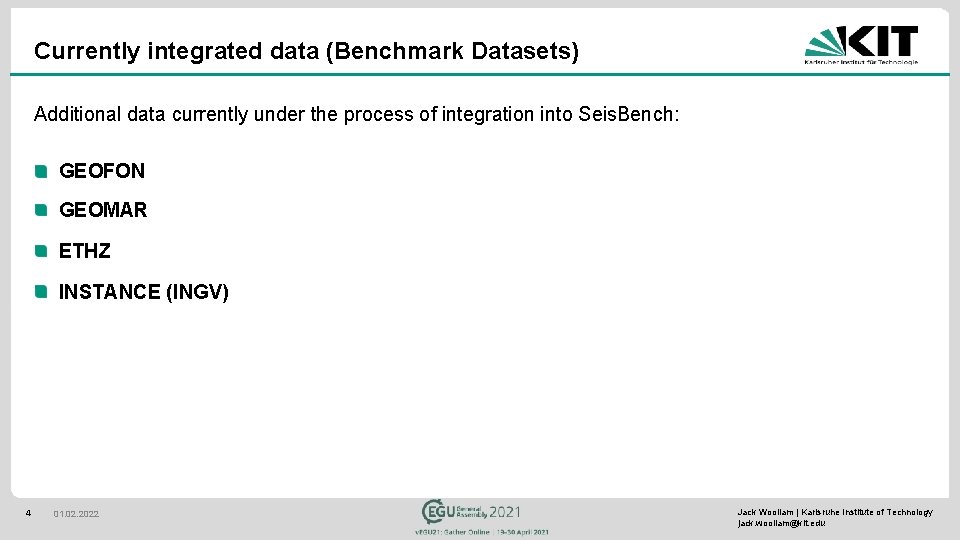
Currently integrated data (Benchmark Datasets) Additional data currently under the process of integration into Seis. Bench: GEOFON GEOMAR ETHZ INSTANCE (INGV) 4 01. 02. 2022 Jack Woollam | Karlsruhe Institute of Technology House of Participation jack. woollam@kit. edu
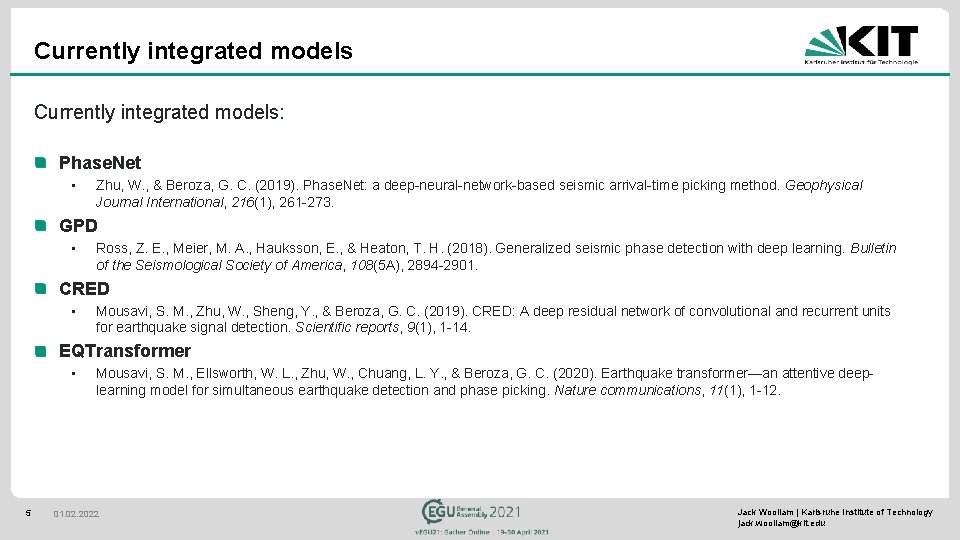
Currently integrated models: Phase. Net • Zhu, W. , & Beroza, G. C. (2019). Phase. Net: a deep-neural-network-based seismic arrival-time picking method. Geophysical Journal International, 216(1), 261 -273. GPD • Ross, Z. E. , Meier, M. A. , Hauksson, E. , & Heaton, T. H. (2018). Generalized seismic phase detection with deep learning. Bulletin of the Seismological Society of America, 108(5 A), 2894 -2901. CRED • Mousavi, S. M. , Zhu, W. , Sheng, Y. , & Beroza, G. C. (2019). CRED: A deep residual network of convolutional and recurrent units for earthquake signal detection. Scientific reports, 9(1), 1 -14. EQTransformer • 5 Mousavi, S. M. , Ellsworth, W. L. , Zhu, W. , Chuang, L. Y. , & Beroza, G. C. (2020). Earthquake transformer—an attentive deeplearning model for simultaneous earthquake detection and phase picking. Nature communications, 11(1), 1 -12. 01. 02. 2022 Jack Woollam | Karlsruhe Institute of Technology House of Participation jack. woollam@kit. edu
- Slides: 5