
A Theory of Fault Based Testing Larry J
A Theory of Fault Based Testing Larry J. Morell Presented by: Joonghoon Lee
A Reliable Test? • A test whose success implies Program Correctness • Unattainable in general
Quality Measures • Desirable to have gradations of ‘goodness’ – ‘Reliable Test’ being the ultimate • Structural Coverage Measures do not imply correctness • Maximize the number of faults eliminated – Hopefully, eliminating all faults
Fault-Based Testing • Determine the absence of pre-specified faults • Based on the number of faults eliminated
A Different Perspective • Traditional point of view – A test that does not find an error is useless • Fault-Based Testing – Every correct program execution contains information that proves the program could not have contained particular faults
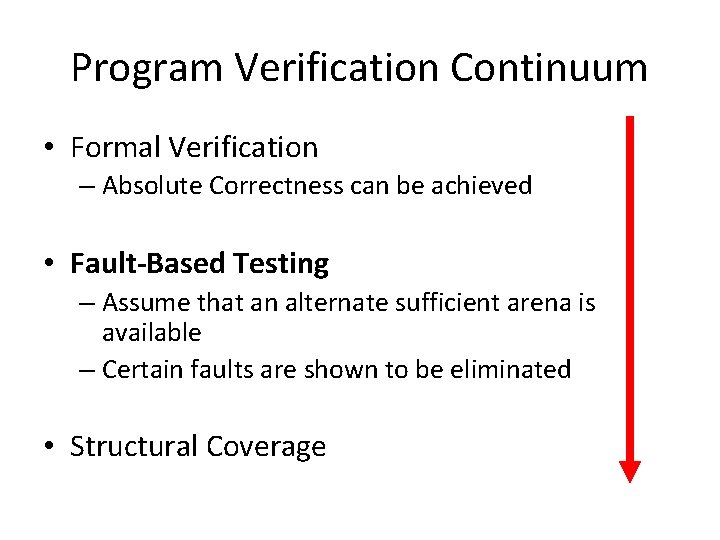
Program Verification Continuum • Formal Verification – Absolute Correctness can be achieved • Fault-Based Testing – Assume that an alternate sufficient arena is available – Certain faults are shown to be eliminated • Structural Coverage
Basic Framework • • <P, S, D>: Arena P: Program S: Specification D: Domain, source of test data
![Framework • • [P]: Program function (input, output) [P](x)↓: P halts on input x](http://slidetodoc.com/presentation_image/cb0c1ed90e1ef11e2a45aad7b72a8bf9/image-8.jpg "Framework • • [P]: Program function (input, output) [P](x)↓: P halts on input x")
Framework • • [P]: Program function (input, output) [P](x)↓: P halts on input x [P](x)↑: doesn’t dom([P]): All points for which P halts
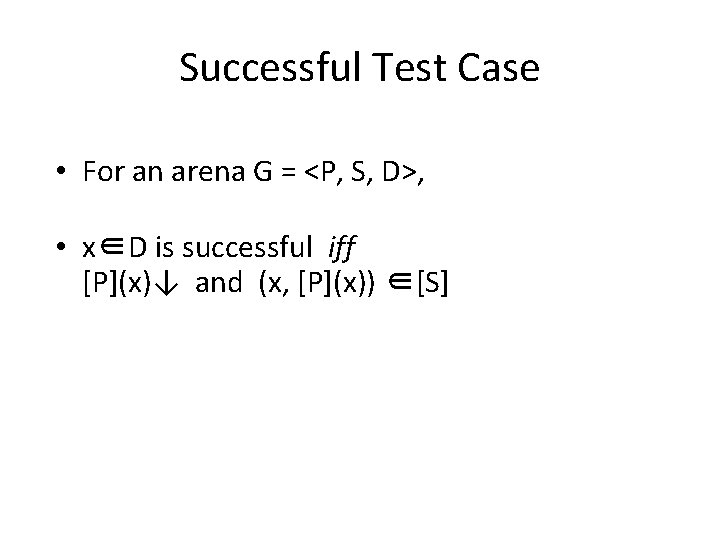
Successful Test Case • For an arena G = <P, S, D>, • x∈D is successful iff [P](x)↓ and (x, [P](x)) ∈[S]
Failure Sets • The set of all failure points for G is the Failure set of G. • A Program P is correct with respect to S iff P’s failure set is empty. • Failures sets are not always recursively enumerable – Must restrict failure set
Fault-Based Arena • • • <P, S, D, L, A> P: Program S: Specification D: Domain, source of test data L: Locations in P A: alternative set associated with locations
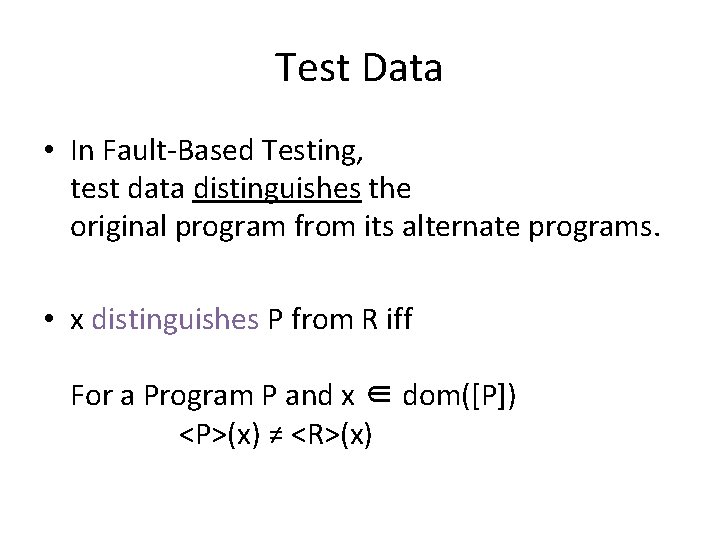
Test Data • In Fault-Based Testing, test data distinguishes the original program from its alternate programs. • x distinguishes P from R iff For a Program P and x ∈ dom([P]) <P>(x) ≠ <R>(x)
Alternate Sufficient • A fault based arena which contains a correct program is alternate sufficient • It is undecidable whether or not an arbitrary fault based arena is alternate sufficient.
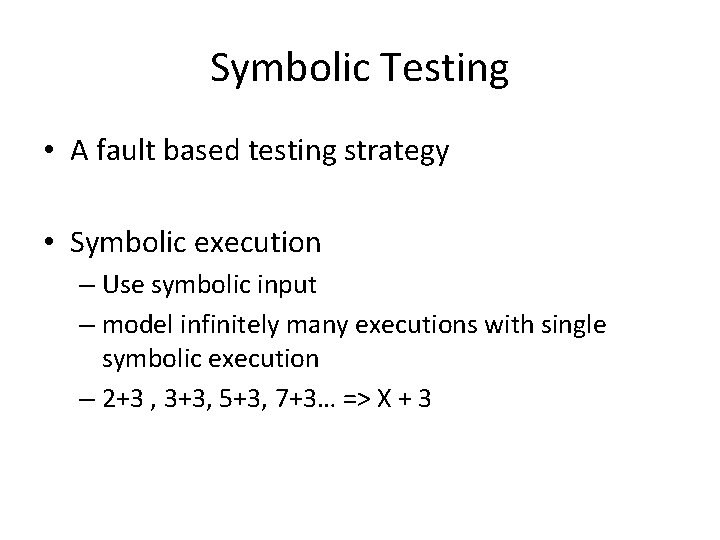
Symbolic Testing • A fault based testing strategy • Symbolic execution – Use symbolic input – model infinitely many executions with single symbolic execution – 2+3 , 3+3, 5+3, 7+3… => X + 3
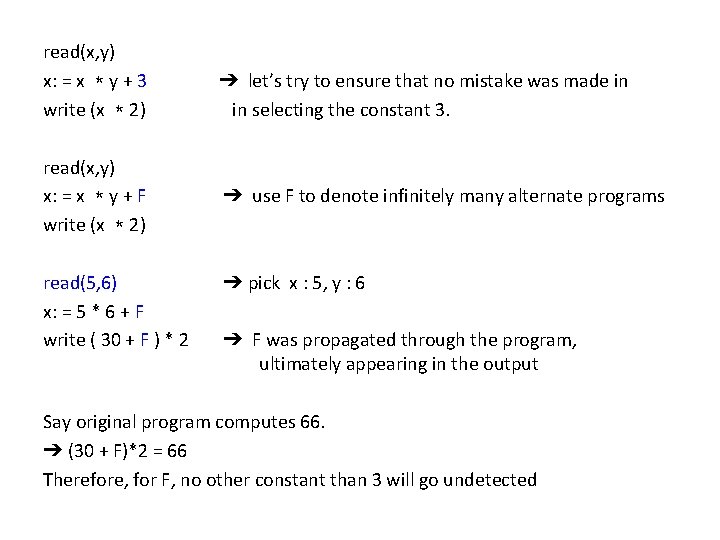
read(x, y) x: = x *y + 3 write (x *2) read(x, y) x: = x *y + F write (x *2) read(5, 6) x: = 5 * 6 + F write ( 30 + F ) * 2 ➔ let’s try to ensure that no mistake was made in in selecting the constant 3. ➔ use F to denote infinitely many alternate programs ➔ pick x : 5, y : 6 ➔ F was propagated through the program, ultimately appearing in the output Say original program computes 66. ➔ (30 + F)*2 = 66 Therefore, for F, no other constant than 3 will go undetected
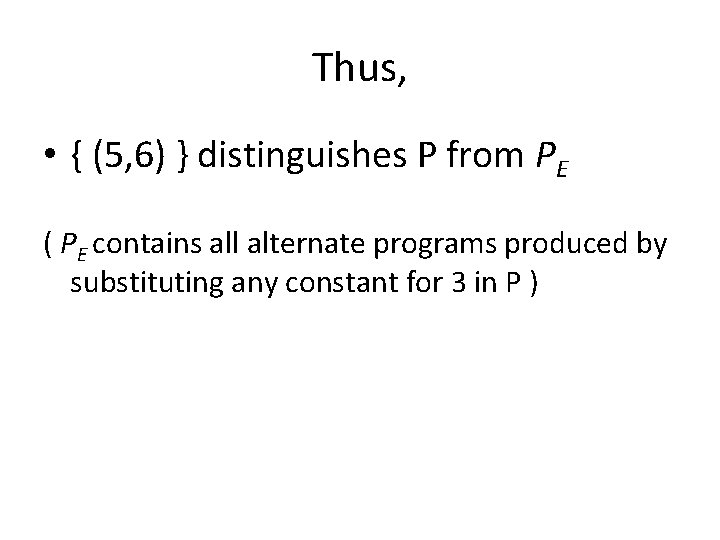
Thus, • { (5, 6) } distinguishes P from PE ( PE contains all alternate programs produced by substituting any constant for 3 in P )
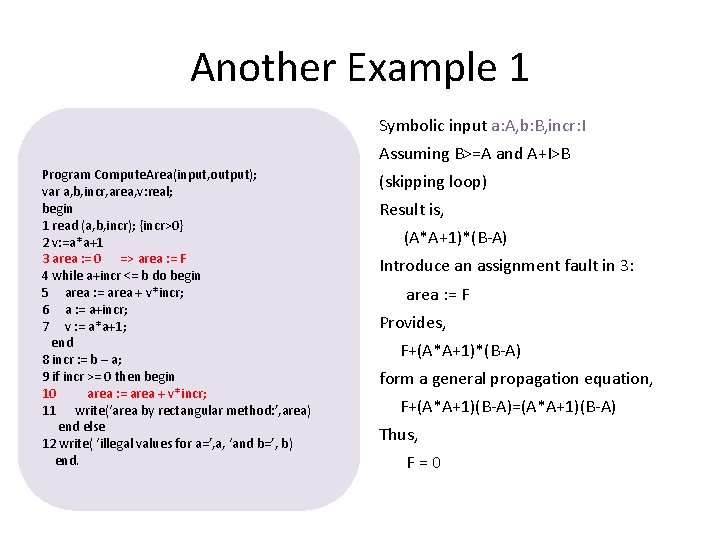
Another Example 1 Symbolic input a: A, b: B, incr: I Assuming B>=A and A+I>B Program Compute. Area(input, output); var a, b, incr, area, v: real; begin 1 read (a, b, incr); {incr>0} 2 v: =a*a+1 3 area : = 0 => area : = F 4 while a+incr <= b do begin 5 area : = area + v*incr; 6 a : = a+incr; 7 v : = a*a+1; end 8 incr : = b – a; 9 if incr >= 0 then begin 10 area : = area + v*incr; 11 write(‘area by rectangular method: ’, area) end else 12 write( ‘illegal values for a=’, a, ‘and b=’, b) end. (skipping loop) Result is, (A*A+1)*(B-A) Introduce an assignment fault in 3: area : = F Provides, F+(A*A+1)*(B-A) form a general propagation equation, F+(A*A+1)(B-A)=(A*A+1)(B-A) Thus, F=0
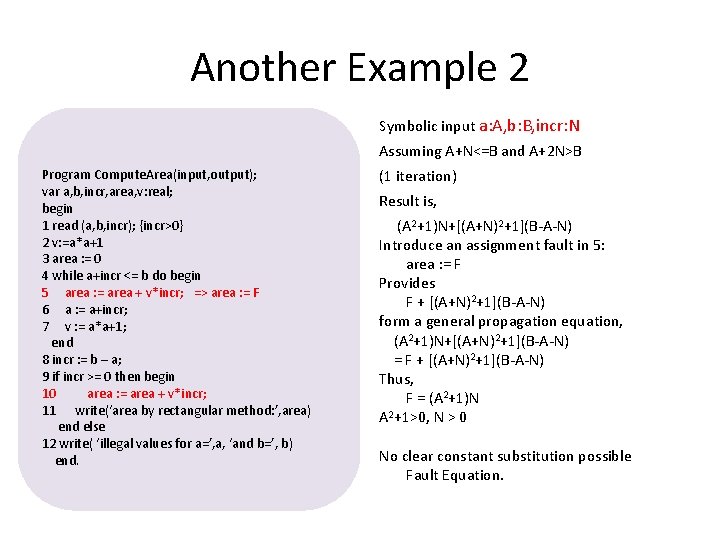
Another Example 2 Symbolic input a: A, b: B, incr: N Assuming A+N<=B and A+2 N>B Program Compute. Area(input, output); var a, b, incr, area, v: real; begin 1 read (a, b, incr); {incr>0} 2 v: =a*a+1 3 area : = 0 4 while a+incr <= b do begin 5 area : = area + v*incr; => area : = F 6 a : = a+incr; 7 v : = a*a+1; end 8 incr : = b – a; 9 if incr >= 0 then begin 10 area : = area + v*incr; 11 write(‘area by rectangular method: ’, area) end else 12 write( ‘illegal values for a=’, a, ‘and b=’, b) end. (1 iteration) Result is, (A 2+1)N+[(A+N)2+1](B-A-N) Introduce an assignment fault in 5: area : = F Provides F + [(A+N)2+1](B-A-N) form a general propagation equation, (A 2+1)N+[(A+N)2+1](B-A-N) = F + [(A+N)2+1](B-A-N) Thus, F = (A 2+1)N A 2+1>0, N > 0 No clear constant substitution possible Fault Equation.
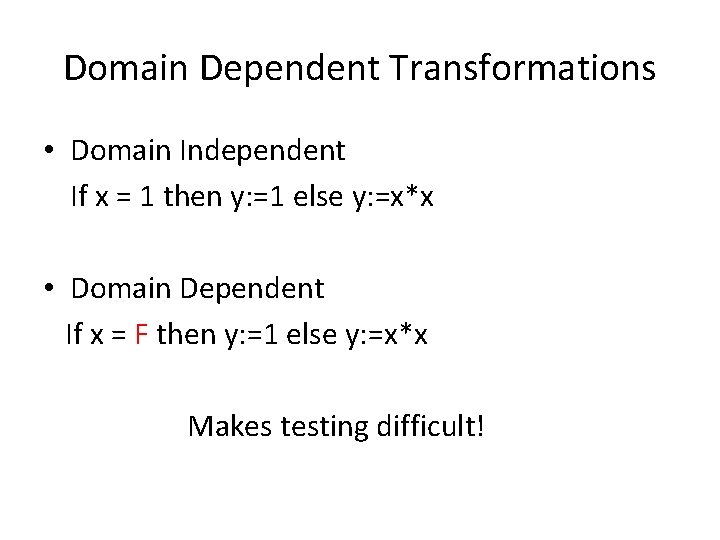
Domain Dependent Transformations • Domain Independent If x = 1 then y: =1 else y: =x*x • Domain Dependent If x = F then y: =1 else y: =x*x Makes testing difficult!
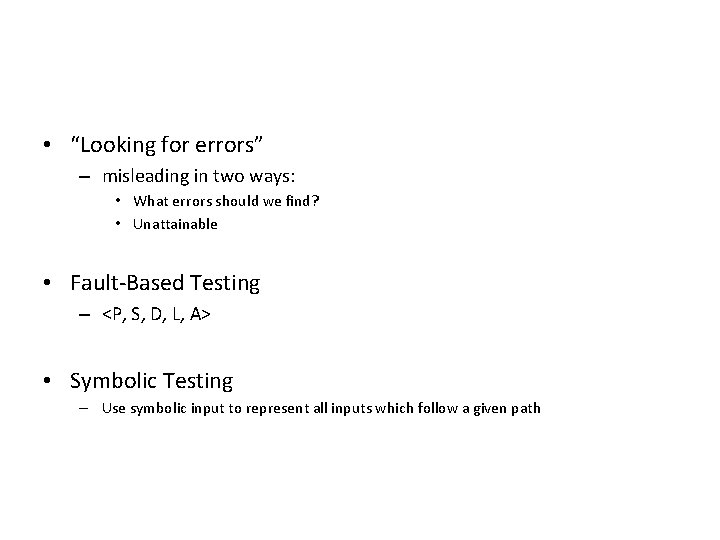
• “Looking for errors” – misleading in two ways: • What errors should we find? • Unattainable • Fault-Based Testing – <P, S, D, L, A> • Symbolic Testing – Use symbolic input to represent all inputs which follow a given path
- Slides: 20