
A Textual Analysis of Course Syllabi for Library
A Textual Analysis of Course Syllabi for Library- and Research. Related Terminology A Quantitative Approach to Faculty Outreach Sarah L. Hood Head Research and Instruction Librarian J. Drake Edens Library Columbia College Columbia, South Carolina
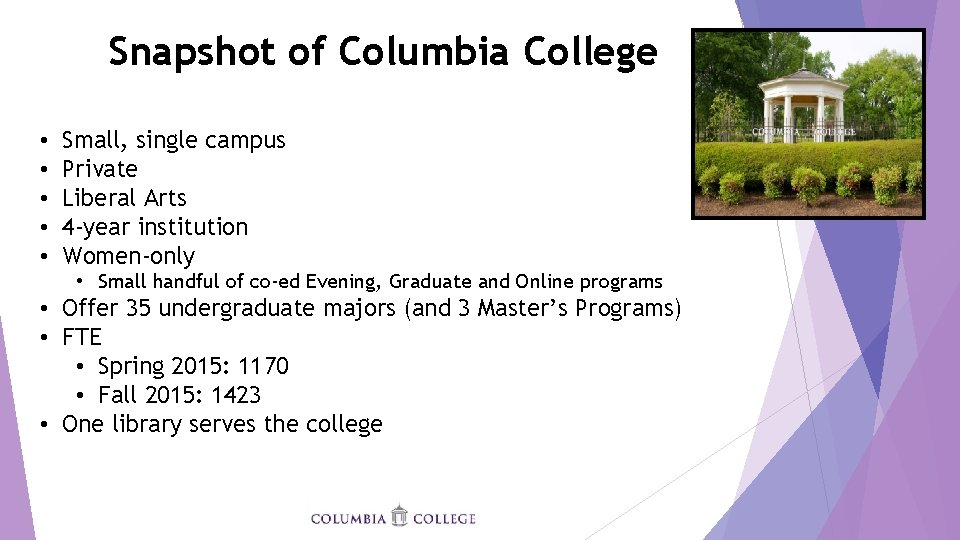
Snapshot of Columbia College • • • Small, single campus Private Liberal Arts 4 -year institution Women-only • Small handful of co-ed Evening, Graduate and Online programs • Offer 35 undergraduate majors (and 3 Master’s Programs) • FTE • Spring 2015: 1170 • Fall 2015: 1423 • One library serves the college
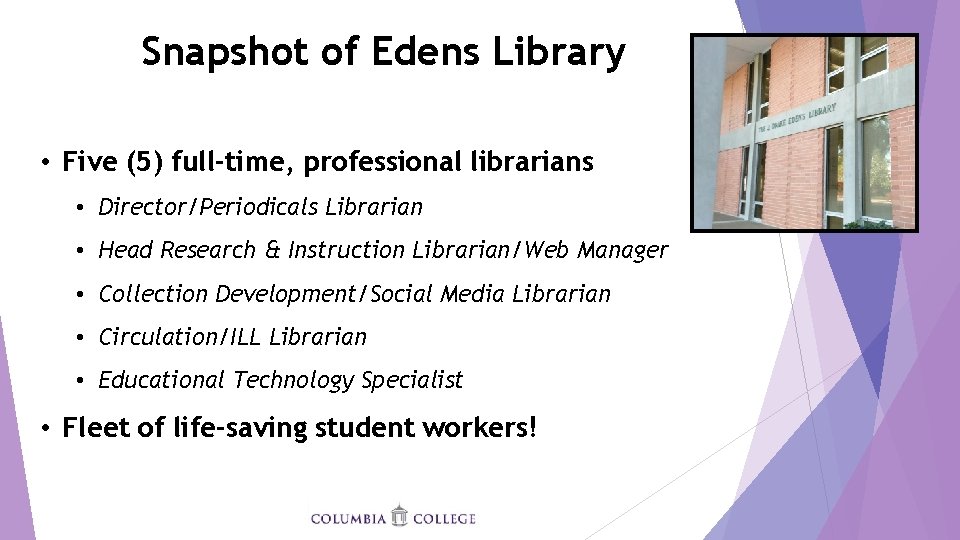
Snapshot of Edens Library • Five (5) full-time, professional librarians • Director/Periodicals Librarian • Head Research & Instruction Librarian/Web Manager • Collection Development/Social Media Librarian • Circulation/ILL Librarian • Educational Technology Specialist • Fleet of life-saving student workers!
Snapshot of our Information Literacy Instruction (IL) Program (Undergraduate) • Have had a very lively and robust IL program for many years : -) • I teach majority of IL sessions, but our Director and CD Librarian occasionally teach • IL Instruction = mostly “one-shots” • Avg. 32 / semester • Avg. class size = 15 students • Assignment-based close collaboration with faculty • No credit-bearing, semester-long IL course at this time : -(
The Study What A Textual Analysis of Course Syllabi for Library- and Research. Related Terminology Analyzed the full text of 425 undergraduate course syllabi for specific key words that would indicate a potential need on the part of the student to engage in the use of one or more library resources
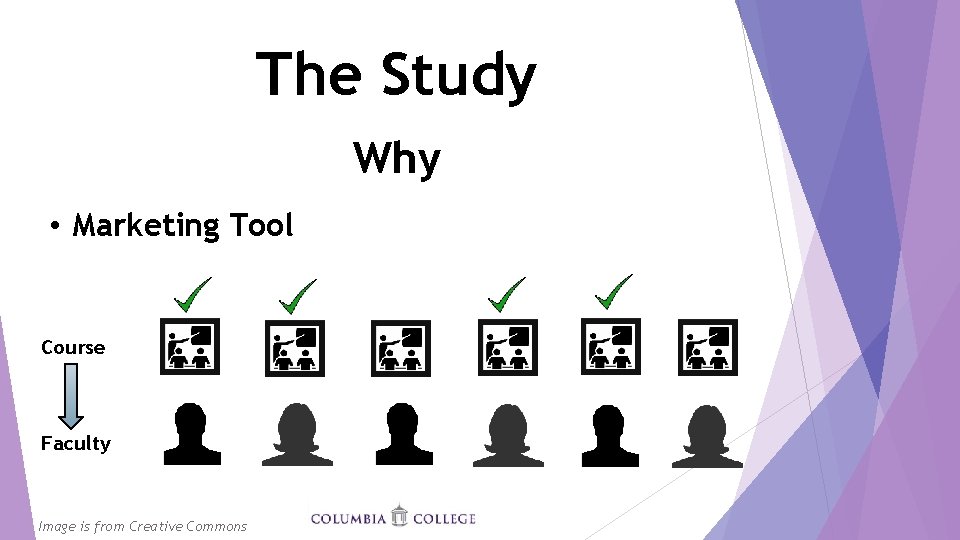
The Study Why • Marketing Tool Course Faculty Image is from Creative Commons
Literature Review (Brief) Early Attempts Rambler, L. K. (1982). Syllabus study: Key to a responsive academic library. Journal of Academic Librarianship, 8(3), 155 -59. Sayles, J. W. (1985). Course information analysis: Foundation for creative library support. Journal of Academic Librarianship, 10(6), 343 -45.
![Literature Review (Brief) 3 Take-Aways #1 “As a result [of examining course syllabi], librarians](http://slidetodoc.com/presentation_image_h/1b15a1feb285ecd182bd5fa9c35816ad/image-8.jpg "Literature Review (Brief) 3 Take-Aways #1 “As a result [of examining course syllabi], librarians")
Literature Review (Brief) 3 Take-Aways #1 “As a result [of examining course syllabi], librarians can be better prepared and in the longer term can demonstrate to faculty a higher degree of involvement in course instruction. ” - Williams, Cody & Parnell, 2004
Literature Review (Brief) 3 Take-Aways #2 “By respecting the exact needs of the instructor, librarians can complement the teaching function rather than play the traditional supplemental role…” - Sayles, 1985
Literature Review (Brief) 3 Take-Aways #3 “The syllabi can also reveal which faculty one should most likely approach, and follow-up discussions with these selected faculty can then provide further information on library assignments. ” - Dewald, 2003
Research Questions How does a faculty member’s perception of the library manifest itself within their course syllabus?
Research Questions How does a faculty member’s perception of the library manifest itself within their course syllabus? How can the answer to this question inform Edens Library’s approach to faculty outreach in relation to our Information Literacy Instruction Program?
Research Questions How does a faculty member’s perception of the library manifest itself within their course syllabus? How can the answer to this question inform Edens Library’s approach to faculty outreach in relation to our Information Literacy Instruction Program? Based on the presence of library- and research-related terminology within course syllabi, which faculty could potentially benefit from one or more library instruction sessions? (aka, the “one-shot”)
Research Questions How does a faculty member’s perception of the library manifest itself within their course syllabus? How can the answer to this question inform Edens Library’s approach to faculty outreach in relation to our Information Literacy Instruction Program? Based on the presence of library- and research-related terminology within course syllabi, which faculty could potentially benefit from one or more library instruction sessions? (aka, the “one-shot”) Of those faculty, with whom have we not yet made contact?
Syllabi Analyzed Access to Course Syllabi • CC has an intra-campus electronic repository to which faculty are required to upload their syllabi each semester • No IRB approval was needed but I had to obtain permission from each individual faculty member (116 total)
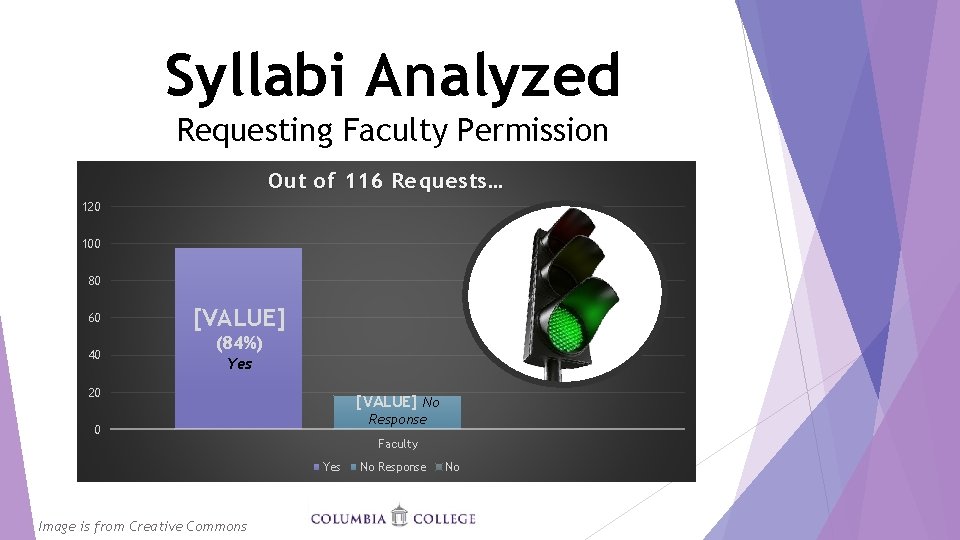
Syllabi Analyzed Requesting Faculty Permission Out of 116 Requests… 120 100 80 60 40 [VALUE] (84%) Yes 20 [VALUE] No Response 0 Faculty Yes Image is from Creative Commons No Response No
Parameters of the Study (Set Up) Course Syllabi Included in the Study: • Spring 2015 and Fall 2015 of all sections of most courses offered in our Undergraduate Programs. This includes: ü Day College (women-only) ü Evening College (co-ed) ü Online Programs (co-ed) These include “Independent Study, ” “Seminar” and “Senior Project” courses.
Parameters of the Study (Set Up) Course Syllabi Eliminated from the Study: • • Graduate level courses (focus is undergrad) The following undergraduate courses (these courses would be least likely to require library use) ü Musical Ensembles (MUE), Applied Music (MUA), or Junior/Senior Recitals ü Physical Education – Activities (PEA) ü Labs ü Internships, Apprenticeships, Field Experiences or Study Abroad in any discipline
![Syllabi Analyzed DISCIPLINE Out of 425 Total Syllabi… [VALUE] Social Sciences 19% [VALUE] Humanities](http://slidetodoc.com/presentation_image_h/1b15a1feb285ecd182bd5fa9c35816ad/image-19.jpg "Syllabi Analyzed DISCIPLINE Out of 425 Total Syllabi… [VALUE] Social Sciences 19% [VALUE] Humanities")
Syllabi Analyzed DISCIPLINE Out of 425 Total Syllabi… [VALUE] Social Sciences 19% [VALUE] Humanities 54. 5% [VALUE] STEM 26. 5%
![Syllabi Analyzed COURSE LEVEL Out of 425 Total Syllabi… [VALUE] 400 -Level 10. 5%](http://slidetodoc.com/presentation_image_h/1b15a1feb285ecd182bd5fa9c35816ad/image-20.jpg "Syllabi Analyzed COURSE LEVEL Out of 425 Total Syllabi… [VALUE] 400 -Level 10. 5%")
Syllabi Analyzed COURSE LEVEL Out of 425 Total Syllabi… [VALUE] 400 -Level 10. 5% [VALUE] 100 -Level 31% 300 -Level 31. 5% [VALUE] 200 -Level 27%
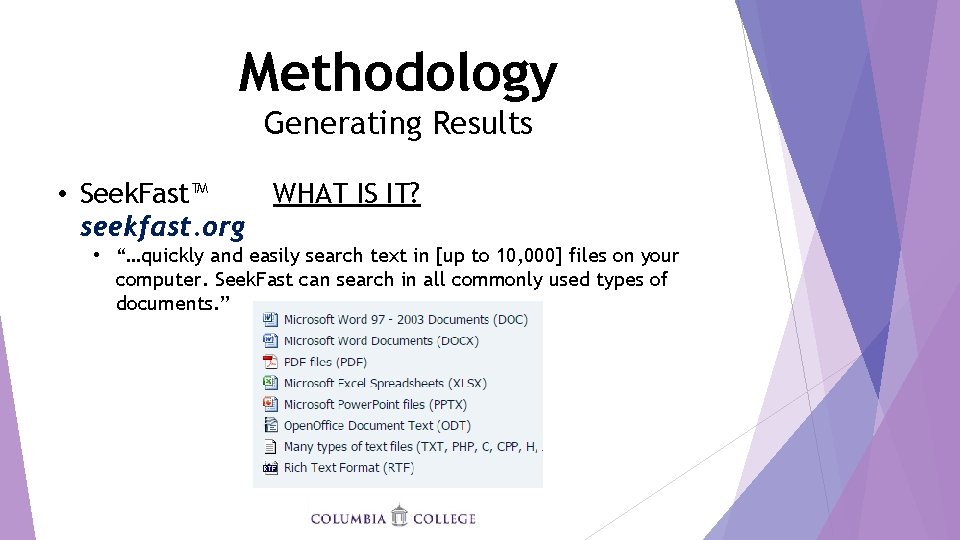
Methodology Generating Results • Seek. Fast™ WHAT IS IT? seekfast. org • “…quickly and easily search text in [up to 10, 000] files on your computer. Seek. Fast can search in all commonly used types of documents. ”
Methodology Generating Results • Seek. Fast™ COST seekfast. org • Version 2. 3 • $28 one-user license • Can purchase up to 50 licenses for $450
Methodology Generating Results • Seek. Fast™ HOW IT WORKS seekfast. org • *Similar* to a Ctrl+F command for multiple files • Can search Word and PDF docs simultaneously
Methodology Generating Results • Seek. Fast™ NEGATIVES seekfast. org • Seems to be no tech support after purchase : -( • “Note that the file may contain unlimited number of sentences compliant with your search, but only the most relevant ones are displayed. ” • To get a truly accurate count, I still had to open each file and do Ctrl+F Image is from Creative Commons
Methodology Word-Count and Occurrence Words Searched Library Librarian Literature review (and other variations of) Scholarly Peer-reviewed Refereed Journal Database
Methodology Word-Count and Occurrence Circumstances in which I did not count the occurrence of a word: • Scholarly: When used in a general sense • i. e. “student must demonstrate scholarly writing, ” “students are expected to engage in scholarly discussion during class” • Journal: When used as a verb • i. e. used in the context of “keeping a journal” or diary • Database: When not referring to a library database • i. e. databases used in Math classes
Methodology Word-Count and Occurrence Special Note About The Word “Library”: • When it simply referred to the LOCATION of something (i. e. a faculty member’s office or classroom, IT, Media Center, or the Academic Skills Center) I counted that occurrence, but I classified it as a Non. Related (N-REL) occurrence. • Pertinent (REL) occurrences generally fell into 3 categories, which I recorded. • Course Reserves • Citation help • Research-specific
Wanted to search these words also… Paper Essay Research But… Image is from Creative Commons
Methodology Recording Results MS Excel • Simple, relatively easy to use • Part of MS Office (No need to purchase additional software)
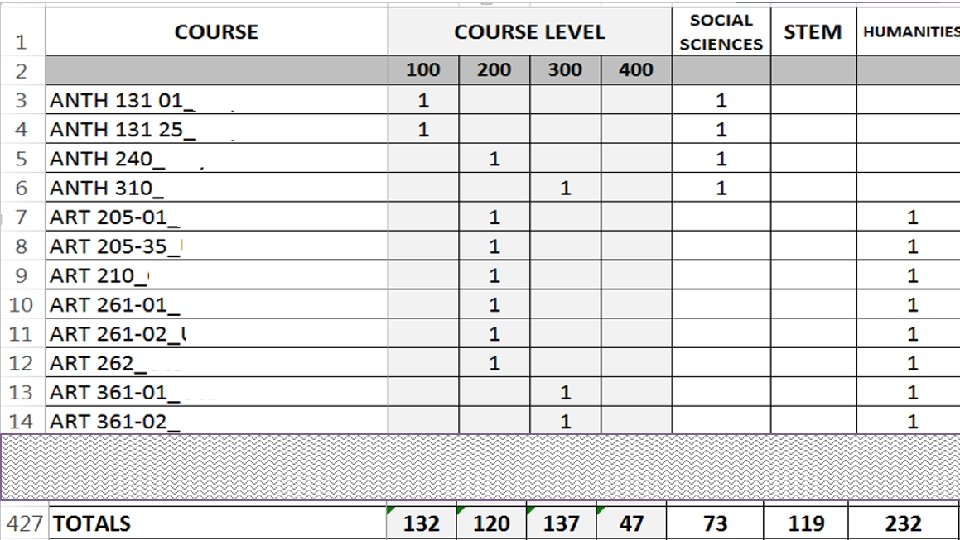
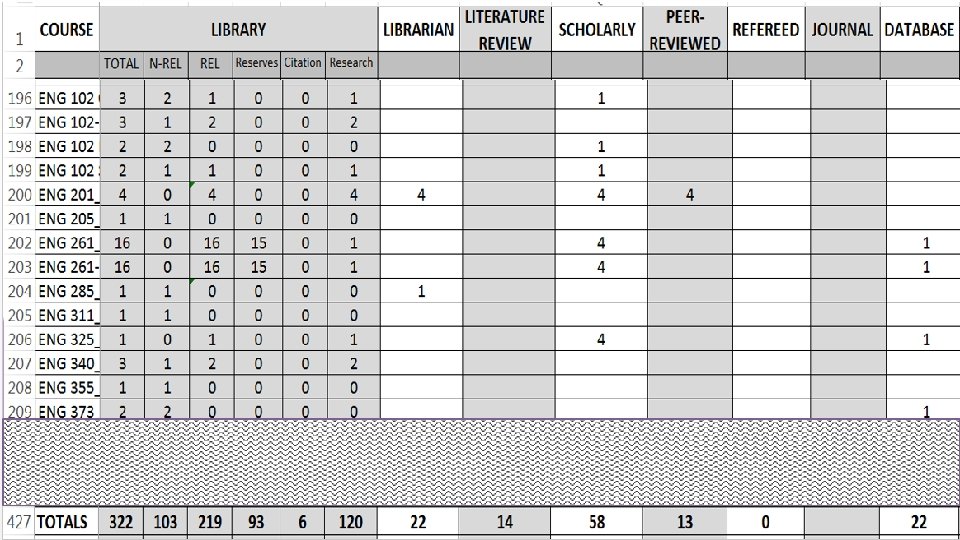
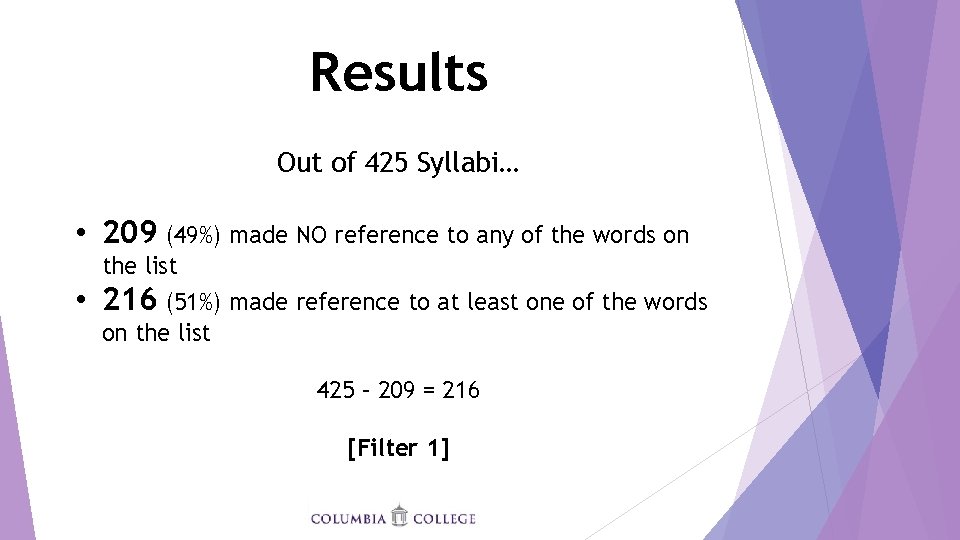
Results Out of 425 Syllabi… • 209 (49%) made NO reference to any of the words on the list • 216 (51%) made reference to at least one of the words on the list 425 – 209 = 216 [Filter 1]
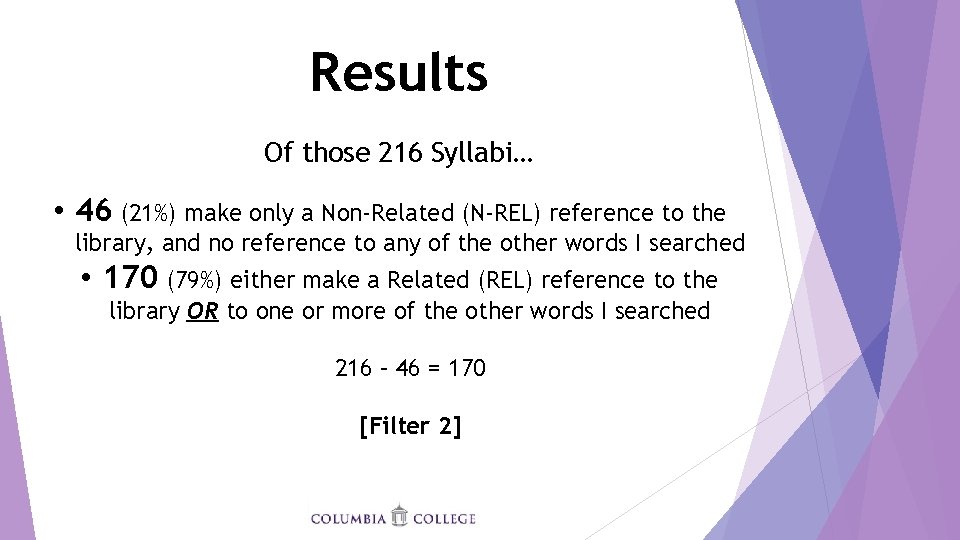
Results Of those 216 Syllabi… • 46 (21%) make only a Non-Related (N-REL) reference to the library, and no reference to any of the other words I searched • 170 (79%) either make a Related (REL) reference to the library OR to one or more of the other words I searched 216 – 46 = 170 [Filter 2]
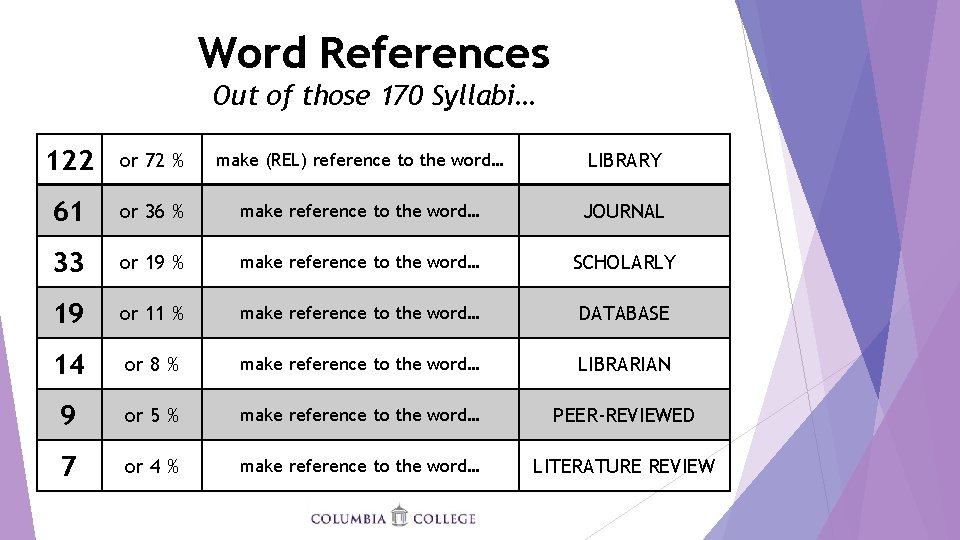
Word References Out of those 170 Syllabi… 122 or 72 % make (REL) reference to the word… LIBRARY 61 or 36 % make reference to the word… JOURNAL 33 or 19 % make reference to the word… SCHOLARLY 19 or 11 % make reference to the word… DATABASE 14 or 8 % make reference to the word… LIBRARIAN 9 or 5 % make reference to the word… PEER-REVIEWED 7 or 4 % make reference to the word… LITERATURE REVIEW
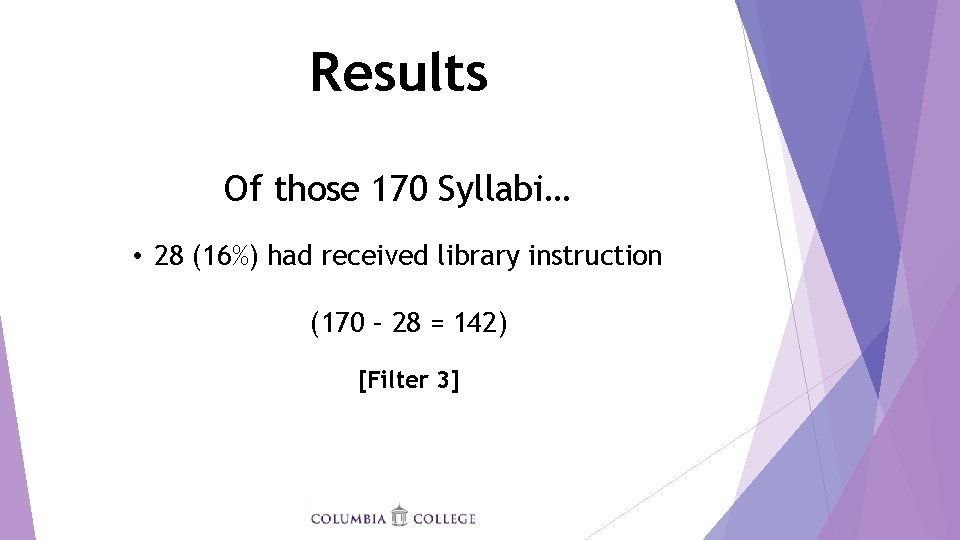
Results Of those 170 Syllabi… • 28 (16%) had received library instruction (170 – 28 = 142) [Filter 3]
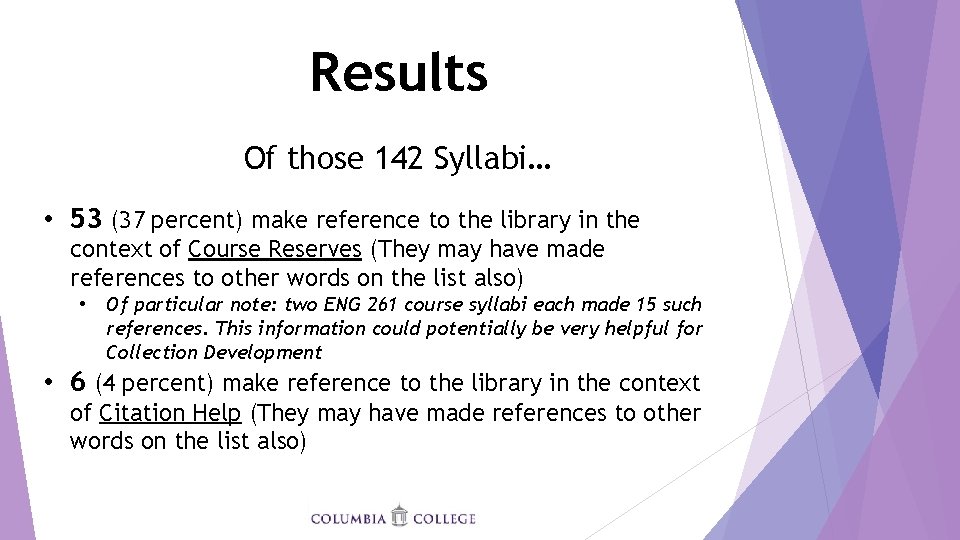
Results Of those 142 Syllabi… • 53 (37 percent) make reference to the library in the context of Course Reserves (They may have made references to other words on the list also) • Of particular note: two ENG 261 course syllabi each made 15 such references. This information could potentially be very helpful for Collection Development • 6 (4 percent) make reference to the library in the context of Citation Help (They may have made references to other words on the list also)
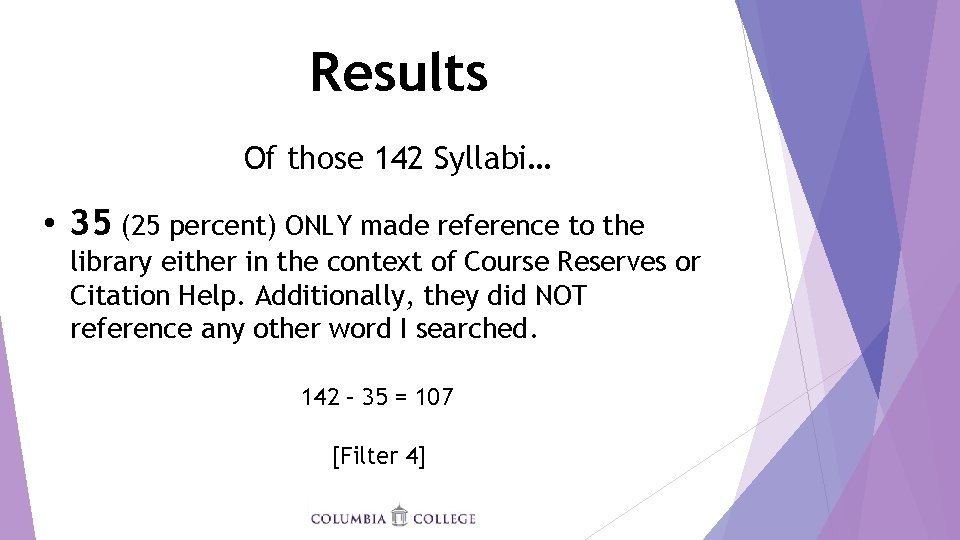
Results Of those 142 Syllabi… • 35 (25 percent) ONLY made reference to the library either in the context of Course Reserves or Citation Help. Additionally, they did NOT reference any other word I searched. 142 – 35 = 107 [Filter 4]
107 Course syllabi either make reference to the library in the context of Research Activities and/or reference one or more of the other words I searched. Image is from Creative Commons
![Discipline Out of The 107 Remaining Syllabi… [VALUE] Social Sciences 34% [VALUE] STEM 16%](http://slidetodoc.com/presentation_image_h/1b15a1feb285ecd182bd5fa9c35816ad/image-39.jpg "Discipline Out of The 107 Remaining Syllabi… [VALUE] Social Sciences 34% [VALUE] STEM 16%")
Discipline Out of The 107 Remaining Syllabi… [VALUE] Social Sciences 34% [VALUE] STEM 16% [VALUE] Humanities 50%
![Course Level Out of The 107 Remaining Syllabi… [VALUE] 400 -Level 9. 5% 27](http://slidetodoc.com/presentation_image_h/1b15a1feb285ecd182bd5fa9c35816ad/image-40.jpg "Course Level Out of The 107 Remaining Syllabi… [VALUE] 400 -Level 9. 5% 27")
Course Level Out of The 107 Remaining Syllabi… [VALUE] 400 -Level 9. 5% 27 100 -Level 25% [VALUE] 300 -Level 36. 5% [VALUE] 200 -Level 29%
CONCLUSIONS & DISCUSSION
![Discipline Out of the 107 Remaining Syllabi… [VALUE] 34% Social Sciences Out of 425](http://slidetodoc.com/presentation_image_h/1b15a1feb285ecd182bd5fa9c35816ad/image-42.jpg "Discipline Out of the 107 Remaining Syllabi… [VALUE] 34% Social Sciences Out of 425")
Discipline Out of the 107 Remaining Syllabi… [VALUE] 34% Social Sciences Out of 425 Total Syllabi… 19% 16% [VALUE] Soc. Sci. [VAL UE] [VALU E] STEM [VALUE] Humaniti es 50% [VALUE] 54. 5% Hum. 26. 5%
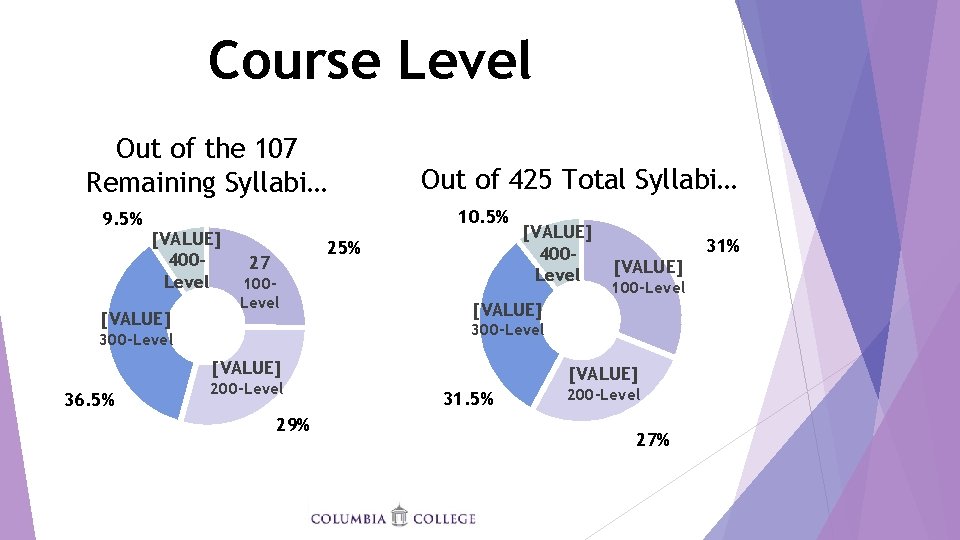
Course Level Out of the 107 Remaining Syllabi… 9. 5% Out of 425 Total Syllabi… 10. 5% [VALUE] 400 Level [VALUE] 25% 27 100 Level 31% [VALUE] 100 -Level [VALUE] 300 -Level [VALUE] 36. 5% [VALUE] 400 Level 200 -Level 29% [VALUE] 31. 5% 200 -Level 27%
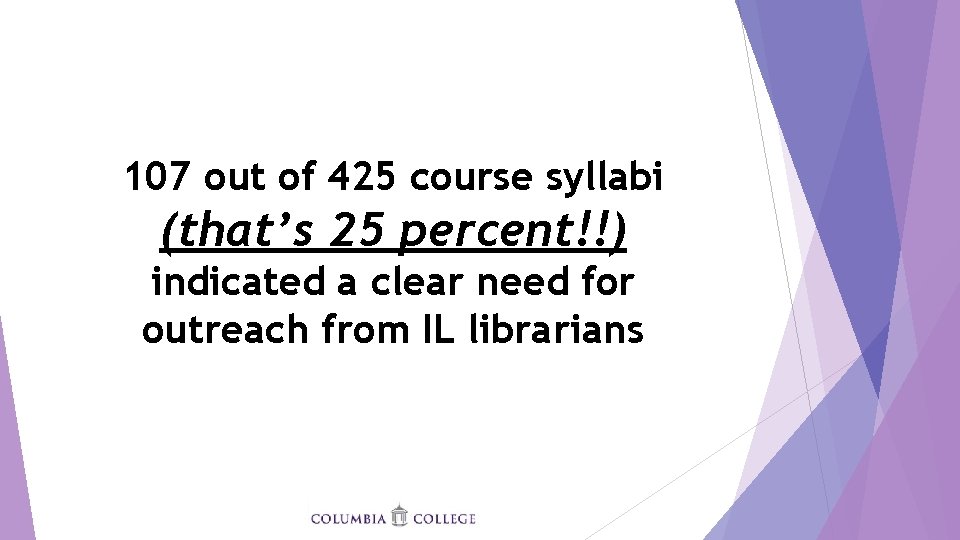
107 out of 425 course syllabi (that’s 25 percent!!) indicated a clear need for outreach from IL librarians
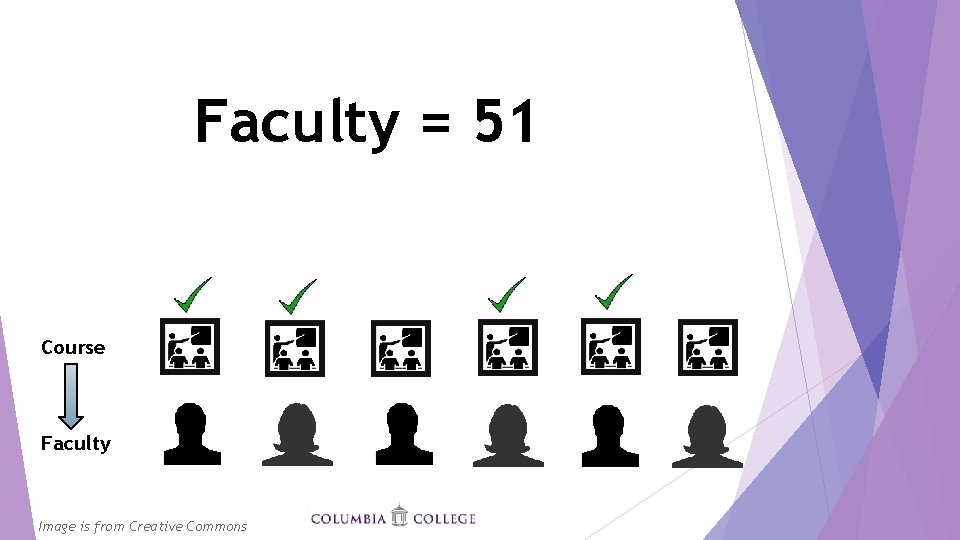
Faculty = 51 Course Faculty Image is from Creative Commons
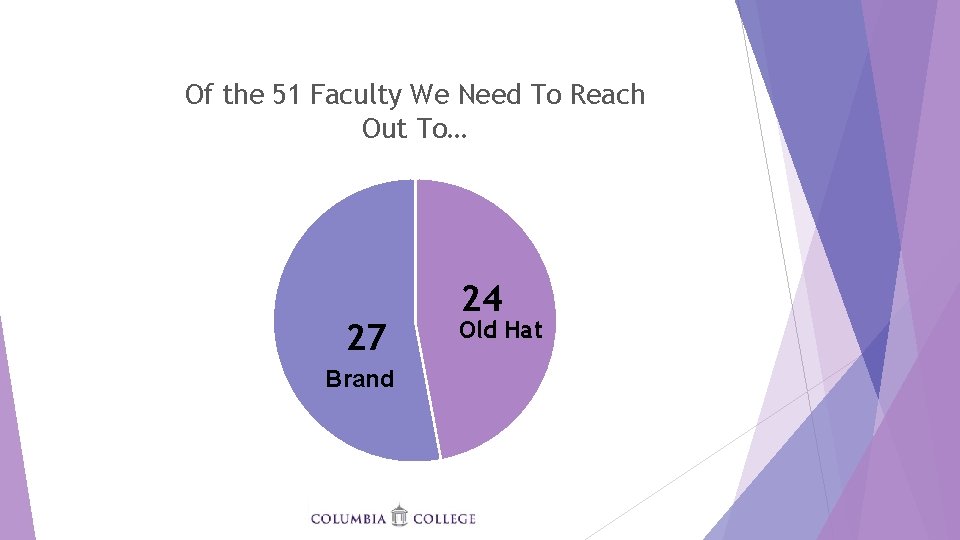
Of the 51 Faculty We Need To Reach Out To… 27 Brand 24 Old Hat
What am I working on? • Making individual contact with ID-ed faculty • PSY 349 – F 2 F IL session • 2 or 3 video tutorials for Online Program
Questions? ?
Discussion Question 1 Do you have faculty who have traditionally been resistant to bringing their classes in for an instruction session? Were you or your colleagues able to overcome that? Does anyone have any success stories they’d like to share?
Discussion Question 2 If you could tell faculty anything you wanted to about the construction of their course syllabi, what would it be?
Ci. Ci and I say… Thank you!
Links of Interest • About Information Literacy Instruction Program at Edens Library, Columbia College http: //libguides. columbiasc. edu/library/informationliteracy • Seek. Fast™ Software http: //seekfast. org/
References Bean, R. , & Klekowski, L. M. (1993). Course syllabi. Extracting their hidden potential. Course Syllabi. Extracting Their Hidden Potential, 1 -9. Boss, K. , & Drabinski, E. (2014). Evidence-based instruction integration: a syllabus analysis project. Reference Services Review, 42(2), 263 -276. doi: 10. 1108/RSR-07 -2013 -0038 Dewald, N. H. (2003). Anticipating library use by business students: the uses of a syllabus study. Research Strategies, 19(1), 33 -45. doi: 10. 1016/j. resstr. 2003. 09. 003 Lauer, J. D. , Merz, L. H. , & Craig, S. L. (1989). What syllabi reveal about library use: A comparative look at two private academic institutions. Research Strategies, 7167 -174. Rambler, L. K. (1982). Syllabus study: Key to a responsive academic library. Journal of Academic Librarianship, 8(3), 155 -59. Sayles, J. W. (1985). Course information analysis: Foundation for creative library support. Journal of Academic Librarianship, 10(6), 343 -45. Smith, C. , Doversberger, L. , Jones, S. , Ladwig, P. , Parker, J. , & Pietraszewski, B. (2012). Using course syllabi to uncover opportunities for curriculum-integrated instruction. Reference & User Services Quarterly, 51(3), 263 -271. Williams, L. M. , Cody, S. A. , & Parnell, J. (2004). Prospecting for new collaborations: Mining syllabi for library service opportunities. Journal of Academic Librarianship, 30(4), 270 -275.
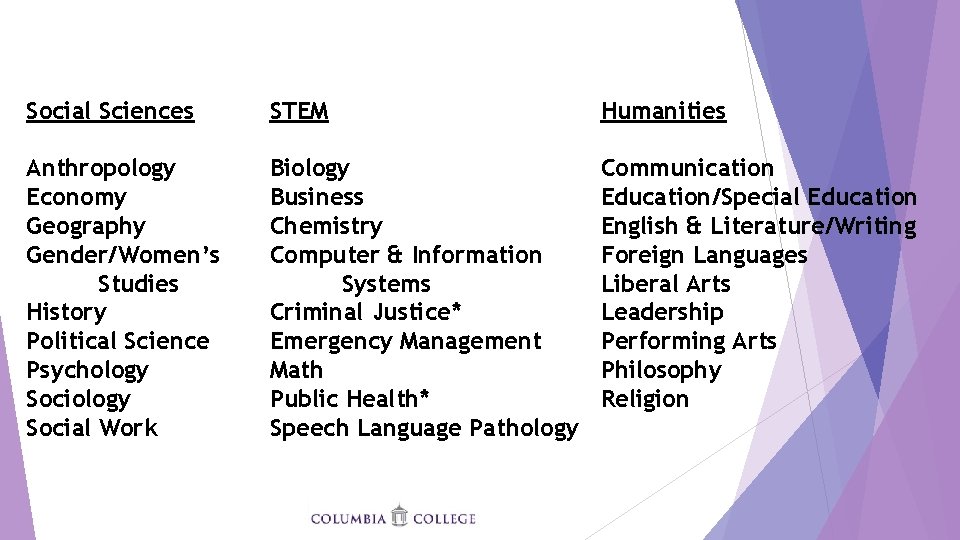
Social Sciences STEM Humanities Anthropology Economy Geography Gender/Women’s Studies History Political Science Psychology Social Work Biology Business Chemistry Computer & Information Systems Criminal Justice* Emergency Management Math Public Health* Speech Language Pathology Communication Education/Special Education English & Literature/Writing Foreign Languages Liberal Arts Leadership Performing Arts Philosophy Religion
- Slides: 54