
A TESTBED FOR STUDENT RESEARCH AND DESIGN OF
A TESTBED FOR STUDENT RESEARCH AND DESIGN OF CONTROL-MOMENT GYROSCOPES FOR ROBOTIC APPLICATIONS Albert Soto, Daniel Brown, Mason Peck Space Systems Design Studio at Cornell University ASEE Annual Conference & Exposition – Austin, Texas June 15, 2009
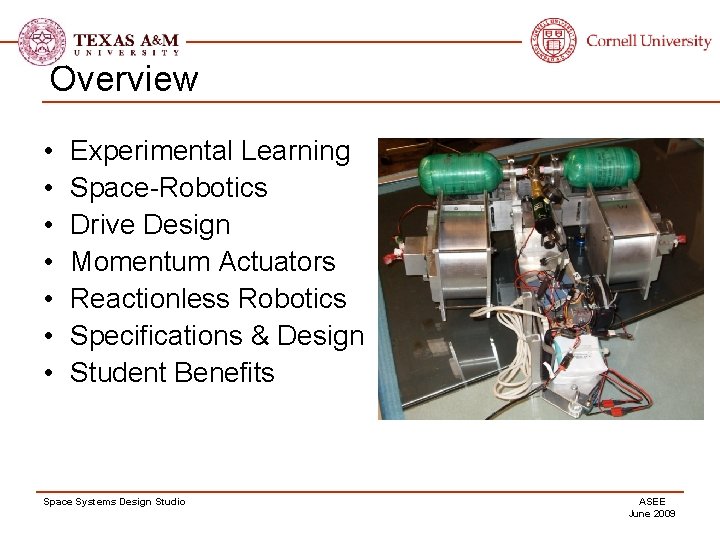
Overview • • Experimental Learning Space-Robotics Drive Design Momentum Actuators Reactionless Robotics Specifications & Design Student Benefits Space Systems Design Studio ASEE June 2009
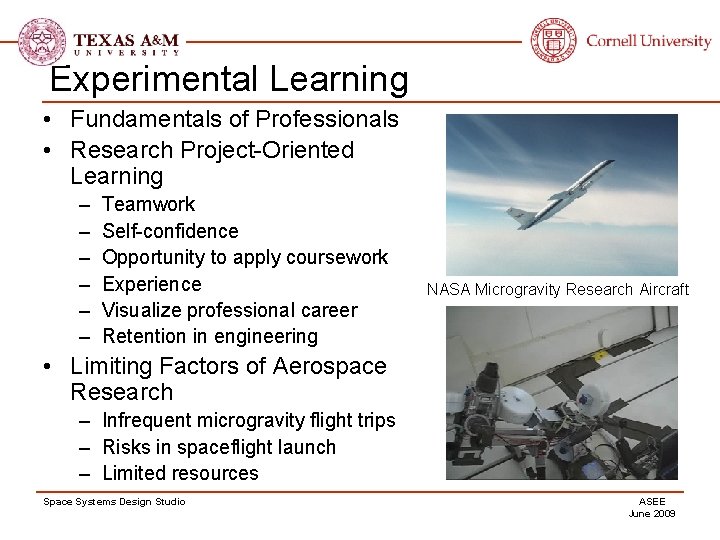
Experimental Learning • Fundamentals of Professionals • Research Project-Oriented Learning – – – Teamwork Self-confidence Opportunity to apply coursework Experience Visualize professional career Retention in engineering NASA Microgravity Research Aircraft • Limiting Factors of Aerospace Research – Infrequent microgravity flight trips – Risks in spaceflight launch – Limited resources Space Systems Design Studio ASEE June 2009
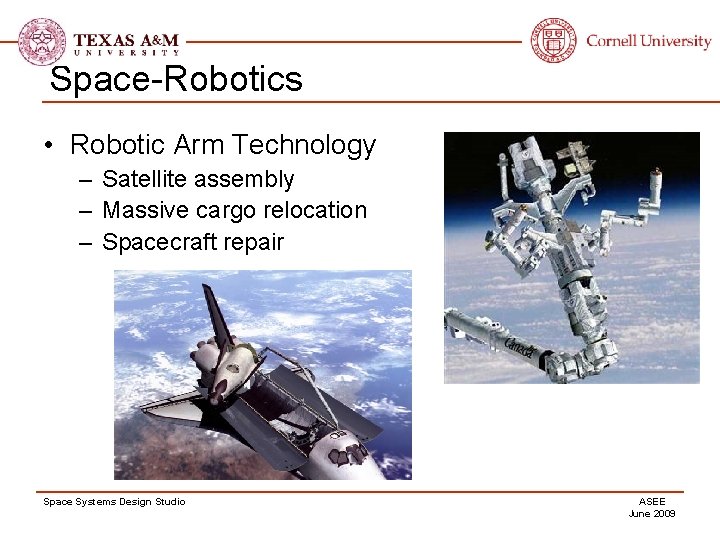
Space-Robotics • Robotic Arm Technology – Satellite assembly – Massive cargo relocation – Spacecraft repair Space Systems Design Studio ASEE June 2009
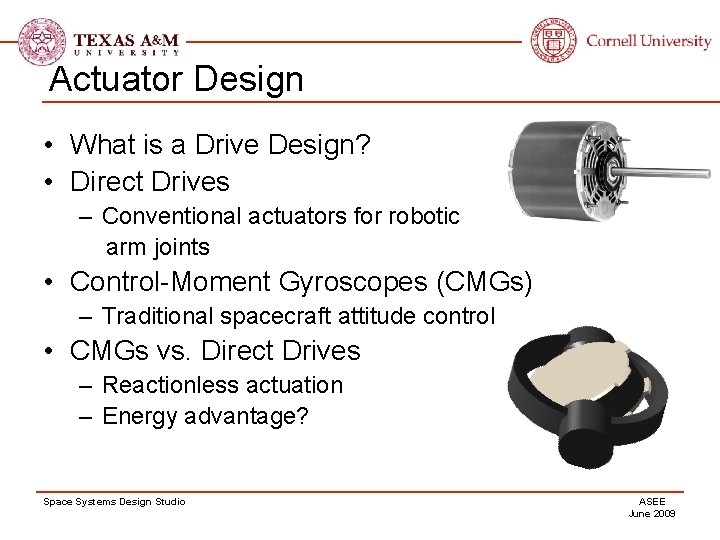
Actuator Design • What is a Drive Design? • Direct Drives – Conventional actuators for robotic arm joints • Control-Moment Gyroscopes (CMGs) – Traditional spacecraft attitude control • CMGs vs. Direct Drives – Reactionless actuation – Energy advantage? Space Systems Design Studio ASEE June 2009

Momentum Actuators • Control-Moment Gyroscope (CMG) – Constant-speed rotor – Gimbal the rotor about g-axis to change angular-momentum vector h – 100 x less power than RWAs 1, 2 tout – CMGs produce greater torque for less energy h 1 h 2 Comparison of CMGs to direct drive needed to bring CMGs into robotics Space Systems Design Studio 1. 2. Carpenter, Peck, 2008 Van Riper, Liden, 1971 ASEE June 2009
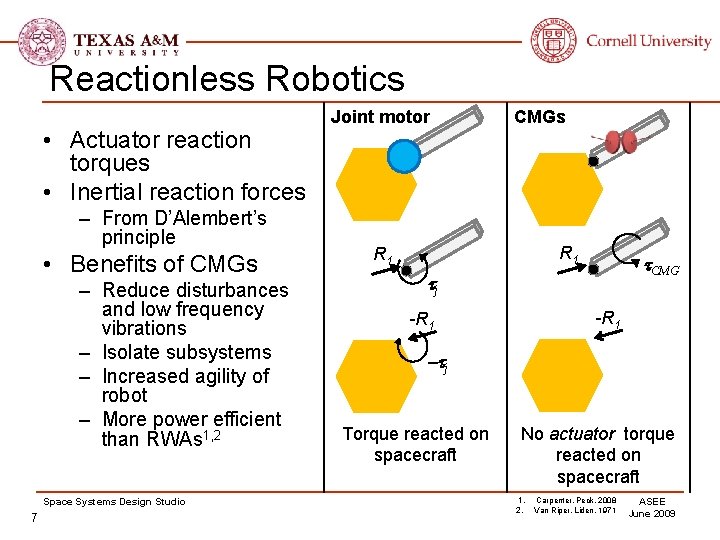
Reactionless Robotics • Actuator reaction torques • Inertial reaction forces – From D’Alembert’s principle • Benefits of CMGs – Reduce disturbances and low frequency vibrations – Isolate subsystems – Increased agility of robot – More power efficient than RWAs 1, 2 Space Systems Design Studio 7 Joint motor CMGs R 1 t. CMG tj -R 1 -tj Torque reacted on spacecraft No actuator torque reacted on spacecraft 1. 2. Carpenter, Peck, 2008 Van Riper, Liden, 1971 ASEE June 2009
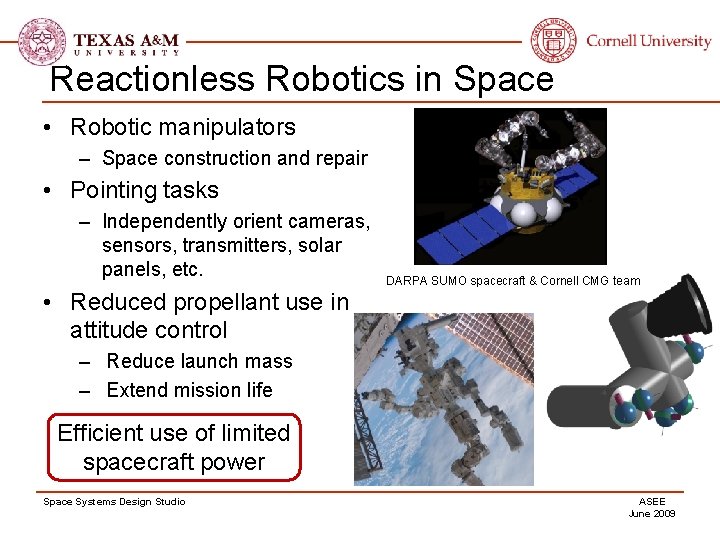
Reactionless Robotics in Space • Robotic manipulators – Space construction and repair • Pointing tasks – Independently orient cameras, sensors, transmitters, solar panels, etc. • Reduced propellant use in attitude control DARPA SUMO spacecraft & Cornell CMG team – Reduce launch mass – Extend mission life Efficient use of limited spacecraft power Space Systems Design Studio ASEE June 2009
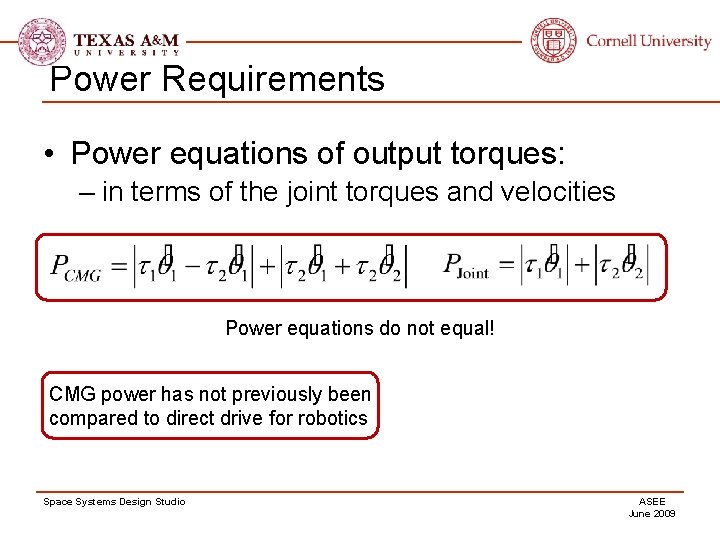
Power Requirements • Power equations of output torques: – in terms of the joint torques and velocities Power equations do not equal! CMG power has not previously been compared to direct drive for robotics Space Systems Design Studio ASEE June 2009
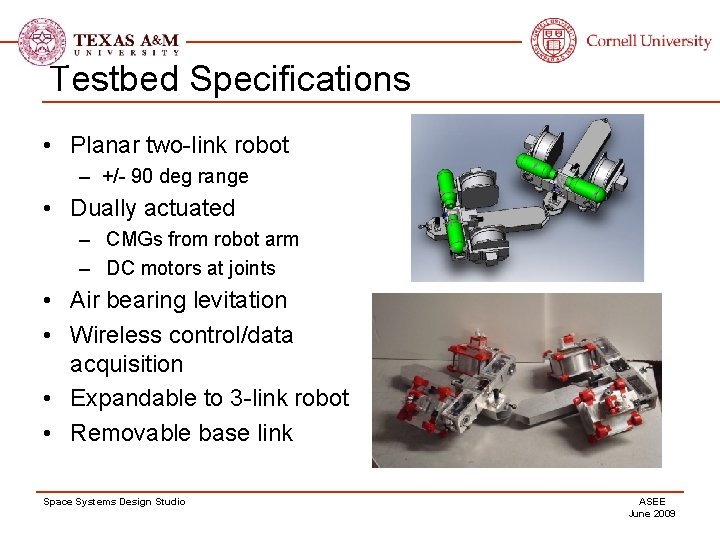
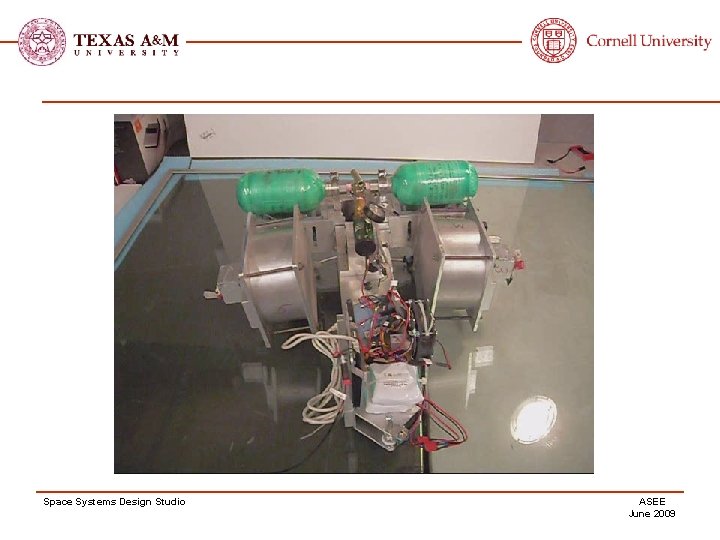
Testbed Specifications • Planar two-link robot – +/- 90 deg range • Dually actuated – CMGs from robot arm – DC motors at joints • Air bearing levitation • Wireless control/data acquisition • Expandable to 3 -link robot • Removable base link Space Systems Design Studio ASEE June 2009
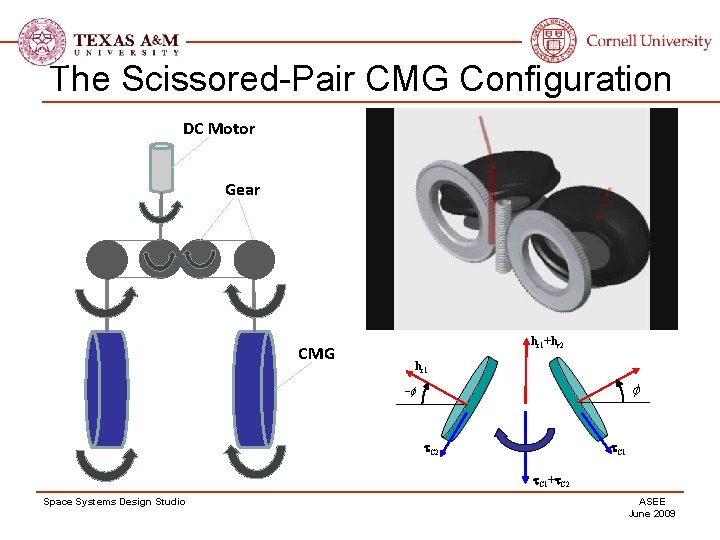
The Scissored-Pair CMG Configuration DC Motor Gear CMG hr 1+hr 2 hr 1 f -f t. C 2 t. C 1+t. C 2 Space Systems Design Studio ASEE June 2009
Benefits • Student introduction to: – – – • Advances faculty and graduate students Reactionless robotics – New experimental Momentum actuators hardware Dynamics of CMGs – Design groups Research Ground testing of space-systems Mechanical design and fabrication Experience for excellence in engineering Space Systems Design Studio ASEE June 2009
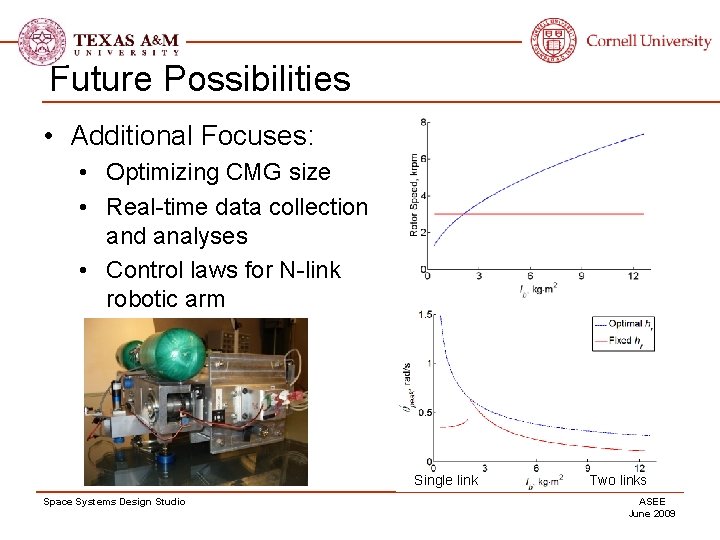
Future Possibilities • Additional Focuses: • Optimizing CMG size • Real-time data collection and analyses • Control laws for N-link robotic arm Single link Space Systems Design Studio Two links ASEE June 2009
Space Systems Design Studio ASEE June 2009
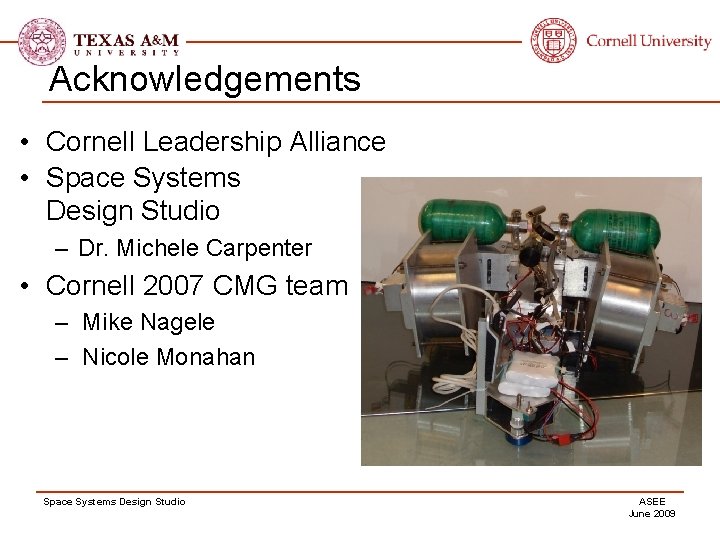
Acknowledgements • Cornell Leadership Alliance • Space Systems Design Studio – Dr. Michele Carpenter • Cornell 2007 CMG team – Mike Nagele – Nicole Monahan Space Systems Design Studio ASEE June 2009
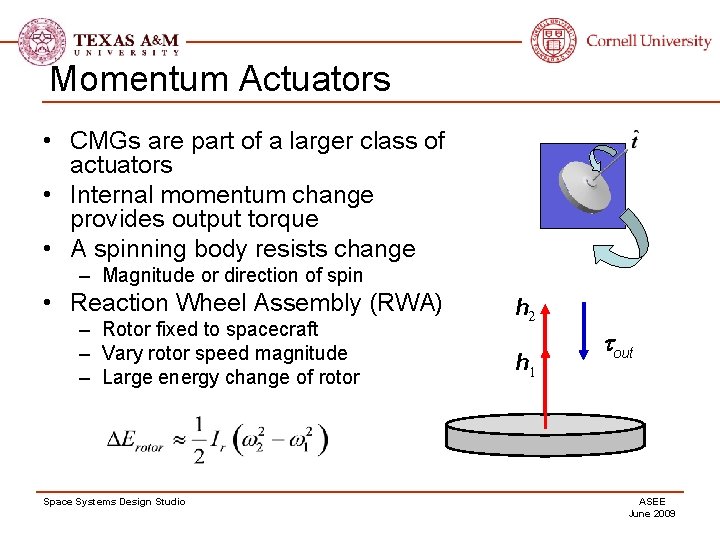
Momentum Actuators • CMGs are part of a larger class of actuators • Internal momentum change provides output torque • A spinning body resists change – Magnitude or direction of spin • Reaction Wheel Assembly (RWA) – Rotor fixed to spacecraft – Vary rotor speed magnitude – Large energy change of rotor Space Systems Design Studio h 2 h 1 tout ASEE June 2009
- Slides: 16