
A tasty new flavour of the GENIE earthsystem
- Slides: 12
A tasty new flavour of the GENIE earth-system model, applied to paleoclimates D. Lunt (1), A. Yool (2), R. Marsh(2), P. Valdes(1) , and the GENIE team (1) Bristol Research Initiative for the Dynamic Global Environment (BRIDGE), Bristol University, UK (2) Southampton Oceanographic Centre, UK 1) Introduction and Motivation 2) The GENIE modelling framework 3) Results Ø Tuning the IGCM atmosphere Ø Ensemble of Last Glacial Maximum simulations Ø Moisture flux experiments with Goldstein 4) Conclusions and future work d. j. lunt@bristol. ac. uk www. genie. ac. uk
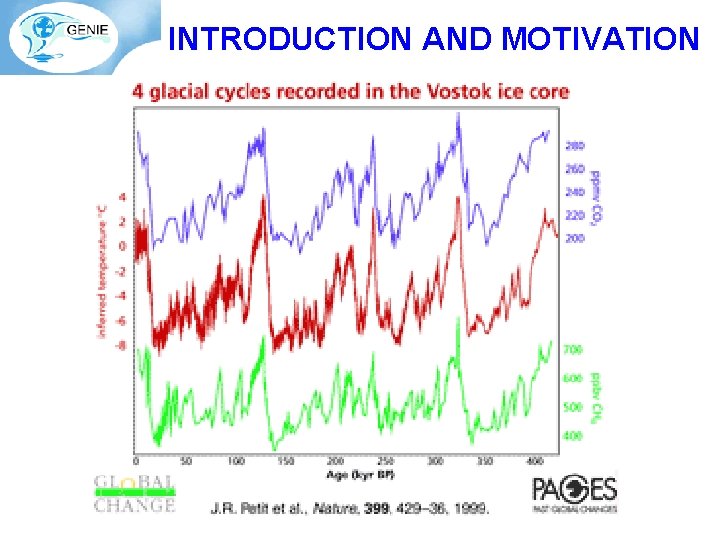
INTRODUCTION AND MOTIVATION
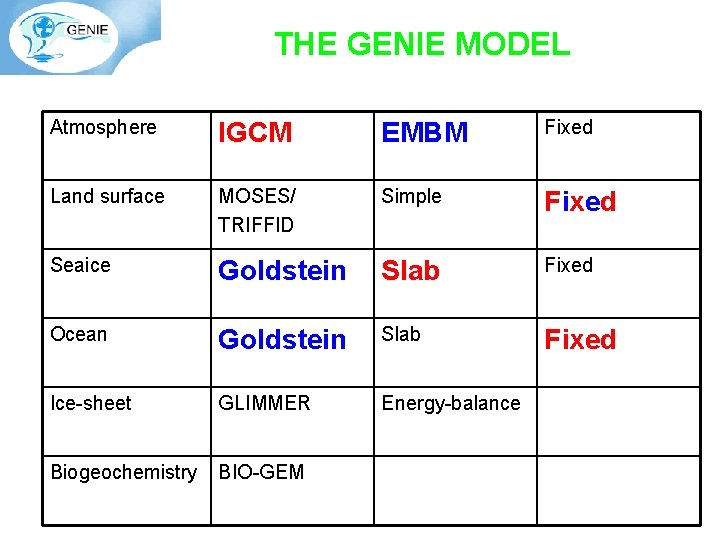
THE GENIE MODEL Atmosphere IGCM EMBM Fixed Land surface MOSES/ TRIFFID Simple Fixed Seaice Goldstein Slab Fixed Ocean Goldstein Slab Fixed Ice-sheet GLIMMER Energy-balance Biogeochemistry BIO-GEM
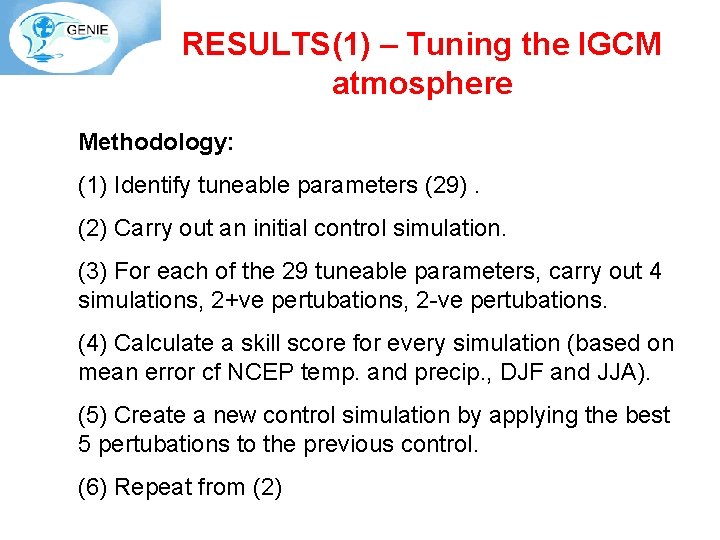
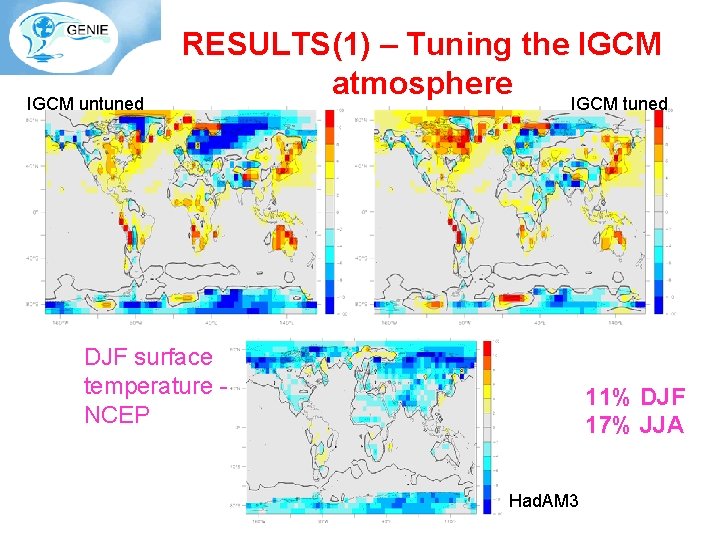
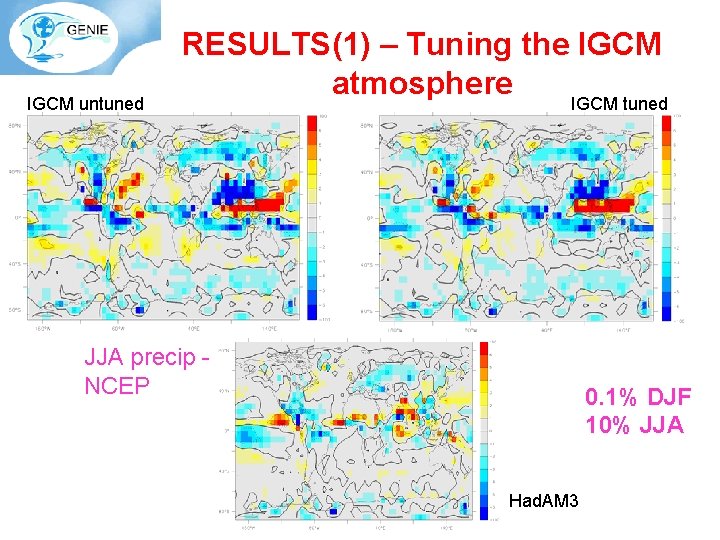
RESULTS(1) – Tuning the IGCM atmosphere Methodology: (1) Identify tuneable parameters (29). (2) Carry out an initial control simulation. (3) For each of the 29 tuneable parameters, carry out 4 simulations, 2+ve pertubations, 2 -ve pertubations. (4) Calculate a skill score for every simulation (based on mean error cf NCEP temp. and precip. , DJF and JJA). (5) Create a new control simulation by applying the best 5 pertubations to the previous control. (6) Repeat from (2)
RESULTS(1) – Tuning the IGCM atmosphere Results: Most improving parameters: 1 st iteration: humidity at which large scale-clouds form. 2 nd iteration: bulk aerodynamic coefficient for L, H Other improving parameters: e. g. roughness length of ocean, typical timescale for convection. Also, turning off the convection scheme improves precip!
IGCM untuned RESULTS(1) – Tuning the IGCM atmosphere IGCM tuned DJF surface temperature NCEP 11% DJF 17% JJA Had. AM 3
IGCM untuned RESULTS(1) – Tuning the IGCM atmosphere IGCM tuned JJA precip NCEP 0. 1% DJF 10% JJA Had. AM 3
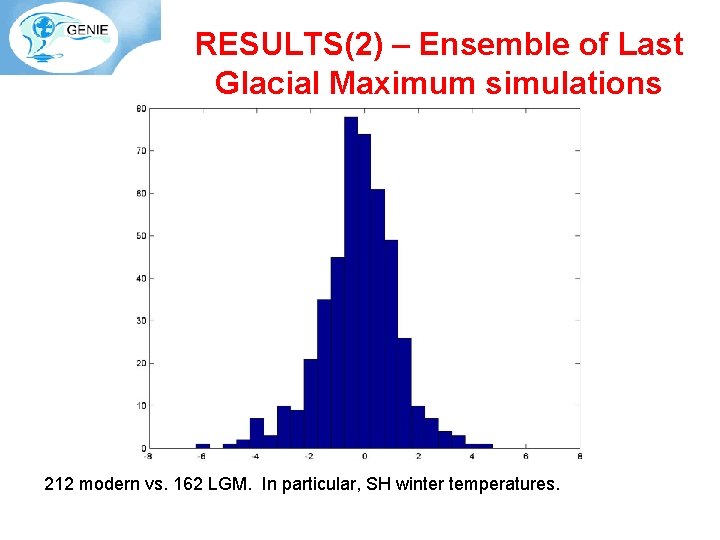
RESULTS(2) – Ensemble of Last Glacial Maximum simulations Is the LGM or the modern climate more sensitive to uncertainties in internal model parameters? Ø 59 -member ensemble of LGM and modern simulation pairs. Each of 58 pairs represent a +ve or –ve anomaly of one of 29 parameters. Plus control pair. ØPMIP boundary conditions except ICE 5 G ice-sheets for LGM. Ø‘Relative sensitivity’, RS, parameters calculated for each pair RS=log( abs( (LGM-LGMcont)/(PD-PDcont) ) ) RS +ve means LGM more sensitive than modern RS –ve means modern more sensitive than LGM RS calculated for 28 parameters, NH/SH DJF/JJA temp/precip +ve/-ve = 448 values.
RESULTS(2) – Ensemble of Last Glacial Maximum simulations 212 modern vs. 162 LGM. In particular, SH winter temperatures.
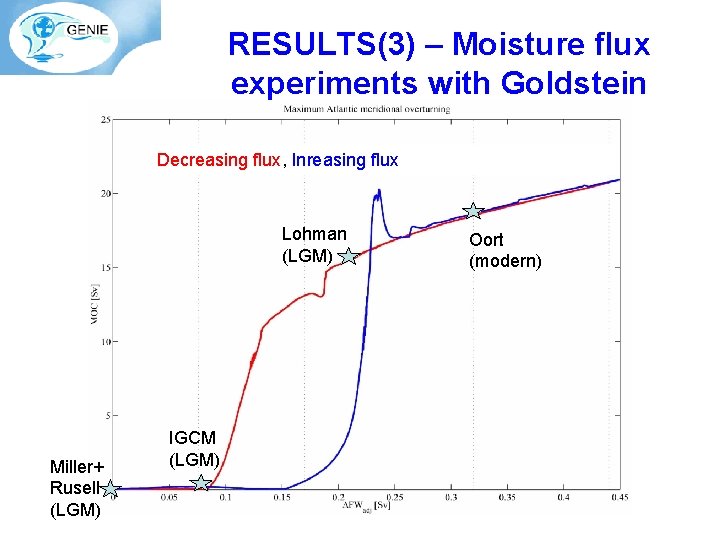
RESULTS(3) – Moisture flux experiments with Goldstein Decreasing flux, Inreasing flux Lohman (LGM) Miller+ Rusell (LGM) IGCM (LGM) Oort (modern)
FUTURE WORK ØTo complete the coupling of the IGCM atmosphere to Goldstein ocean to MOSES/TRIFFID land surface to GLIMMER ice-sheet. ØIntegrate Tiedtke convection scheme into IGCM. ØTune the modern model components with En. KF scheme. ØLong-term transient simulations (glacial/interglacial cycle) ØShort-timescale experiments, e. g. 8. 2 kyr. BP holocene cooling event.
CONCLUSIONS ØIGCM has been tuned with sledgehammer approach. Temperature responds well, precip not much improved – need to replace with new scheme. ØModern atmosphere is more sensitive to internal model parameters than the LGM. ØGoldstein ocean sensitive to LGM Atlantic-Pacific freshwater flux. Coupling to IGCM will allow an investigation of the ocean’s response to interannual, decadal, and centennial variations in this flux. ØMany experiments/investigations to be carried out soon!