
A Tamperresistant Monitoring Framework for Anomaly Detection in

- Slides: 35
A Tamper-resistant Monitoring Framework for Anomaly Detection in Computer Systems S. Upadhyaya Computer Science & Eng. University at Buffalo, New York, 14260 Febrraury 14, 2003 Upadhyaya – Brock Univ. 2003 1
Outline § General Background § A New Intrusion Detection Strategy § Tamper-resistant Monitoring § Some Experimental Results § Center of Excellence in IA at Buffalo § Research and Educational Activities February 14, 2003 Upadhyaya – Brock Univ 2003 2
Basic Terminologies § § A Host § A computer system A Service § A user space program that performs some useful task A Vulnerability § A flaw in a program with security implications § An Attacker targets vulnerabilities in programs to gain elevated privileges An intrusion detection system (IDS) attempts to detect and prevent attacks February 14, 2003 Upadhyaya – Brock Univ 2003 3
Cyberspace Threats and Vulnerabilities § § Hacking in 2000 brought down Yahoo, Amazon, CNN. com etc. § Cost millions of $ in lost revenues NIMDA virus a week after the Sept. 11 attack § Struck leading financial services firms § Went nationwide, lasted for 5 days, attacked 86, 000 computers § Forced firms offline, denied customer access Sources estimate the impact of cyber attacks in $13 billion in 2001 Insider Threats February 14, 2003 Upadhyaya – Brock Univ 2003 4
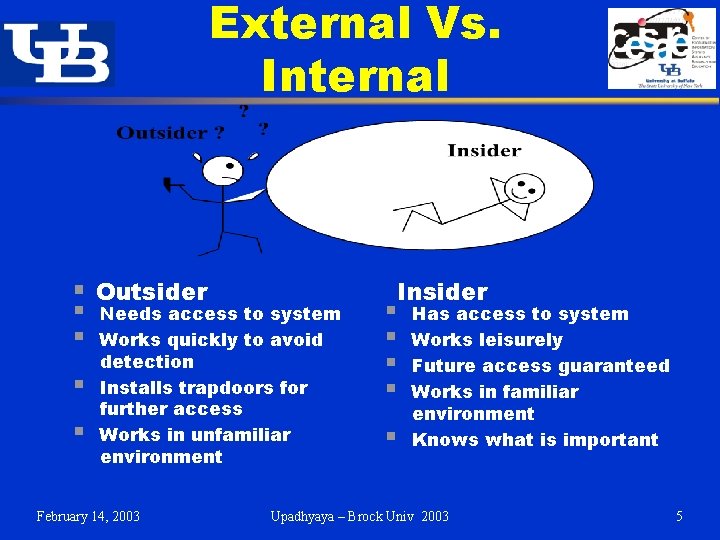
External Vs. Internal § Outsider § § Needs access to system Works quickly to avoid detection Installs trapdoors for further access Works in unfamiliar environment February 14, 2003 § § § Insider Has access to system Works leisurely Future access guaranteed Works in familiar environment Knows what is important Upadhyaya – Brock Univ 2003 5
Measures Taken by the U. S. Government § § Targeting Cyberterrorism § October 1997, President’s Commission on CIP § Identifies nation’s electrical, transportation, telecom & financial systems as critical points Need to be made secure and dependable § Information Security Summit at White House, Feb. 2000 § Goal was to find ways to defeat distributed DOS Cyber security a national level effort, 2002 National strategy was unveiled in Sept. 2002 February 14, 2003 Upadhyaya – Brock Univ 2003 6
Cryptographic Techniques § § § § Computer crime is certain to continue Institute controls to preserve § Confidentiality, Integrity, Availability Encryption is the most powerful tool Strongly based on Information Theory Heavily researched topic - RSA Scheme, Elliptic Curve It doesn’t solve all the security problems Need to develop counter-measures that would complement existing schemes February 14, 2003 Upadhyaya – Brock Univ 2003 7
What is IDS? § § In its general sense -§ Acquires information about its environment to analyze system behavior § Aims to discover security breaches, attempted breaches, open vulnerabilities that could lead to potential breaches Types of information – § Long term info. – a knowledge base of attacks (static) § Configuration info. – a model of the current state (static) § Audit info. – describing the events happening (dynamic) February 14, 2003 Upadhyaya – Brock Univ 2003 8
IDS Architecture February 14, 2003 Upadhyaya – Brock Univ 2003 9
Approaches to Intrusion Detection § § § Intrusion Detection – § Pioneered by D. Denning at SRI International § Misuse detection and anomaly detection Misuse Detection – § Called knowledge-based detectors § Uses a defined set of rules crafted to catch a specific malicious event Anomaly Detection – § Called behavior-based detectors § Raises an alarm for strange system behavior § Need a baseline for monitoring February 14, 2003 Upadhyaya – Brock Univ 2003 10
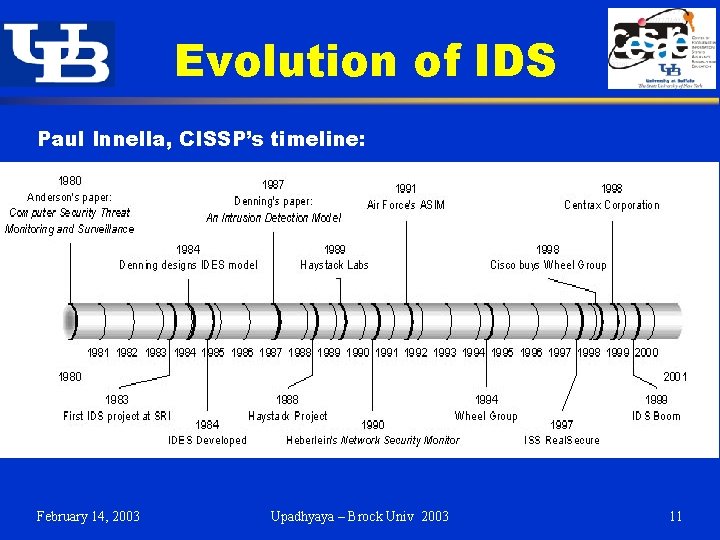
Evolution of IDS Paul Innella, CISSP’s timeline: February 14, 2003 Upadhyaya – Brock Univ 2003 11
Limitations of Current Approaches § Existing Intrusion detection techniques § § concentrate on sampling at low level § instrumentation is easy, but volumes of data § Huge computation § Semantics of user activities becomes diffuse Intrusion detection requires synthesis of this data Mostly after-the-fact February 14, 2003 Upadhyaya – Brock Univ 2003 12
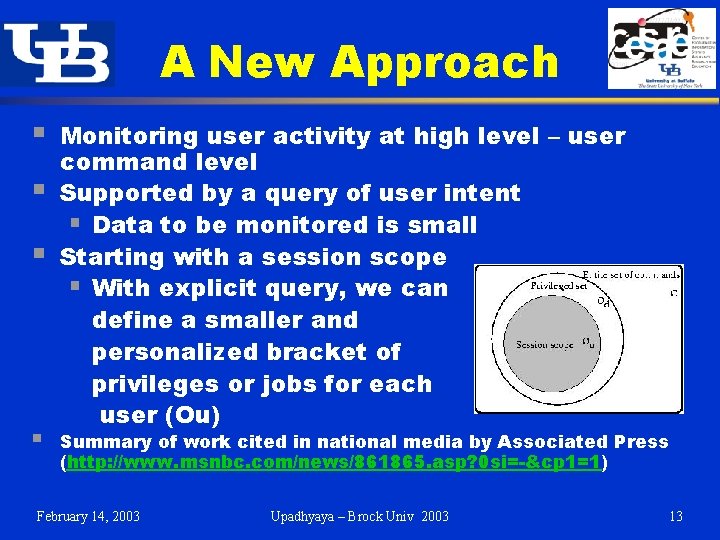
A New Approach § § Monitoring user activity at high level – user command level Supported by a query of user intent § Data to be monitored is small Starting with a session scope § With explicit query, we can define a smaller and personalized bracket of privileges or jobs for each user (Ou) Summary of work cited in national media by Associated Press (http: //www. msnbc. com/news/861865. asp? 0 si=-&cp 1=1) February 14, 2003 Upadhyaya – Brock Univ 2003 13
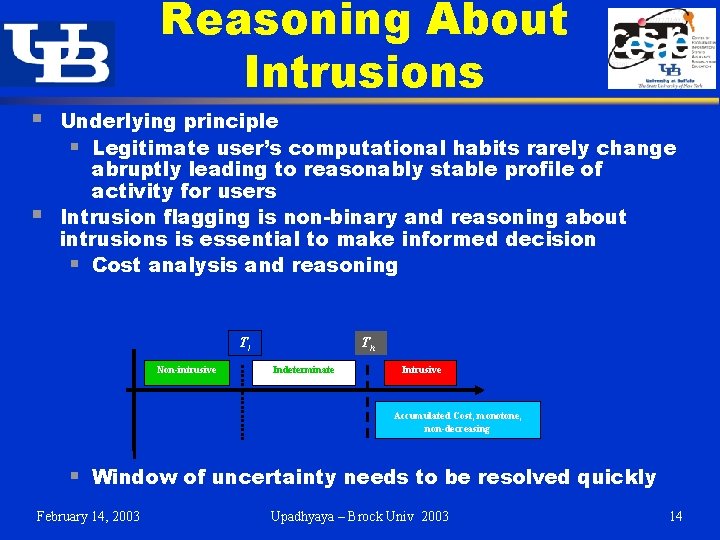
Reasoning About Intrusions § § Underlying principle § Legitimate user’s computational habits rarely change abruptly leading to reasonably stable profile of activity for users Intrusion flagging is non-binary and reasoning about intrusions is essential to make informed decision § Cost analysis and reasoning Tl Non-intrusive Th Indeterminate Intrusive Accumulated Cost, monotone, non-decreasing § Window of uncertainty needs to be resolved quickly February 14, 2003 Upadhyaya – Brock Univ 2003 14
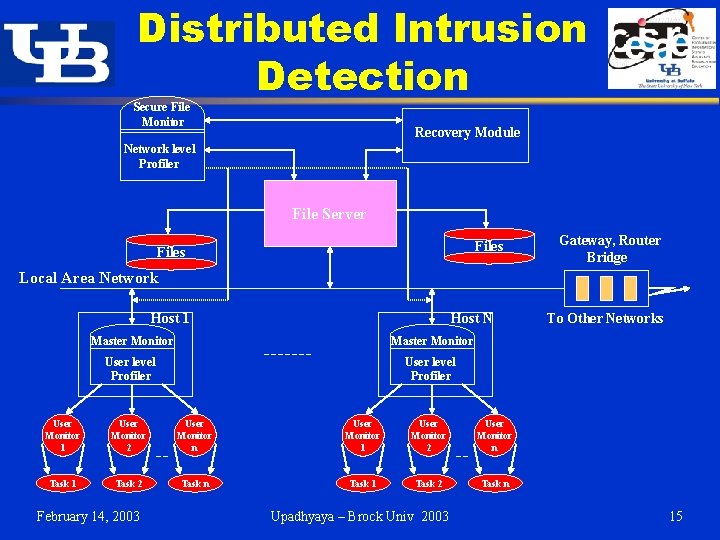
Distributed Intrusion Detection Secure File Monitor Recovery Module Network level Profiler File Server Files Gateway, Router Bridge Local Area Network Host 1 Host N Master Monitor User level Profiler User Monitor 1 User Monitor 2 User Monitor n Task 1 Task 2 Task n February 14, 2003 Upadhyaya – Brock Univ 2003 To Other Networks 15
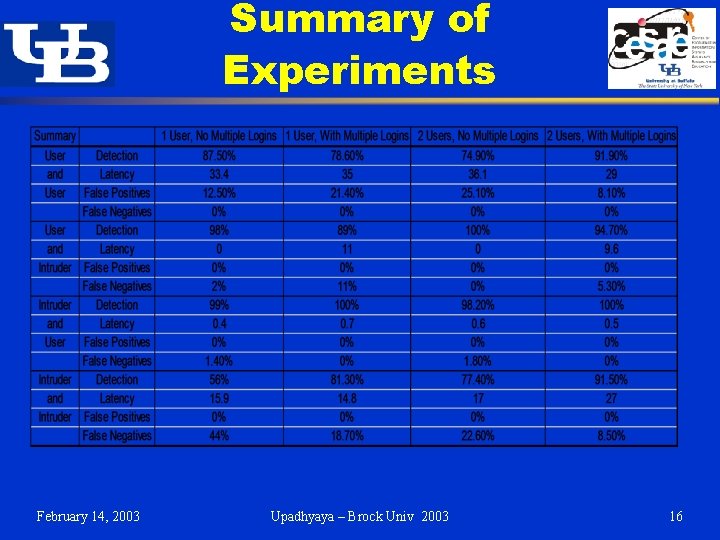
Summary of Experiments February 14, 2003 Upadhyaya – Brock Univ 2003 16
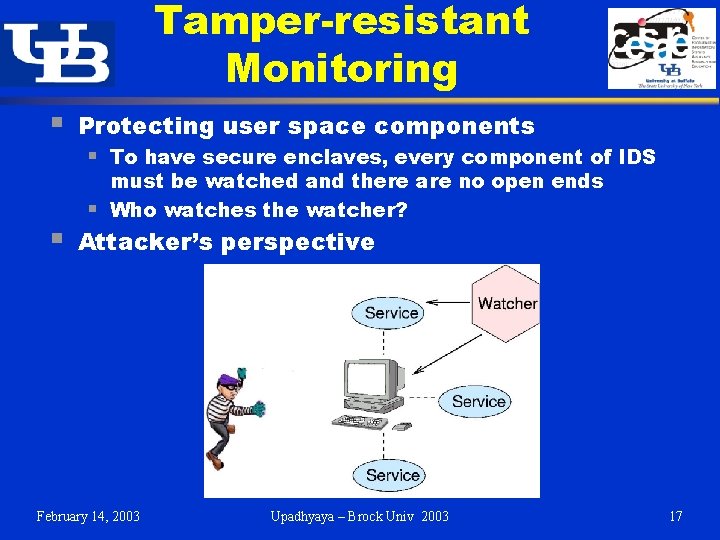
Tamper-resistant Monitoring § § Protecting user space components § To have secure enclaves, every component of IDS must be watched and there are no open ends Who watches the watcher? § Attacker’s perspective February 14, 2003 Upadhyaya – Brock Univ 2003 17
The Attack Model § § An attacker is successful, if: He compromises the service running on the host He disables or compromises the IDS, if one is deployed Note: § Bypassing an IDS by taking advantage of its limited coverage is a known weakness and it is not a part of the attack model February 14, 2003 Upadhyaya – Brock Univ 2003 18
Criteria for Analysis § § § § Failure due to faults and failure due to attacks are not one and the same Each software component can potentially fail due to attacks; we just don't know how yet! Security of a system is only as strong as the weakest link Hence, even if a service is monitored by a separate detection mechanism, is the entire setup really secure? An IDS is a program and it too can be compromised So, implement it inside the kernel for tamperresistance Kernel implementations affect the whole system February 14, 2003 Upadhyaya – Brock Univ 2003 19
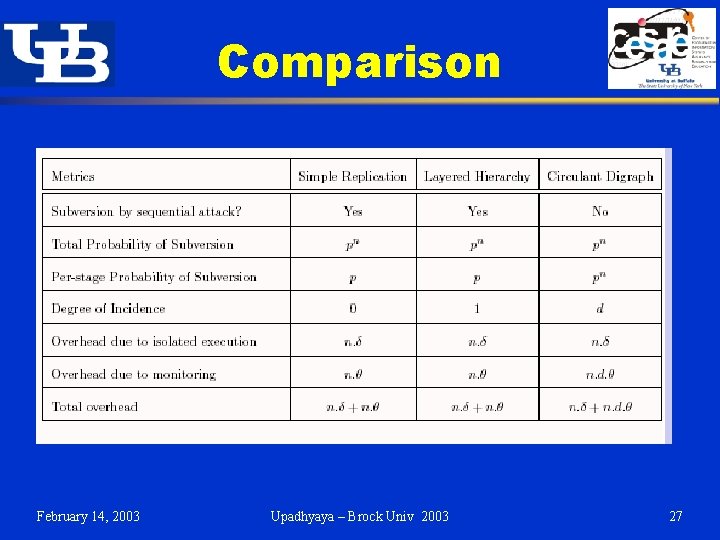
Probabilistic Analysis § § An attacker has little knowledge about how the entire system works and the attacks are by trial and error Factors that determine the overall security are: § For each component, individual probability of failure § For a n component system, the total probability of failure § An attack can proceed in stages, perstage probability of failure § Search space for a successful attack February 14, 2003 Upadhyaya – Brock Univ 2003 20
Deterministic Analysis § An attacker has complete knowledge § of the system and its vulnerabilities Factors that determine the overall security are § A successful attack strategy February 14, 2003 Upadhyaya – Brock Univ 2003 21
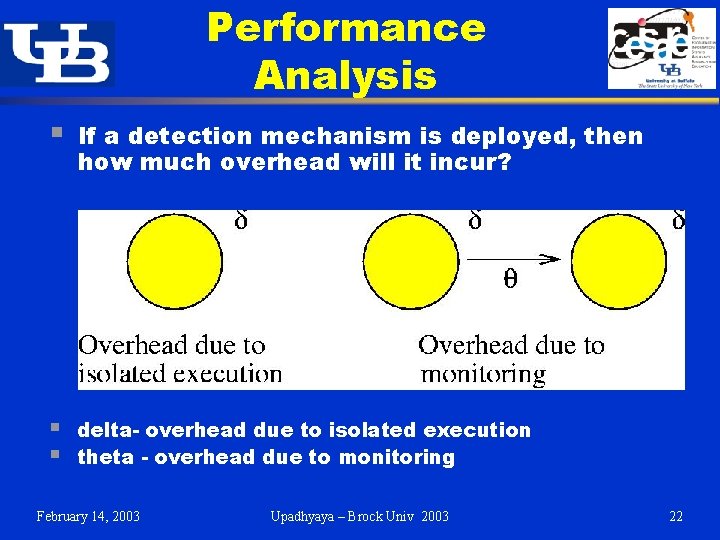
Performance Analysis § If a detection mechanism is deployed, then how much overhead will it incur? § § delta- overhead due to isolated execution theta - overhead due to monitoring February 14, 2003 Upadhyaya – Brock Univ 2003 22
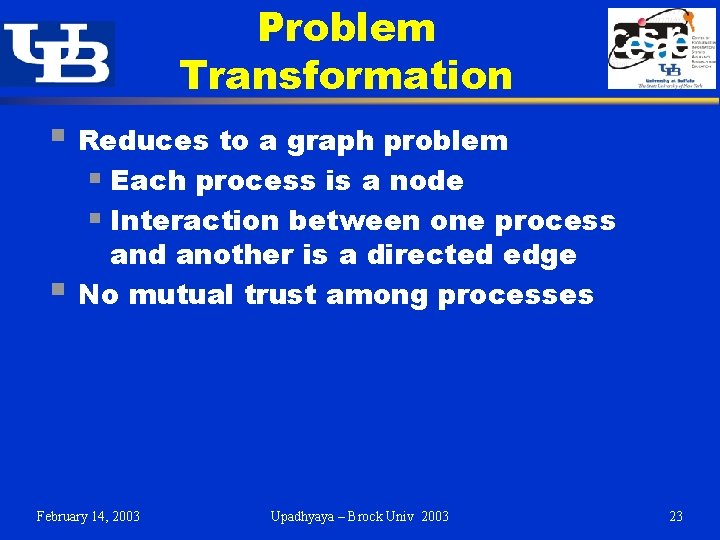
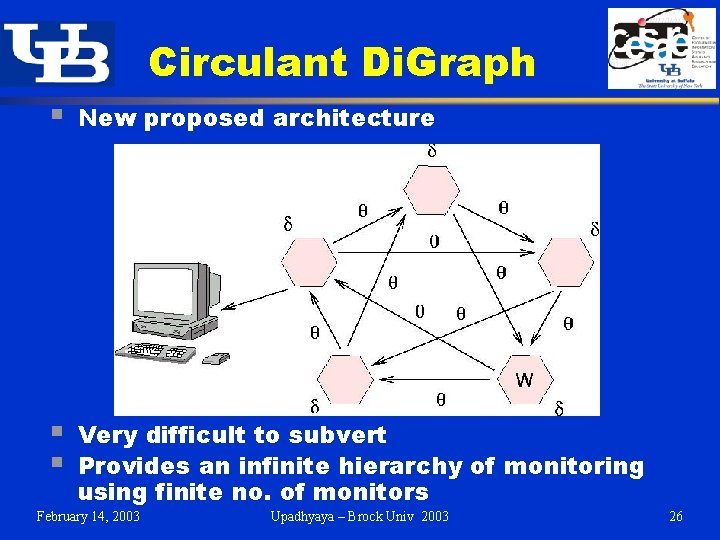
Problem Transformation § Reduces to a graph problem § Each process is a node § Interaction between one process § and another is a directed edge No mutual trust among processes February 14, 2003 Upadhyaya – Brock Univ 2003 23
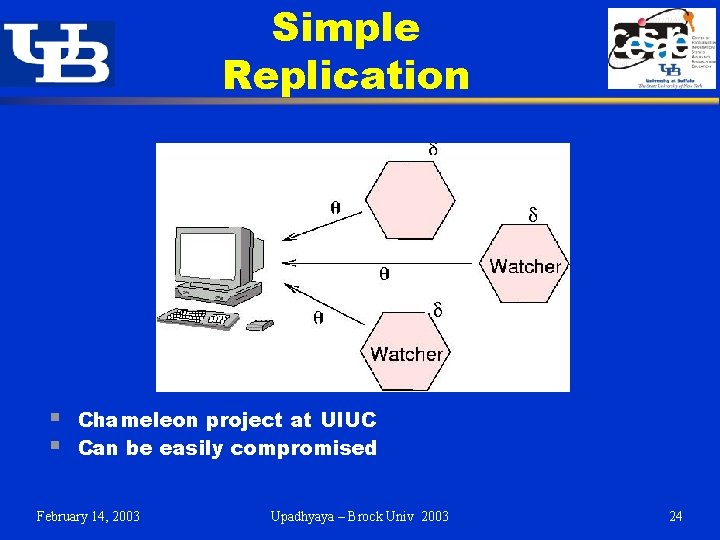
Simple Replication § § Chameleon project at UIUC Can be easily compromised February 14, 2003 Upadhyaya – Brock Univ 2003 24
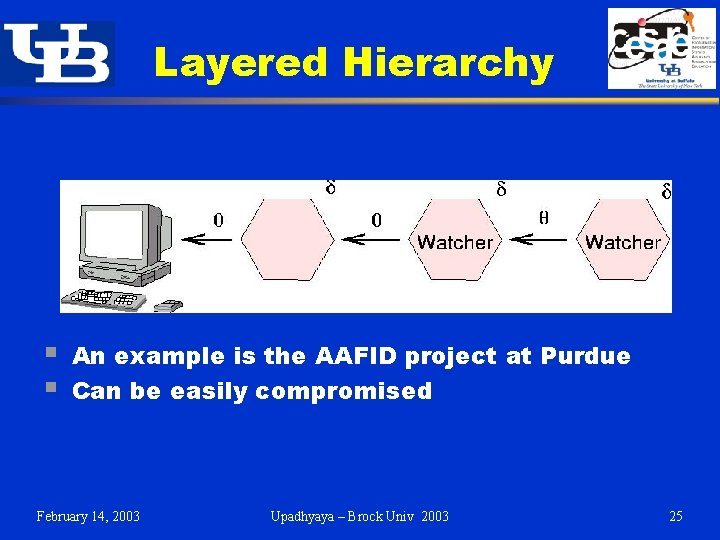
Layered Hierarchy § § An example is the AAFID project at Purdue Can be easily compromised February 14, 2003 Upadhyaya – Brock Univ 2003 25
Circulant Di. Graph § New proposed architecture § § Very difficult to subvert Provides an infinite hierarchy of monitoring using finite no. of monitors February 14, 2003 Upadhyaya – Brock Univ 2003 26
Comparison February 14, 2003 Upadhyaya – Brock Univ 2003 27
Implementation § Requires a sense-decide-act loop § Uses Free. BSD's kqueue subsystem § Each node in the graph is a process § monitor Multiple outgoing edges from a node are threads February 14, 2003 Upadhyaya – Brock Univ 2003 28
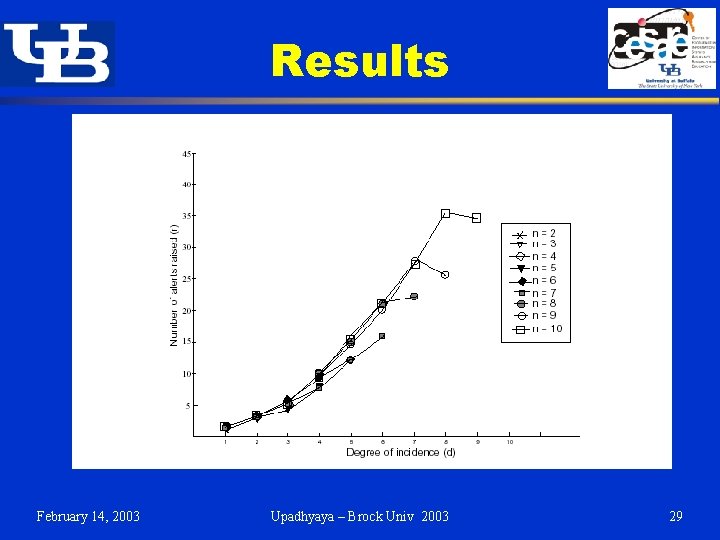
Results February 14, 2003 Upadhyaya – Brock Univ 2003 29
Future Work § The short term goal is to supplement the § § kqueue subsystem to support more events The long term goal is to devise a way to provide a generic tamper-resistant wrapper Extend it to network level monitoring Our website: § http: //www. cse. buffalo. edu/caeiae/ Other projects – security in mobile networks, biometrics authentication etc. February 14, 2003 Upadhyaya – Brock Univ 2003 30
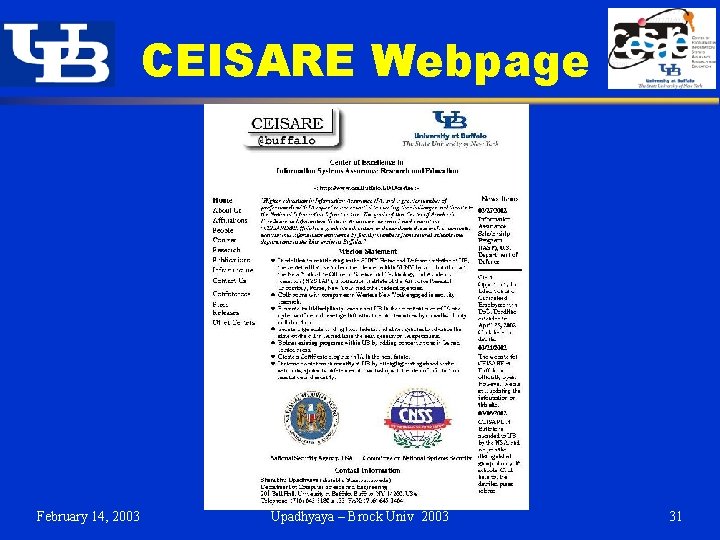
CEISARE Webpage February 14, 2003 Upadhyaya – Brock Univ 2003 31
§ § Major Players -Academia Purdue – § Eugene Spafford, Director of CERIAS § One of the four witness to testify before the House Science committee on infosec in 2001 § Leads the center with about 5 faculty and numerous students and projects § Developed an IDS Using Autonomous Agents UC Davis – § Karl Levitt and Matt Bishop direct the security lab § Developed Gr. IDS (Graph based IDS) CMU – Home of CERT/CC Cornell § Language-based security led by F. Schneider February 14, 2003 Upadhyaya – Brock Univ 2003 32
Major Players -Industries § § § IBM Watson, IBM Zurich -§ Global Security Analysis Laboratory § Marc Dacier at Zurich leads the IDS projects Microsoft § Recently started the Trustworthy Computing initiative Cisco § Does research and development § Builds intrusion detection appliances – sensors and software February 14, 2003 Upadhyaya – Brock Univ 2003 33
Major Players – Labs/Government § § § SRI International -§ Developer of EMERALD through funds from ITO, DARPA Air Force Research Lab -§ Defensive Information Warfare Branch Naval Research Lab -§ Center for High Assurance Computer Systems § Multi-level security National Institute of Standards and Technology -§ Computer Security Resource Center National Security Agency -§ Research and education February 14, 2003 Upadhyaya – Brock Univ 2003 34
Popular Websites § § SANS (System Administration, Networking and Security) Institute § http: //www. sans. org/aboutsans. php CERT/CC § http: //www. cert. org/ CERIAS (Center for Education and Research in Information Assurance and Security) § http: //www. cerias. purdue. edu/ NIST (National Institute of Standards and Tech. ) § http: //csrc. nist. gov/index. html February 14, 2003 Upadhyaya – Brock Univ 2003 35