
A talk about giving talks Whats the point
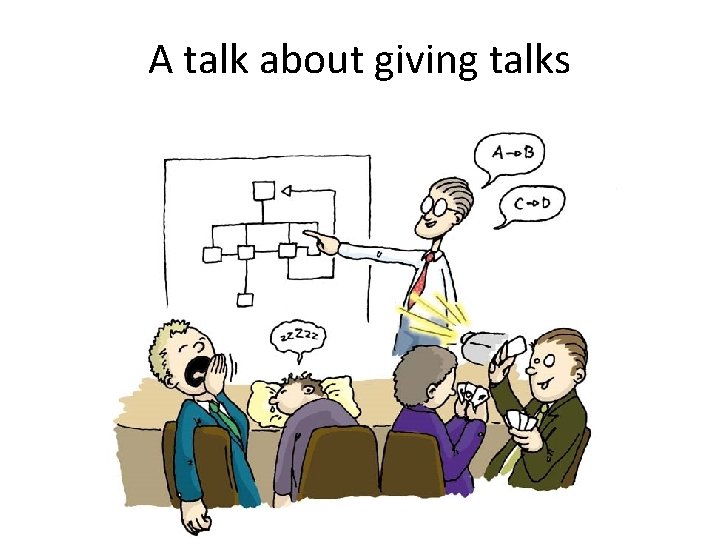
A talk about giving talks
What’s the point? • Visual aid to demonstrate your point • Show interesting results to audience • A cue to you to stay on topic
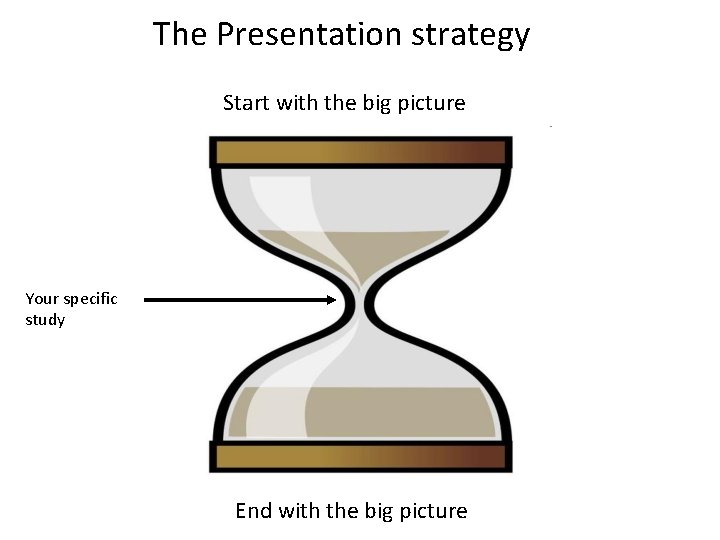
The Presentation strategy Start with the big picture Your specific study End with the big picture
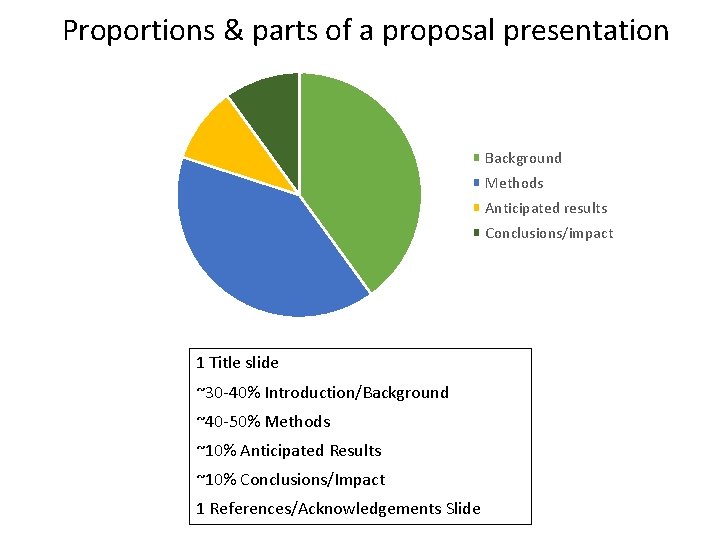
Proportions & parts of a proposal presentation Background Methods Anticipated results Conclusions/impact 1 Title slide ~30 -40% Introduction/Background ~40 -50% Methods ~10% Anticipated Results ~10% Conclusions/Impact 1 References/Acknowledgements Slide
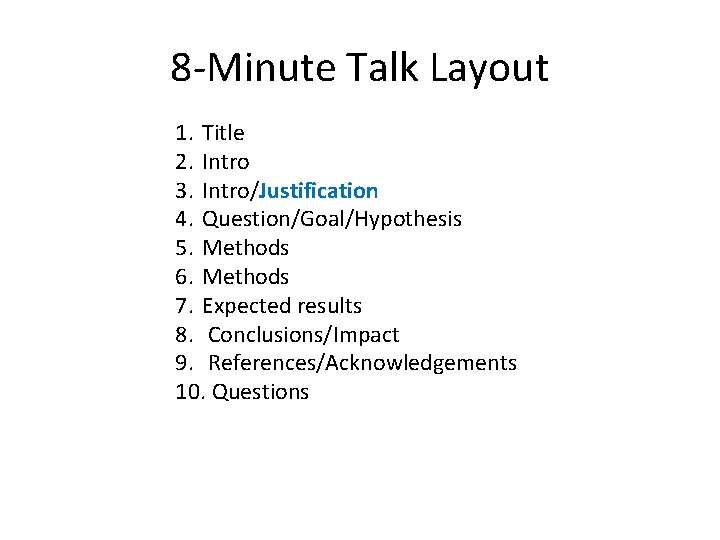
8 -Minute Talk Layout 1. Title 2. Intro 3. Intro/Justification 4. Question/Goal/Hypothesis 5. Methods 6. Methods 7. Expected results 8. Conclusions/Impact 9. References/Acknowledgements 10. Questions
Title Your name Advisor’s name (Research Methods I) Optional: University, dept.
Rules to live by …these are not suggestions. • Format : either as I outlined or same as your proposal papers • 1 slide ≈ 1 minute • Keep text to an absolute minimum • Be consistent in you slide design (font, titles, placement, color, etc…) • Keep it simple and clean
Rules to live by …these are not suggestions. • Write in point-form (≤ 5 per slide), not complete sentences • Use at least 20 pt font for text and 36 for titles – You should never have to say "I know you can't read this, but…” • Use a line drawing, photo, figure or simple table rather than text whenever possible • Each slide should make 1 -2 main points and have no more than 2 figures
More tips • Make sure graphics are clean and high quality • Try to use graphics made by you or your lab • Cite “stolen” graphics – Name and yr (preferable) OR website • Have a visual theme, but avoid very stylistic Power. Point templates • Videos (but be careful of Mac to PC issues)
Slide Structure – Good • Show one point at a time: – Will help audience concentrate on what you are saying – Will prevent audience from reading ahead – Will help you keep your presentation focused
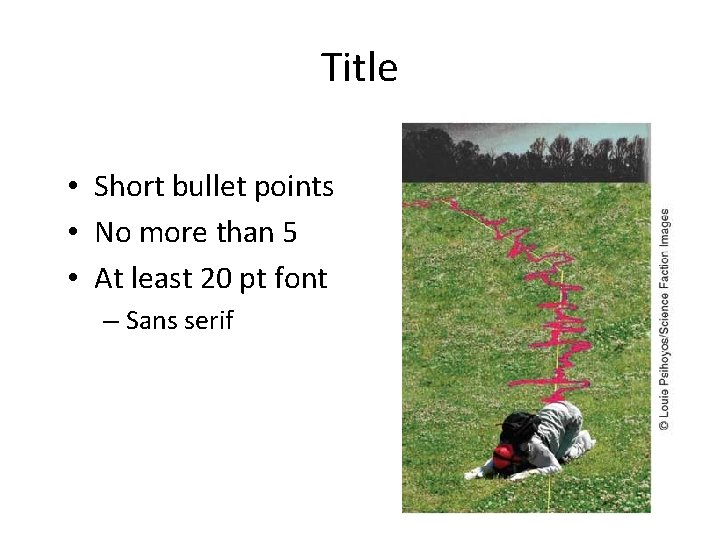
Title • Short bullet points • No more than 5 • At least 20 pt font – Sans serif
Slide Structure - Bad • This page contains too many words for a presentation slide. It is not written in point form, making it difficult both for your audience to read and for you to present each point. • Although there are exactly the same number of points on this slide as the previous slide, it looks much more complicated. • In short, your audience will spend too much time trying to read this text instead of listening to you.
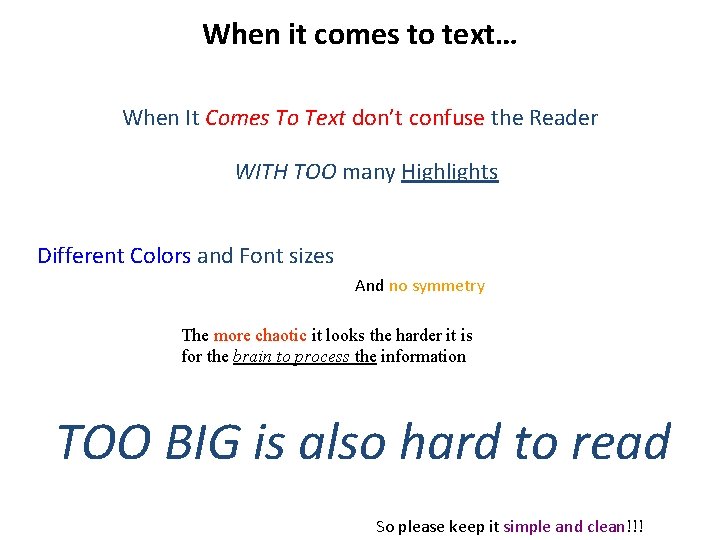
When it comes to text… When It Comes To Text don’t confuse the Reader WITH TOO many Highlights Different Colors and Font sizes And no symmetry The more chaotic it looks the harder it is for the brain to process the information TOO BIG is also hard to read So please keep it simple and clean!!!
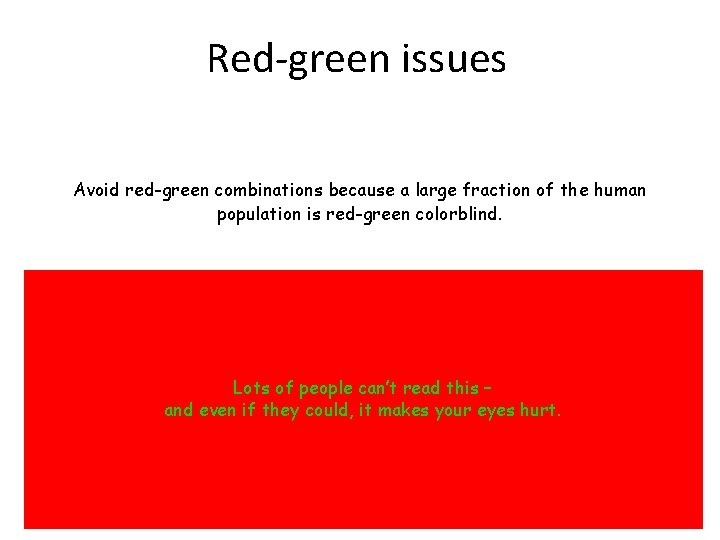
Red-green issues Avoid red-green combinations because a large fraction of the human population is red-green colorblind. Lots of people can’t read this – and even if they could, it makes your eyes hurt.
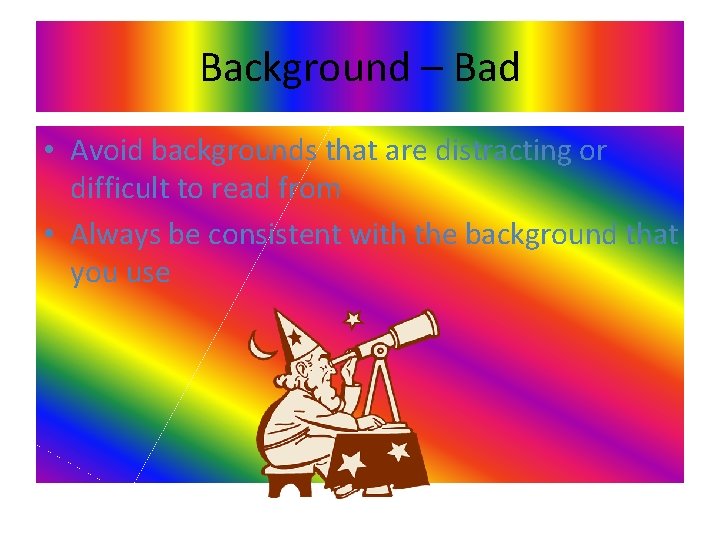
Background – Bad • Avoid backgrounds that are distracting or difficult to read from • Always be consistent with the background that you use
Figures, photos, and drawings • Use in place of text whenever possible …but use responsibly • Only 1 -2 figures/slide • Avoid using animation unless it helps demonstrate your point

Don’t cram things
Animation & Videos If you are trying…. . to talk about your data…. . it can get quite annoying. . if you use too many animation, videos… . . and sounds Use animations only to make a point - don’t overuse and abuse it!
An example of explaining using figures
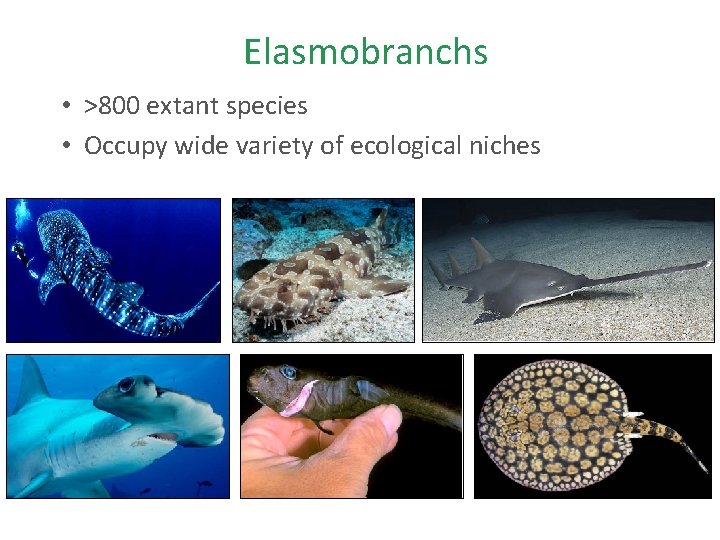
Elasmobranchs • >800 extant species • Occupy wide variety of ecological niches
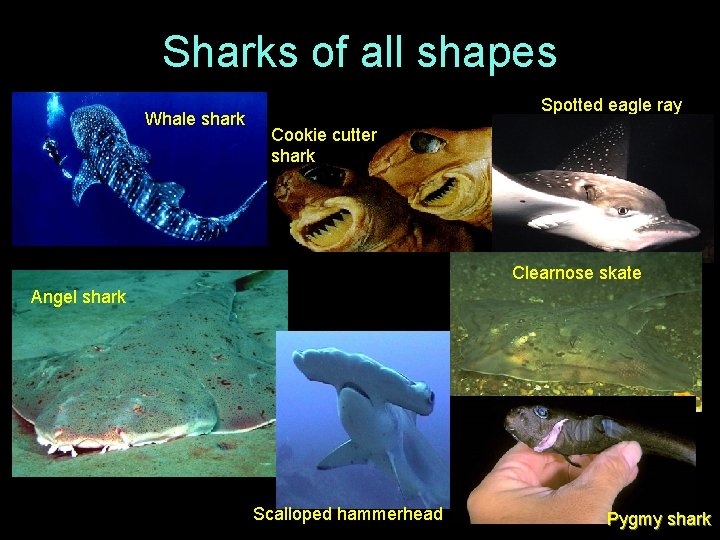
Sharks of all shapes Whale shark Spotted eagle ray Cookie cutter shark Clearnose skate Angel shark Scalloped hammerhead Pygmy shark
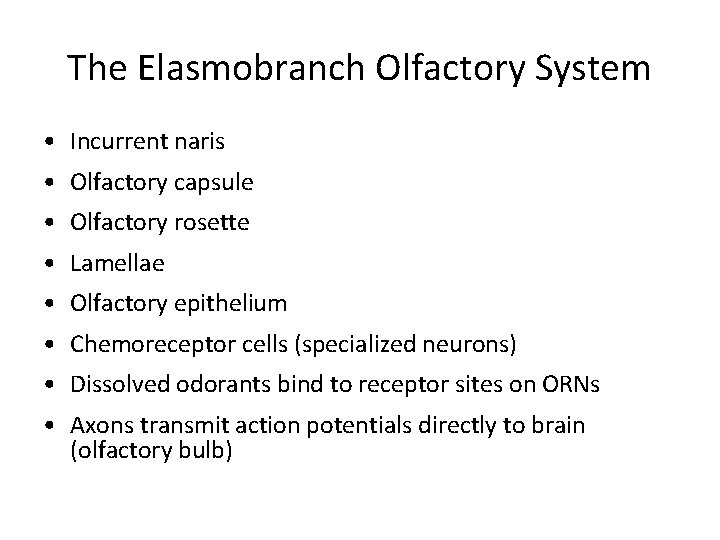
The Elasmobranch Olfactory System • Incurrent naris • Olfactory capsule • Olfactory rosette • Lamellae • Olfactory epithelium • Chemoreceptor cells (specialized neurons) • Dissolved odorants bind to receptor sites on ORNs • Axons transmit action potentials directly to brain (olfactory bulb)
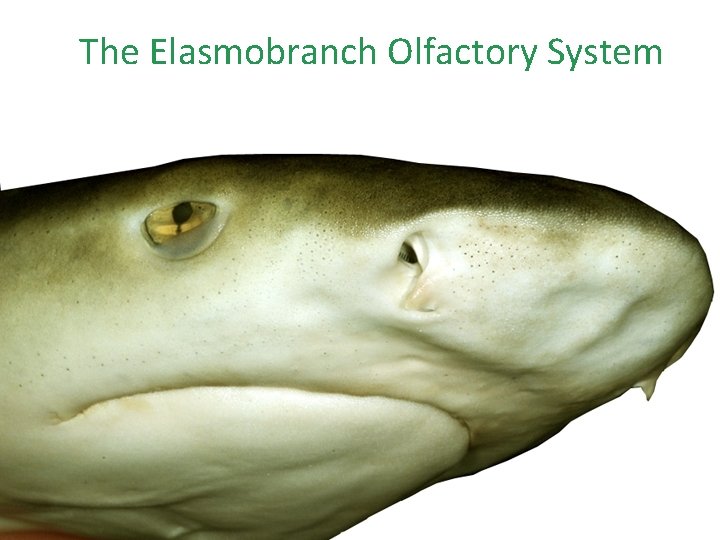
The Elasmobranch Olfactory System
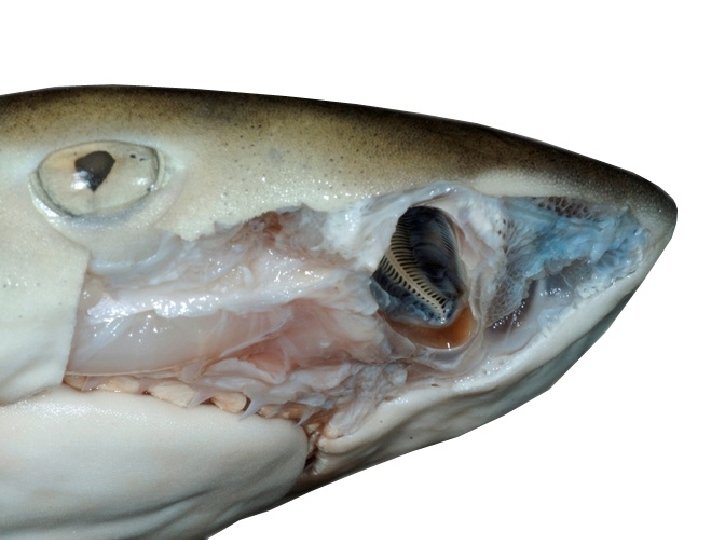
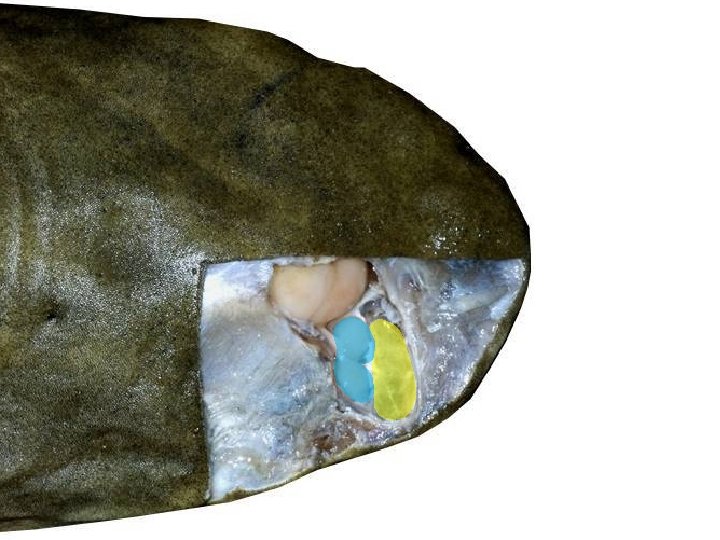
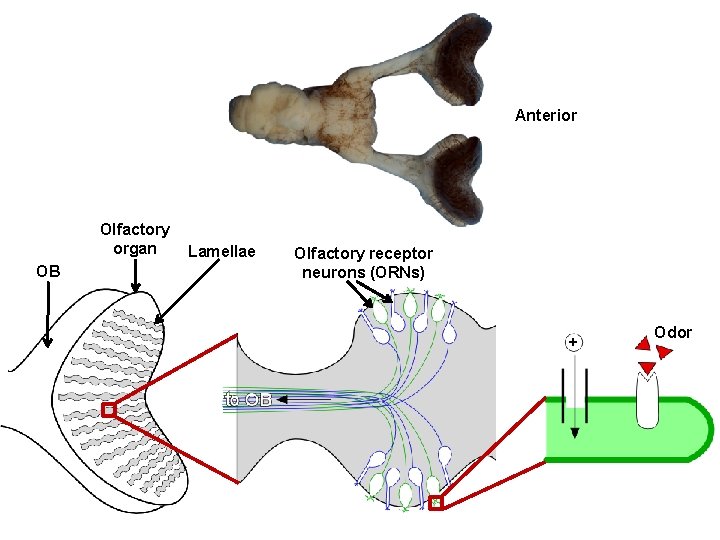
Anterior Olfactory organ OB Lamellae Olfactory receptor neurons (ORNs) + Odor
Your Conclusion • Use an effective and strong closing – Your audience is likely to remember your last words • Use a conclusion slide to: – Summarize the main points of your presentation – Place your research study into a broader framework • Give impact of achieving your anticipated results – Suggest future avenues of research
Acknowledgements • Labmates: Mikki Mc. Comb, Laura Macesic, Chris Bedore, Dave Mc. Gowan, Morgan Smith • DIS students, volunteers • Dr. Carl Luer, Mote Marine Laboratory • Dr. John Caprio, LSU • Gumbo Limbo Environmental Complex • AES Travel Grant • Dr. Vincent R. Saurino Fellowship • FAU Alumni Scholarship

Slide Critique Practice
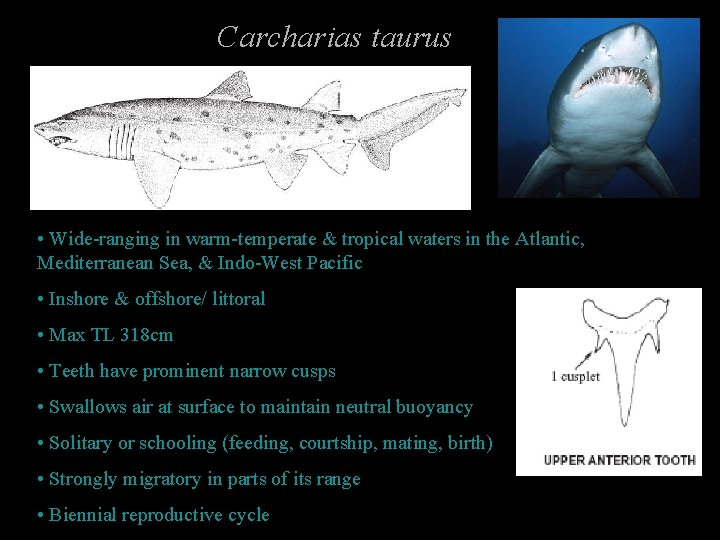
Carcharias taurus • Wide-ranging in warm-temperate & tropical waters in the Atlantic, Mediterranean Sea, & Indo-West Pacific • Inshore & offshore/ littoral • Max TL 318 cm • Teeth have prominent narrow cusps • Swallows air at surface to maintain neutral buoyancy • Solitary or schooling (feeding, courtship, mating, birth) • Strongly migratory in parts of its range • Biennial reproductive cycle

Claspers • Paired copulatory organs • Form articulations with the pelvic fin upon reaching maturity • During copulation, only one clasper is inserted into the female Rhipidion Clasper Pelvic fin – A grip on the right pectoral fin positions the female on the male’s left, and the right clasper would be used • Terminal rhipidion serves to anchor the clasper within the reproductive tract of the female (hook or spine) • Sperm is ejected via siphon sacs Siphon sac – Speculation that they may serve to flush the female reproductive tract of semen from previous matings [whitetip reef shark]
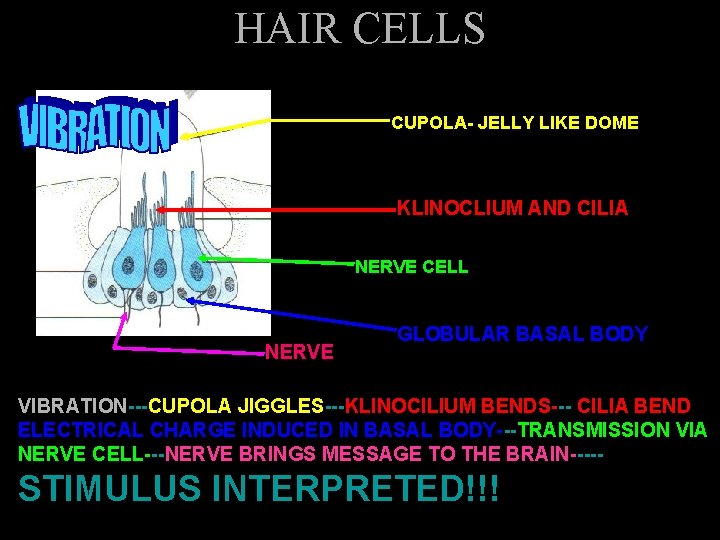
HAIR CELLS CUPOLA- JELLY LIKE DOME KLINOCLIUM AND CILIA NERVE CELL NERVE GLOBULAR BASAL BODY VIBRATION---CUPOLA JIGGLES---KLINOCILIUM BENDS--- CILIA BEND ELECTRICAL CHARGE INDUCED IN BASAL BODY---TRANSMISSION VIA NERVE CELL---NERVE BRINGS MESSAGE TO THE BRAIN----- STIMULUS INTERPRETED!!!
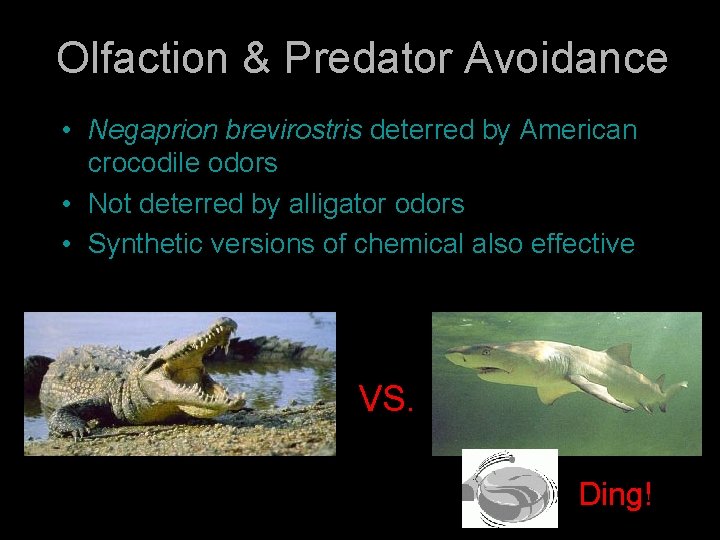
Olfaction & Predator Avoidance • Negaprion brevirostris deterred by American crocodile odors • Not deterred by alligator odors • Synthetic versions of chemical also effective VS. Ding!
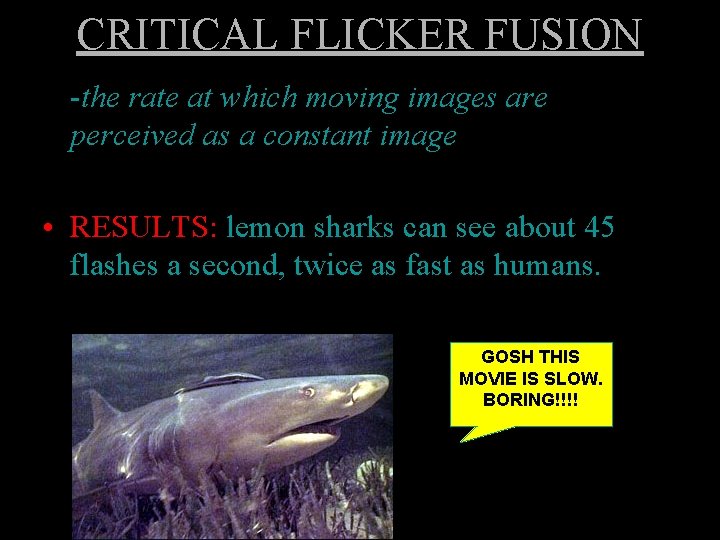
CRITICAL FLICKER FUSION -the rate at which moving images are perceived as a constant image • RESULTS: lemon sharks can see about 45 flashes a second, twice as fast as humans. GOSH THIS MOVIE IS SLOW. BORING!!!!
Presentation Tips
There is more to giving a good talk than showing good slides • Never read your slides • Look at your audience – Never turn your back to your audience • Speak loud, clearly, and slowly • Use laser pointer sparingly
There is more to giving a good talk than showing good slides • • NEVER go over allotted time Practice your talk out loud Practice smooth transitions Avoid “um” and others
Question and Answer Pointers • To encourage your audience - "What questions do you have? " • Repeat or restate a question • Respond directly and avoid rambling • Don't bluff or lose your cool or respond defensively • Offer to make yourself available after your presentation & always thank your audience
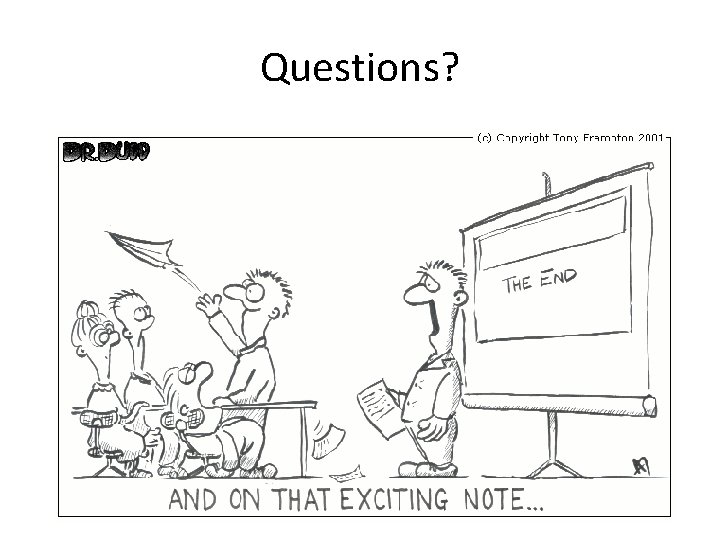
Questions?
- Slides: 39