
A Systems Approach to Quality Improvement Lean Six



- Slides: 31
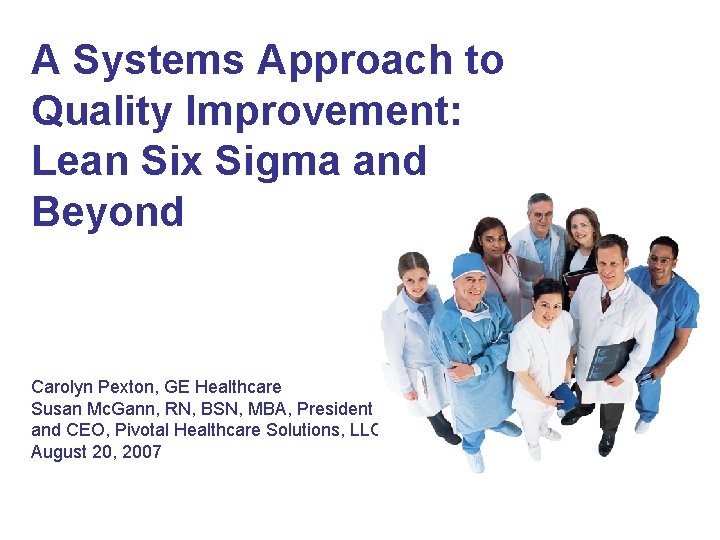
A Systems Approach to Quality Improvement: Lean Six Sigma and Beyond Carolyn Pexton, GE Healthcare Susan Mc. Gann, RN, BSN, MBA, President and CEO, Pivotal Healthcare Solutions, LLC August 20, 2007 Date
Agenda • Introductions/Expectations • Some elements of a systems approach • Change Acceleration Process • Work-Out • Lean • Six Sigma • Management and leadership systems • Summary & Questions
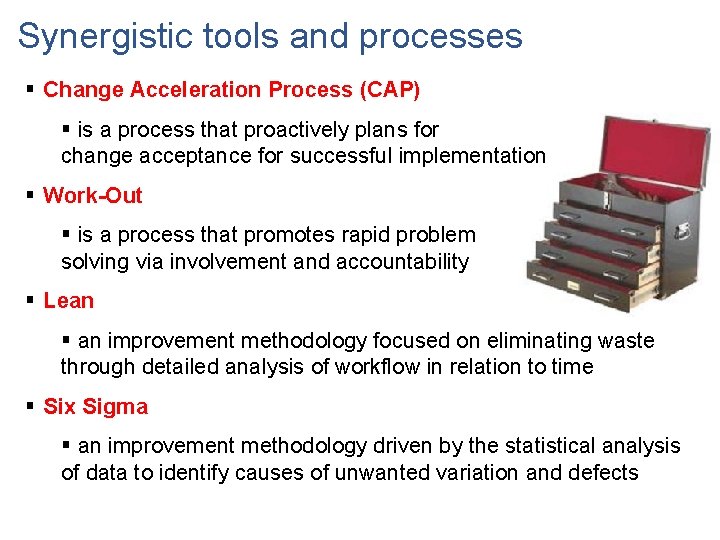
Synergistic tools and processes § Change Acceleration Process (CAP) § is a process that proactively plans for change acceptance for successful implementation § Work-Out § is a process that promotes rapid problem solving via involvement and accountability § Lean § an improvement methodology focused on eliminating waste through detailed analysis of workflow in relation to time § Six Sigma § an improvement methodology driven by the statistical analysis of data to identify causes of unwanted variation and defects
Change Management (CAP and Work-Out)
Change Acceleration Process (CAP) If we all know change is hard, why does resistance to change keep sneaking up on us? ? ?
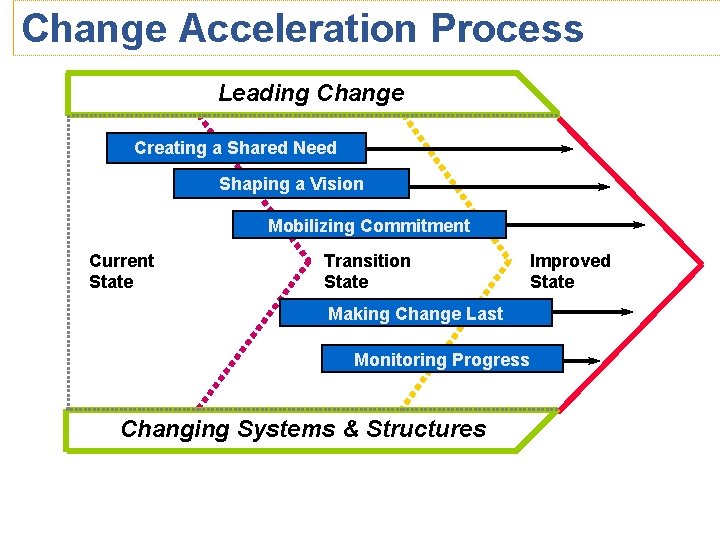
Change Acceleration Process Leading Change Creating a Shared Need Shaping a Vision Mobilizing Commitment Current State Transition State Making Change Last Monitoring Progress Changing Systems & Structures Improved State
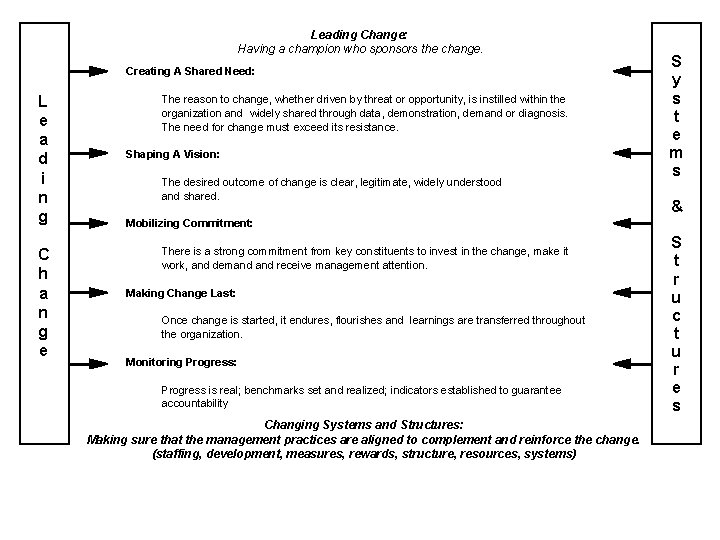
Leading Change: Having a champion who sponsors the change. Creating A Shared Need: L e a d i n g C h a n g e The reason to change, whether driven by threat or opportunity, is instilled within the organization and widely shared through data, demonstration, demand or diagnosis. The need for change must exceed its resistance. Shaping A Vision: The desired outcome of change is clear, legitimate, widely understood and shared. S y s t e m s & Mobilizing Commitment: There is a strong commitment from key constituents to invest in the change, make it work, and demand receive management attention. Making Change Last: Once change is started, it endures, flourishes and learnings are transferred throughout the organization. Monitoring Progress: Progress is real; benchmarks set and realized; indicators established to guarantee accountability Changing Systems and Structures: Making sure that the management practices are aligned to complement and reinforce the change. (staffing, development, measures, rewards, structure, resources, systems) S t r u c t u r e s
Work-Out “I know the results I want but how do I get my staff involved? Wouldn’t it be great if they could get all their ideas out, organize and prioritize them and implement the solution? ? ? But that could never happen…. . ”
What a Work. Out Looks Like….
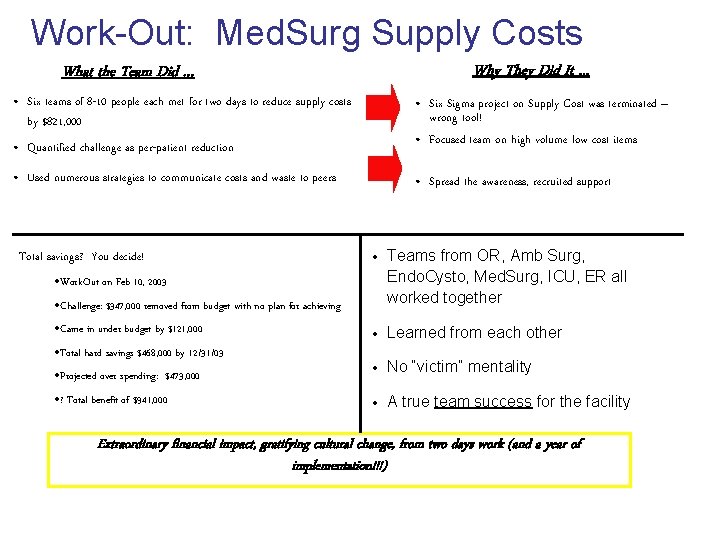
Work-Out: Med. Surg Supply Costs Why They Did It … What the Team Did … • Six teams of 8 -10 people each met for two days to reduce supply costs by $821, 000 • Six Sigma project on Supply Cost was terminated – wrong tool! • Focused team on high volume low cost items • Quantified challenge as per-patient reduction • Used numerous strategies to communicate costs and waste to peers Total savings? You decide! ·Work. Out Teams from OR, Amb Surg, Endo. Cysto, Med. Surg, ICU, ER all worked together · Learned from each other · No “victim” mentality · A true team success for the facility $347, 000 removed from budget with no plan for achieving ·Came in under budget by $121, 000 ·Total hard savings $468, 000 by 12/31/03 ·? · on Feb 10, 2003 ·Challenge: ·Projected • Spread the awareness, recruited support over spending: $473, 000 Total benefit of $941, 000 Extraordinary financial impact, gratifying cultural change, from two days work (and a year of implementation!!!)
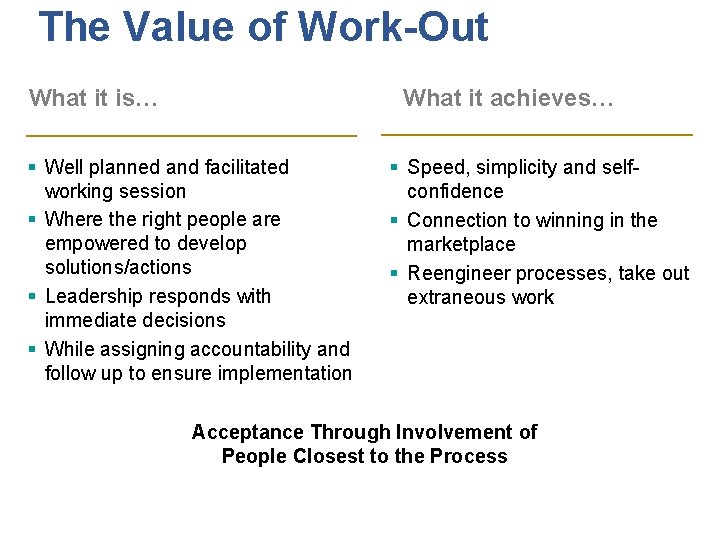
The Value of Work-Out What it achieves… What it is… § Well planned and facilitated working session § Where the right people are empowered to develop solutions/actions § Leadership responds with immediate decisions § While assigning accountability and follow up to ensure implementation § Speed, simplicity and selfconfidence § Connection to winning in the marketplace § Reengineer processes, take out extraneous work Acceptance Through Involvement of People Closest to the Process
Lean Healthcare
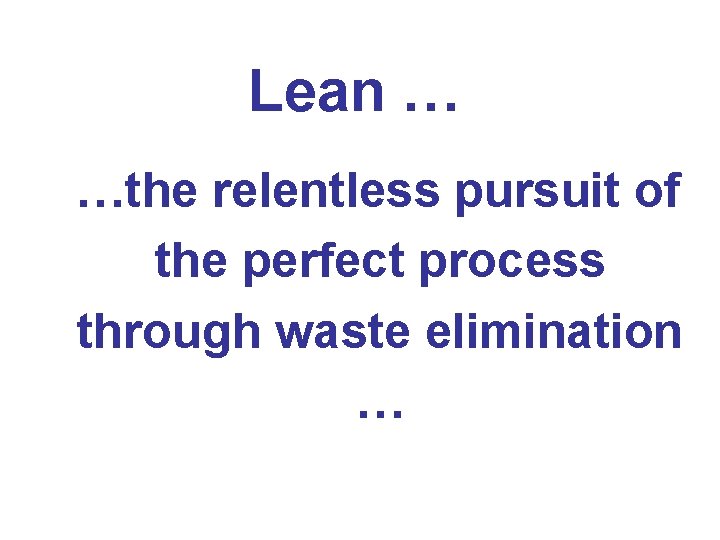
Lean … …the relentless pursuit of the perfect process through waste elimination …
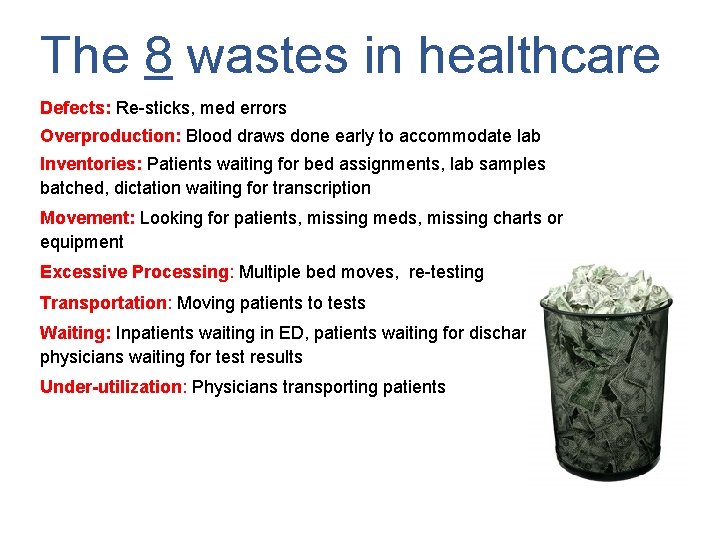
The 8 wastes in healthcare Defects: Re-sticks, med errors Overproduction: Blood draws done early to accommodate lab Inventories: Patients waiting for bed assignments, lab samples batched, dictation waiting for transcription Movement: Looking for patients, missing meds, missing charts or equipment Excessive Processing: Multiple bed moves, re-testing Transportation: Moving patients to tests Waiting: Inpatients waiting in ED, patients waiting for discharge, physicians waiting for test results Under-utilization: Physicians transporting patients
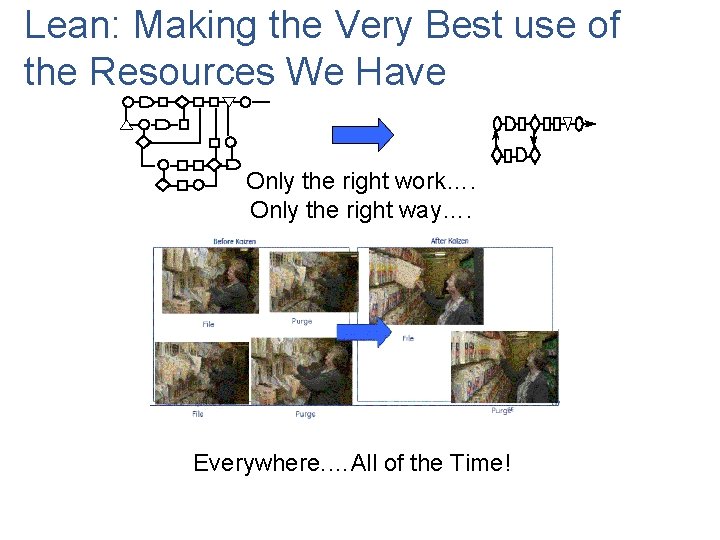
Lean: Making the Very Best use of the Resources We Have Only the right work…. Only the right way…. Everywhere. …All of the Time!
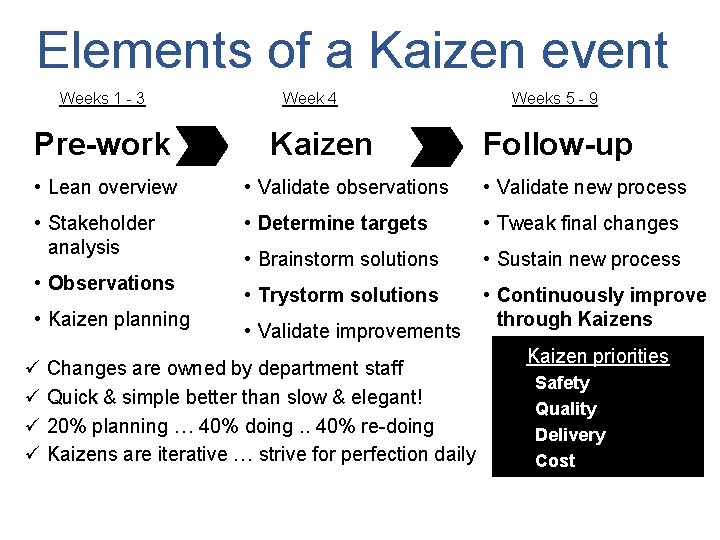
Elements of a Kaizen event Weeks 1 - 3 Pre-work Week 4 Kaizen Weeks 5 - 9 Follow-up • Lean overview • Validate observations • Validate new process • Stakeholder analysis • Determine targets • Tweak final changes • Brainstorm solutions • Sustain new process • Trystorm solutions • Continuously improve through Kaizens • Observations • Kaizen planning • Validate improvements ü Changes are owned by department staff ü Quick & simple better than slow & elegant! ü 20% planning … 40% doing. . 40% re-doing ü Kaizens are iterative … strive for perfection daily Kaizen priorities Safety Quality Delivery Cost
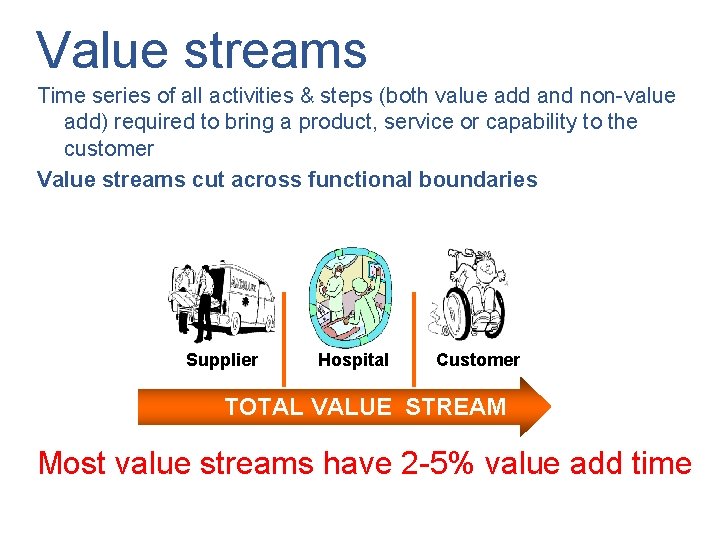
Value streams Time series of all activities & steps (both value add and non-value add) required to bring a product, service or capability to the customer Value streams cut across functional boundaries Supplier Hospital Customer TOTAL VALUE STREAM Most value streams have 2 -5% value add time
Six Sigma
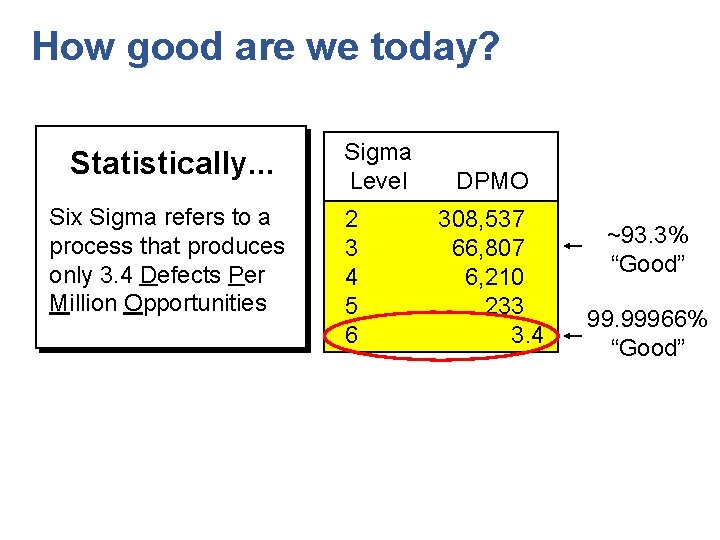
How good are we today? Statistically. . . Six Sigma refers to a process that produces only 3. 4 Defects Per Million Opportunities Sigma Level 2 3 4 5 6 DPMO 308, 537 Goal 66, 807 6, 210 233 3. 4 ~93. 3% “Good” 99. 99966% “Good”
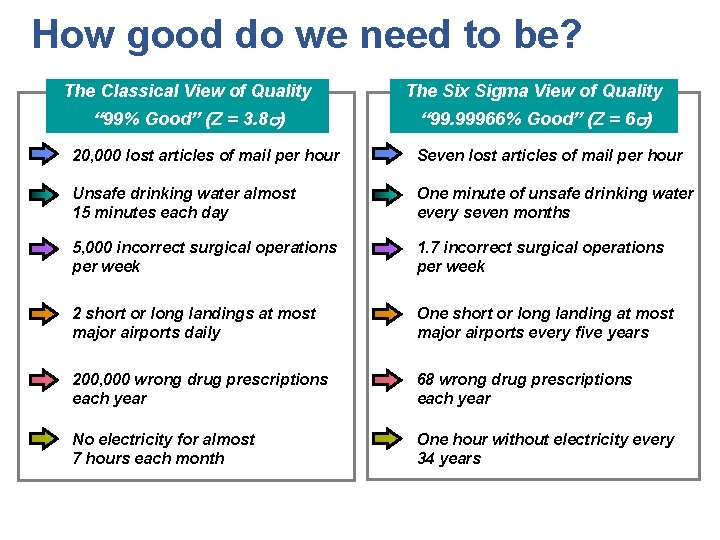
How good do we need to be? The Classical View of Quality The Six Sigma View of Quality “ 99% Good” (Z = 3. 8 s) “ 99. 99966% Good” (Z = 6 s) 20, 000 lost articles of mail per hour Seven lost articles of mail per hour Unsafe drinking water almost 15 minutes each day One minute of unsafe drinking water every seven months 5, 000 incorrect surgical operations per week 1. 7 incorrect surgical operations per week 2 short or long landings at most major airports daily One short or long landing at most major airports every five years 200, 000 wrong drug prescriptions each year 68 wrong drug prescriptions each year No electricity for almost 7 hours each month One hour without electricity every 34 years
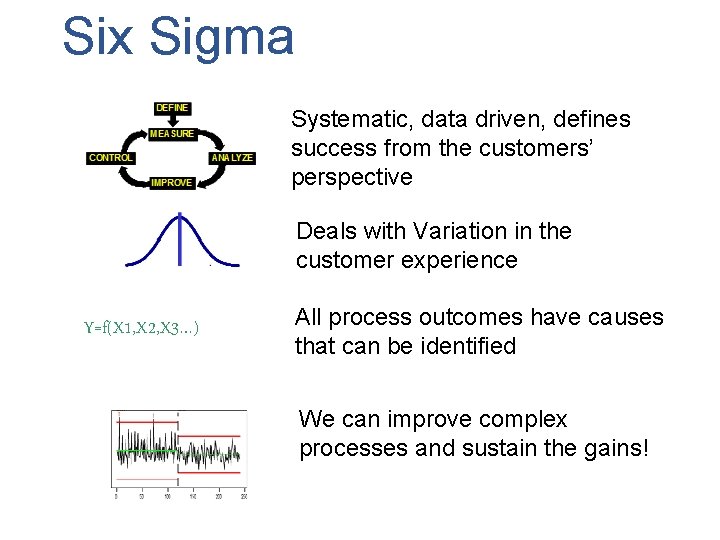
Six Sigma Systematic, data driven, defines success from the customers’ perspective Deals with Variation in the customer experience Y=f(X 1, X 2, X 3…) All process outcomes have causes that can be identified We can improve complex processes and sustain the gains!
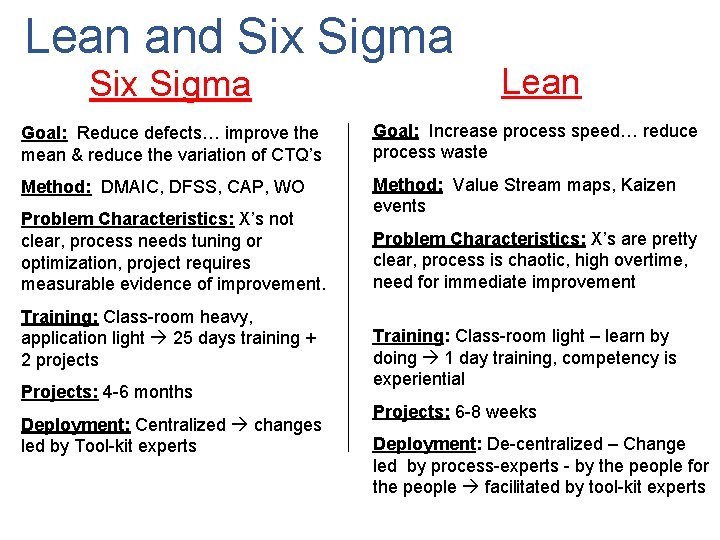
Lean and Six Sigma Lean Goal: Reduce defects… improve the mean & reduce the variation of CTQ’s Goal: Increase process speed… reduce process waste Method: DMAIC, DFSS, CAP, WO Method: Value Stream maps, Kaizen events Problem Characteristics: X’s not clear, process needs tuning or optimization, project requires measurable evidence of improvement. Training: Class-room heavy, application light 25 days training + 2 projects Projects: 4 -6 months Deployment: Centralized changes led by Tool-kit experts Problem Characteristics: X’s are pretty clear, process is chaotic, high overtime, need for immediate improvement Training: Class-room light – learn by doing 1 day training, competency is experiential Projects: 6 -8 weeks Deployment: De-centralized – Change led by process-experts - by the people for the people facilitated by tool-kit experts
Integrating Tools and Techniques
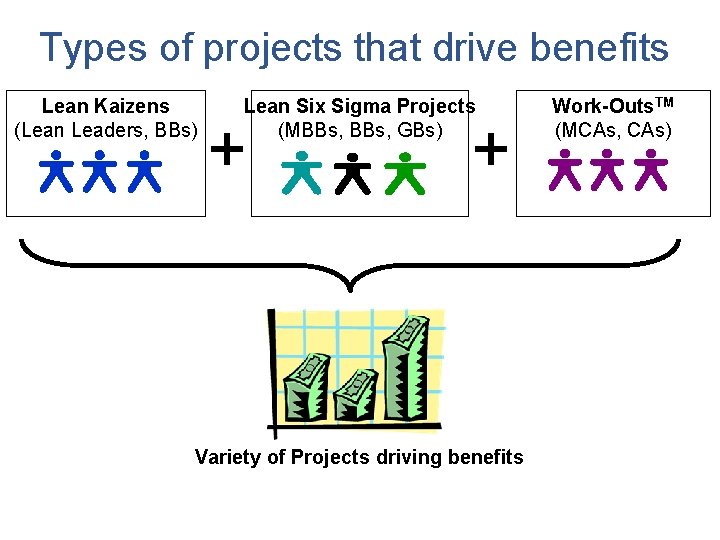
Types of projects that drive benefits Lean Kaizens (Lean Leaders, BBs) Lean Six Sigma Projects (MBBs, GBs) + + Variety of Projects driving benefits Work-Outs. TM (MCAs, CAs)
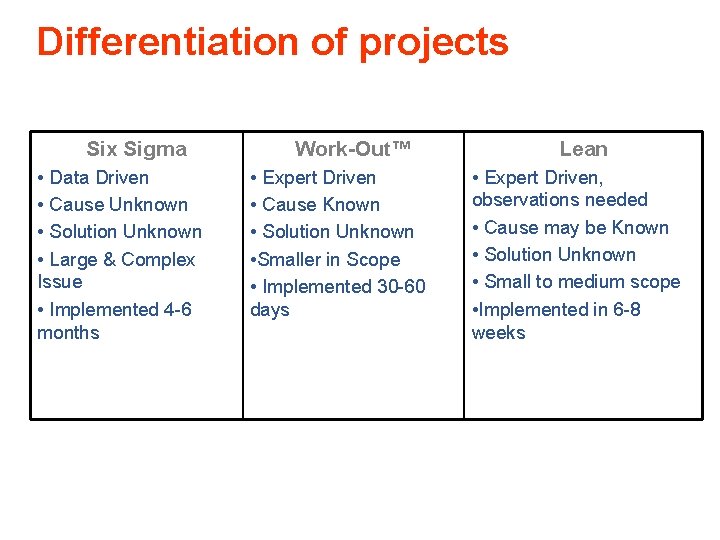
Differentiation of projects Six Sigma • Data Driven • Cause Unknown • Solution Unknown • Large & Complex Issue • Implemented 4 -6 months Work-Out™ • Expert Driven • Cause Known • Solution Unknown • Smaller in Scope • Implemented 30 -60 days Lean • Expert Driven, observations needed • Cause may be Known • Solution Unknown • Small to medium scope • Implemented in 6 -8 weeks
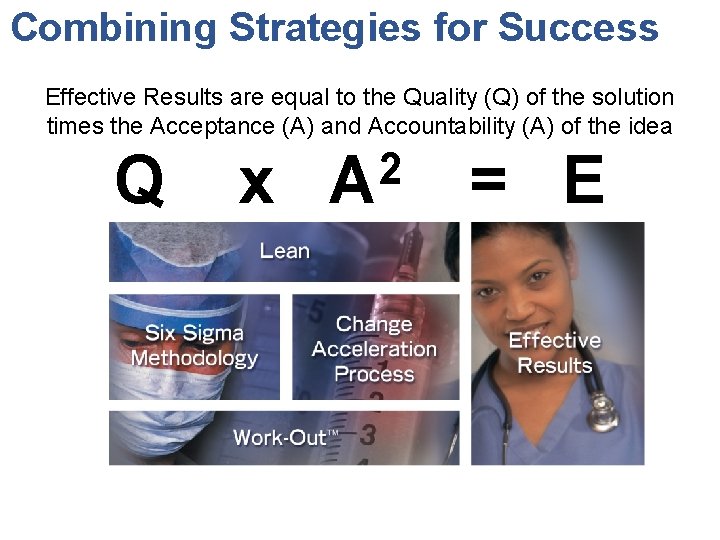
Combining Strategies for Success Effective Results are equal to the Quality (Q) of the solution times the Acceptance (A) and Accountability (A) of the idea Q x 2 A = E
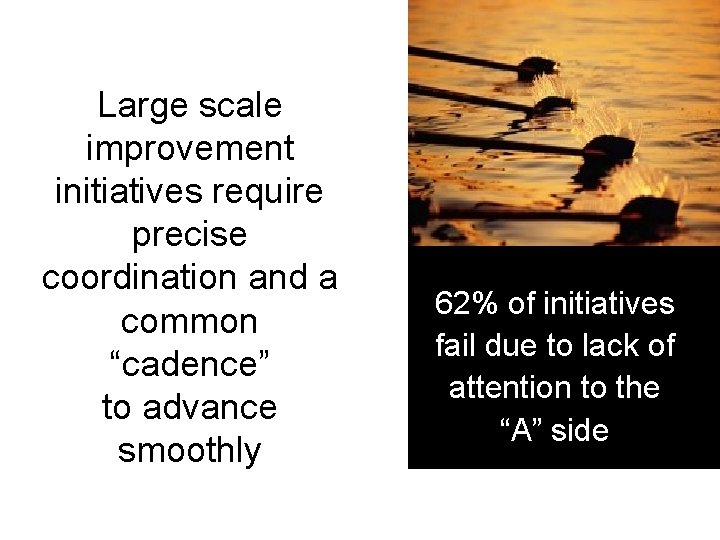
Large scale improvement initiatives require precise coordination and a common “cadence” to advance smoothly 62% of initiatives fail due to lack of attention to the “A” side
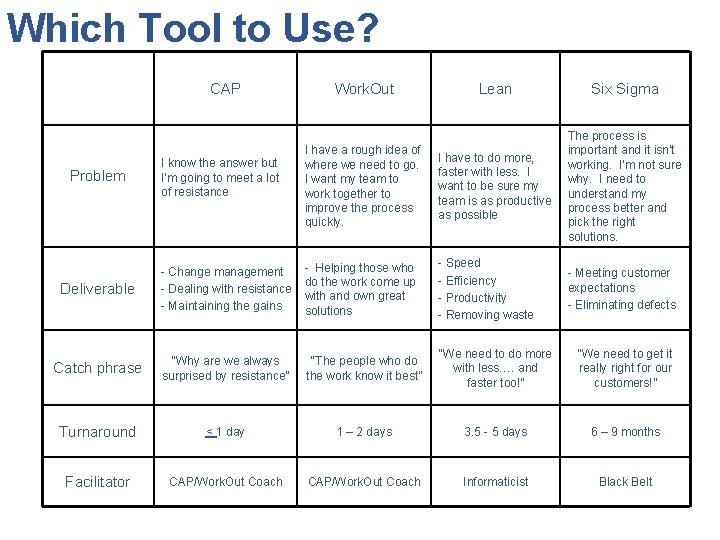
Which Tool to Use? CAP Lean Six Sigma I have a rough idea of where we need to go. I want my team to work together to improve the process quickly. I have to do more, faster with less. I want to be sure my team is as productive as possible The process is important and it isn’t working. I’m not sure why. I need to understand my process better and pick the right solutions. Deliverable - Change management - Dealing with resistance - Maintaining the gains - Helping those who do the work come up with and own great solutions - Speed - Efficiency - Productivity - Removing waste - Meeting customer expectations - Eliminating defects Catch phrase “Why are we always surprised by resistance” “The people who do the work know it best” “We need to do more with less…. and faster too!” “We need to get it really right for our customers!” Turnaround < 1 day 1 – 2 days 3. 5 - 5 days 6 – 9 months Facilitator CAP/Work. Out Coach Informaticist Black Belt Problem I know the answer but I’m going to meet a lot of resistance Work. Out
Summary and Q&A
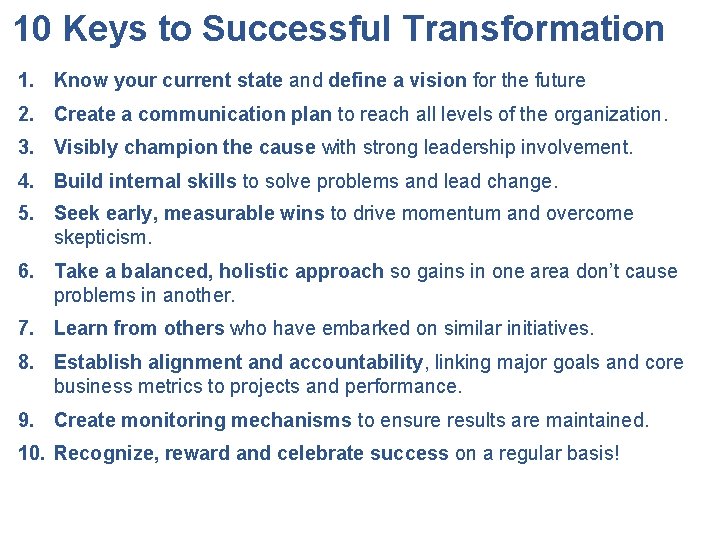
10 Keys to Successful Transformation 1. Know your current state and define a vision for the future 2. Create a communication plan to reach all levels of the organization. 3. Visibly champion the cause with strong leadership involvement. 4. Build internal skills to solve problems and lead change. 5. Seek early, measurable wins to drive momentum and overcome skepticism. 6. Take a balanced, holistic approach so gains in one area don’t cause problems in another. 7. Learn from others who have embarked on similar initiatives. 8. Establish alignment and accountability, linking major goals and core business metrics to projects and performance. 9. Create monitoring mechanisms to ensure results are maintained. 10. Recognize, reward and celebrate success on a regular basis!
For more information contact: Carolyn Pexton, Director of PR and Communications, GE Healthcare Performance Solutions 925 -275 -0726 Carolyn. Pexton@med. ge. com Susan Mc. Gann, RN, BSN, MBA, President and CEO, Pivotal Healthcare Solutions, LLC 609 -694 -1333 Susanmcgann@pivotalhcs. com