
A systematic review of effective behaviour change techniques
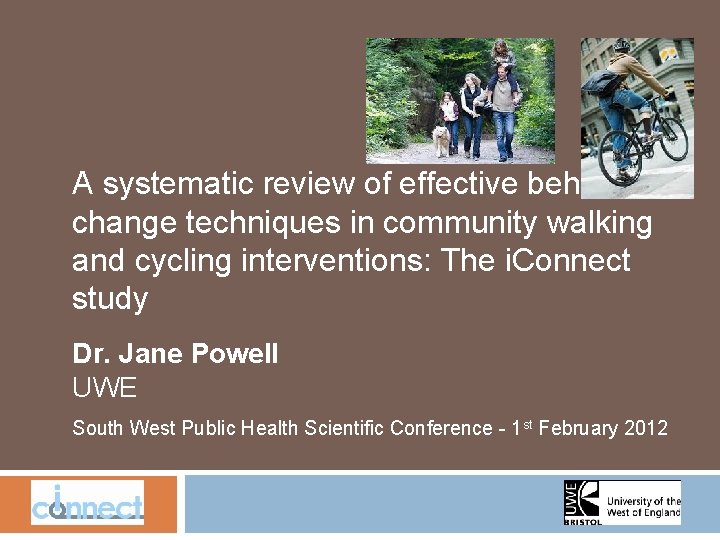
A systematic review of effective behaviour change techniques in community walking and cycling interventions: The i. Connect study Dr. Jane Powell UWE South West Public Health Scientific Conference - 1 st February 2012
Background Walking and cycling interventions may have the potential to change behaviour - however, evidence is inconclusive (Ogilvie et al, 2007; Yang et al. , 2010) Potentially attributed to: � Differences in design characteristics (i. e. Audience, outcome measures, evaluation criteria, etc. ) � Differences in intervention content (i. e. Behaviour change techniques (BCTs))
Background This has restricted our understanding of how intervention content is related to intervention efficacy So. . . BCT taxonomy (Abraham and Michie, 2008) � Standardised list of 26 BCTs commonly utilised by behavioural interventions � Used to describe content of behavioural interventions � Not yet applied to walking and cycling interventions
Present study. . . A systematic review of the behaviour change techniques (BCTs) incorporated into walking and cycling interventions
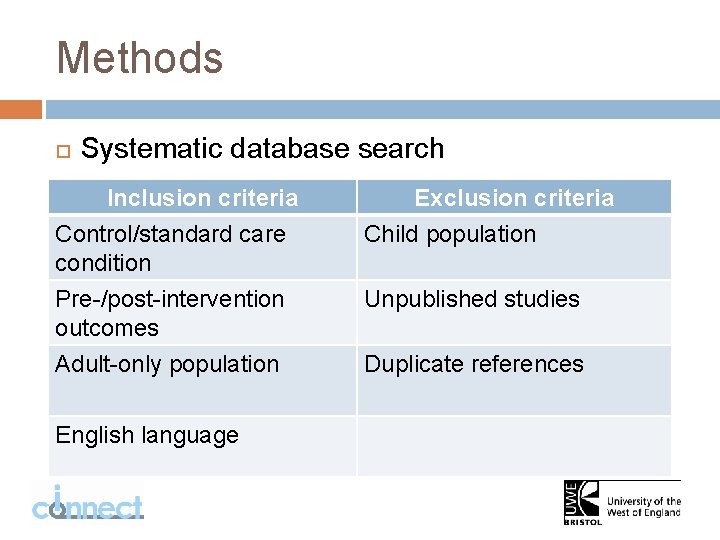
Methods Systematic database search Inclusion criteria Control/standard care condition Pre-/post-intervention outcomes Exclusion criteria Child population Adult-only population Duplicate references English language Unpublished studies
Methods Data extraction: � Design characteristics (e. g. Audience, outcome measures, delivery, sample size, etc. ) � BCTs (using Taxonomy coding manual) Quality appraisal � 8 -item checklist adapted from previous reviews (Ogilvie et al. , 2007; Yang et al. , 2010)
Results 40 studies met the inclusion criteria: � 17 = statistically significant change � 10 = no statistically significant change � 13 = of uncertain statistical significance Variation in: � Design characteristics /outcomes (i. e. Population, delivery, sample size, effect size, etc. ) � Vocabulary used
Results Behaviour change techniques (BCTs): � Variation � Majority in number of BCTs coded per study (0 -14) coded multiple BCTs (M = 4. 55, SD = 3. 06) � “Self-monitoring” � More = most frequently coded (65%)* BCTs = more effective? (F(1, 25) = 10. 27, p = 0. 004) * = for *studies reporting statistically significant change
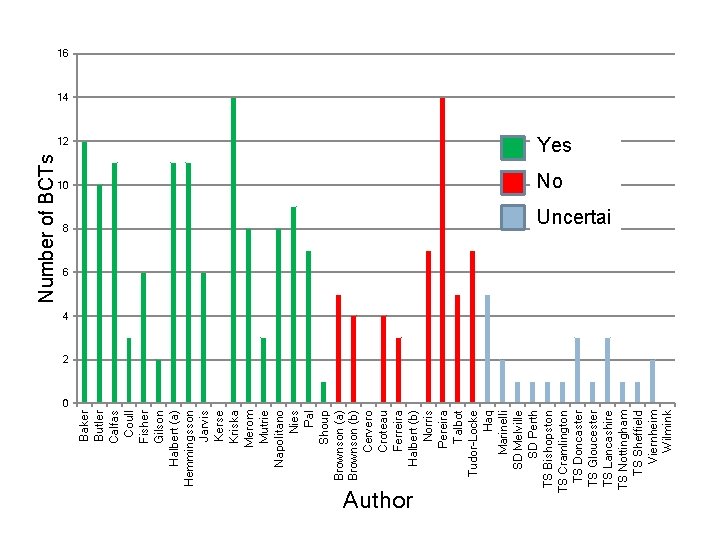
Baker Butler Calfas Coull Fisher Gilson Halbert (a) Hemmingsson Jarvis Kerse Kriska Merom Mutrie Napolitano Nies Pal Shoup Brownson (a) Brownson (b) Cervero Croteau Ferreira Halbert (b) Norris Pereira Talbot Tudor-Locke Haq Marinelli SD Melville SD Perth TS Bishopston TS Cramlington TS Doncaster TS Gloucester TS Lancashire TS Nottingham TS Sheffield Viernheim Wilmink Number of BCTs 16 14 12 Yes 10 No 8 Uncertai 6 4 2 0 Author
Discussion Variation in vocabulary No clear combination of BCTs Heterogeneity in number of BCTs coded � “Self-monitoring” - support for inclusion? � More BCTs = more effective? Potential for more simple intervention content
Discussion Impact of design characteristics? � Audience, duration. . . delivery mode, theoretical framework, Impact of environmental factors? Exhaustive list of BCTs? Coding reliant on study reporting style � Were BCTs missed? � Discrepancies across coders?
Recommendations 1) 2) 3) Further exploration of the BCTs used in walking and cycling interventions Detailed, standardised reporting of walking and cycling intervention content Standardised intervention manuals
Questions? Contact us. . . emma. bird@uwe. ac. uk Collaborators: Miss Emma Bird UWE Dr. Graham Baker University of Strathclyde Dr. Jane Powell UWE Prof. Nanette Mutrie University of Strathclyde Dr. David Ogilvie MRC Epidemiology Unit, Cambridge Dr. Shannon Sahlqvist MRC Epidemiology Unit, Cambridge
- Slides: 13