
A Survey on PositionBased Routing in Mobile Ad
A Survey on Position-Based Routing in Mobile Ad Hoc Networks by Martin Mauve, Jorg Widmer, and Hannes Hartenstein
Ad Hoc Networks Reviews • Self-organizing • No pre-established infrastructure • Consisting of autonomous nodes end systems as well as routers at the same time • Classification: • Static – such as rooftop networks • Mobile • changing topology frequently & unpredictably
Two different approaches in routing • Topology-based routing • proactive approaches • reactive approaches • hybrid approaches • Position-based routing
Topology-based Approaches Proactive routing protocols - maintain routing info. of all available paths Drawback: maintenance of unused path Reactive routing protocols - only maintain routes currently in use Drawbacks: - require route discovery - suffer traffic increasing when topology change - packets lost due to route changing
Topology-based Approaches (cont. ) Hybrid ad hoc routing protocols -Zone Routing Protocol (ZRP): local proactive routing with global reactive routing Limitation: still need to maintain routes currently in use

Position-based Routing Algorithms • require physical location info of nodes • routing decision: based on destination’s location and locations of forwarding node’s neighbors • no establishment or maintenance of routes
Basic Principles and Problems • location service: determine position of a node - how many nodes host the service - some or all nodes maintained by position server • forwarding strategies - greedy forwarding - restricted directional flooding - hierarchical
Location Services • Centralized approaches: viable only as an external service that can be reached via non-ad hoc means - single point of failure - bottleneck on central server - server might be far from nearby nodes Example: cellular phone system
Location Services (cont. ) • Decentralized approaches: location service is part of the ad hoc network - Distance Routing Effect Algorithm for Mobility (DREAM) - Quorum-Based Location Service - Grid Location Service - Homezone
Example: Grid Location Service (GLS) • hierarchy of squares • n-order squares contain exactly four (n-1)order squares • each node maintains all other node within the local 0 -order square
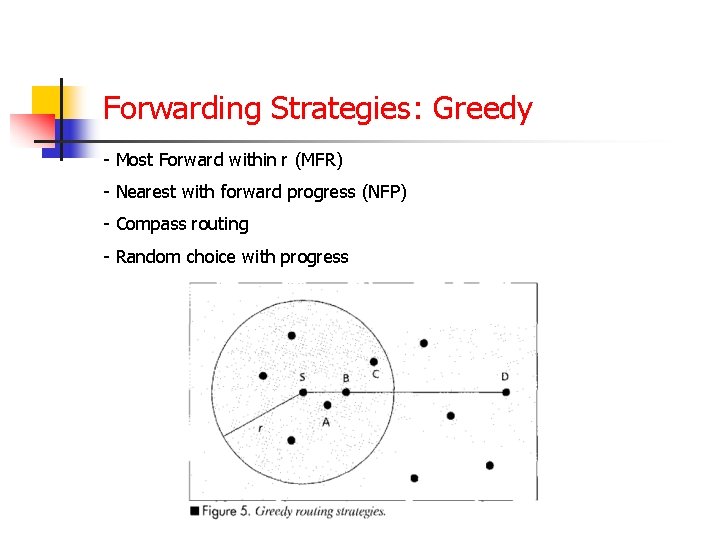
Forwarding Strategies: Greedy - Most Forward within r (MFR) - Nearest with forward progress (NFP) - Compass routing - Random choice with progress
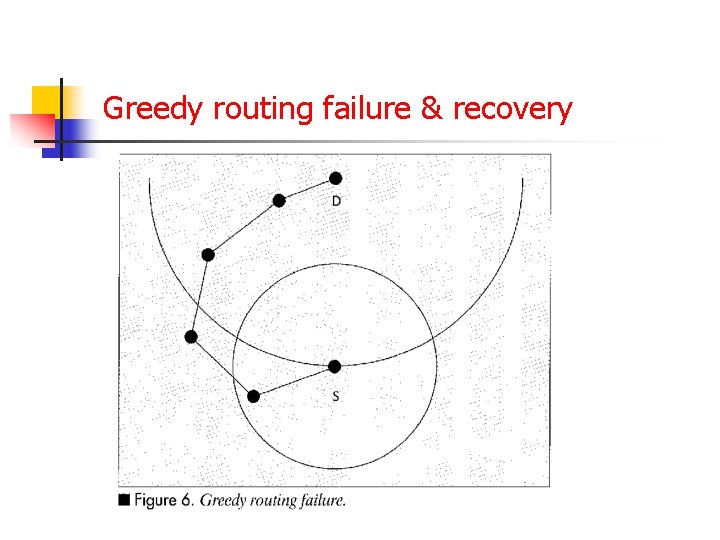
Greedy routing failure & recovery
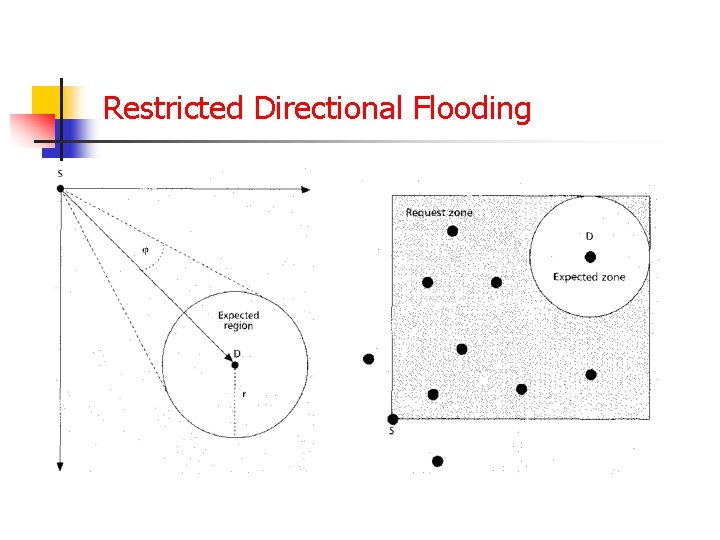
Restricted Directional Flooding
Hierarchical Forwarding • reduce complexity in individual node • scale to large number of nodes • Grid • Terminodes
- Slides: 14