
A survey on methods and analysis of dynamic
![Method 1 – Community Detection Brain Q 1: Functional Brain States? [b 1] Ecology](https://slidetodoc.com/presentation_image_h2/844467465409e1439634f1b321426f62/image-4.jpg "Method 1 – Community Detection Brain Q 1: Functional Brain States? [b 1] Ecology")
![Method 2 Summary statistics Brain structural connectivity and functional connectivity ⇔ age [b 4]](https://slidetodoc.com/presentation_image_h2/844467465409e1439634f1b321426f62/image-8.jpg "Method 2 Summary statistics Brain structural connectivity and functional connectivity ⇔ age [b 4]")
![Method 3 - Features Brain Functional Network => Type of figures [B 5] Ecology](https://slidetodoc.com/presentation_image_h2/844467465409e1439634f1b321426f62/image-12.jpg "Method 3 - Features Brain Functional Network => Type of figures [B 5] Ecology")
![Method 3 Example (Continued) From [m 1], DRN: rows are transcription factor (TF)–target interactions,](https://slidetodoc.com/presentation_image_h2/844467465409e1439634f1b321426f62/image-14.jpg "Method 3 Example (Continued) From [m 1], DRN: rows are transcription factor (TF)–target interactions,")
![Specific Techniques in Molecular biology Data integration From [m 1], the framework of candidates](https://slidetodoc.com/presentation_image_h2/844467465409e1439634f1b321426f62/image-16.jpg "Specific Techniques in Molecular biology Data integration From [m 1], the framework of candidates")
![Biological Problems in molecular biology • Finding the drug targeting [m 1] (DRN) [m](https://slidetodoc.com/presentation_image_h2/844467465409e1439634f1b321426f62/image-17.jpg "Biological Problems in molecular biology • Finding the drug targeting [m 1] (DRN) [m")
![Specific Techniques in Ecology • Multiple level analysis [e 12, e 13] 1. Dyadic](https://slidetodoc.com/presentation_image_h2/844467465409e1439634f1b321426f62/image-21.jpg "Specific Techniques in Ecology • Multiple level analysis [e 12, e 13] 1. Dyadic")

![Bibliography - Ecology [e 1] Petanidou, Theodora, et al. "Long‐term observation of a pollination](https://slidetodoc.com/presentation_image_h2/844467465409e1439634f1b321426f62/image-26.jpg "Bibliography - Ecology [e 1] Petanidou, Theodora, et al. \"Long‐term observation of a pollination")
![Bibliography - Molecular biology [m 1] Yosef, Nir, et al. "Dynamic regulatory network controlling](https://slidetodoc.com/presentation_image_h2/844467465409e1439634f1b321426f62/image-27.jpg "Bibliography - Molecular biology [m 1] Yosef, Nir, et al. \"Dynamic regulatory network controlling")
- Slides: 30
A survey on methods and analysis of dynamic networks applied to biological problems Vena Chai Umberto
Outline of presentation • Motivation • Common techniques • Method • Example • Discussion • Area specific techniques • Suggestions • Methods across field • Methods to be developed • Conclusion
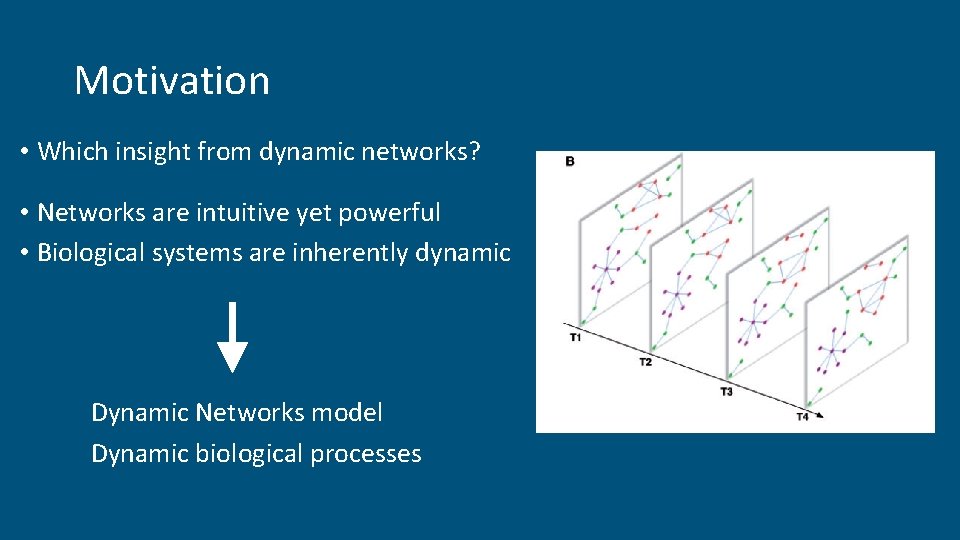
Motivation • Which insight from dynamic networks? • Networks are intuitive yet powerful • Biological systems are inherently dynamic Dynamic Networks model Dynamic biological processes
Method 1 – Community Detection Brain Q 1: Functional Brain States? [b 1] Ecology Q 1: Are bats able to maintain stable individual relationships? [e 4] Q 2: How does community structure impact the disease spread and information flow? [e 9] Molecular Q 1: Protein-protein interaction networks, hubs evolution [m 5] biology Q 2: How to detect functional modules [m 5]
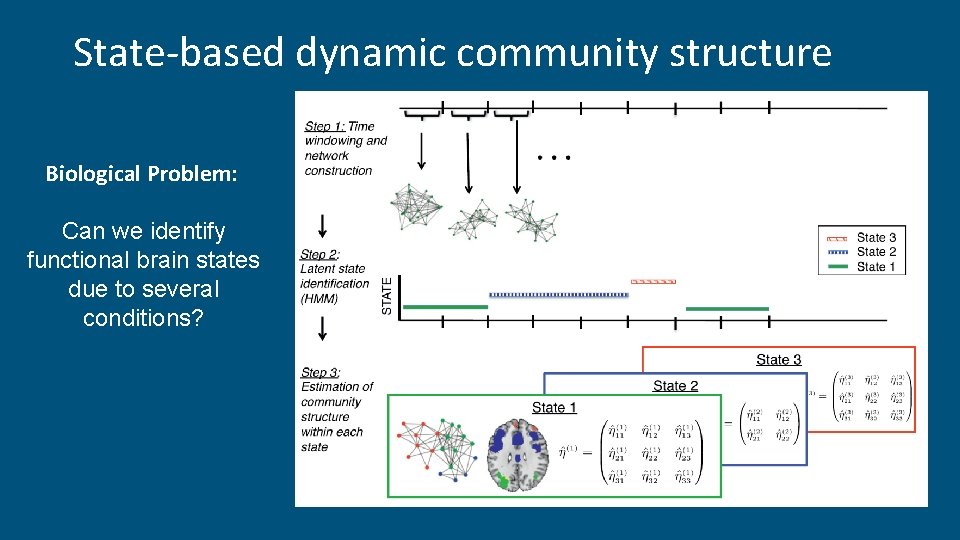
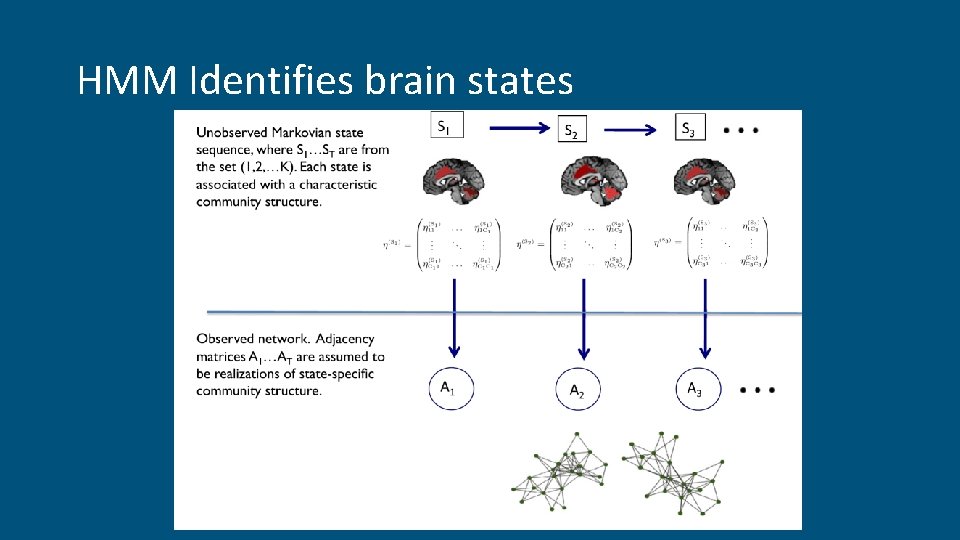
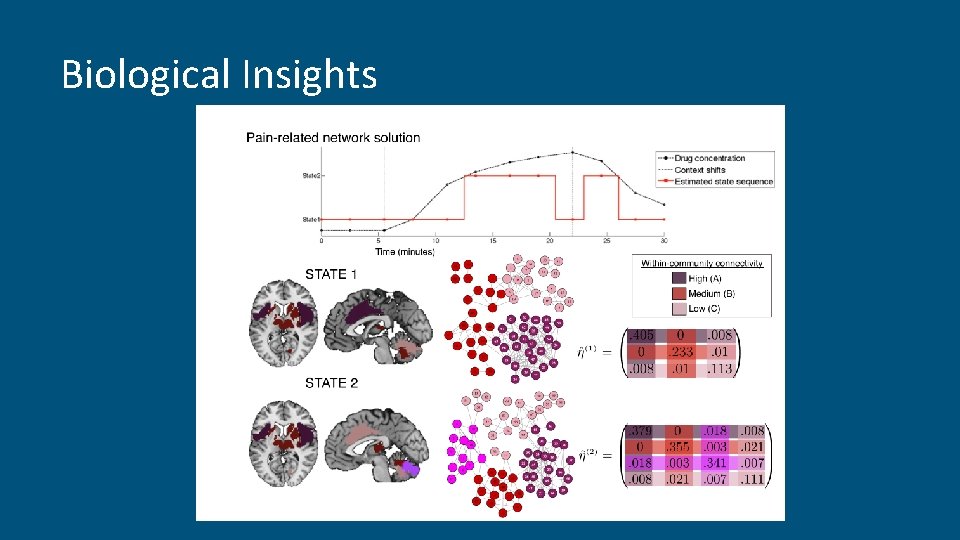
State-based dynamic community structure Biological Problem: Can we identify functional brain states due to several conditions?
HMM Identifies brain states
Method 1 Discussion • Biological insight on brain communities • Model has too many parameters-> don’t scale • Dynamic community detection algorithms could be used
Method 2 Summary statistics Brain structural connectivity and functional connectivity ⇔ age [b 4] Dynamic functional networks topology ⇔ communication efficiency [b 3] Ecology plant, pollinator species ⇔ generalists or specialists [e 1] seasonal changes in the topological structure of macaque social networks? [e 10] Molecular biology -
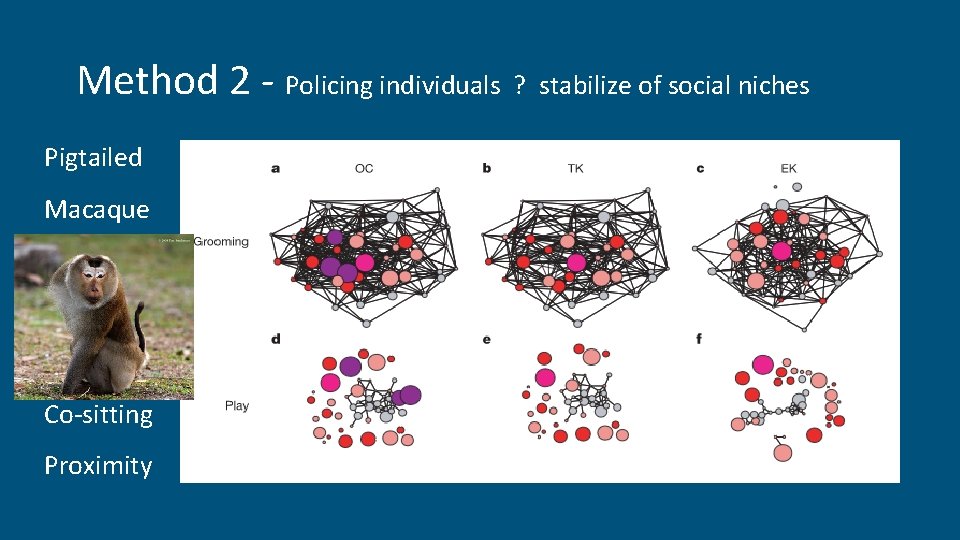
Method 2 - Policing individuals ? stabilize of social niches Pigtailed Macaque Co-sitting Proximity
Method 2 Example • Assortativity ⇔ interaction partner diversity • Clustering coefficient ⇔ more or less clusters • Conclusion: without policing individuals, more interaction, but less diverse, more clusters • Answer to the original question: • Policing helps stabilization
Method 2 Discussion • Good Practice: • Compare with random network to test significance • Measures correspond to biological interpretations • Bad example: • No significance test, only based on values are similar • Measure did not change much => “network remain equally functional”
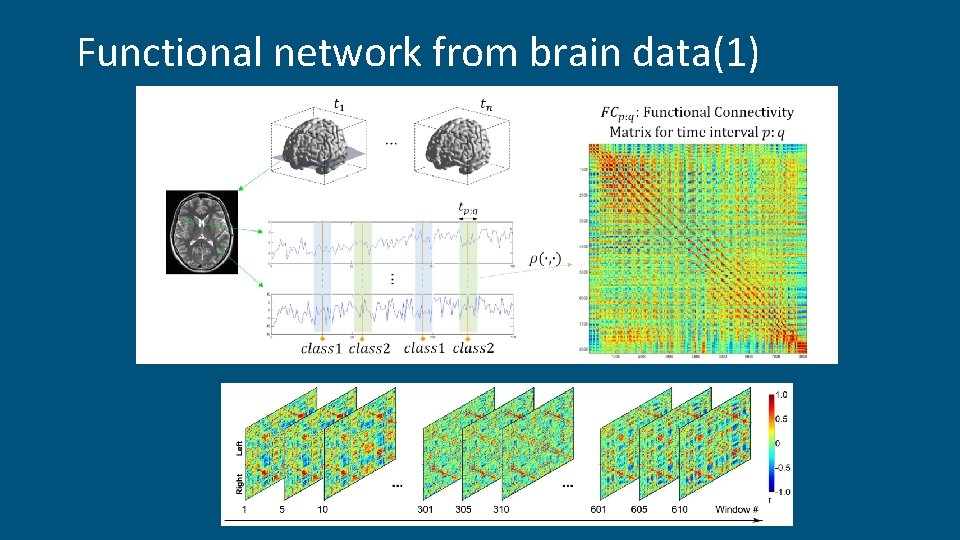
Method 3 - Features Brain Functional Network => Type of figures [B 5] Ecology - Molecular Regulatory network => drug target genes [m 1] biology
Method 3 - Dynamic regulatory network (DRN) • Finding candidates for gene perturbation (i. e. drug targeting). • DRN ⇔ transcription factor (known vs. unknown) • New TF to control TH 17 cell
Method 3 Example (Continued) From [m 1], DRN: rows are transcription factor (TF)–target interactions, columns are times
Method 3 Discussion • Good Practice: • Good reason of using dynamic network • Gene regulatory behaves dynamically. • Static network: cannot capture dynamic of gene expression • Bad example: • Focus on building the network • Have few statistic summary analysis
Specific Techniques in Molecular biology Data integration From [m 1], the framework of candidates identification for perturbation
Biological Problems in molecular biology • Finding the drug targeting [m 1] (DRN) [m 6] (DPPI network) • Capturing dynamic co-expression in embryo cells developments [m 2, m 3] (DRN) • Amount of Chemical substances => products in each part of cells [m 10], [m 11] (Metabolic pathways)
Molecular dynamic network conclusion • Few works exist • The main use: capturing dynamic behavior among molecular components. • The way to obtain networks are bias, expensive, and experiment specific. • Multiple data integration can help • Big data needed
Functional network from brain data(1)
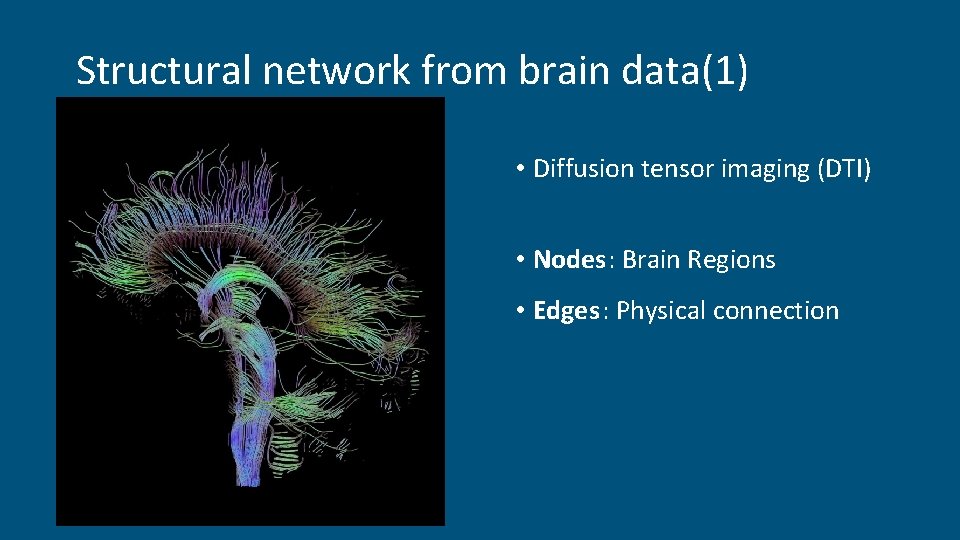
Structural network from brain data(1) • Diffusion tensor imaging (DTI) • Nodes: Brain Regions • Edges: Physical connection
Specific Techniques in Ecology • Multiple level analysis [e 12, e 13] 1. Dyadic 2. Ego 3. Population • Related with the study of flow and social learning [e 6, e 7, e 8, e 9] • Simulations for studying the impact of different factors [e 2, e 5, e 11]
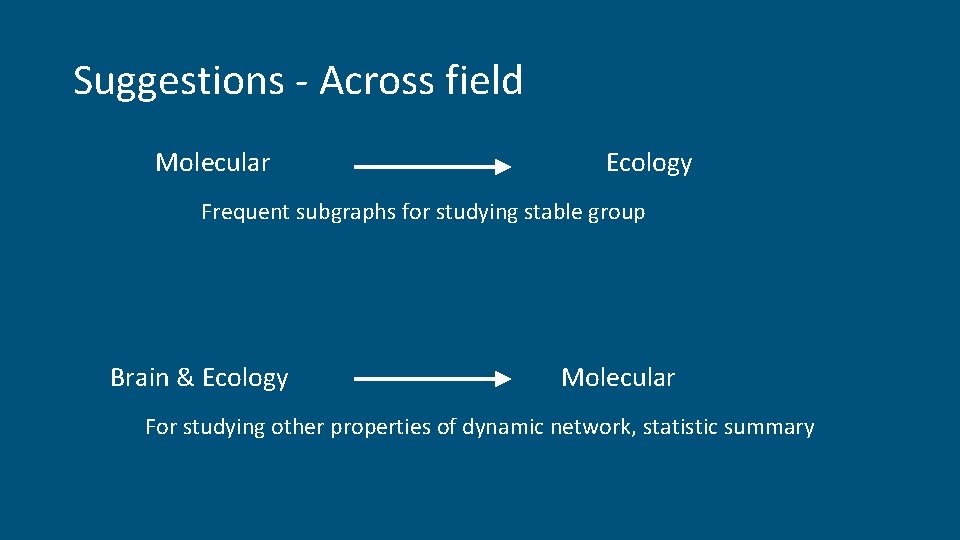
Suggestions - Across field Molecular Ecology Frequent subgraphs for studying stable group Brain & Ecology Molecular For studying other properties of dynamic network, statistic summary
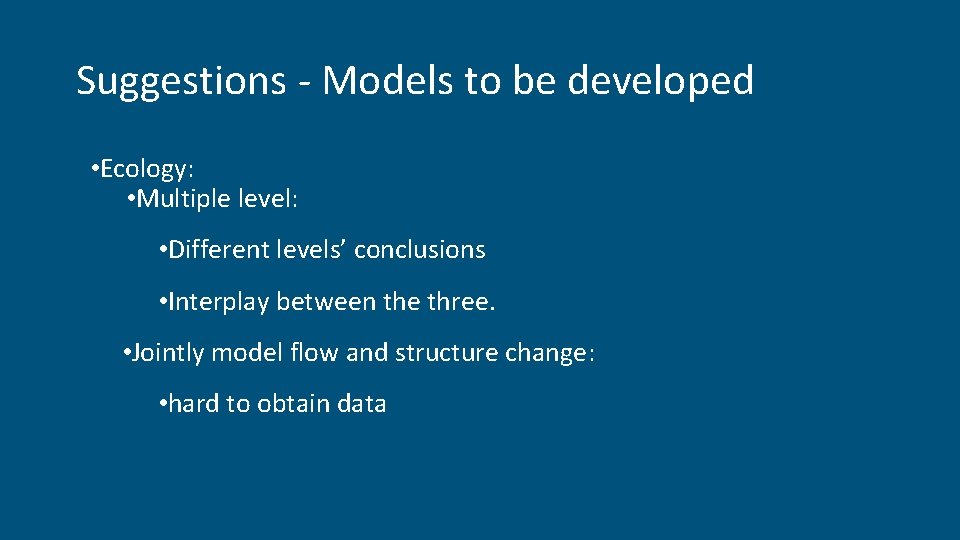
Suggestions - Models to be developed • Ecology: • Multiple level: • Different levels’ conclusions • Interplay between the three. • Jointly model flow and structure change: • hard to obtain data
Conclusion • Each field surveyed to identify dynamic network techniques • Detailed summaries for each field • Focus on the common methods across disciplines • Suggestions: exchange and new models
Bibliography - Ecology [e 1] Petanidou, Theodora, et al. "Long‐term observation of a pollination network: fluctuation in species and interactions, relative invariance of network structure and implications for estimates of specialization. " Ecology Letters 11. 6 (2008): 564 -575. [e 2] Romanuk, Tamara N. , et al. "Predicting invasion success in complex ecological networks. " Philosophical Transactions of the Royal Society of London B: Biological Sciences 364. 1524 (2009): 1743 -1754. [e 3] Flack, Jessica C. , et al. "Policing stabilizes construction of social niches in primates. " Nature 439. 7075 (2006): 426 -429. [e 4] Funk, Sebastian, Marcel Salathé, and Vincent AA Jansen. "Modelling the influence of human behaviour on the spread of infectious diseases: a review. "Journal of the Royal Society Interface 7. 50 (2010): 1247 -1256. [e 5] Blonder, Benjamin, and Anna Dornhaus. "Time-ordered networks reveal limitations to information flow in ant colonies. " Plo. S one 6. 5 (2011): e 20298. [e 6] Franz, Mathias, and Charles L. Nunn. "Network-based diffusion analysis: a new method for detecting social learning. " Proceedings of the Royal Society of London B: Biological Sciences 276. 1663 (2009): 1829 -1836. [e 7] Kendal, Rachel L. , et al. "Evidence for social learning in wild lemurs (Lemur catta). " Learning & Behavior 38. 3 (2010): 220 -234. [e 8] Chan, Joseph, Antony Holmes, and Raul Rabadan. "Network analysis of global influenza spread. " PLo. S Comput Biol 6. 11 (2010): e 1001005. [e 9] Salathé, Marcel, and James H. Jones. "Dynamics and control of diseases in networks with community structure. " PLo. S Comput Biol 6. 4 (2010): e 1000736. [e 10] Brent, Lauren JN, et al. "Seasonal changes in the structure of rhesus macaque social networks. " Behavioral ecology and sociobiology 67. 3 (2013): 349 -359. [e 11] Hasenjager, Matthew J. , and Lee Alan Dugatkin. "Chapter Three-Social Network Analysis in Behavioral Ecology. " Advances in the Study of Behavior 47 (2015): 39 -114. [e 12] de Silva, Shermin, Ashoka DG Ranjeewa, and Sergey Kryazhimskiy. "The dynamics of social networks among female Asian elephants. " BMC ecology 11. 1 (2011): 1. [e 13] Hobson, Elizabeth A. , Michael L. Avery, and Timothy F. Wright. "An analytical framework for quantifying and testing patterns of temporal dynamics in social networks. " Animal Behaviour 85. 1 (2013): 83 -96.
Bibliography - Molecular biology [m 1] Yosef, Nir, et al. "Dynamic regulatory network controlling TH 17 cell differentiation. " Nature 496. 7446 (2013): 461 -468. [m 2] Annunziata, Rossella, and Maria Ina Arnone. "A dynamic regulatory network explains Para. Hox gene control of gut patterning in the sea urchin. " Development 141. 12 (2014): 2462 -2472. [m 3] Cui, Miao, et al. "Specific functions of the Wnt signaling system in gene regulatory networks throughout the early sea urchin embryo. " Proceedings of the National Academy of Sciences 111. 47 (2014): E 5029 -E 5038. [m 4] Xenitidis, Panagiotis, et al. "Evaluation of Time Series Microarray Data for Dynamic Gene Regulatory Network Inference. " XIV Mediterranean Conference on Medical and Biological Engineering and Computing 2016. Springer International Publishing, 2016. [m 5] Chen, Bolin, et al. “Identifying protein complexes and functional modules—from static PPI networks to dynamic PPI networks. ” Briefings in bioinformatics (2013): bbt 039. [m 6] Wang, Jianxin, et al. "Dynamic protein interaction network construction and applications. " Proteomics 14. 4 -5 (2014): 338 -352. [m 7] Mucha PJ, Richardson T, Macon K, et al. “Community structure in time-dependent, multiscale, and multiplex networks. ” Science (2010); 328: 876 – 878. [m 8] Jin, Ruoming, et al. "Identify dynamic network modules with temporal and spatial constraints. " Pacific symposium on biocomputing. 2009. [m 9] Komurov K, White M. “Revealing static and dynamic modular architecture of the eukaryotic protein interaction network. ” Mol Syst Biol (2007); 3: 110. [m 10] Sekiyama, Yasuyo, and Jun Kikuchi. "Towards dynamic metabolic network measurements by multi-dimensional NMR-based fluxomics. " Phytochemistry 68. 16 (2007): 2320 -2329. [m 11] Goel, Gautam, I-Chun Chou, and Eberhard O. Voit. "System estimation from metabolic time-series data. " Bioinformatics 24. 21 (2008): 25052511. [m 12] Gulati, Jyotasana, Ian T. Baldwin, and Emmanuel Gaquerel. "The roots of plant defenses: integrative multivariate analyses uncover dynamic behaviors of gene and metabolic networks of roots elicited by leaf herbivory. " The Plant Journal 77. 6 (2014): 880 -892.
Bibliography - Brain 1. 2. 3. 4. 5. Dynamic functional connectivity using state-based dynamic community structure: Method and application to opioid analgesia Spontaneous functional network dynamics and associated structural substrates in the human brain A dynamic core Network and GLobal efficiency in the resting human brain Changes in structural and functional connectivity among resting-state networks across the human lifespan Large scale functional connectivity for brain decoding
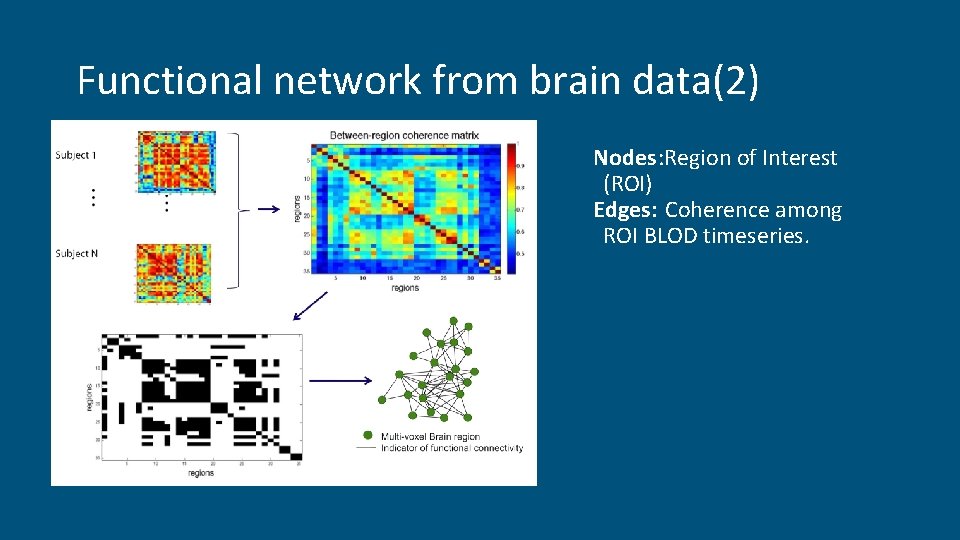
Functional network from brain data(2) Nodes: Region of Interest (ROI) Edges: Coherence among ROI BLOD timeseries.
Biological Insights