
A Super Toolkit for the CDM Gareth Phillips
- Slides: 9
A Super Toolkit for the CDM? Gareth Phillips and Seleha Lockwood November 2010 Development - Finance - Technology
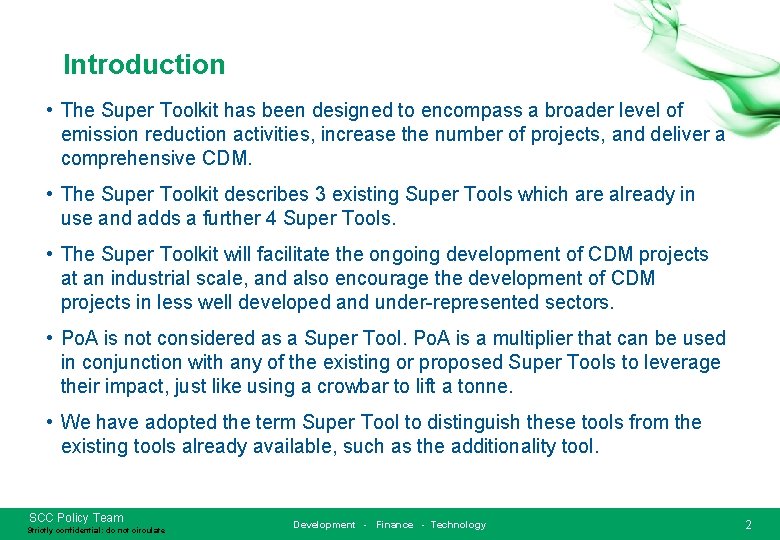
Introduction • The Super Toolkit has been designed to encompass a broader level of emission reduction activities, increase the number of projects, and deliver a comprehensive CDM. • The Super Toolkit describes 3 existing Super Tools which are already in use and adds a further 4 Super Tools. • The Super Toolkit will facilitate the ongoing development of CDM projects at an industrial scale, and also encourage the development of CDM projects in less well developed and under-represented sectors. • Po. A is not considered as a Super Tool. Po. A is a multiplier that can be used in conjunction with any of the existing or proposed Super Tools to leverage their impact, just like using a crowbar to lift a tonne. • We have adopted the term Super Tool to distinguish these tools from the existing tools already available, such as the additionality tool. SCC Policy Team Strictly confidential: do not circulate Development - Finance - Technology 2
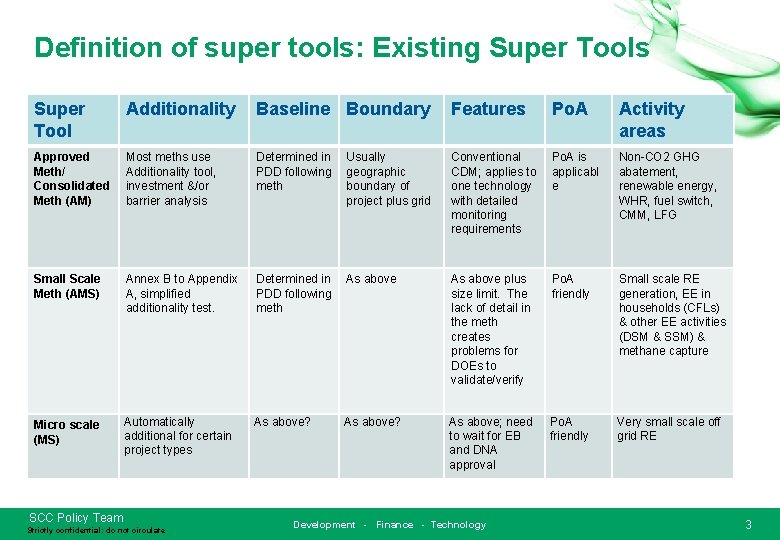
Definition of super tools: Existing Super Tools Super Tool Additionality Baseline Boundary Features Po. A Activity areas Approved Meth/ Consolidated Meth (AM) Most meths use Additionality tool, investment &/or barrier analysis Determined in PDD following meth Usually geographic boundary of project plus grid Conventional CDM; applies to one technology with detailed monitoring requirements Po. A is applicabl e Non-CO 2 GHG abatement, renewable energy, WHR, fuel switch, CMM, LFG Small Scale Meth (AMS) Annex B to Appendix A, simplified additionality test. Determined in PDD following meth As above plus size limit. The lack of detail in the meth creates problems for DOEs to validate/verify Po. A friendly Small scale RE generation, EE in households (CFLs) & other EE activities (DSM & SSM) & methane capture Micro scale (MS) Automatically additional for certain project types As above? As above; need to wait for EB and DNA approval Po. A friendly Very small scale off grid RE SCC Policy Team Strictly confidential: do not circulate Development - Finance - Technology 3
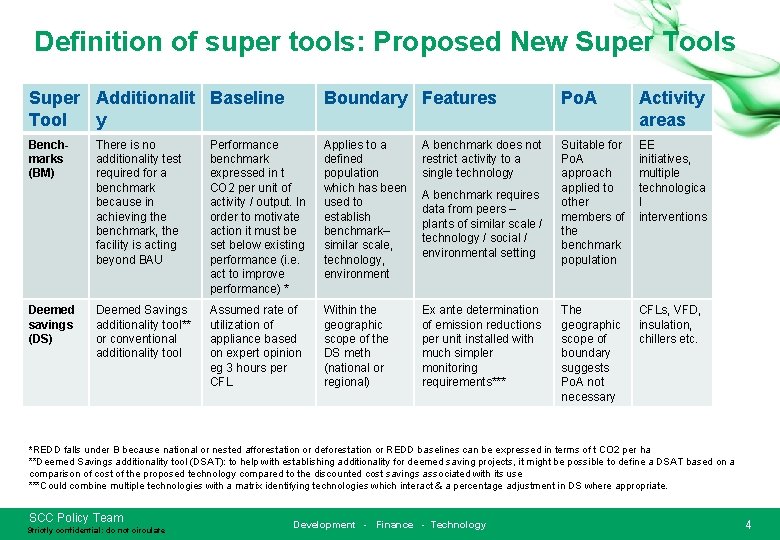
Definition of super tools: Proposed New Super Tools Super Additionalit Baseline Tool y Boundary Features Po. A Activity areas Benchmarks (BM) Suitable for Po. A approach applied to other members of the benchmark population EE initiatives, multiple technologica l interventions The geographic scope of boundary suggests Po. A not necessary CFLs, VFD, insulation, chillers etc. Deemed savings (DS) There is no additionality test required for a benchmark because in achieving the benchmark, the facility is acting beyond BAU Performance benchmark expressed in t CO 2 per unit of activity / output. In order to motivate action it must be set below existing performance (i. e. act to improve performance) * Applies to a defined population which has been used to establish benchmark– similar scale, technology, environment A benchmark does not restrict activity to a single technology Deemed Savings additionality tool** or conventional additionality tool Assumed rate of utilization of appliance based on expert opinion eg 3 hours per CFL Within the geographic scope of the DS meth (national or regional) Ex ante determination of emission reductions per unit installed with much simpler monitoring requirements*** A benchmark requires data from peers – plants of similar scale / technology / social / environmental setting *REDD falls under B because national or nested afforestation or deforestation or REDD baselines can be expressed in terms of t CO 2 per ha **Deemed Savings additionality tool (DSAT): to help with establishing additionality for deemed saving projects, it might be possible to define a DSAT based on a comparison of cost of the proposed technology compared to the discounted cost savings associated with its use ***Could combine multiple technologies with a matrix identifying technologies which interact & a percentage adjustment in DS where appropriate. SCC Policy Team Strictly confidential: do not circulate Development - Finance - Technology 4
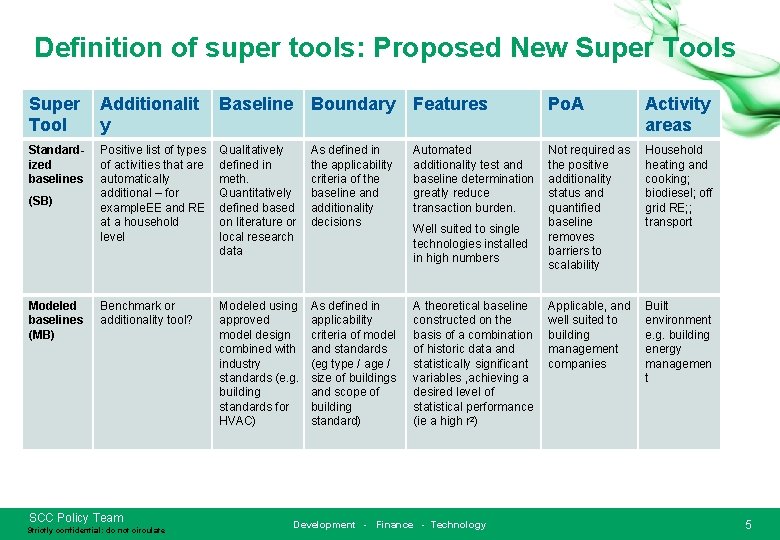
Definition of super tools: Proposed New Super Tools Super Tool Additionalit y Baseline Boundary Features Po. A Activity areas Standardized baselines Positive list of types of activities that are automatically additional – for example. EE and RE at a household level Qualitatively defined in meth. Quantitatively defined based on literature or local research data As defined in the applicability criteria of the baseline and additionality decisions Automated additionality test and baseline determination greatly reduce transaction burden. Not required as the positive additionality status and quantified baseline removes barriers to scalability Household heating and cooking; biodiesel; off grid RE; ; transport Benchmark or additionality tool? Modeled using approved model design combined with industry standards (e. g. building standards for HVAC) As defined in applicability criteria of model and standards (eg type / age / size of buildings and scope of building standard) A theoretical baseline constructed on the basis of a combination of historic data and statistically significant variables , achieving a desired level of statistical performance (ie a high r 2) Applicable, and well suited to building management companies Built environment e. g. building energy managemen t (SB) Modeled baselines (MB) SCC Policy Team Strictly confidential: do not circulate Well suited to single technologies installed in high numbers Development - Finance - Technology 5
Application • Taking these tools, the EB, DNA or project proponents can decide which tool best suits the projects/ technologies/ sectors they want to work in. • Methodologies would be proposed and approved, but not just using the existing “new methodology” template. New templates would be required to suit the design features of the new super tools. • As a result, we will see not just the continued application of large and small scale meths to CDM projects but also an expansion of the CDM into new areas of activity. • The following table provides an overview of which super tools might best be applied to technologies / sectors / types of project activities. The most suitable super tool(s) is in bold. SCC Policy Team Strictly confidential: do not circulate Development - Finance - Technology 6
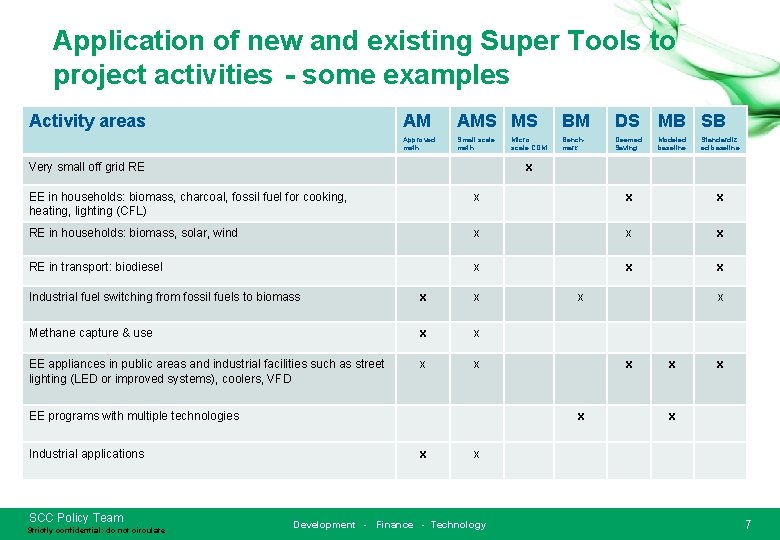
Application of new and existing Super Tools to project activities - some examples Activity areas AM AMS MS BM DS MB SB Approved meth Small scale meth Benchmark Deemed Saving Modeled baseline Very small off grid RE Micro scale CDM Standardiz ed baseline x EE in households: biomass, charcoal, fossil fuel for cooking, heating, lighting (CFL) x x x RE in households: biomass, solar, wind x x x RE in transport: biodiesel x x x Industrial fuel switching from fossil fuels to biomass x x Methane capture & use x x EE appliances in public areas and industrial facilities such as street lighting (LED or improved systems), coolers, VFD x x EE programs with multiple technologies Industrial applications SCC Policy Team Strictly confidential: do not circulate x x x x x Development - Finance - Technology 7
Conclusion • These new proposed “super tools” compliment the existing super tools which have been developed to date under the CDM. • In doing so, they would facilitate the expansion of the CDM into more sectors of Non-Annex 1 economies. • The scope of these tools would suggest re-aligning some existing and new methodologies (some examples are given in the Annex). SCC Policy Team Strictly confidential: do not circulate Development - Finance - Technology 8
Annex The following are some detailed points for consideration which would identify some of the immediate consequences of this approach: • AM 70 and AMSIIJ should be restructured as a deemed saving methodology, perhaps with a deemed savings additionality tool and an interaction matrix for multiple technologies. • From the table on slide 7, it is clear that the small scale CDM approach is less relevant. The objectives of the small scale CDM can be better achieved using other tools. Practical experience with the small scale CDM would also suggest that the approach is problematic. • The reference to benchmarks in ACM 13 should be replaced with an investment threshold and these terms should be defined. • NM 302, the benchmark methodology for the cement sector, should be developed as a benchmarking methodology, rather than trying to force it into an approved methodology with a baseline and additionality test. SCC Policy Team Strictly confidential: do not circulate Development - Finance - Technology 9