
A Subsea Node Network for KM 3 Ne
A Sub-sea Node Network for KM 3 Ne. T Advantages of this node network are: ü That the transparent 10 Gb/s bandwidth point to point multiple node network is built with components of the shelf technology, a standard according to ITU specifications. ü Photonic technology enables a maximum migration of sub-sea electronics to the shore. ü - Transparent electronic circuitries in the sub-sea detector area. Enables sending raw data from the PMT circuitry to shore, To. T signals or even multilevel To. T signals Less production time and test time for the sub-sea equipment. Onshore flexibility in developing DAQ hardware/software. Future updates possibilities are granted. ü The PON (Passive Optical Network) has inherently a fixed signal propagation. This feature makes sending/receiving time critical signals to/from the detector transparent. ü Low power requirements on the seabed ü The network is almost cost neutral compared to conventional electronic/optic solutions. 15/16 -10 -08 Paris, KM 3 Ne. T meeting WP 3, WP 4, WP 5 Jelle Hogenbirk et. al. 1 electronic department
History of development ü Innovative design study using photonic technology for data transport started after the VLVn. T workshop in Amsterdam, 2003 ü Various studies on conceptual aspects of a novel architecture by Nikhef, 2003 -2005 ü Photonic workshop at Nikhef within the framework of WP 4, November 2006 ü First basic experiments at the University of Eindhoven, summer 2007 üFeasibility study results presented by CIP at the KM 3 Ne. T CDR workshop, November 2007 ü Realization with industry (CIP) of ‘SPARK’ with 3 optical channels 10 Gb/s, August 2008 15/16 -10 -08 Paris, KM 3 Ne. T meeting WP 3, WP 4, WP 5 Jelle Hogenbirk et. al. 2 electronic department
Architecture of KM 3 Ne. T Node Network Dense Wavelength Division Multiplexing - Array of centralized continuous wave laser sources on-shore, shared by all Optical Modules Optical power splitting and amplification - ~ 100 wavelengths per fiber - ~ 100 fibers - for 10. 000 OM’s A single fiber working between Optical Module and Junction Box - Separate go/return fibers to shore due to Coherent Rayleigh backscatter - Accurate timing over fiber is proved PMT data taking/multiplexing - Initially electric, but on longer term “all Optical” frontend solutions feasible. 15/16 -10 -08 Paris, KM 3 Ne. T meeting WP 3, WP 4, WP 5 Jelle Hogenbirk et. al. 3 electronic department
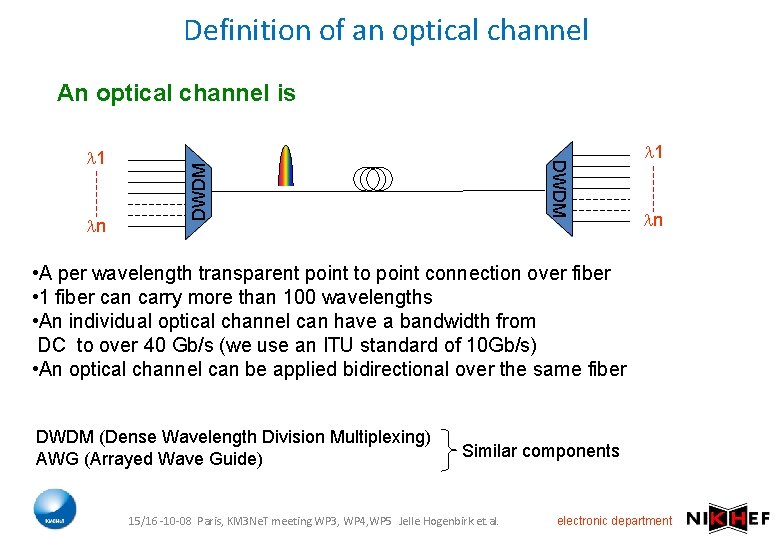
Definition of an optical channel An optical channel is DWDM ln DWDM l 1 ln • A per wavelength transparent point to point connection over fiber • 1 fiber can carry more than 100 wavelengths • An individual optical channel can have a bandwidth from DC to over 40 Gb/s (we use an ITU standard of 10 Gb/s) • An optical channel can be applied bidirectional over the same fiber DWDM (Dense Wavelength Division Multiplexing) AWG (Arrayed Wave Guide) Similar components 15/16 -10 -08 Paris, KM 3 Ne. T meeting WP 3, WP 4, WP 5 Jelle Hogenbirk et. al. electronic department
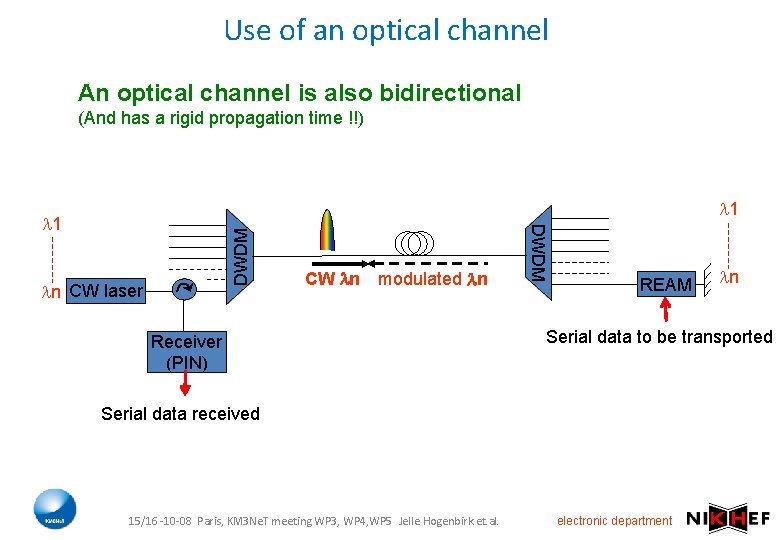
Use of an optical channel An optical channel is also bidirectional (And has a rigid propagation time !!) l 1 DWDM ln CW laser CW ln modulated ln Receiver (PIN) DWDM l 1 REAM Serial data to be transported Serial data received 15/16 -10 -08 Paris, KM 3 Ne. T meeting WP 3, WP 4, WP 5 Jelle Hogenbirk et. al. ln electronic department
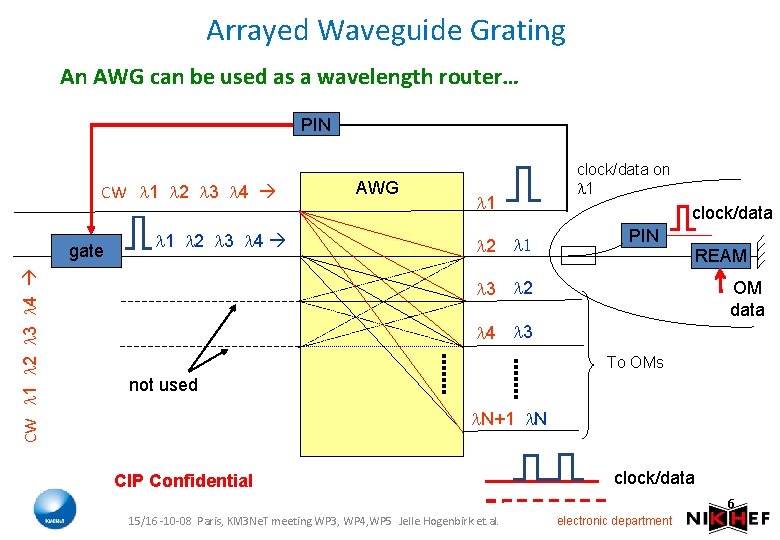
Arrayed Waveguide Grating An AWG can be used as a wavelength router… PIN CW l 1 l 2 l 3 l 4 gate l 1 l 2 l 3 l 4 AWG l 1 l 2 l 1 clock/data on l 1 clock/data PIN l 3 l 2 REAM OM data l 4 l 3 To OMs not used l. N+1 l. N CIP Confidential clock/data 6 15/16 -10 -08 Paris, KM 3 Ne. T meeting WP 3, WP 4, WP 5 Jelle Hogenbirk et. al. electronic department
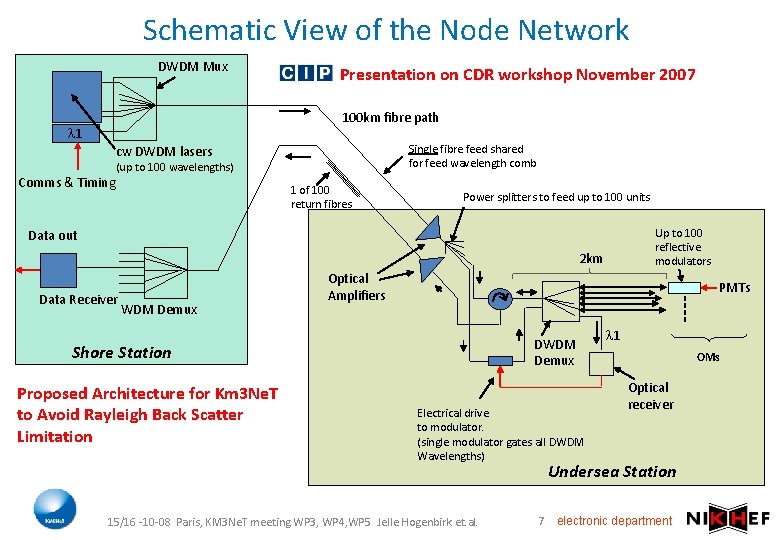
Schematic View of the Node Network DWDM Mux Presentation on CDR workshop November 2007 100 km fibre path l 1 Single fibre feed shared for feed wavelength comb cw DWDM lasers Comms & Timing (up to 100 wavelengths) 1 of 100 return fibres Power splitters to feed up to 100 units Up to 100 reflective modulators Data out 2 km Data Receiver WDM Demux Optical Amplifiers PMTs DWDM Demux Shore Station Proposed Architecture for Km 3 Ne. T to Avoid Rayleigh Back Scatter Limitation Electrical drive to modulator. (single modulator gates all DWDM Wavelengths) l 1 OMs Optical receiver Undersea Station 15/16 -10 -08 Paris, KM 3 Ne. T meeting WP 3, WP 4, WP 5 Jelle Hogenbirk et. al. 7 electronic department
Transmission Timing Skew ü Wavelength dependent timing skew due to group delay over 100 km (LEAFâ) • ~90 ns for 25 GHz comb (1530 nm – 1550 nm) • ~140 ns for 40 GHz comb (1530 nm – 1562 nm) • This is deterministic, at fixed temperature ü Temperature dependence • estimates based on published data… • Bulk: 96 ps/o. C per km 9. 6 ns/o. C (100 km) (LEAFâ) • Skew: lo ~ 0. 03 nm/o. C 8. 6 ps/o. C (100 km) (standard fibre 40 GHz comb) • Shows that relative timing information will stay constant, absolute timing varies insignificant with temperature. 15/16 -10 -08 Paris, KM 3 Ne. T meeting WP 3, WP 4, WP 5 Jelle Hogenbirk et. al. 8 electronic department
Clock and Timing Calibration ü Shore based master clock / framing generator ü Distribute clock sync and framing to each Optical Module by over-modulating cyclic copy of DWDM seed using distribution property of dual input AWG each OM receives two wavelengths, one cw for return data modulation, one conveying clock and data (not returned to shore) ü Use pulse echo measurements to calculate relative delay of each OM 15/16 -10 -08 Paris, KM 3 Ne. T meeting WP 3, WP 4, WP 5 Jelle Hogenbirk et. al. 9 electronic department
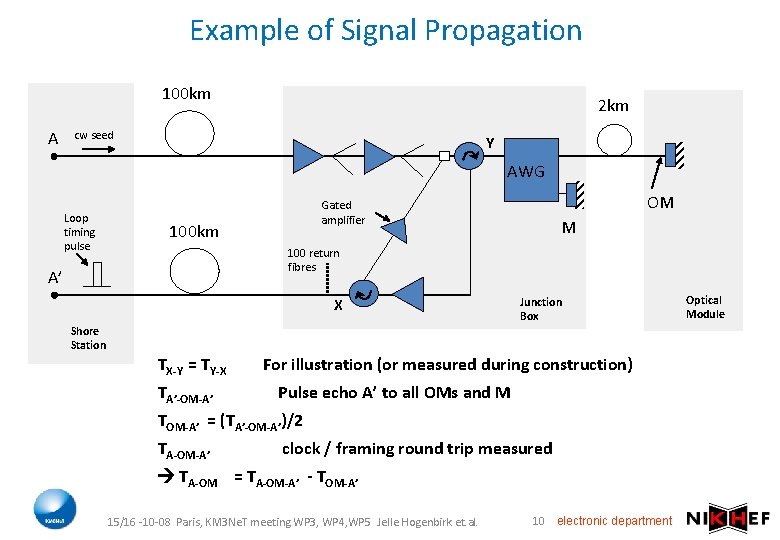
Example of Signal Propagation 100 km A 2 km cw seed Y AWG Loop timing pulse OM Gated amplifier 100 km M 100 return fibres A’ X Junction Box Shore Station TX-Y = TY-X TA’-OM-A’ For illustration (or measured during construction) Pulse echo A’ to all OMs and M TOM-A’ = (TA’-OM-A’)/2 TA-OM-A’ clock / framing round trip measured TA-OM = TA-OM-A’ - TOM-A’ 15/16 -10 -08 Paris, KM 3 Ne. T meeting WP 3, WP 4, WP 5 Jelle Hogenbirk et. al. 10 electronic department Optical Module
SPARK Sophisticated Photonic Architecture Reference for KM 3 Ne. T Joint activity of Nikhef and CIP Purchased by Nikhef Required: A reference photonic test bench based on a KM 3 Ne. T architecture for a node network with 10 Gb/s bandwidth/OC, with an intrinsic signal propagation time jitter of << 50 ps. What we have: A reference photonic test bench based on a KM 3 Ne. T architecture for a node network with 10 Gb/s bandwidth/OC, with an intrinsic signal propagation ime jitter of << 50 ps. The door is wide open for: • Optimizing PON components for a final node network to be deployed. • Transparently connects front-end (sub-sea) electronics to backend (on-shore) electronics with signal propagation time only. • The entire test bed is relatively easy to copy: all parts are COTS (Components Of The Shelf) • A low cost test bed with reduced components for a single optical channel can be very helpful for developing front-end and back-end electronics in different laboratories. 15/16 -10 -08 Paris, KM 3 Ne. T meeting WP 3, WP 4, WP 5 Jelle Hogenbirk et. al. 11 electronic department
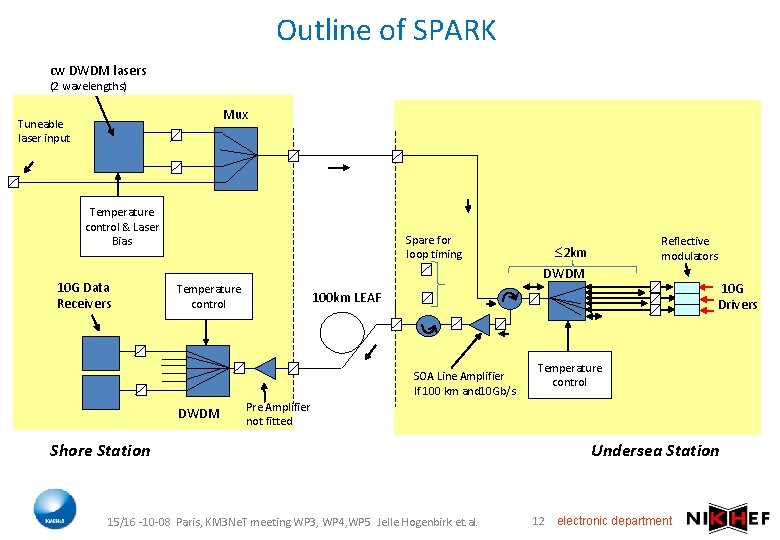
Outline of SPARK cw DWDM lasers (2 wavelengths) Mux Tuneable laser input Temperature control & Laser Bias 10 G Data Receivers Spare for loop timing Temperature control 10 G Drivers 100 km LEAF SOA Line Amplifier If 100 km and 10 Gb/s DWDM Reflective modulators £ 2 km DWDM Temperature control Pre Amplifier not fitted Shore Station 15/16 -10 -08 Paris, KM 3 Ne. T meeting WP 3, WP 4, WP 5 Jelle Hogenbirk et. al. Undersea Station 12 electronic department
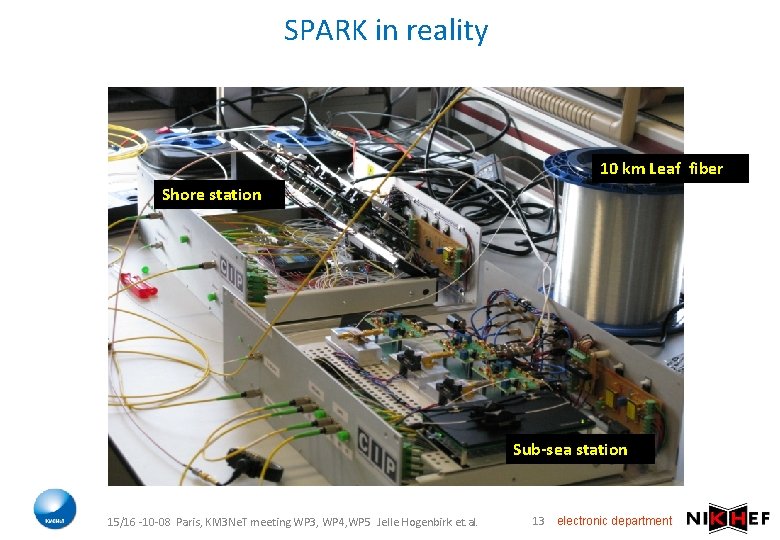
SPARK in reality 10 km Leaf fiber Shore station Sub-sea station 15/16 -10 -08 Paris, KM 3 Ne. T meeting WP 3, WP 4, WP 5 Jelle Hogenbirk et. al. 13 electronic department
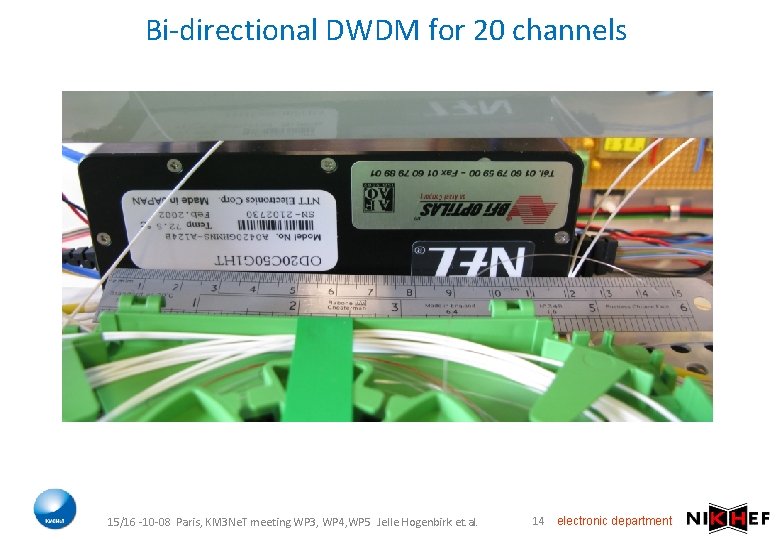
Bi-directional DWDM for 20 channels 15/16 -10 -08 Paris, KM 3 Ne. T meeting WP 3, WP 4, WP 5 Jelle Hogenbirk et. al. 14 electronic department
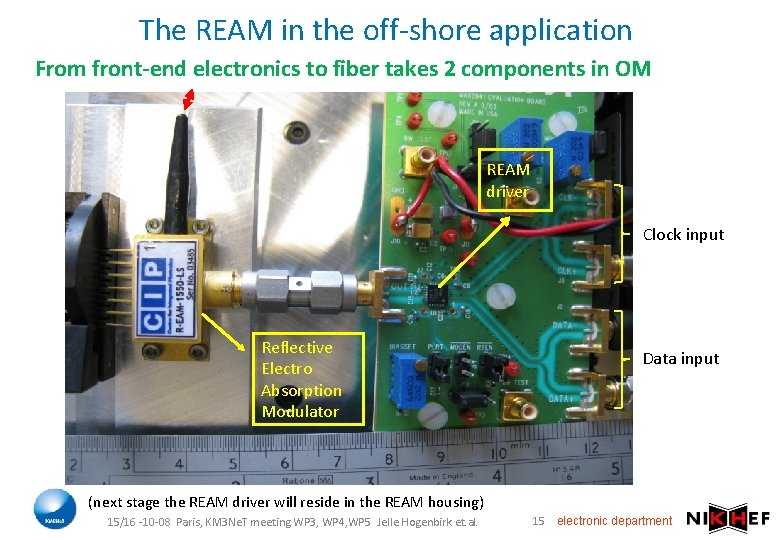
The REAM in the off-shore application From front-end electronics to fiber takes 2 components in OM REAM driver Clock input Reflective Electro Absorption Modulator Data input (next stage the REAM driver will reside in the REAM housing) 15/16 -10 -08 Paris, KM 3 Ne. T meeting WP 3, WP 4, WP 5 Jelle Hogenbirk et. al. 15 electronic department
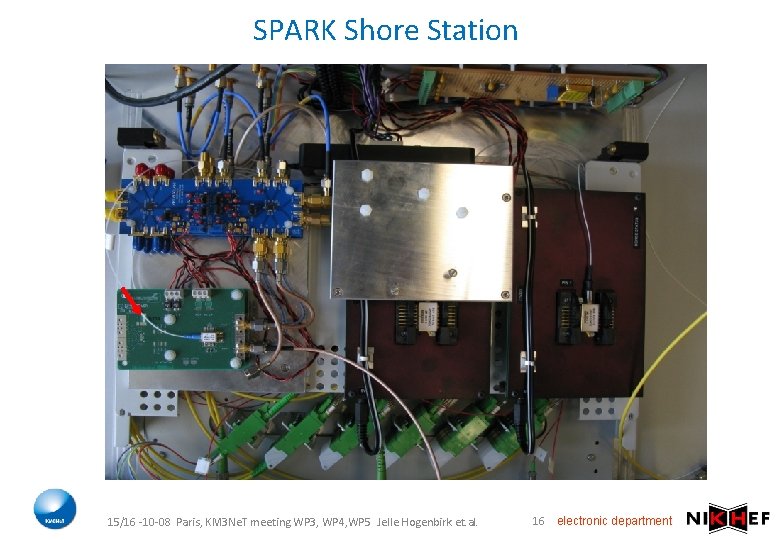
SPARK Shore Station 15/16 -10 -08 Paris, KM 3 Ne. T meeting WP 3, WP 4, WP 5 Jelle Hogenbirk et. al. 16 electronic department
SPARK First Measurements Laser & AWG Spectrum 15/16 -10 -08 Paris, KM 3 Ne. T meeting WP 3, WP 4, WP 5 Jelle Hogenbirk et. al. 17 electronic department
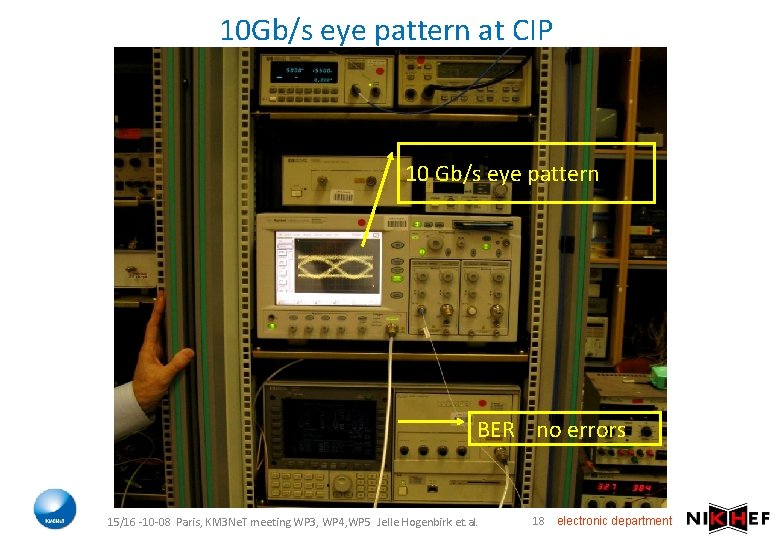
10 Gb/s eye pattern at CIP 10 Gb/s eye pattern BER no errors 15/16 -10 -08 Paris, KM 3 Ne. T meeting WP 3, WP 4, WP 5 Jelle Hogenbirk et. al. 18 electronic department
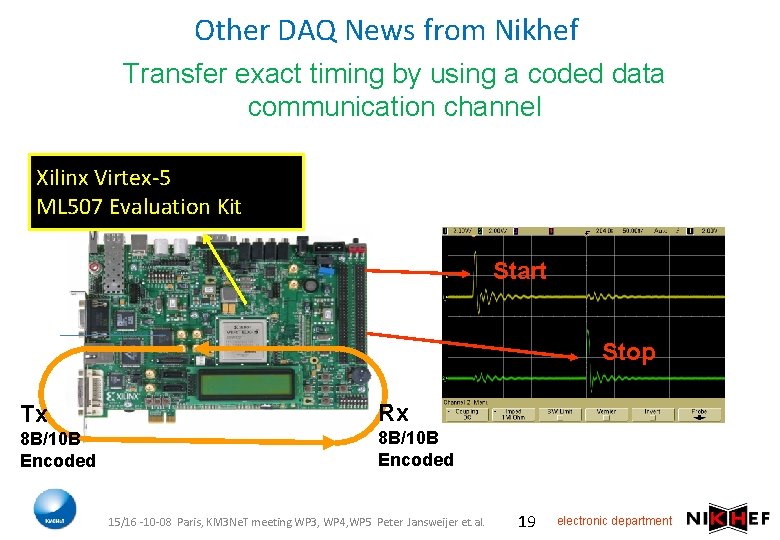
Other DAQ News from Nikhef Transfer exact timing by using a coded data communication channel Xilinx Virtex-5 ML 507 Evaluation Kit Start Stop Tx Rx 8 B/10 B Encoded 15/16 -10 -08 Paris, KM 3 Ne. T meeting WP 3, WP 4, WP 5 Peter Jansweijer et. al. 19 electronic department
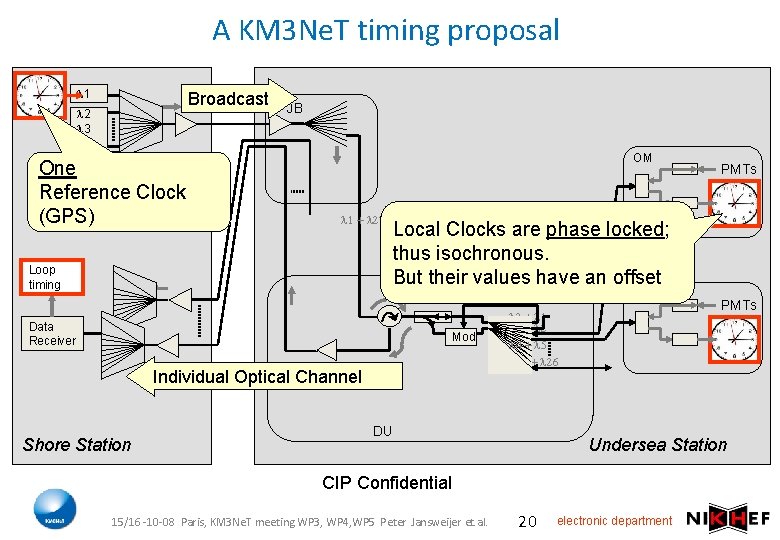
A KM 3 Ne. T timing proposal l 1 Broadcast l 2 l 3 l 27 One Reference Clock (GPS) JB OM l 1 + l 27 Loop timing Local Clocks are phase locked; thus isochronous. But their values have an offset OM l 1 Data Receiver Mod Individual Optical Channel Shore Station PMTs l 2 + l 1 l 3 + l 2 l 4 + l 5 l 27 + l 26 DU Undersea Station CIP Confidential 15/16 -10 -08 Paris, KM 3 Ne. T meeting WP 3, WP 4, WP 5 Peter Jansweijer et. al. PMTs 20 electronic department
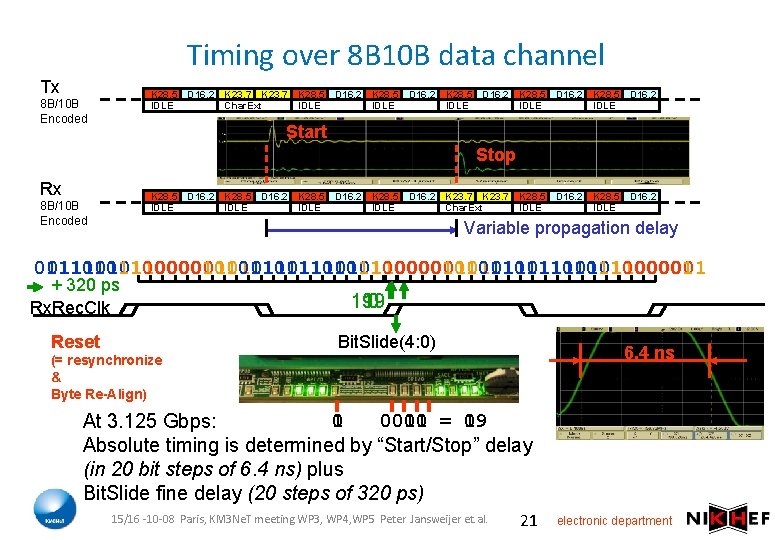
Timing over 8 B 10 B data channel Tx K 28. 5 IDLE 8 B/10 B Encoded D 16. 2 K 23. 7 Char. Ext K 28. 5 IDLE D 16. 2 K 28. 5 IDLE D 16. 2 Start Stop Rx K 28. 5 IDLE 8 B/10 B Encoded D 16. 2 K 28. 5 IDLE D 16. 2 K 23. 7 Char. Ext Variable propagation delay 0111010110000010101101110101100000101011011101011000001 + 320 ps Rx. Rec. Clk Reset 1919 0 Bit. Slide(4: 0) 6. 4 ns (= resynchronize & Byte Re-Align) 0 1 0000 = 19 0011 0 At 3. 125 Gbps: Absolute timing is determined by “Start/Stop” delay (in 20 bit steps of 6. 4 ns) plus Bit. Slide fine delay (20 steps of 320 ps) 15/16 -10 -08 Paris, KM 3 Ne. T meeting WP 3, WP 4, WP 5 Peter Jansweijer et. al. 21 electronic department
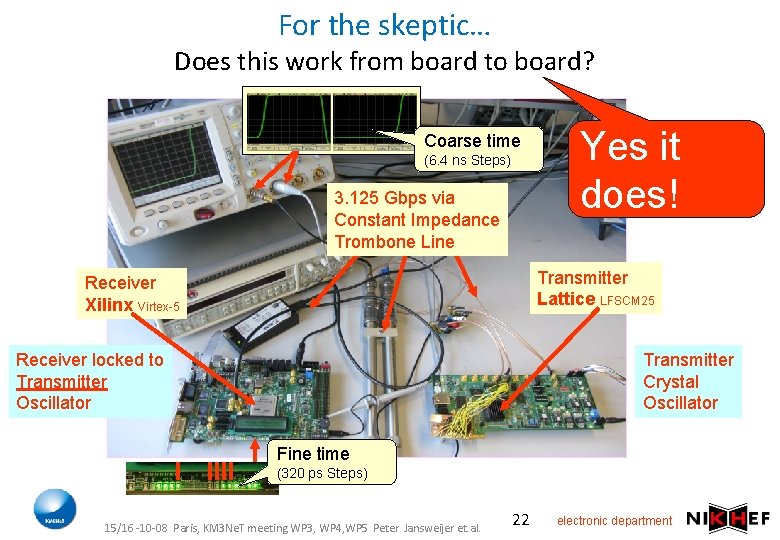
For the skeptic… Does this work from board to board? Coarse time (6. 4 ns Steps) 3. 125 Gbps via Constant Impedance Trombone Line Yes it does! Transmitter Lattice LFSCM 25 Receiver Xilinx Virtex-5 Receiver locked to Transmitter Oscillator Transmitter Crystal Oscillator Fine time (320 ps Steps) 15/16 -10 -08 Paris, KM 3 Ne. T meeting WP 3, WP 4, WP 5 Peter Jansweijer et. al. 22 electronic department
To be continued 15/16 -10 -08 Paris, KM 3 Ne. T meeting WP 3, WP 4, WP 5 Jelle Hogenbirk et. al. 23 electronic department
- Slides: 23