
A STUDY OF VIRAL FILTRATION PERFORMANCE OF RESIDENTIAL


- Slides: 15
A STUDY OF VIRAL FILTRATION PERFORMANCE OF RESIDENTIAL HVAC FILTERS John Zhang • December 4, 2020
INVESTIGATORS • John Zhanga, Doug Huntleya, Andy Foxa, Bryan Gerhardta • Al Vatineb, John Cherneb • a: Construction and Home Improvement Market Division, 3 M Company, Building 251 -1 E-19, MN 55144 -1000 • b: LMS Technologies Inc. , 6423 Cecilia Cir, Minneapolis, MN 55439
OUTLINE • Background • Test Method • Test Procedure • Test Results • Conclusions
BACKGROUND • COVID 19 pandemic q 53 million confirmed cases as of November 2020 q 1. 3 million deaths as of November 2020 q. SARS-Co. V-2, also known as coronavirus, is known to transmit through droplets, surface contact and aerosols. q. Aerosols from human atomization appears to be the dominant route for the transmission of COVID 19. • Are HVAC filters effective at capturing virus particles?
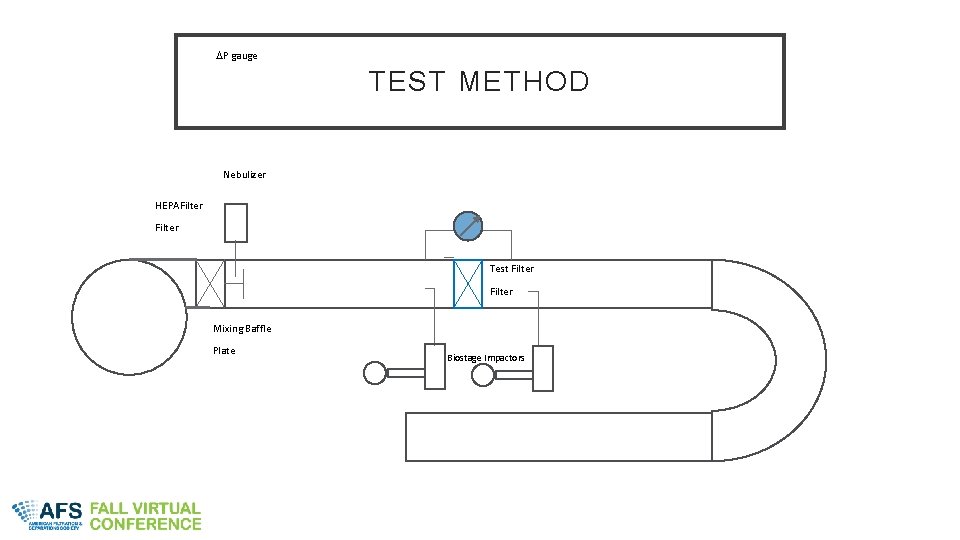
DP gauge TEST METHOD Nebulizer HEPAFilter Test Filter Mixing Baffle Plate Biostage Impactors
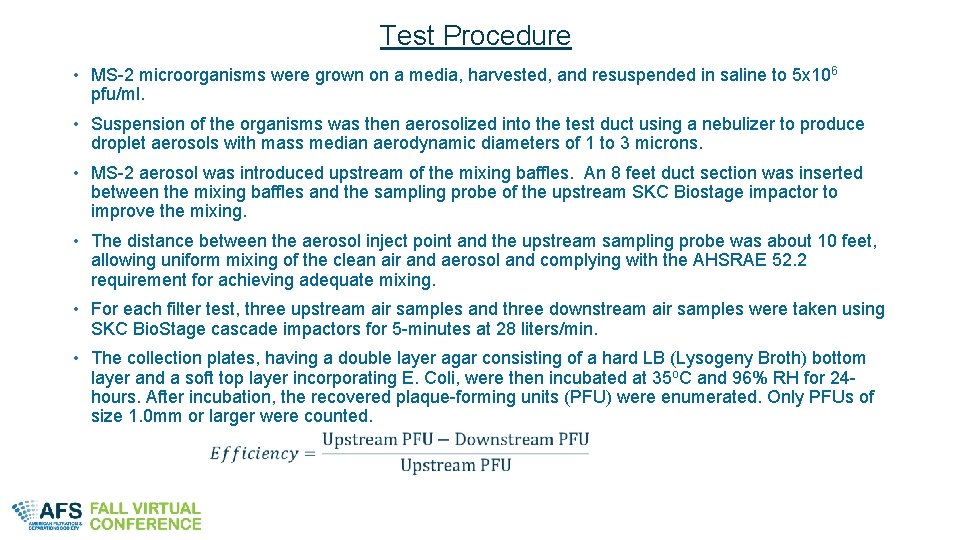
Test Procedure • MS-2 microorganisms were grown on a media, harvested, and resuspended in saline to 5 x 10⁶ pfu/ml. • Suspension of the organisms was then aerosolized into the test duct using a nebulizer to produce droplet aerosols with mass median aerodynamic diameters of 1 to 3 microns. • MS-2 aerosol was introduced upstream of the mixing baffles. An 8 feet duct section was inserted between the mixing baffles and the sampling probe of the upstream SKC Biostage impactor to improve the mixing. • The distance between the aerosol inject point and the upstream sampling probe was about 10 feet, allowing uniform mixing of the clean air and aerosol and complying with the AHSRAE 52. 2 requirement for achieving adequate mixing. • For each filter test, three upstream air samples and three downstream air samples were taken using SKC Bio. Stage cascade impactors for 5 -minutes at 28 liters/min. • The collection plates, having a double layer agar consisting of a hard LB (Lysogeny Broth) bottom layer and a soft top layer incorporating E. Coli, were then incubated at 35 o. C and 96% RH for 24 hours. After incubation, the recovered plaque-forming units (PFU) were enumerated. Only PFUs of size 1. 0 mm or larger were counted.
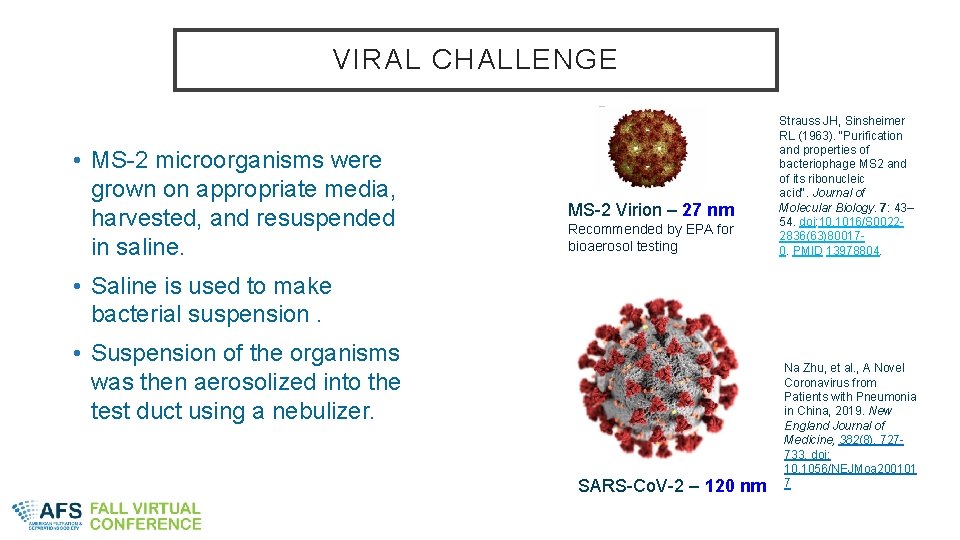
VIRAL CHALLENGE • MS-2 microorganisms were grown on appropriate media, harvested, and resuspended in saline. MS-2 Virion – 27 nm Recommended by EPA for bioaerosol testing Strauss JH, Sinsheimer RL (1963). "Purification and properties of bacteriophage MS 2 and of its ribonucleic acid". Journal of Molecular Biology. 7: 43– 54. doi: 10. 1016/S 00222836(63)800170. PMID 13978804. • Saline is used to make bacterial suspension. • Suspension of the organisms was then aerosolized into the test duct using a nebulizer. SARS-Co. V-2 – 120 nm Na Zhu, et al. , A Novel Coronavirus from Patients with Pneumonia in China, 2019. New England Journal of Medicine, 382(8), 727733. doi: 10. 1056/NEJMoa 200101 7
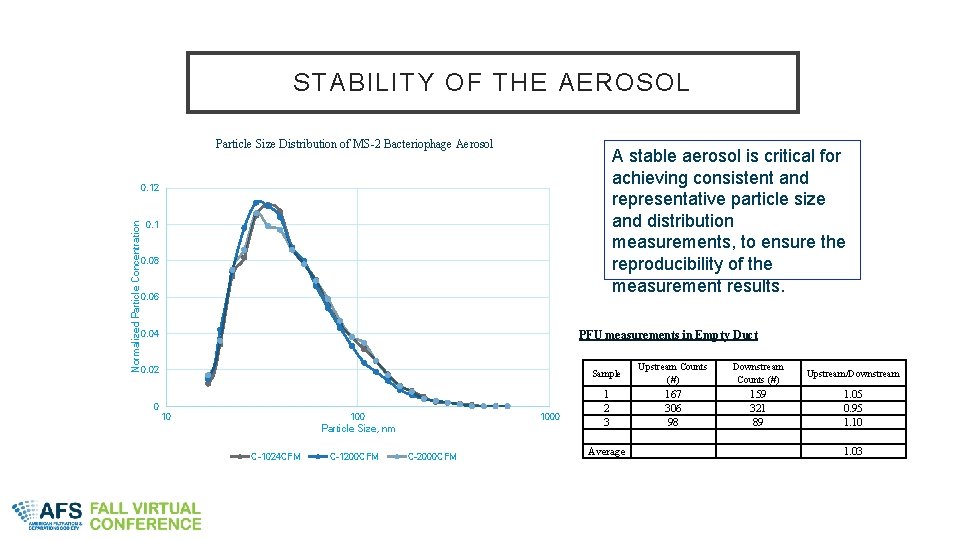
STABILITY OF THE AEROSOL Particle Size Distribution of MS-2 Bacteriophage Aerosol A stable aerosol is critical for achieving consistent and representative particle size and distribution measurements, to ensure the reproducibility of the measurement results. Normalized Particle Concentration 0. 12 0. 1 0. 08 0. 06 PFU measurements in Empty Duct 0. 04 0. 02 Sample 0 10 1000 Particle Size, nm C-1024 CFM C-1200 CFM C-2000 CFM Upstream Counts (#) 1 2 3 Average Downstream Counts (#) 167 306 98 159 321 89 Upstream/Downstream 1. 05 0. 95 1. 10 1. 03
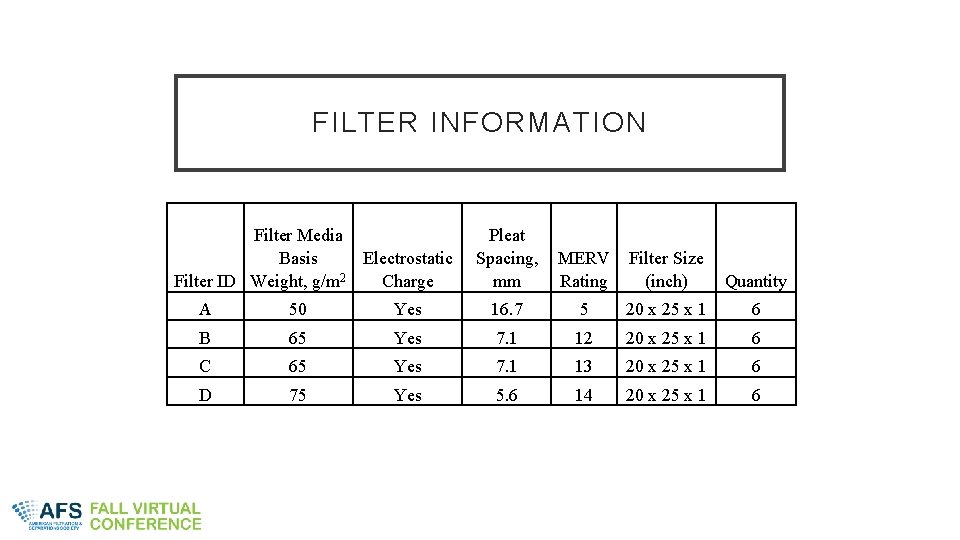
FILTER INFORMATION Filter Media Basis Electrostatic Filter ID Weight, g/m 2 Charge Pleat Spacing, MERV Filter Size mm Rating (inch) Quantity A 50 Yes 16. 7 5 20 x 25 x 1 6 B 65 Yes 7. 1 12 20 x 25 x 1 6 C 65 Yes 7. 1 13 20 x 25 x 1 6 D 75 Yes 5. 6 14 20 x 25 x 1 6
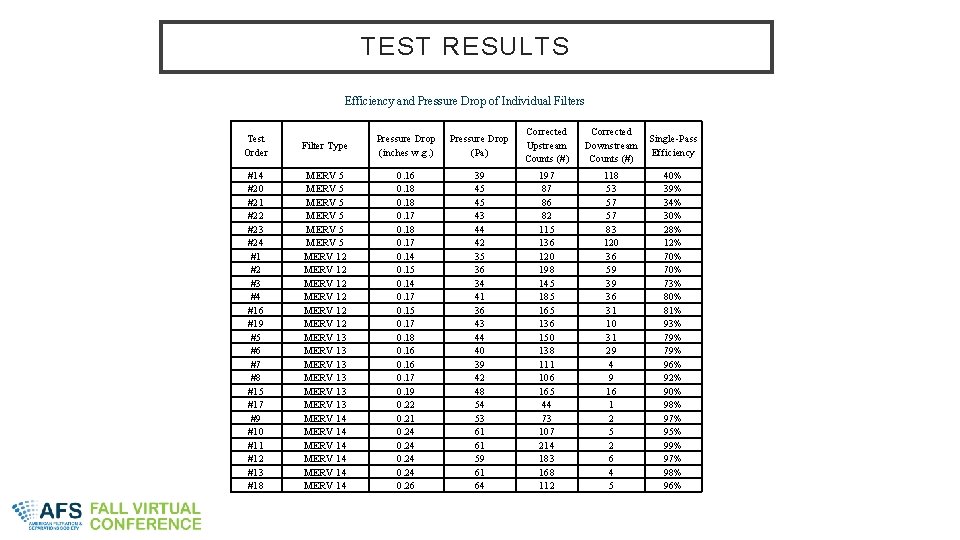
TEST RESULTS Efficiency and Pressure Drop of Individual Filters Test Order #14 #20 #21 #22 #23 #24 #1 #2 #3 #4 #16 #19 #5 #6 #7 #8 #15 #17 #9 #10 #11 #12 #13 #18 Filter Type Pressure Drop (inches w. g. ) Pressure Drop (Pa) Corrected Upstream Counts (#) MERV 5 MERV 5 MERV 12 MERV 12 MERV 13 MERV 13 MERV 14 MERV 14 0. 16 0. 18 0. 17 0. 14 0. 15 0. 14 0. 17 0. 15 0. 17 0. 18 0. 16 0. 17 0. 19 0. 22 0. 21 0. 24 0. 26 39 45 45 43 44 42 35 36 34 41 36 43 44 40 39 42 48 54 53 61 61 59 61 64 197 87 86 82 115 136 120 198 145 185 165 136 150 138 111 106 165 44 73 107 214 183 168 112 Corrected Single-Pass Downstream Efficiency Counts (#) 118 53 57 57 83 120 36 59 39 36 31 10 31 29 4 9 16 1 2 5 2 6 4 5 40% 39% 34% 30% 28% 12% 70% 73% 80% 81% 93% 79% 96% 92% 90% 98% 97% 95% 99% 97% 98% 96%
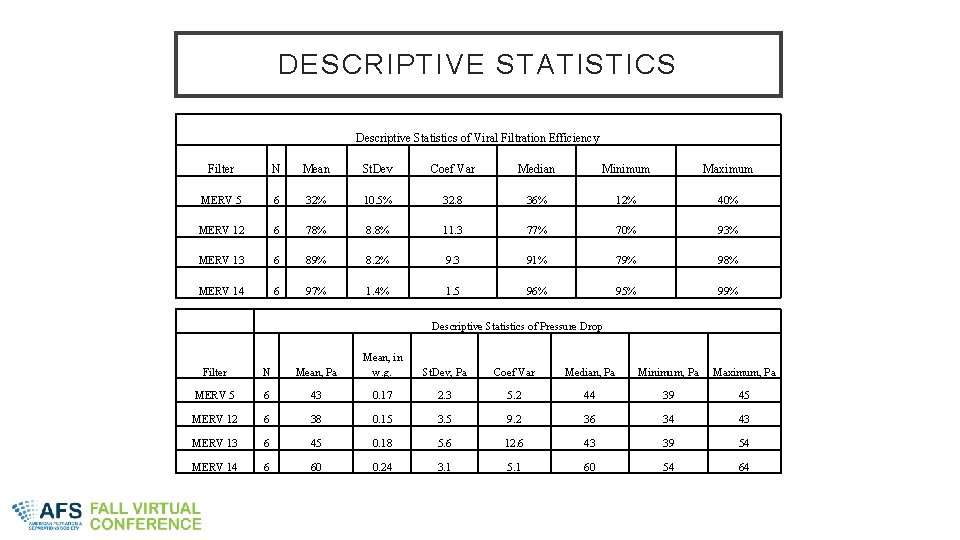
DESCRIPTIVE STATISTICS Descriptive Statistics of Viral Filtration Efficiency Filter N Mean St. Dev Coef Var Median Minimum Maximum MERV 5 6 32% 10. 5% 32. 8 36% 12% 40% MERV 12 6 78% 8. 8% 11. 3 77% 70% 93% MERV 13 6 89% 8. 2% 9. 3 91% 79% 98% MERV 14 6 97% 1. 4% 1. 5 96% 95% 99% Descriptive Statistics of Pressure Drop Filter N Mean, Pa Mean, in w. g. St. Dev, Pa Coef Var Median, Pa Minimum, Pa Maximum, Pa MERV 5 6 43 0. 17 2. 3 5. 2 44 39 45 MERV 12 6 38 0. 15 3. 5 9. 2 36 34 43 MERV 13 6 45 0. 18 5. 6 12. 6 43 39 54 MERV 14 6 60 0. 24 3. 1 5. 1 60 54 64
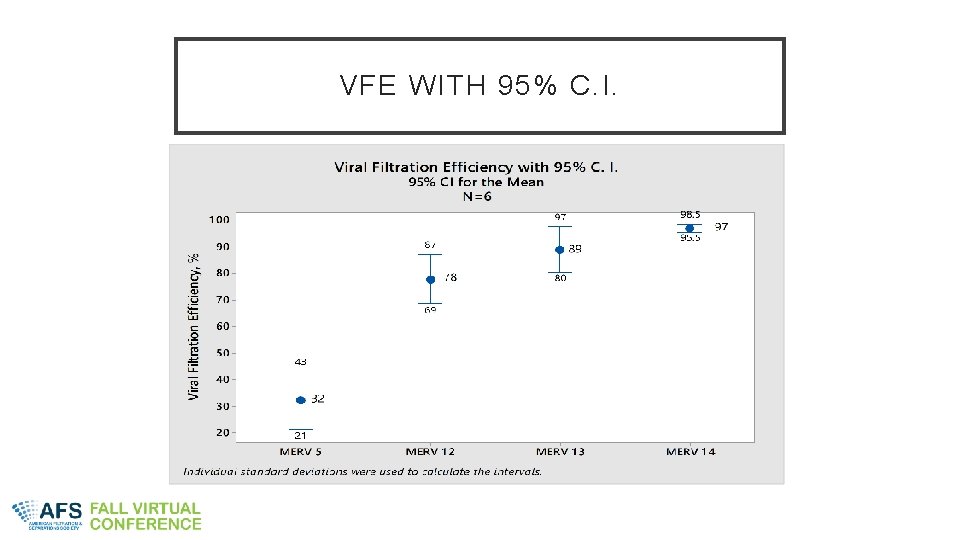
VFE WITH 95% C. I.
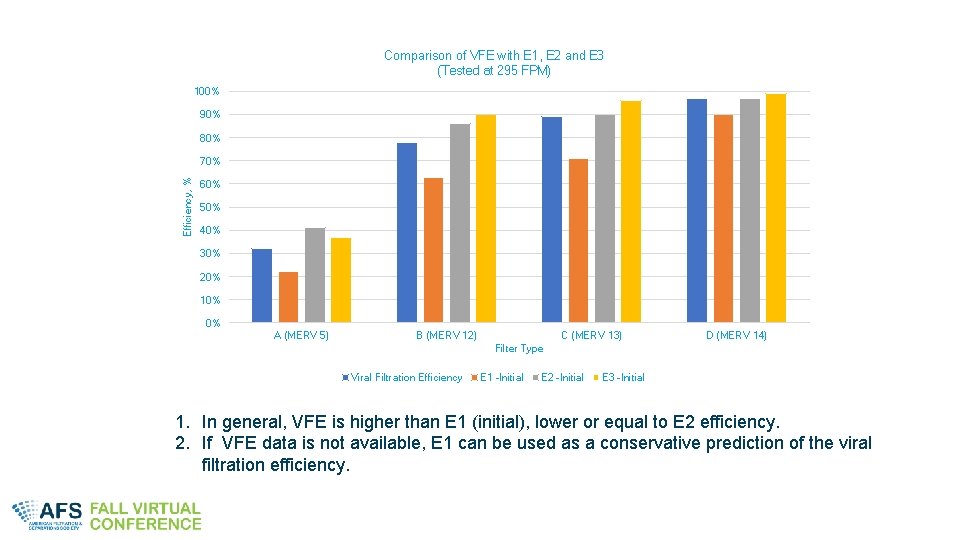
Comparison of VFE with E 1, E 2 and E 3 (Tested at 295 FPM) 100% 90% 80% Efficiency, % 70% 60% 50% 40% 30% 20% 10% 0% A (MERV 5) B (MERV 12) C (MERV 13) D (MERV 14) Filter Type Viral Filtration Efficiency E 1 -Initial E 2 -Initial E 3 -Initial 1. In general, VFE is higher than E 1 (initial), lower or equal to E 2 efficiency. 2. If VFE data is not available, E 1 can be used as a conservative prediction of the viral filtration efficiency.
CONCLUSIONS • High efficiency residential HVAC filters were found to be effective at capturing airborne virus particles. • Filter viral filtration efficiency was found to be generally correlated to its MERV rating, i. e. the higher the MERV rating, the higher the viral filtration efficiency. • In comparison to E 1, E 2 and E 3 efficiencies measured per ASHRAE 52. 2, VFE was found to be higher than initial E 1 efficiency, but lower than initial E 2 and E 3 efficiencies.
Thank You!