
A STUDENTS GUIDE TO JOB HUNTING Tips and
A STUDENT’S GUIDE TO JOB HUNTING Tips and tricks to landing the job
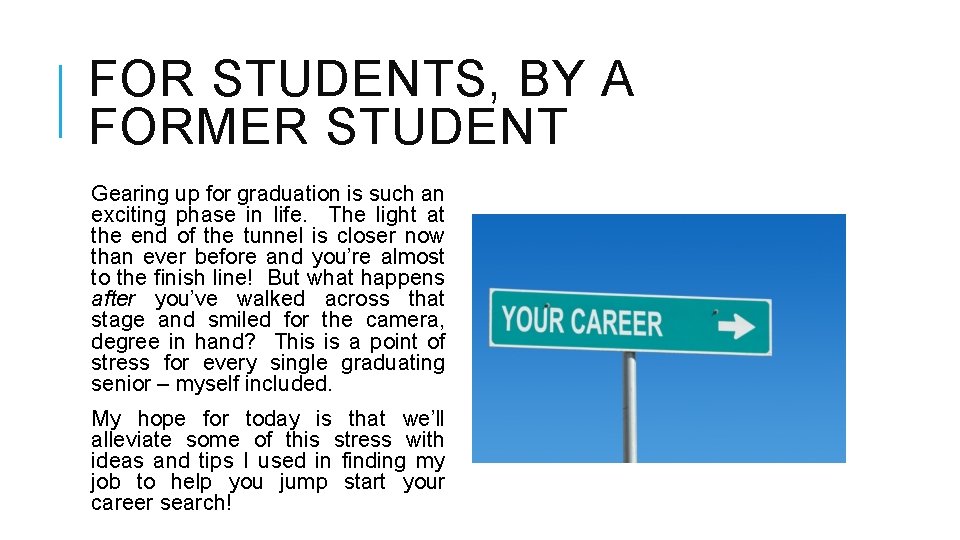
FOR STUDENTS, BY A FORMER STUDENT Gearing up for graduation is such an exciting phase in life. The light at the end of the tunnel is closer now than ever before and you’re almost to the finish line! But what happens after you’ve walked across that stage and smiled for the camera, degree in hand? This is a point of stress for every single graduating senior – myself included. My hope for today is that we’ll alleviate some of this stress with ideas and tips I used in finding my job to help you jump start your career search!
THE SIX STEP JOBSEARCH PLAN A step-by-step guide through the job hunting process Adapted from Harry Dahlstrom’s The Job Hunting Handbook (2012)
THE SIX STEP JOB-SEARCH PLAN: STEP 1 1. Identify the “right stuff” § Explore job board sites and make a list of the top requirements listed in the ads that interest you. In order to be the best fit for the job, you have to know what employers Go 2 Work. Source. com are a great place to start for local listings.
THE SIX STEP JOB-SEARCH PLAN: STEP 2 2. Use your findings to create a job-focused resume § Incorporate the experience and skills you have to show you’re capable of fulfilling these requirements. By tailoring your resume to specific positions (a jobfocused resume), you’re speaking directly to what each employer wants. Remember that when it comes to resumes, one size does NOT fit all jobs, evenwithinthesamefield/industry. Showthem why you’re the perfect fit for this specific position.
THE SIX STEP JOB-SEARCH PLAN: STEP 3 3. Get connected with the “hidden job market” § Tap into the “hidden job market” by extending your job search beyond the advertised openings. The open positions listed on job boards represent only a fraction of the open jobs out there. Western’s Human Services community is an incredible resource for networking. Connect with your professors, peers, internship supervisors, former graduates, etc. to learn about organizations that like hiring graduates of the program. This is especially advantageous for those of you who want to stick around the ‘Ham after school – Human Services is wellknown in our community and is a great “name dropper” when job hunting. Once you find agencies with connections to the program, reach out and express your

THE SIX STEP JOB-SEARCH PLAN: STEP 4 4. Make your interactions with employers count by selling your strengths § Develop a script for speaking with employers that highlights your strengths, abilities, and interest in their agency. When speaking with potential employers, you want them to know that you’re not u’re ngthat but work justfind looking to Reiterating your interest in the specific position and agency shows employers that you’re excited and ready to be as dedicated to their work as they are. Emphasize the specific skills and experience you offer. For students, this can be a challenge Focus on transferrable. For example, skills. customer a service role can directly correlate to direct service in that you’re working with the public and, quite often, frustrated or “difficult to work with” customers. Additionally, express your desire to further develop professionally. An eager-to-learn attitude can make up for potential lack of experience, as was the case in my being hired.
THE SIX STEP JOB-SEARCH PLAN: STEP 5 5. Rock your interview by preparing, preparing § The #1 way to overcome your interview nerves is to familiarize yourself with the interviewing process through practice. Practicing with friends and family can be helpful, but interviewing with mirrors wing nt ence. best stranger a want to fully capitalize on your practice, get connected with mockinterview programs. You have access to the Career Services Center’s programs as a student, which includes mock-interviewing career with a counselor. Work. Source Whatcom hostsinterviewingworkshops, aswellasmany other employment-readiness workshops. Schedules for these programs can be found http: //www. wa. gov/esd/Event. Calendars/whatcom. htm at
THE SIX STEP JOB-SEARCH PLAN: STEP 6 6. Follow up after an interview to keep your name on the manager’s radar § Send a quick thank-you email to your interviewer(s) the day of the interview and follow up within the week. I can speak to the value of these two simple practices from personal
ROCK YOUR INTERVIEW Helpful hints to make the most of your interview Adapted from Harry Dahlstrom’s The Job Hunting Handbook (2012)
ROCK YOUR INTERVIEW Going into the job hunting process, I felt pretty confident about my interviewing skills and understanding of the do’s and don’ts of the interview process. Prior to my interviews, I met with an employment case manager at the agency I interned at – someone who has a strong background in assisting with job-seeking – for guidance on how to best approach interviewing. This next segment will cover some of the tips I learned from the case manager, as well as helpful information from The Job Hunting Handbook by Harry Dahlstrom.
FIRST IMPRESSIONS First impressions can often make or break the success of your interview, and these simple steps can help in delivering a positive impression: Arrive ten minutes early for your interview § Let the manager know you’re reliable and excited to be there Capitalize on your energy and dedication § An eager-to-learn attitude and passion for the scope of work can make up for a lack of professional experience Come prepared with questions § Show your interest in the agency’s work by researching their website and related information, and thinking of questions for the manager about the agency, its services, etc.
THE LOOK: SMALL DETAILS, BIG MESSAGE When it comes to interview attire and appearance, it is a good idea to err on the side of caution. You have to consider your audience, and many agencies enforce professional office dress codes. It is better to tone things down and get a feel for things or ask for permission once you’ve been offered a position. § Keep it simple – hairstyles, makeup, and fashion § Avoid bright colors or clashing patterns § Be aware of scentsitivities – don’t wear strong perfumes or colognes § Others can have sensitivities or allergies to these, so it’s best to ask permission later on § Ditch the nose ring for now § Facial jewelry generally isn’t as well-received by older generations. It is better to ask for permission after proving your qualification for the position.
ASSIMILATING TO WORKPLACE CULTURE Guidance on entering today’s multi-generational workforce Adapted from Jodie Sue Kelley’s The Workplace Excellence Series
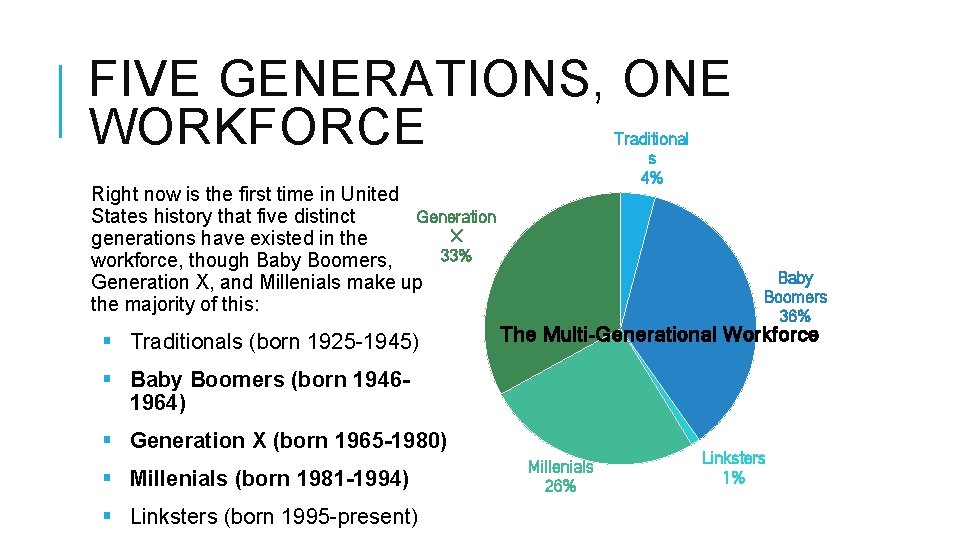
FIVE GENERATIONS, ONE WORKFORCE Traditional s 4% Right now is the first time in United Generation States history that five distinct X generations have existed in the 33% workforce, though Baby Boomers, Generation X, and Millenials make up the majority of this: § Traditionals (born 1925 -1945) Baby Boomers 36% The Multi-Generational Workforce § Baby Boomers (born 19461964) § Generation X (born 1965 -1980) § Millenials (born 1981 -1994) § Linksters (born 1995 -present) Millenials 26% Linksters 1%
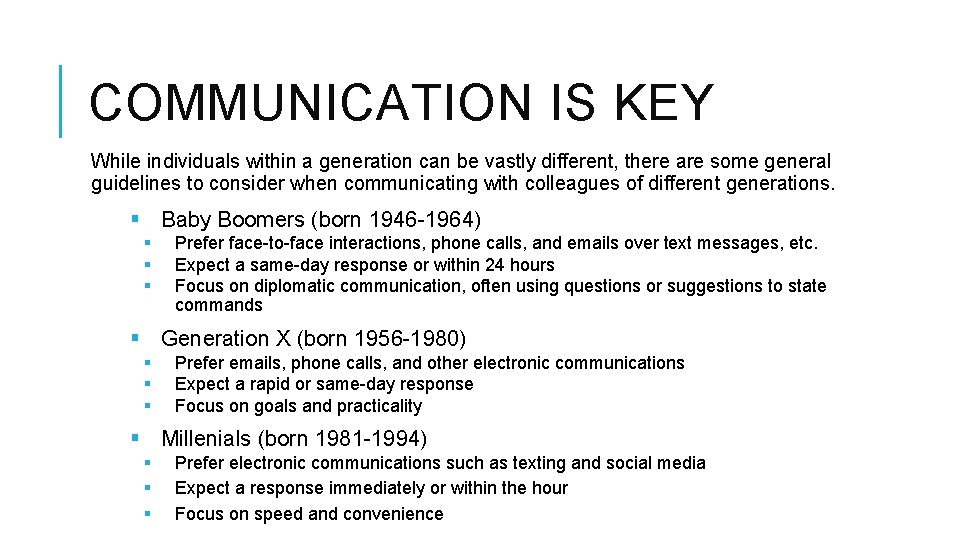
COMMUNICATION IS KEY While individuals within a generation can be vastly different, there are some general guidelines to consider when communicating with colleagues of different generations. § Baby Boomers (born 1946 -1964) § § § Prefer face-to-face interactions, phone calls, and emails over text messages, etc. Expect a same-day response or within 24 hours Focus on diplomatic communication, often using questions or suggestions to state commands § Generation X (born 1956 -1980) § § § Prefer emails, phone calls, and other electronic communications Expect a rapid or same-day response Focus on goals and practicality § Millenials (born 1981 -1994) § § § Prefer electronic communications such as texting and social media Expect a response immediately or within the hour Focus on speed and convenience
A FEW PERSONAL TIPS Since starting my first professional post-grad job, it has been a challenge to assimilate to office culture after spending the majority of my time in the academic realm. Here a few key points I’ve come up with from my initial months at the job that can be helpful in this process: § Be prepared to make sacrifices and adjustments to your lifestyle § § Full-time careers require a huge investment of time and energy. Make sure your schedule and lifestyle can accommodate these new demands. Capitalize on the experience and knowledge of your colleagues and supervisors and ask questions § § This can help to not only promote your professional development, but also your relationships with other staff. People appreciate when their opinion and wisdom are valued. Respect the learning curve and focus on your strengths § It can be easy to feel discouraged and overwhelmed during the transition from student to professional – don’t let the learning curve defeat you. Focus on the improvements you make and see mistakes as learning opportunities.
REFERENCES The Job Hunting Handbook: Dahlstrom, Harry. The Job Hunting Handbook. Holliston, MA: Dahlstrom & Company, 2012. Print. The Workplace Excellence Series: (From copies distributed at staff training) More information is available at http: //workplaceexcellence. net/the-curriculum/
- Slides: 18