
A Structured Partnership Approach Session Plan Why is
- Slides: 17
A Structured Partnership Approach
Session Plan • Why is this guidance needed? • What is a Structured Partnership Approach? • Case scenarios This symbol indicates there is a voice recording to accompany the slide, click to play
Why is this Guidance Needed? • This guidance has been developed by Solihull Safeguarding Adults Board • It was acknowledged that professionals can find it challenging to work with individuals who have multiple needs, are living with high levels of risk and services are struggling to engage with them • This guidance seeks to provide a framework to support professionals in working together to support such individuals • This guidance may be particularly useful when other frameworks such as Section 42 Enquiry are not suitable
What is a Structured Partnership Approach? A Structured Partnership Approach should be used when one or more of the partner agencies working with an individual have concerns and believe a multi-agency discussion would be of benefit. It requires the following: • Identifying a lead professional • Holding multi-agency meetings • Sharing information • Clarifying of roles and responsibilities • Using a risk enablement approach and • Ensuring effective record keeping
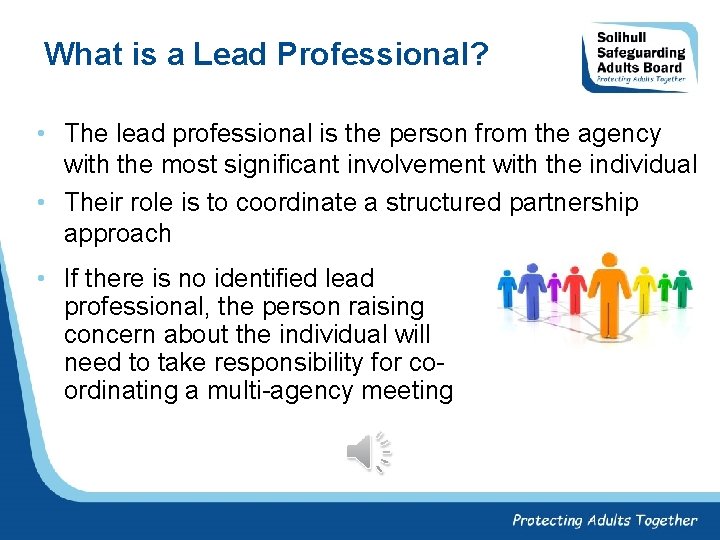
What is a Lead Professional? • The lead professional is the person from the agency with the most significant involvement with the individual • Their role is to coordinate a structured partnership approach • If there is no identified lead professional, the person raising concern about the individual will need to take responsibility for coordinating a multi-agency meeting
Multi-Agency Meetings • • • Arranged as soon as possible Should be made a priority by those asked to attend Chaired by a manager Person centred All agencies involved or with relevant information should be invited
Sharing Information • Individuals should know when, why and with whom information about them is being shared and their consent should be obtained • For more information please see the SSAB Information Sharing Agreement and SCIE Safeguarding Adults: Sharing information guidance • Practitioners can share information without consent in some circumstances, but must be able to evidence their rationale in order to make the decision to share defensible Take a minute now to discuss situations where you as a professional could share information about an individual without their consent.
When Can Professionals Share Information Without Consent? • If they believe the person lacks capacity with regard to the concerns and they believe it would be in the person’s best interests to share. • If they believe there is a risk to others • For the ‘prevention or detection of crime’. • If they believe sharing information is in the ‘public interest’ which may include if they believe the person is being controlled or coerced.
Roles and Responsibilities • A lack of clarity around who is going to do what can lead to confusion resulting in duplication, conflict or inaction • It is therefore important at the soonest opportunity to clarify who can/will do what, when, why and with whom • This should also be clearly recorded
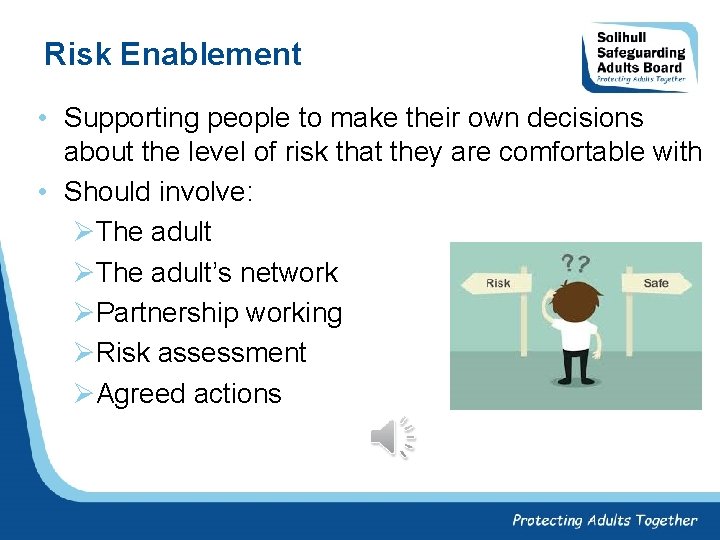
Risk Enablement • Supporting people to make their own decisions about the level of risk that they are comfortable with • Should involve: ØThe adult’s network ØPartnership working ØRisk assessment ØAgreed actions
Record Keeping Recording should show: • Reasons for the decisions • That decisions are balanced • That the adult has been appropriately supported with decision making, including being supported to weigh the potential negative consequences of the options they consider • That decisions are regularly reviewed • Reference to relevant legislation
Case Scenarios • How might you use the Structured Partnership Approach in the following scenarios….
Case Example: Sarah You are working with Sarah, an older person who appears to be finding it difficult to manage her home, which is falling into disrepair. She appears to be maintaining her personal care, although she is always in the same clothes when you meet her, whatever the weather. She also looks a little thinner than when you last saw her. You have spoken to her about having some support which she has declined; you believe she has capacity to make this decision. She recently saw her GP and has told you that the GP is happy with her health. You continue to have concerns that there are risks surrounding this situation but aren’t sure what else you can do.
Sarah – how might SPA help? • You discuss with your manager and decide to use the Structured Partnership Approach to call a multi agency meeting • A number of partners attend; housing, Adult Social Care, GP and Age UK • The GP shares that they have concerns about how Sarah is managing and these have been raised with her previously • An action plan is agreed; starting with the GP making a follow up appointment with Sarah to review her physical health and discuss support options
Case Example: Joe You are working with Joe, a young adult who has recently started dressing in expensive clothes and has a new mobile which he tells you is a gift from a new friend. He is reluctant to tell you any details but you are worried as he is very trusting and has previously told you he is desperate to have friends and be loved. You notice he is now spending significant periods of time on his phone and he has told you he is going to meet up with his new friend at their flat soon. You raise a safeguarding concern but this does not progress as Joe was not deemed to have care and support needs. You remain concerned that Joe is at risk of being taken advantage of.
Joe – How might SPA help? • Using the Structured Partnership Approach, a multi agency meeting is attended by Police and Advocacy • It is agreed that initially, further conversations should be held with Joe to talk about why professionals are concerned about his new friend and to seek his views – you are identified to do this as the person with the best working relationship with him • Police also suggest that any information obtained about the friend that is cause for concern is shared with them via a Force Intelligence Bureau (FIB) form
Further Information The Structured Partnership Approach Guidance can be found on the SSAB website under Solihull local practice guidance: https: //www. ssab. org. uk/ssaboard/professionalspractitioners/solihull-local-practice-guidance-20. php Please contact ssab@solihull. gov. uk if you have any questions or feedback. Thank you