
A Strategic Capital Engagement Model for Macro Curriculum

- Slides: 32
A Strategic Capital Engagement Model for Macro Curriculum Design Mayra Lopez Humphreys, LMSW, Ph. D College of Staten Island, City University of New York mayra. humphreys@csi. cuny. edu
Forecast A Strategic Capital Engagement model to identify the implicit and explicit human, social and financial forms of capital needed in the successful design of a social work Macro practice concentration.
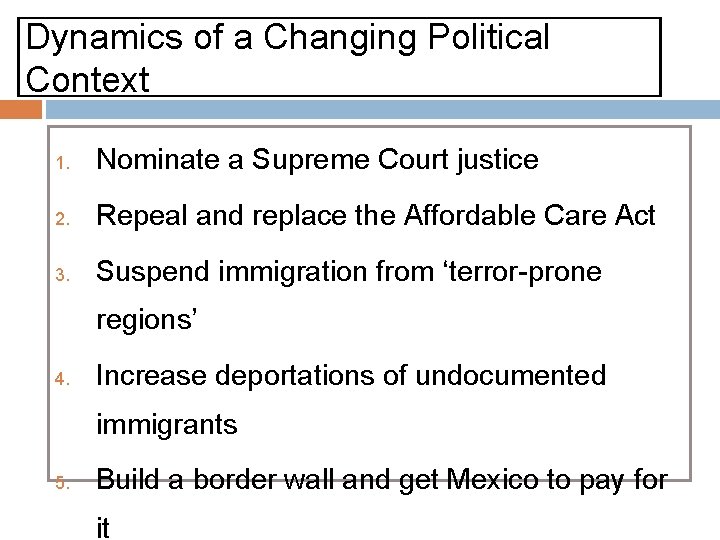
Dynamics of a Changing Political Context 1. Nominate a Supreme Court justice 2. Repeal and replace the Affordable Care Act 3. Suspend immigration from ‘terror-prone regions’ 4. Increase deportations of undocumented immigrants 5. Build a border wall and get Mexico to pay for it
Expected Growth in Macro Employment Administrative and management positions in social and community service agencies has an expected job growth of 21 percent between 2014 and 2024, an increase higher than the average for all other occupations (Bureau of Labor Statistics, 2014).
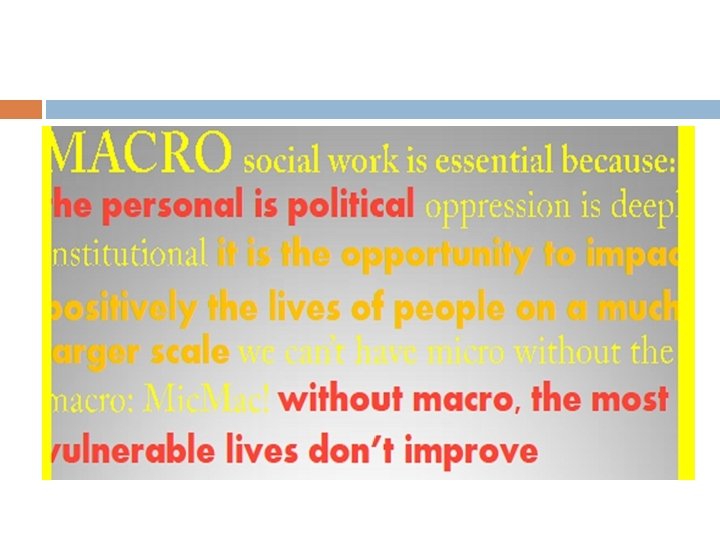
Macro social work is not “indirect practice”. Social work curriculum that focuses on interventions “with organizations, communities, and groups of people” (and its goal is “to bring about planned change in” those systems (Netting, Kettner, Mc. Murty, & Thomas, 2011).
Current State of Macro Practice In the United States, less than 9% of all MSW students are enrolled in all the macro practice areas combined. A 2014 survey of accredited MSW programs found that only 23% had advanced practice concentrations in community practice, management practice, or policy practice (Council on Social Work Education, 2014, as in Reisch, 2016).
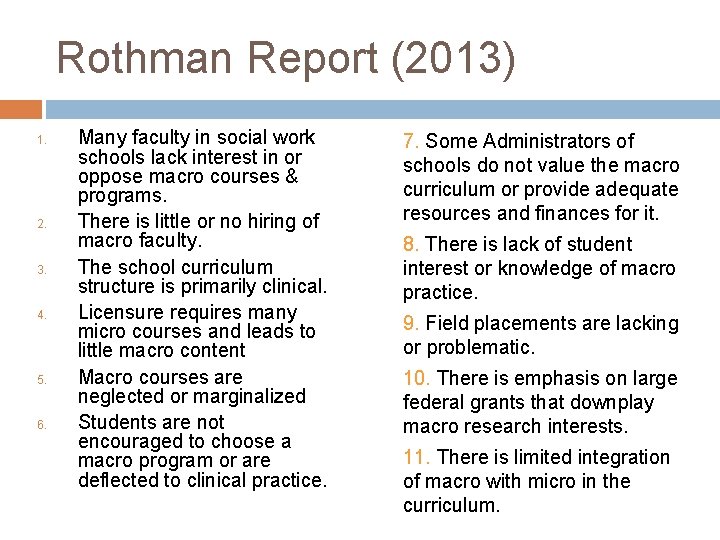
Rothman Report (2013) 1. 2. 3. 4. 5. 6. Many faculty in social work schools lack interest in or oppose macro courses & programs. There is little or no hiring of macro faculty. The school curriculum structure is primarily clinical. Licensure requires many micro courses and leads to little macro content Macro courses are neglected or marginalized Students are not encouraged to choose a macro program or are deflected to clinical practice.
Rothman Report (2013) 7. Some Administrators of schools do not value the macro curriculum or provide adequate resources and finances for it. 8. There is lack of student interest or knowledge of macro practice. 9. Field placements are lacking or problematic. 10. There is emphasis on large federal grants that downplay macro research interests. 11. There is limited integration of macro with micro in the curriculum.
Rothman Report (2013) 1. 2. 3. 4. 5. 6. Many faculty in social work schools lack interest in or oppose macro courses & programs. There is little or no hiring of macro faculty. The school curriculum structure is primarily clinical. Licensure requires many micro courses and leads to little macro content Macro courses are neglected or marginalized Students are not encouraged to choose a macro program or are deflected to clinical practice. 7. Some Administrators of schools do not value the macro curriculum or provide adequate resources and finances for it. 8. There is lack of student interest or knowledge of macro practice. 9. Field placements are lacking or problematic. 10. There is emphasis on large federal grants that downplay macro research interests. 11. There is limited integration of macro with micro in the curriculum.
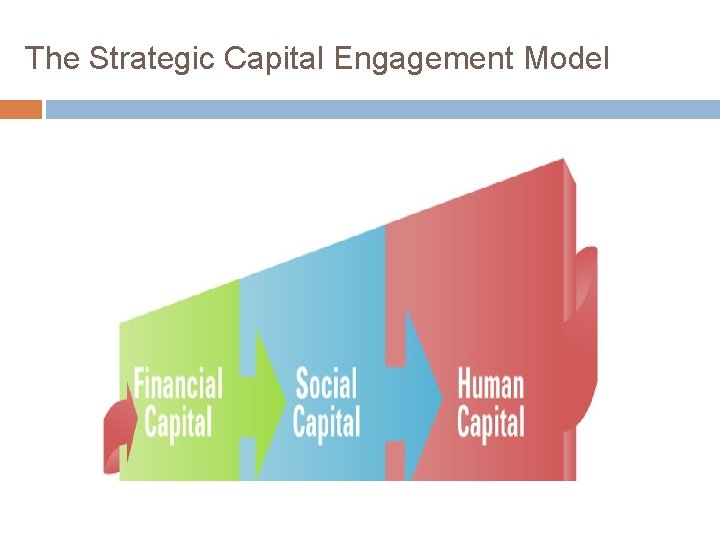
The Strategic Capital Engagement Model
Financial Capital The National Institute of Health (NIH), a primary funder of health service research, only dedicates 1% of its budget to social work research. � Most of the academic institutions receiving NIH funding in the last 15 years, has remained unchanged by the federal government (Acquavita and Tice, 2015).
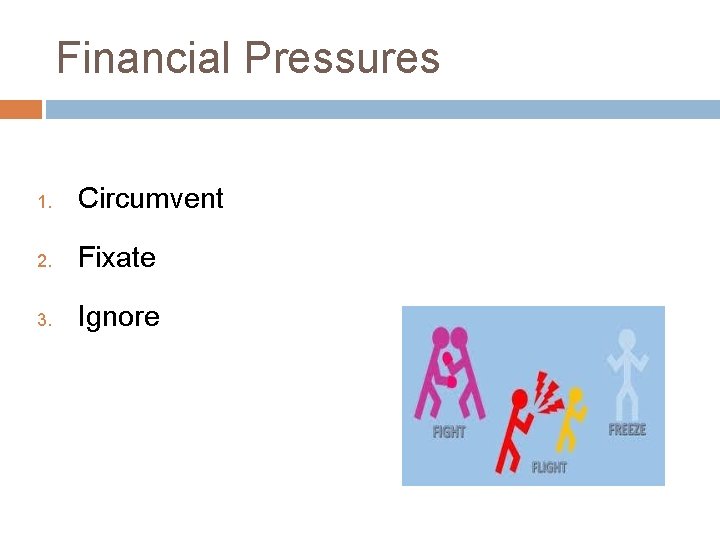
Financial Pressures 1. Circumvent 2. Fixate 3. Ignore
Financial Capital How are the unique skills and knowledge of Macro practice leveraged in financially viable partnerships and collaborations?
Financial Capital Strategies 1. 2. 3. Extending the boundaries of the discipline to include other disciplines with mutual need and incentive. Applying for community-academic partnership grants. Funders/individual donors who have a close and continuing association with the institution’s environmental processes and practices.
Social Capital Via synergistic relationships between governing authorities, community stakeholders, and organizational leadership, social networks enable opportunities to collectively solve potential problems and achieve common goals (Saegert, 2001).
We are in this together…but why? What are the Clear and Consequential motivations for why and how “we are in this together”? � Clearly articulating the need for a Macro practice concentration. � What are the impending outcomes of not investing in macro practitioners?
Social Capital “The survival of macro practice is in the collective self-interest of the social work profession as a whole and the people with whom it works. ” (Reisch, 2014)
Social Capital What is it that sets social workers apart from their colleagues in other helping professions?
Social Capital Perhaps the most important distinction is that social workers are educated to understand the intimate and complex relationship between individual suffering and the social context from which it arises. (Garrey, 2012)
We are in this together… enlightened legislation that addresses key social issues; reasoned and principled social and agency policies and initiatives; and adequate funding by federal, state, and local governments.
Social Capital Are there meaningful social capital enhancing practices that can cultivate opportunities for the department to experience meaningful reciprocal relationships?
Cultivating Meaningful Reciprocal Relationships Sharing case studies that assist clinical classes with the integration of macro practice. Integrating interpersonal clinical skills within the supervision and conflict resolution curriculum of the Macro Leadership course. Opening a Macro course as an Elective for Clinical track students and vice versa.
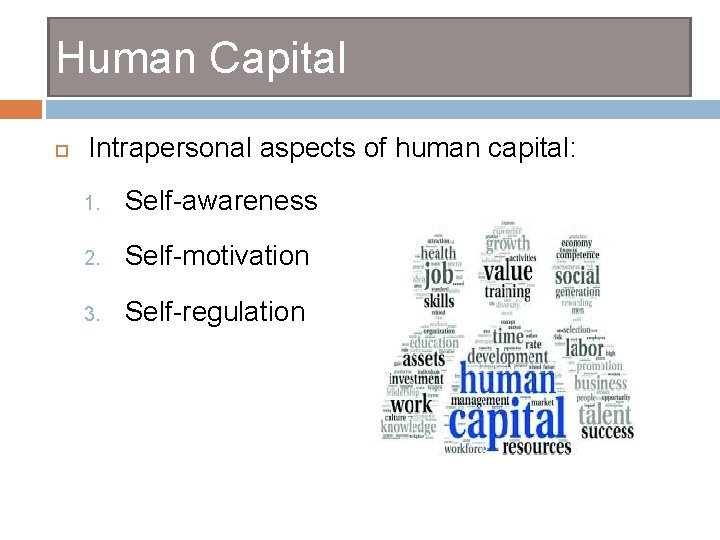
Human Capital Intrapersonal aspects of human capital: 1. Self-awareness 2. Self-motivation 3. Self-regulation
Human Capital Mindful Leadership involves cultivating focus, clarity, creativity and compassion. It strengthens the ability to embody leadership presence. (Burghardt & Tolliver, 2009).
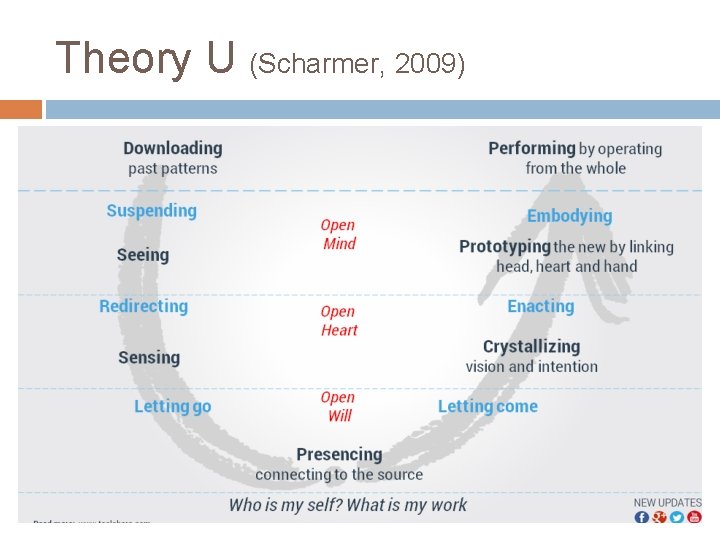
Theory U (Scharmer, 2009)
Human Capital 1. Connecting fully with others who disagree. � If I am not willing to assume that the other person is either thoughtless or malicious, what might make them hold the views they do?
Human Capital � So how do we know when we are practicing open & deep listening? Downloading Factual listening Empathic listening: seeing through someone else’s eyes, people are able to understand respect the other person. Generative listening: People listen to create without their personalities getting in the way of results. By connecting their own intuition with the environment, they tap into pure thoughts and ideas.
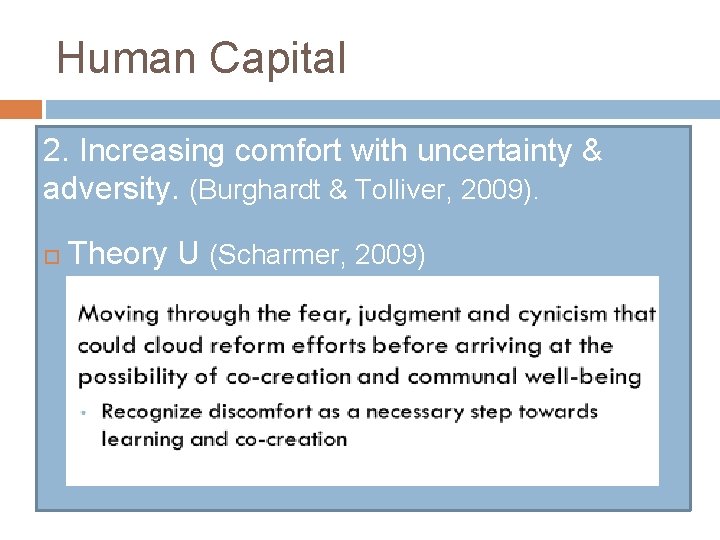
Human Capital 2. Increasing comfort with uncertainty & adversity. (Burghardt & Tolliver, 2009). Theory U (Scharmer, 2009)
Human Capital 3. Deeply listening to one’s intuition. Purposeful pause: use the experience of feeling stressed as a signal to check in with yourself. 4. Accessing creative solutions
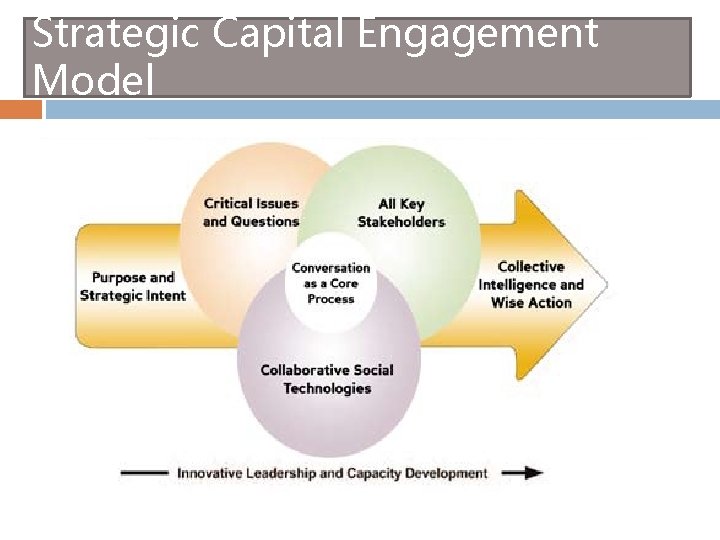
Strategic Capital Engagement Model
References Burghardt, S. & Tolliver, W. (2009). Stories of Transformative Leadership in the Human Services. Thousand Oaks: SAGE Publications. Corvo, K. , Selmi, O. , & Montemaro, S. (2003). Icons of conformity: The marketing of social work education. Journal of Community Practice, 11(1), 85– 99. Day, D. (2013). Leadership development: A review in context. Leadership Quarterly, 11(4), 581613. Mott, A. (2008). Community Learning Project Report on University Education for Social Change. 2 nd edition. Retrieved from http: //communitylearningpartnership. org/wpcontent/uploads/2015/12/University-Education for. Community-Change. pdf Packard, T. (2004). Issues in Designing and Adapting an Administration Concentration. Administration in Social Work, 28(1), 5 -20. doi: 10. 1300/J 147 v 28 n 01_02 Pritzker, S. , & Applewhite, S. R. (2015). Going "Macro": Exploring the Careers of Macro Practitioners. Social Work, 60(3), 191 -199. doi: 10. 1093/sw/swv 019 Putnam, R. (2000). Thinking About Social Change In America, in Bowling Alone. NY: Simon & Schuster, 15 28. Rothman, J. (2013). Education for macro intervention: A survey of problems and prospects. Lynwood, IL: Association for Community Organization and Social Administration. Retrieved from http: //www. acosa. org/joomla/pdf/Rothman. Report. Revised. June 2013. pdf Saegert, S. , Thompson, J. T. , & Warren, M. (2001). Social Capital and Poor Communities, New York: Russell Sage Foundation.