
A Stochastic Perturbation Scheme For Representing Model Related
A Stochastic Perturbation Scheme For Representing Model Related Uncertainty Dingchen Hou, Zoltan Toth and Yuejian Zhu Acknowledgements: Mark Iredell, Henry Juang, Stephane Vannitsem, Richard Wobus, Bo Cui, Cecile Penland, Prashant Sardeshmukh, Weiyu Yang, James Purser and Mozheng Wei NOAA THORPEX PI WORKSHOP January 17 -19, 2006 at NCEP, Camp Springs, MD
OUTLINE MOTIVATION u STOCHASTIC PARAMETERIZATION SCHEMES u Existing Schemes The Proposed Scheme A Simplified Version u RESULTS OF EXPERIMENTS Outliers Spread and Ensemble Mean Forecast Probabilistic Forecasts Comparison with a Bias-correction Procedure Combination with a Bias-correction Procedure u SUMMARY AND ONGOING RESEARCH
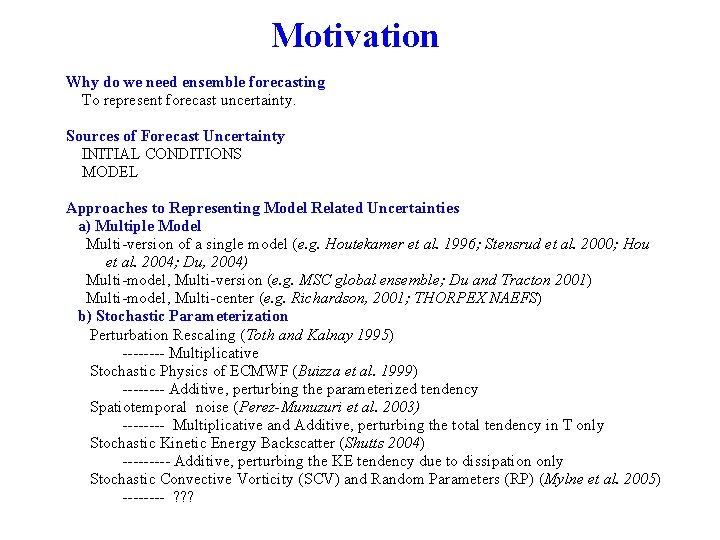
Motivation Why do we need ensemble forecasting To represent forecast uncertainty. Sources of Forecast Uncertainty INITIAL CONDITIONS MODEL Approaches to Representing Model Related Uncertainties a) Multiple Model Multi-version of a single model (e. g. Houtekamer et al. 1996; Stensrud et al. 2000; Hou et al. 2004; Du, 2004) Multi-model, Multi-version (e. g. MSC global ensemble; Du and Tracton 2001) Multi-model, Multi-center (e. g. Richardson, 2001; THORPEX NAEFS) b) Stochastic Parameterization Perturbation Rescaling (Toth and Kalnay 1995) ---- Multiplicative Stochastic Physics of ECMWF (Buizza et al. 1999) ---- Additive, perturbing the parameterized tendency Spatiotemporal noise (Perez-Munuzuri et al. 2003) ---- Multiplicative and Additive, perturbing the total tendency in T only Stochastic Kinetic Energy Backscatter (Shutts 2004) ----- Additive, perturbing the KE tendency due to dissipation only Stochastic Convective Vorticity (SCV) and Random Parameters (RP) (Mylne et al. 2005) ---- ? ? ?
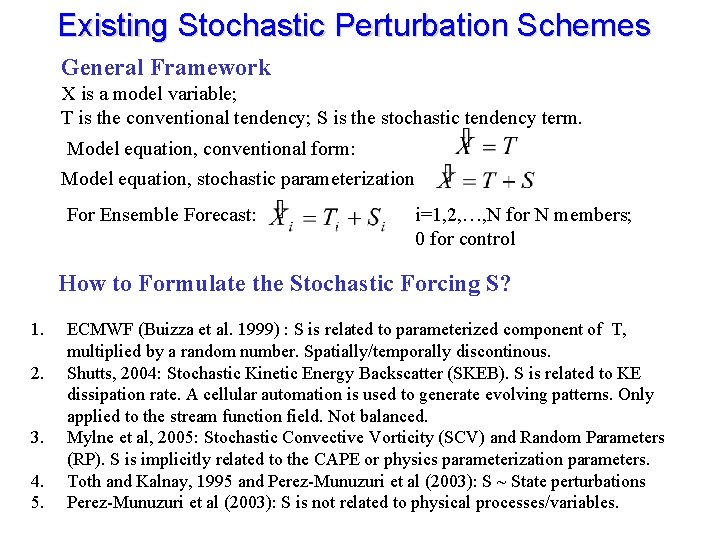
Existing Stochastic Perturbation Schemes General Framework X is a model variable; T is the conventional tendency; S is the stochastic tendency term. Model equation, conventional form: Model equation, stochastic parameterization For Ensemble Forecast: i=1, 2, …, N for N members; 0 for control How to Formulate the Stochastic Forcing S? 1. 2. 3. 4. 5. ECMWF (Buizza et al. 1999) : S is related to parameterized component of T, multiplied by a random number. Spatially/temporally discontinous. Shutts, 2004: Stochastic Kinetic Energy Backscatter (SKEB). S is related to KE dissipation rate. A cellular automation is used to generate evolving patterns. Only applied to the stream function field. Not balanced. Mylne et al, 2005: Stochastic Convective Vorticity (SCV) and Random Parameters (RP). S is implicitly related to the CAPE or physics parameterization parameters. Toth and Kalnay, 1995 and Perez-Munuzuri et al (2003): S ~ State perturbations Perez-Munuzuri et al (2003): S is not related to physical processes/variables.
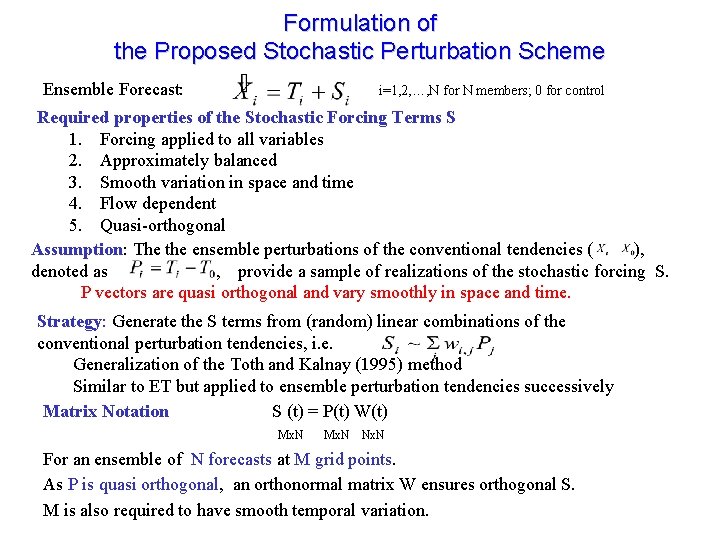
Formulation of the Proposed Stochastic Perturbation Scheme Ensemble Forecast: i=1, 2, …, N for N members; 0 for control Required properties of the Stochastic Forcing Terms S 1. Forcing applied to all variables 2. Approximately balanced 3. Smooth variation in space and time 4. Flow dependent 5. Quasi-orthogonal Assumption: The the ensemble perturbations of the conventional tendencies ( ), denoted as , provide a sample of realizations of the stochastic forcing S. P vectors are quasi orthogonal and vary smoothly in space and time. Strategy: Generate the S terms from (random) linear combinations of the conventional perturbation tendencies, i. e. Generalization of the Toth and Kalnay (1995) method Similar to ET but applied to ensemble perturbation tendencies successively Matrix Notation S (t) = P(t) W(t) Mx. N Nx. N For an ensemble of N forecasts at M grid points. As P is quasi orthogonal, an orthonormal matrix W ensures orthogonal S. M is also required to have smooth temporal variation.
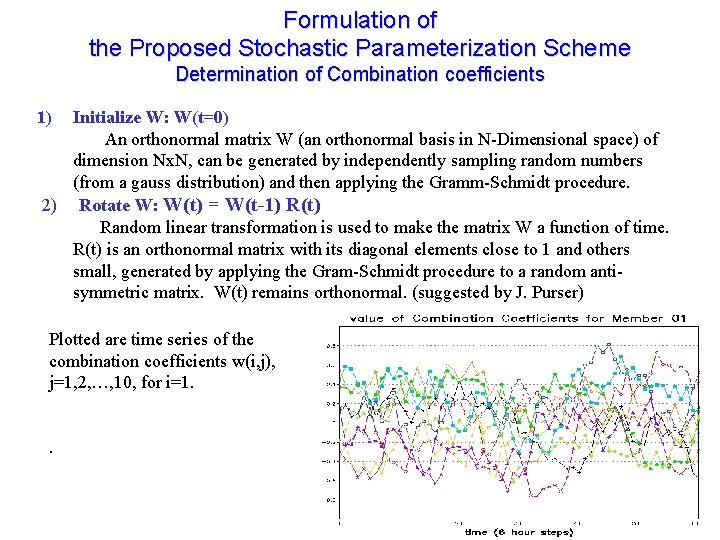
Formulation of the Proposed Stochastic Parameterization Scheme Determination of Combination coefficients 1) Initialize W: W(t=0) An orthonormal matrix W (an orthonormal basis in N-Dimensional space) of dimension Nx. N, can be generated by independently sampling random numbers (from a gauss distribution) and then applying the Gramm-Schmidt procedure. 2) Rotate W: W(t) = W(t-1) R(t) Random linear transformation is used to make the matrix W a function of time. R(t) is an orthonormal matrix with its diagonal elements close to 1 and others small, generated by applying the Gram-Schmidt procedure to a random antisymmetric matrix. W(t) remains orthonormal. (suggested by J. Purser) Plotted are time series of the combination coefficients w(i, j), j=1, 2, …, 10, for i=1. .
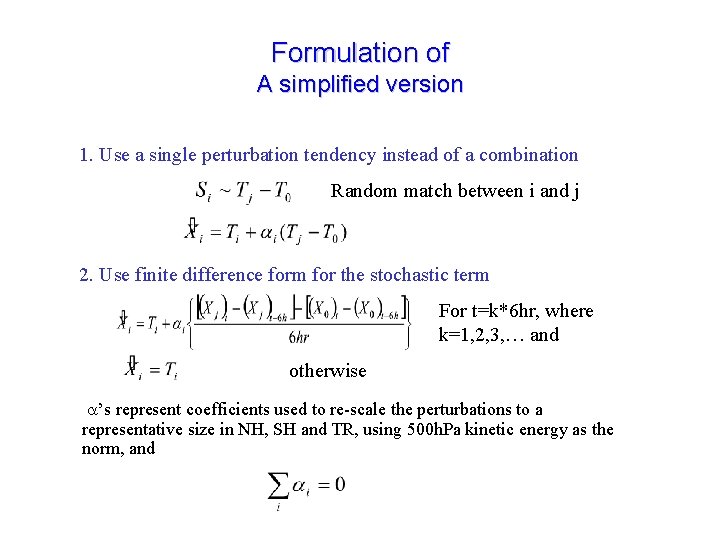
Formulation of A simplified version 1. Use a single perturbation tendency instead of a combination Random match between i and j 2. Use finite difference form for the stochastic term For t=k*6 hr, where k=1, 2, 3, … and otherwise a’s represent coefficients used to re-scale the perturbations to a representative size in NH, SH and TR, using 500 h. Pa kinetic energy as the norm, and
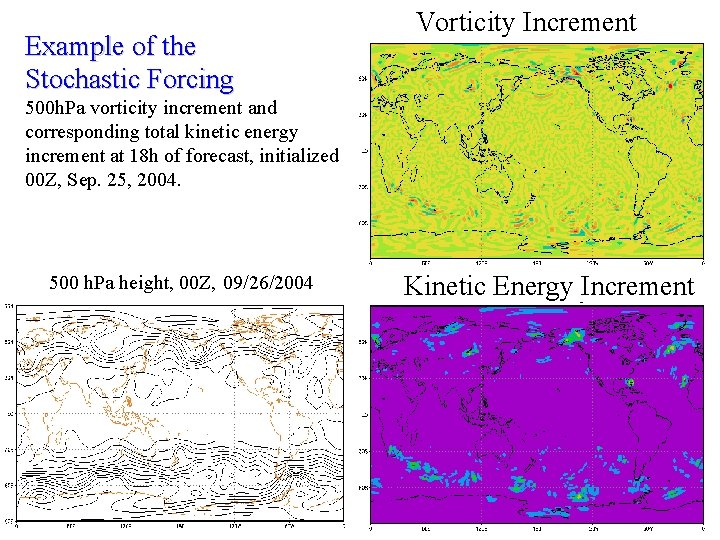
Example of the Stochastic Forcing Vorticity Increment 500 h. Pa vorticity increment and corresponding total kinetic energy increment at 18 h of forecast, initialized 00 Z, Sep. 25, 2004. 500 h. Pa height, 00 Z, 09/26/2004 Kinetic Energy Increment
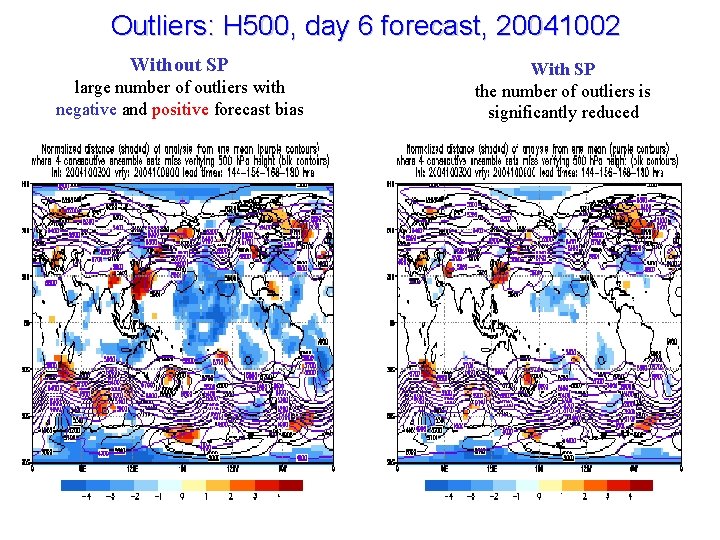
Outliers: H 500, day 6 forecast, 20041002 Without SP large number of outliers with negative and positive forecast bias With SP the number of outliers is significantly reduced
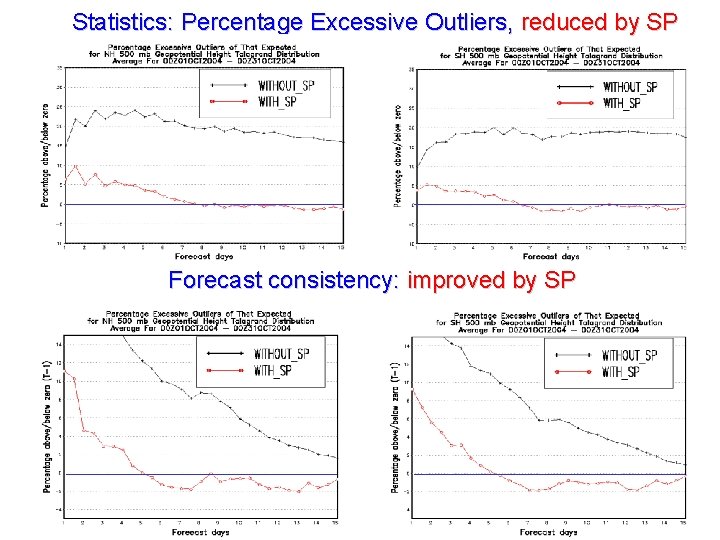
Statistics: Percentage Excessive Outliers, reduced by SP Forecast consistency: improved by SP
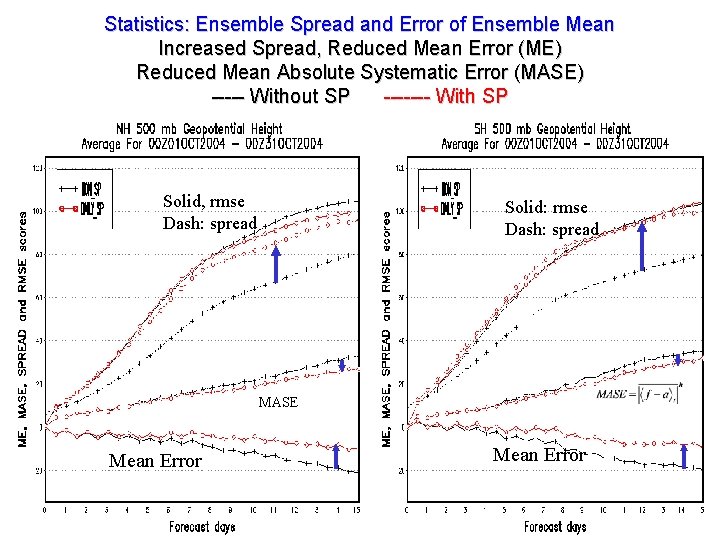
Statistics: Ensemble Spread and Error of Ensemble Mean Increased Spread, Reduced Mean Error (ME) Reduced Mean Absolute Systematic Error (MASE) ----- Without SP ------- With SP Solid, rmse Dash: spread Solid: rmse Dash: spread MASE Mean Error
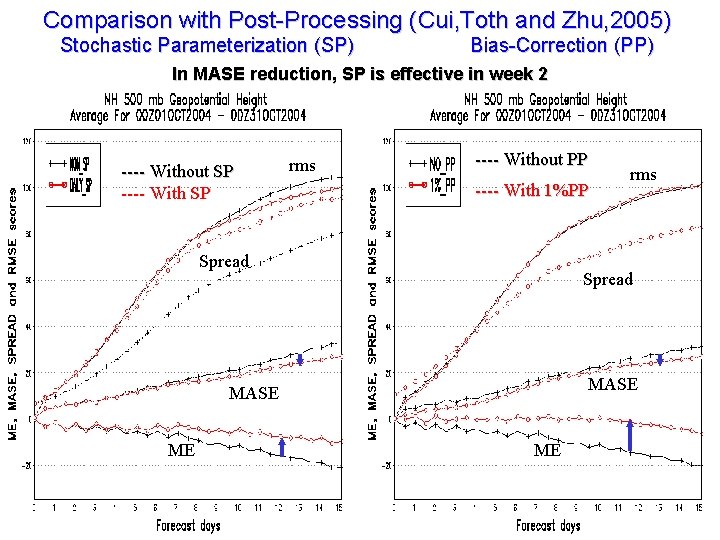
Comparison with Post-Processing (Cui, Toth and Zhu, 2005) Stochastic Parameterization (SP) Bias-Correction (PP) In MASE reduction, SP is effective in week 2 ---- Without SP ---- With SP rms ---- Without PP ---- With 1%PP Spread MASE ME rms ME
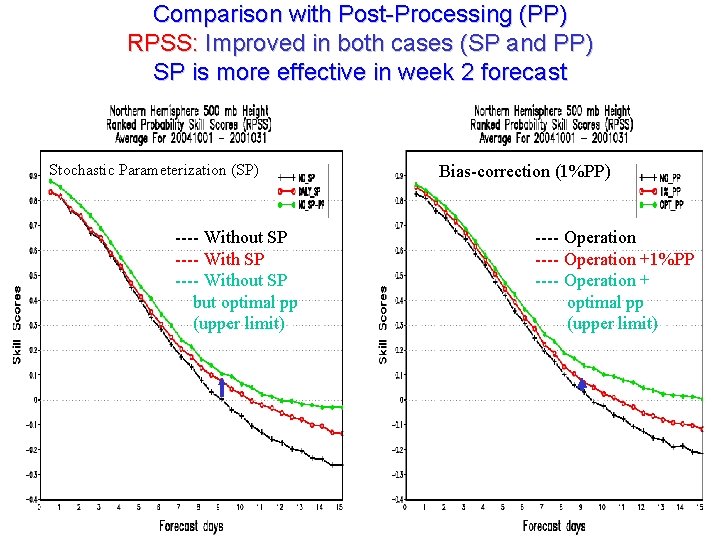
Comparison with Post-Processing (PP) RPSS: Improved in both cases (SP and PP) SP is more effective in week 2 forecast Stochastic Parameterization (SP) ---- Without SP but optimal pp (upper limit) Bias-correction (1%PP) ---- Operation +1%PP ---- Operation + optimal pp (upper limit)
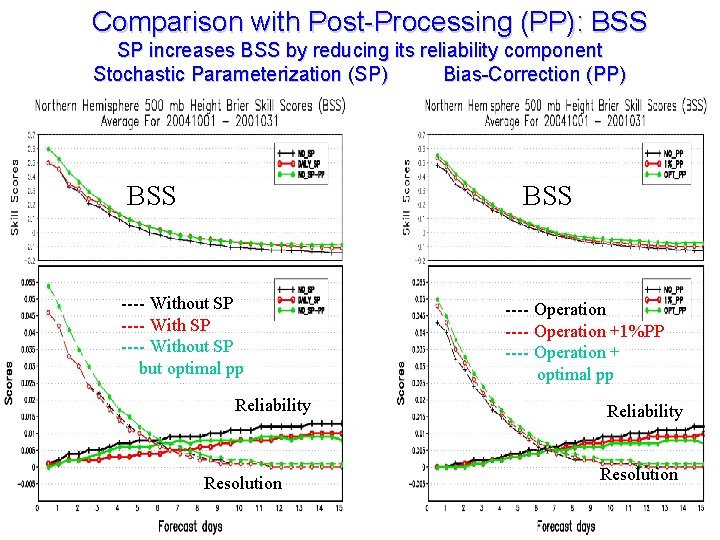
Comparison with Post-Processing (PP): BSS SP increases BSS by reducing its reliability component Stochastic Parameterization (SP) Bias-Correction (PP) BSS ---- Without SP but optimal pp Reliability Resolution ---- Operation +1%PP ---- Operation + optimal pp Reliability Resolution
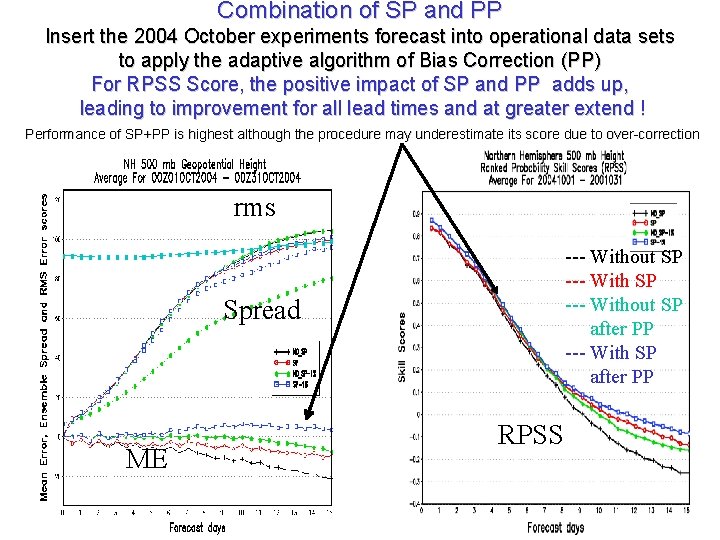
Combination of SP and PP Insert the 2004 October experiments forecast into operational data sets to apply the adaptive algorithm of Bias Correction (PP) For RPSS Score, the positive impact of SP and PP adds up, leading to improvement for all lead times and at greater extend ! Performance of SP+PP is highest although the procedure may underestimate its score due to over-correction rms ---OPT ---SP ---OPT+PP ---SP+PP --- Without SP after PP --- With SP after PP Spread ME RPSS
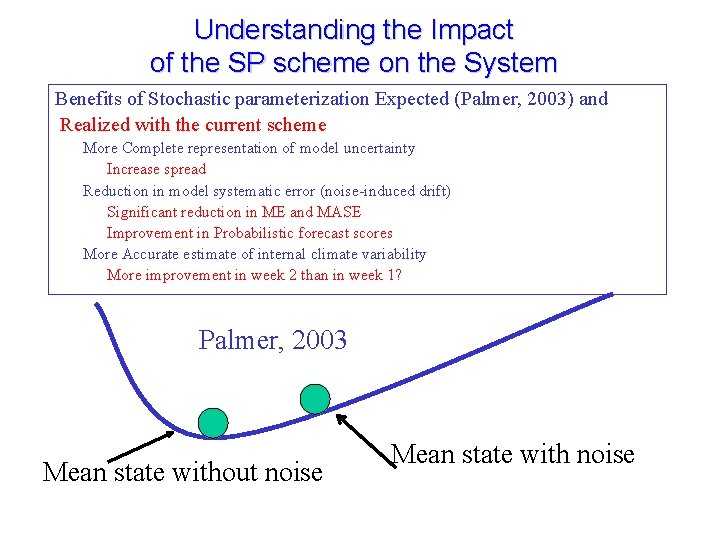
Understanding the Impact of the SP scheme on the System Benefits of Stochastic parameterization Expected (Palmer, 2003) and Realized with the current scheme More Complete representation of model uncertainty Increase spread Reduction in model systematic error (noise-induced drift) Significant reduction in ME and MASE Improvement in Probabilistic forecast scores More Accurate estimate of internal climate variability More improvement in week 2 than in week 1? Palmer, 2003 Mean state without noise Mean state with noise
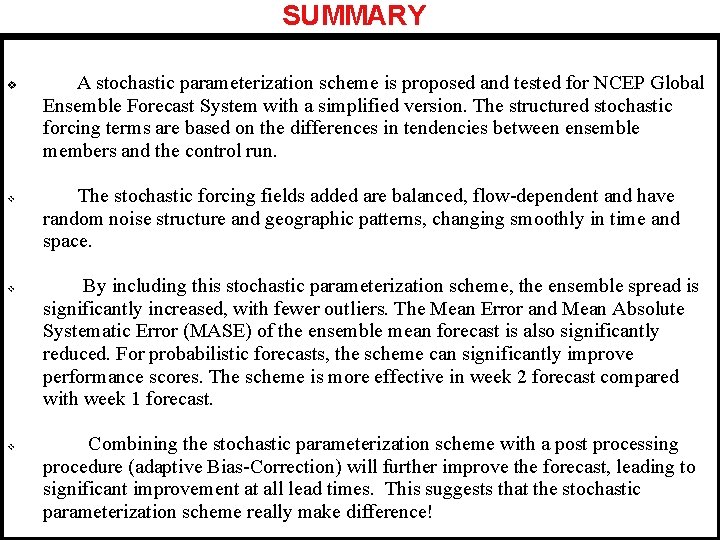
SUMMARY v v A stochastic parameterization scheme is proposed and tested for NCEP Global Ensemble Forecast System with a simplified version. The structured stochastic forcing terms are based on the differences in tendencies between ensemble members and the control run. The stochastic forcing fields added are balanced, flow-dependent and have random noise structure and geographic patterns, changing smoothly in time and space. By including this stochastic parameterization scheme, the ensemble spread is significantly increased, with fewer outliers. The Mean Error and Mean Absolute Systematic Error (MASE) of the ensemble mean forecast is also significantly reduced. For probabilistic forecasts, the scheme can significantly improve performance scores. The scheme is more effective in week 2 forecast compared with week 1 forecast. Combining the stochastic parameterization scheme with a post processing procedure (adaptive Bias-Correction) will further improve the forecast, leading to significant improvement at all lead times. This suggests that the stochastic parameterization scheme really make difference!
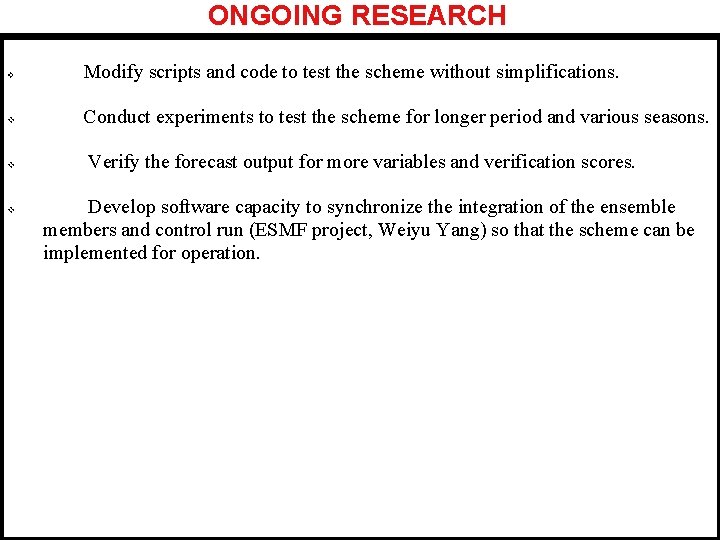
ONGOING RESEARCH v Modify scripts and code to test the scheme without simplifications. v Conduct experiments to test the scheme for longer period and various seasons. v v Verify the forecast output for more variables and verification scores. Develop software capacity to synchronize the integration of the ensemble members and control run (ESMF project, Weiyu Yang) so that the scheme can be implemented for operation.
- Slides: 18