
A State Machine Language for the Undergraduate Operating
- Slides: 23
A State Machine Language for the Undergraduate Operating Systems Course CSC Research & Teaching Talk Dale E. Parson Tuesday, April 28, 2015 http: //faculty. kutztown. edu/parson
Motivation • Low-level projects such as modifying and extending real O. S. modules -- scheduling, paging, I/O drivers, etc. -- entail a lot of inertia and incidental work. • A theoretical / mathematical approach such as queuing theory does not provide the constructivist experience of a building system. • Kutztown’s dual software development / IT tracks have diverging prerequisite paths. 2
Why UML State Diagrams? • Unified Modeling Language State Diagrams are among the few UML diagram types capable of fully specifying executable code. • Network protocol handlers. • I had a need for a MIDI controller protocol handler. • Operating systems textbooks specify many standard algorithms using state machines. • CPU scheduling, page replacement, disk I/O scheduling. • Tools might have been available. 3
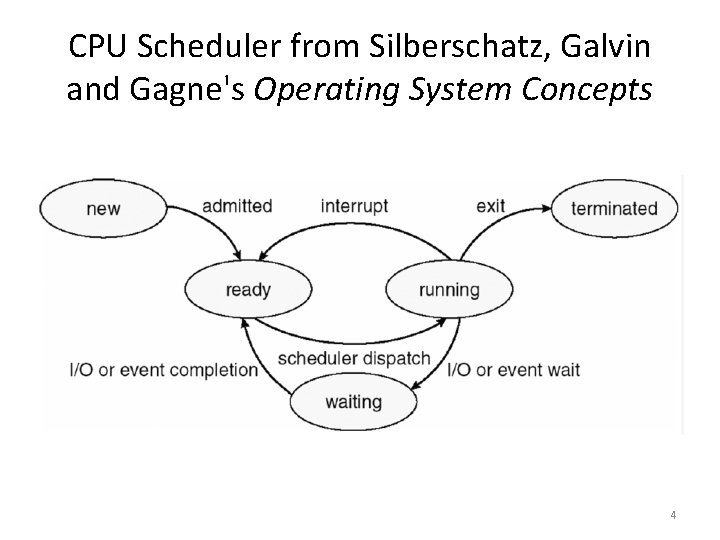
CPU Scheduler from Silberschatz, Galvin and Gagne's Operating System Concepts 4
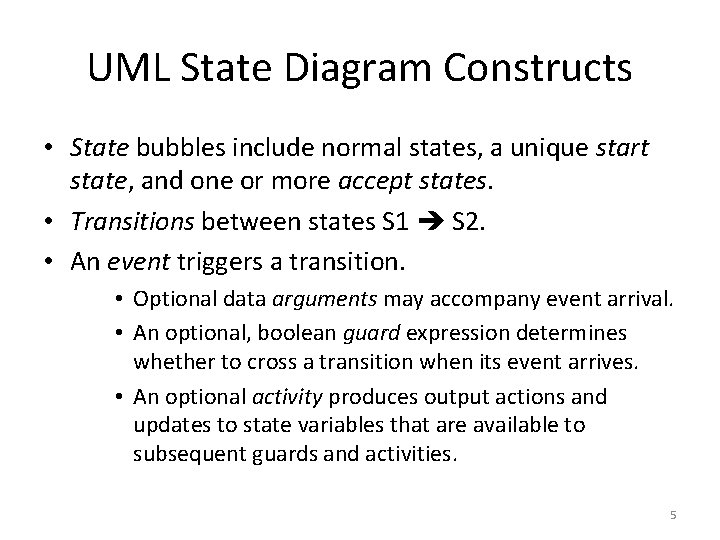
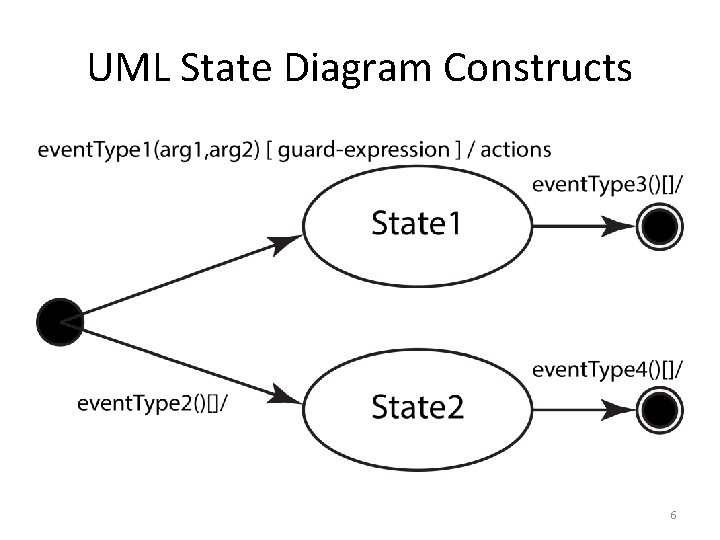
UML State Diagram Constructs • State bubbles include normal states, a unique start state, and one or more accept states. • Transitions between states S 1 S 2. • An event triggers a transition. • Optional data arguments may accompany event arrival. • An optional, boolean guard expression determines whether to cross a transition when its event arrives. • An optional activity produces output actions and updates to state variables that are available to subsequent guards and activities. 5
UML State Diagram Constructs 6
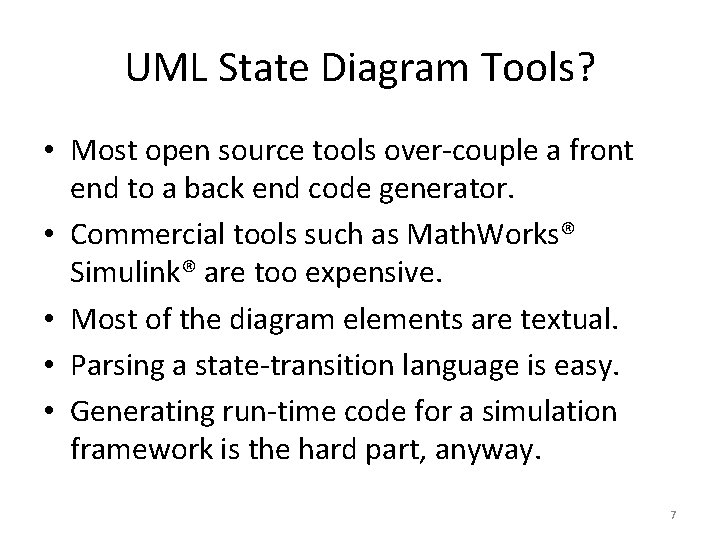
UML State Diagram Tools? • Most open source tools over-couple a front end to a back end code generator. • Commercial tools such as Math. Works® Simulink® are too expensive. • Most of the diagram elements are textual. • Parsing a state-transition language is easy. • Generating run-time code for a simulation framework is the hard part, anyway. 7
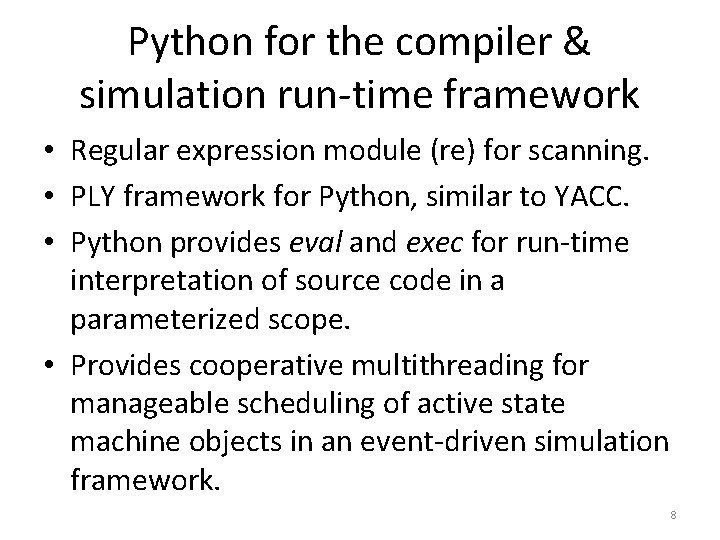
Python for the compiler & simulation run-time framework • Regular expression module (re) for scanning. • PLY framework for Python, similar to YACC. • Python provides eval and exec for run-time interpretation of source code in a parameterized scope. • Provides cooperative multithreading for manageable scheduling of active state machine objects in an event-driven simulation framework. 8
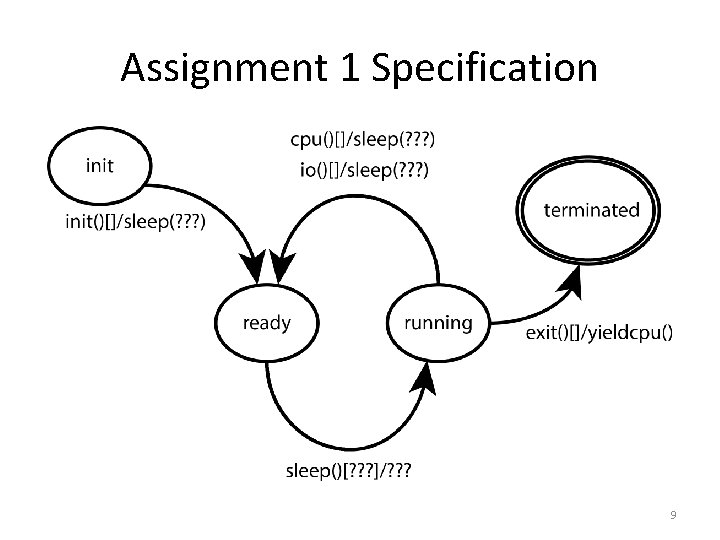
Assignment 1 Specification 9
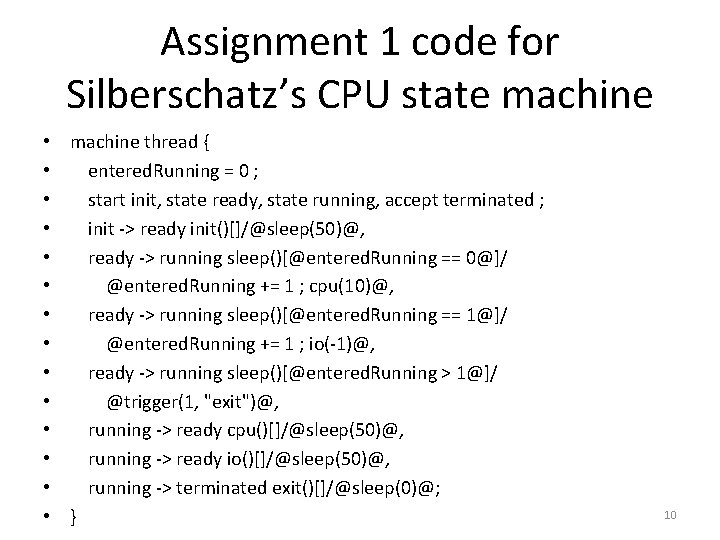
Assignment 1 code for Silberschatz’s CPU state machine • machine thread { • entered. Running = 0 ; • start init, state ready, state running, accept terminated ; • init -> ready init()[]/@sleep(50)@, • ready -> running sleep()[@entered. Running == 0@]/ • @entered. Running += 1 ; cpu(10)@, • ready -> running sleep()[@entered. Running == 1@]/ • @entered. Running += 1 ; io(-1)@, • ready -> running sleep()[@entered. Running > 1@]/ • @trigger(1, "exit")@, • running -> ready cpu()[]/@sleep(50)@, • running -> ready io()[]/@sleep(50)@, • running -> terminated exit()[]/@sleep(0)@; • } 10
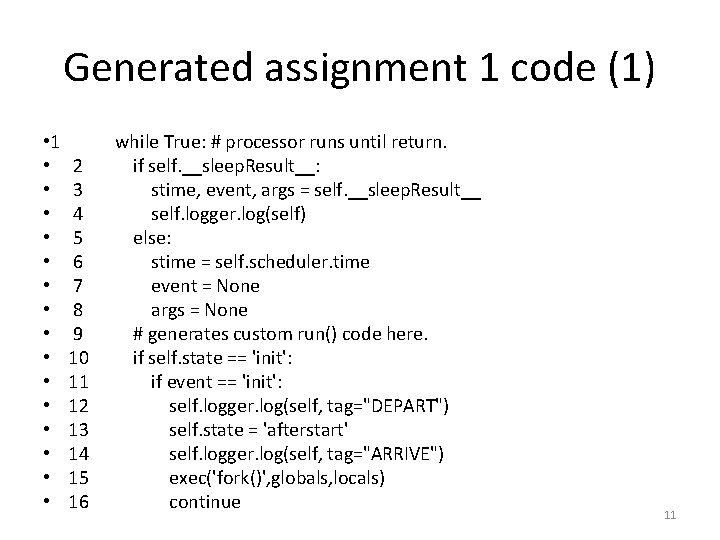
Generated assignment 1 code (1) • 1 • • • • 2 3 4 5 6 7 8 9 10 11 12 13 14 15 16 while True: # processor runs until return. if self. __sleep. Result__: stime, event, args = self. __sleep. Result__ self. logger. log(self) else: stime = self. scheduler. time event = None args = None # generates custom run() code here. if self. state == 'init': if event == 'init': self. logger. log(self, tag="DEPART") self. state = 'afterstart' self. logger. log(self, tag="ARRIVE") exec('fork()', globals, locals) continue 11
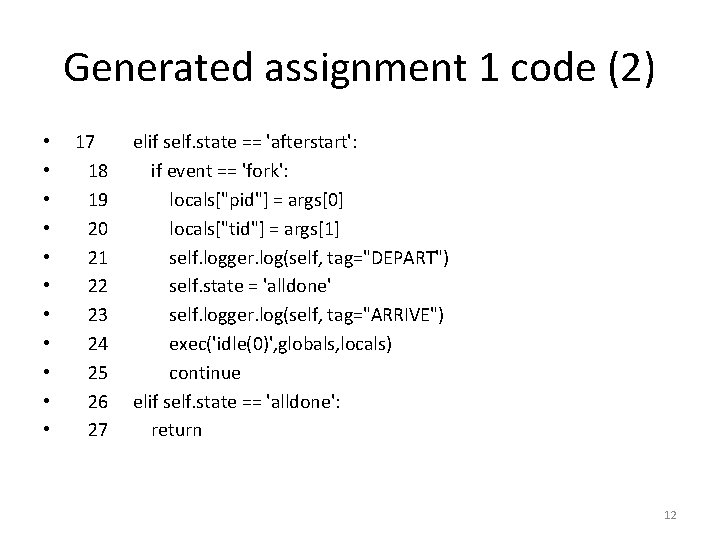
Generated assignment 1 code (2) • • • 17 18 19 20 21 22 23 24 25 26 27 elif self. state == 'afterstart': if event == 'fork': locals["pid"] = args[0] locals["tid"] = args[1] self. logger. log(self, tag="DEPART") self. state = 'alldone' self. logger. log(self, tag="ARRIVE") exec('idle(0)', globals, locals) continue elif self. state == 'alldone': return 12
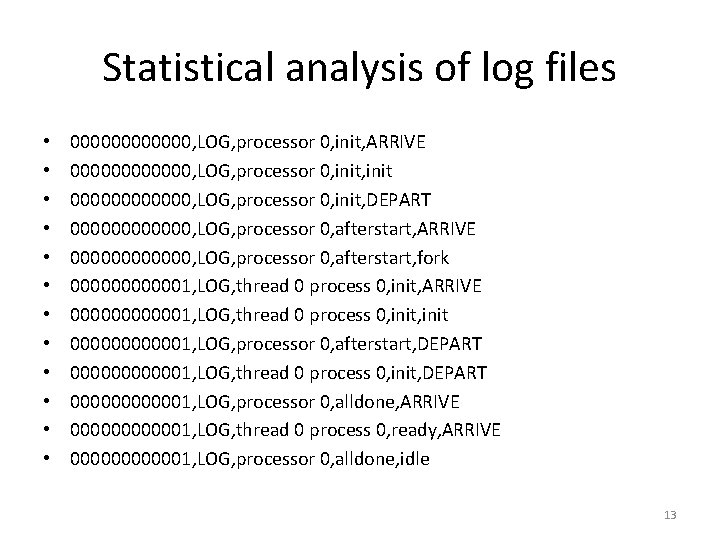
Statistical analysis of log files • • • 000000, LOG, processor 0, init, ARRIVE 000000, LOG, processor 0, init, DEPART 000000, LOG, processor 0, afterstart, ARRIVE 000000, LOG, processor 0, afterstart, fork 0000001, LOG, thread 0 process 0, init, ARRIVE 0000001, LOG, thread 0 process 0, init 0000001, LOG, processor 0, afterstart, DEPART 0000001, LOG, thread 0 process 0, init, DEPART 0000001, LOG, processor 0, alldone, ARRIVE 0000001, LOG, thread 0 process 0, ready, ARRIVE 0000001, LOG, processor 0, alldone, idle 13
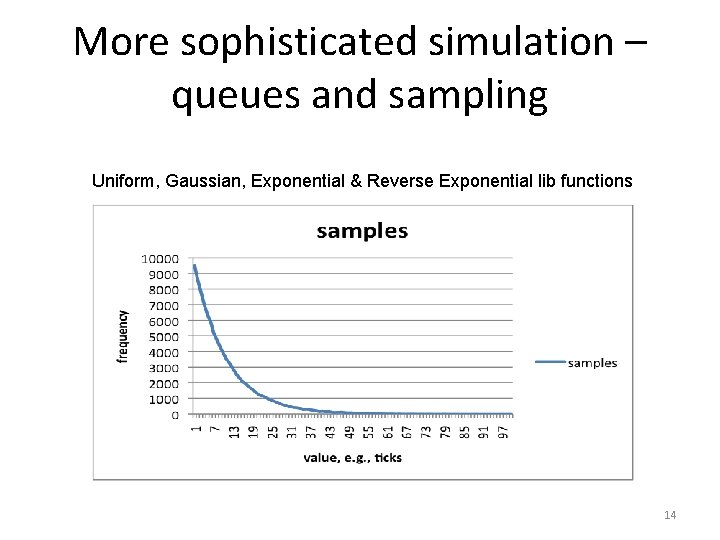
More sophisticated simulation – queues and sampling Uniform, Gaussian, Exponential & Reverse Exponential lib functions 14
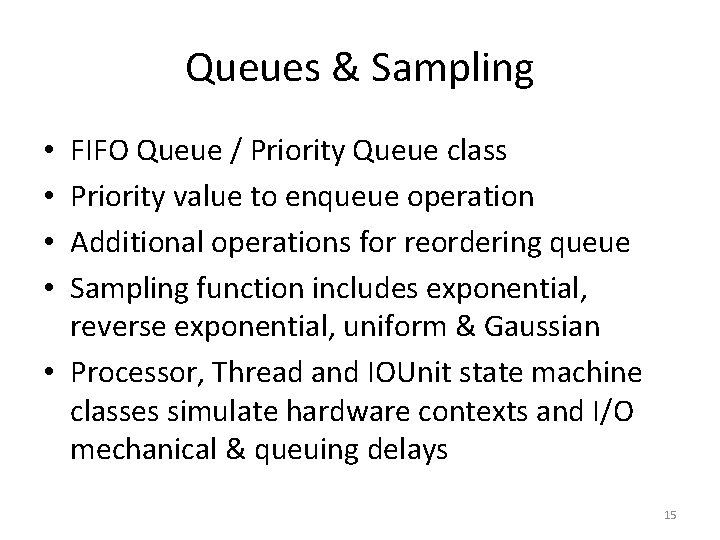
Queues & Sampling FIFO Queue / Priority Queue class Priority value to enqueue operation Additional operations for reordering queue Sampling function includes exponential, reverse exponential, uniform & Gaussian • Processor, Thread and IOUnit state machine classes simulate hardware contexts and I/O mechanical & queuing delays • • 15
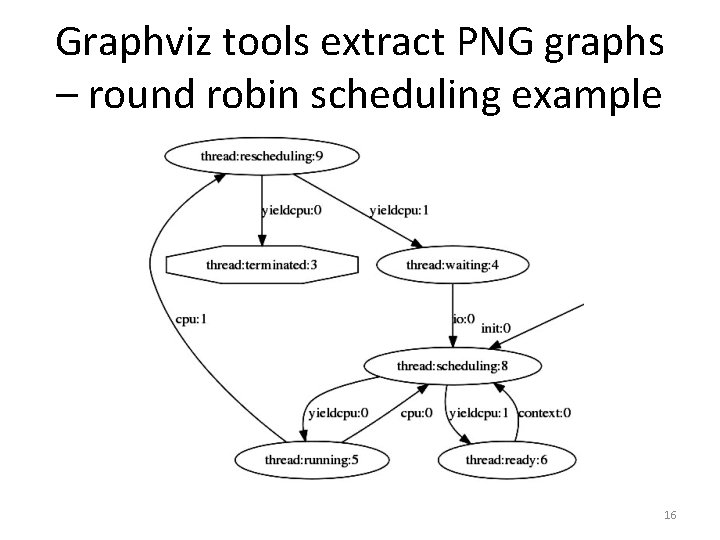
Graphviz tools extract PNG graphs – round robin scheduling example 16
Summary from First Year • State machine diagrams provide a good intermediate level of abstraction between real O. S. modules & mathematical models • Implement & run entire algorithm at a high level • Assignments included CPU scheduler, page replacement algorithms & I/O scheduling • Instructor hands out 1 solution, students adapt it • Like solving a puzzle or a proof • Enhancements for Fall 2014 include macros to avoid repeated code, pure functions, and push-down automata for subroutine-style reuse 17
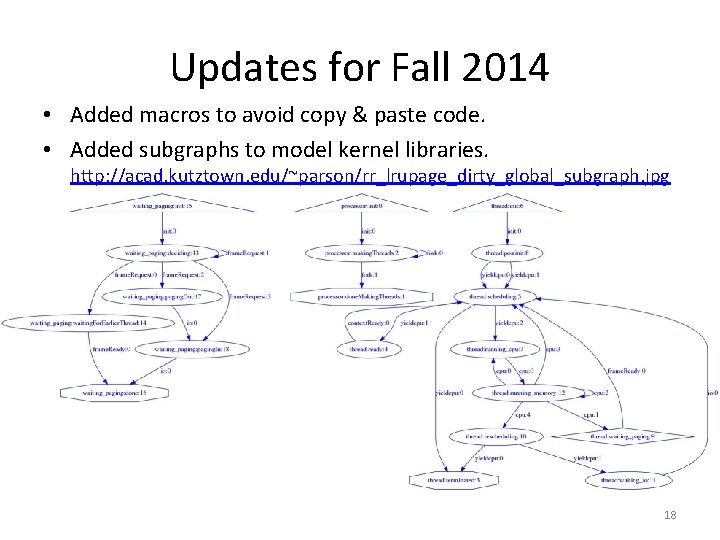
Updates for Fall 2014 • Added macros to avoid copy & paste code. • Added subgraphs to model kernel libraries. http: //acad. kutztown. edu/~parson/rr_lrupage_dirty_global_subgraph. jpg 18
Plans for Fall 2015 • Increase the emphasis on analysis. – The coding part if relatively small and “easy. ” – Small changes create massive statistical changes. – Add more analysis into student workload. • Increase the amount of data analyzed by increasing simulation speed and hence throughput. – Switch from Python threads to Python generators. – How will we deal with massive student data sets? 19
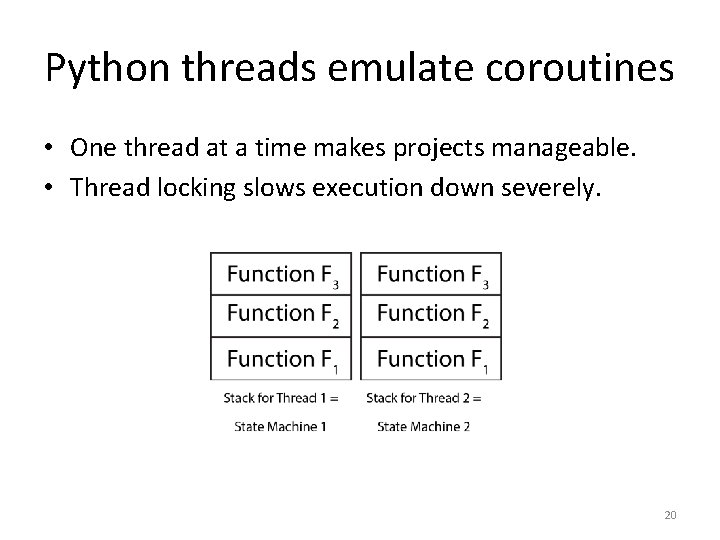
Python threads emulate coroutines • One thread at a time makes projects manageable. • Thread locking slows execution down severely. 20
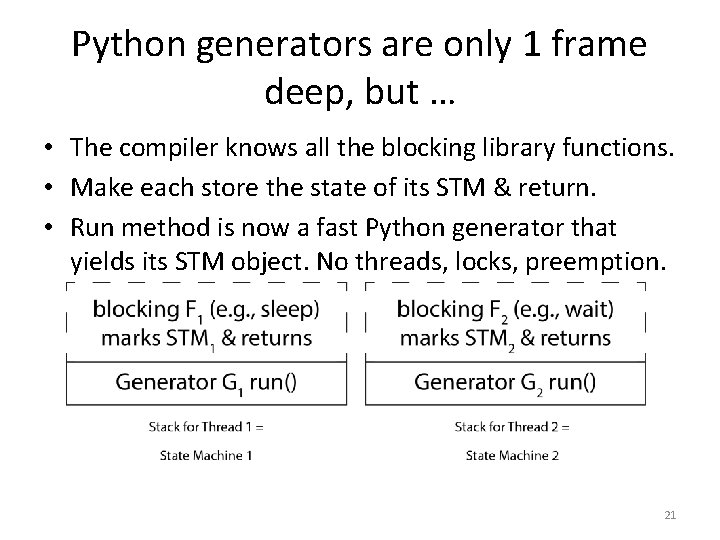
Python generators are only 1 frame deep, but … • The compiler knows all the blocking library functions. • Make each store the state of its STM & return. • Run method is now a fast Python generator that yields its STM object. No threads, locks, preemption. 21
Fast == generate much data Overrun student accounts, /tmp not solution. Run it through a compressor on the way out. Student inspects log via a decompressor. Make them learn to use Unix less etc. Statistical cruncher temporary decompresses. The statistical diffs are based on the statistical analysis, not on the big raw data set. • Maybe data mining tools (e. g. , Weka)! • • • 22
Other benefits for students • They learn how to write statistical, discretetime, discrete-event simulations. • These could be applied to other domains. • They could apply this to load analysis, etc. in their upcoming careers. • With slightly more robust & sophisticated tools, they could take these tools with them. • I may work on a debugger. 23