
A stable low bias longterm satellite based data
A stable, low bias, long-term, satellite based data record of sea surface temperature from ESA's Climate Change Initiative Nick Rayner 1, Simon Good 1 and Chris Merchant 2 1 Met Office Hadley Centre, UK 2 University www. esa-sst-cci. org of Edinburgh, UK
Overview • ESA Climate Change Initiative programme and SST CCI project • SST CCI long-term products • Methodological improvements compared to existing products • Plans for validation and comparisons to other things over the next six months • SST CCI next phase • How to take part in the assessment www. esa-sst-cci. org
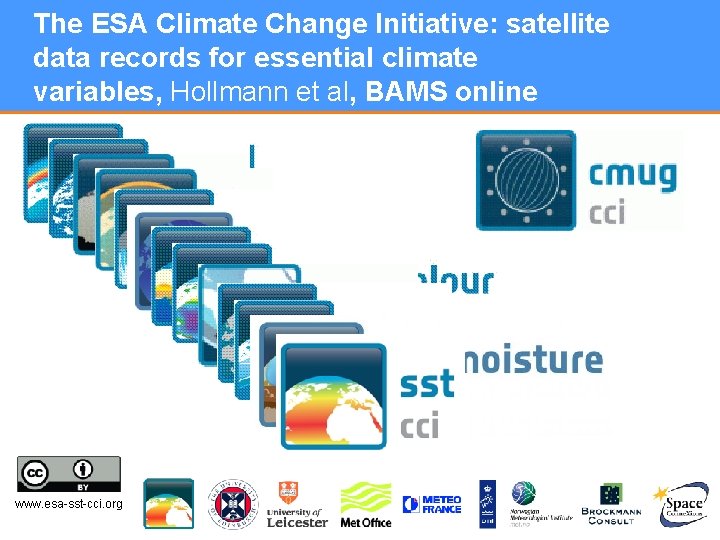
The ESA Climate Change Initiative: satellite data records for essential climate variables, Hollmann et al, BAMS online www. esa-sst-cci. org
SST CCI Long-term Products • Satellite only – independent of measurements made in situ • Period: 1991 -2010 • Different levels: level 2 (AVHRR), level 3 (ATSR) and level 4 (combined) • Depths: SSTskin, SST 0. 2 m • CF-compliant Net. CDF in GHRSST compatible format • Documentation, including a Product User Guide with quick start guide and also more detailed information • Tools www. esa-sst-cci. org
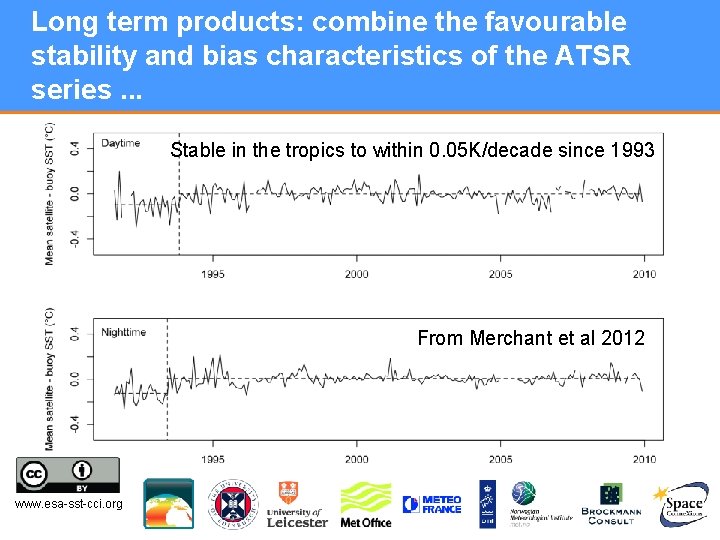
Long term products: combine the favourable stability and bias characteristics of the ATSR series. . . Stable in the tropics to within 0. 05 K/decade since 1993 From Merchant et al 2012 www. esa-sst-cci. org
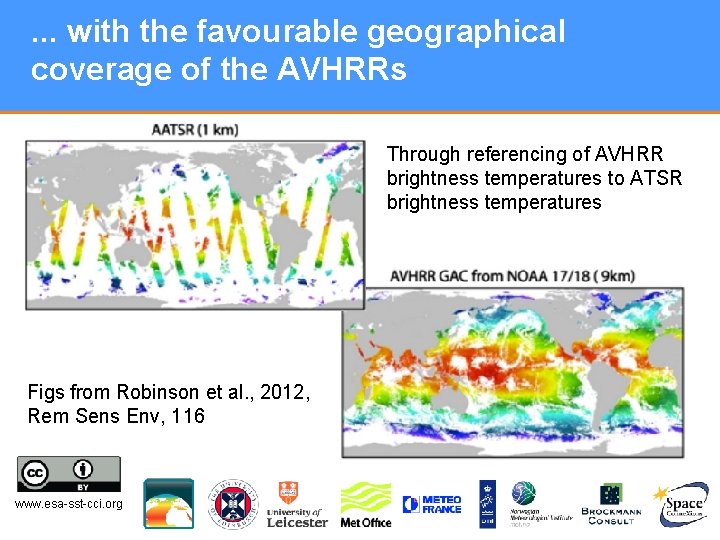
. . . with the favourable geographical coverage of the AVHRRs Through referencing of AVHRR brightness temperatures to ATSR brightness temperatures Figs from Robinson et al. , 2012, Rem Sens Env, 116 www. esa-sst-cci. org
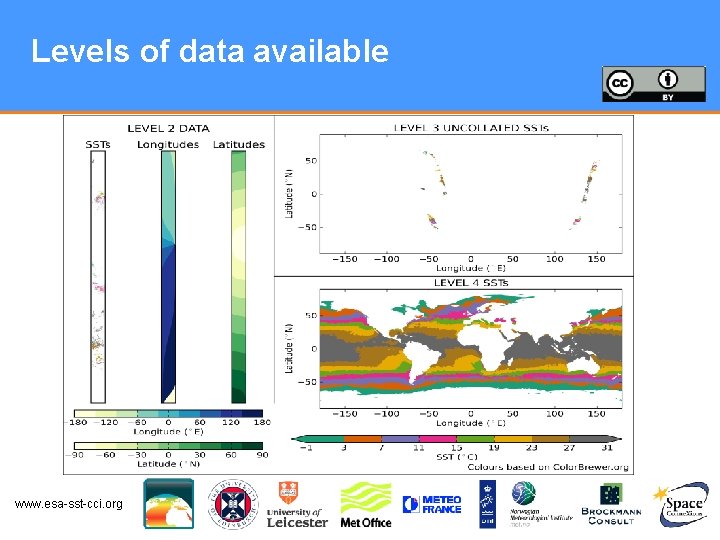
Levels of data available www. esa-sst-cci. org
SST CCI Long-term Products • Satellite only – independent of measurements made in situ • Period: 1991 -2010 • Different levels: level 2 (AVHRR), level 3 (ATSR) and level 4 (combined) • Depths: SSTskin, SST 0. 2 m • CF-compliant Net. CDF in Group for High Resolution SST compatible format • Documentation, including a Product User Guide with quick start guide and also more detailed information • Tools www. esa-sst-cci. org
Retrieval algorithm selection • Open competitive process • Test data provided to contributors for several sensors: • • Contributed algorithms assessed against a range of metrics using reference data that were not used in algorithm development by independent people: • • ATSR 2, AATSR, Metop AVHRR, NOAA 17, AVHRR, NOAA 18 AVHRR and NOAA 19 AVHRR bias, stability (long-term, seasonal and diurnal), sensitivity to SST variability, precision , degree of independence from in situ observations, validity of associated uncertainty estimates, improvability, generality, and implementation issues. Optimal estimation algorithm selected which uses the Along Track Scanning Radiometers as a reference www. esa-sst-cci. org
Estimating uncertainty • Uncertainty is estimated from contributions to the retrieval process, not through comparison to in situ measurements • Uncertainty in each value in the L 2 and L 3 products is split into three components due to: n n n Uncorrelated effects, e. g. Radiometric noise Synoptically correlated effects (1 day and 100 km), e. g. Retrieval or depth adjustment error due to imperfect knowledge of atmospheric conditions Large-scale correlated effects, e. g. Residual errors in sensor calibration after cross referencing • SST CCI tools aim to propagate uncertainties in the retrievals appropriately through averaging • Nomenclature used in project documents has been refined in discussion with the metrology community www. esa-sst-cci. org
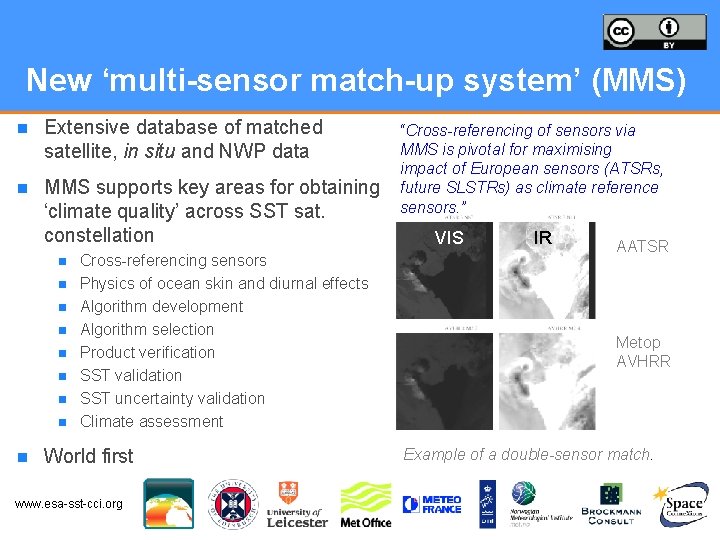
New ‘multi-sensor match-up system’ (MMS) n Extensive database of matched satellite, in situ and NWP data n MMS supports key areas for obtaining ‘climate quality’ across SST sat. constellation n n n n Cross-referencing sensors Physics of ocean skin and diurnal effects Algorithm development Algorithm selection Product verification SST validation SST uncertainty validation Climate assessment World first www. esa-sst-cci. org “Cross-referencing of sensors via MMS is pivotal for maximising impact of European sensors (ATSRs, future SLSTRs) as climate reference sensors. ” VIS IR AATSR Metop AVHRR Example of a double-sensor match.
Producing the L 4 analysis • Developed from the Met Office OSTIA analysis system • Uses a multi-scale OI scheme with persisted background and background error estimates split between two spatial scales • • Sizes and correlation lengths of background errors have been improved for the SST CCI analysis and their seasonal cycle included Includes only satellite data from both day and night (10. 30 am and pm) adjusted to 0. 2 m depth for the long-term product • Approximates to the daily mean SST www. esa-sst-cci. org
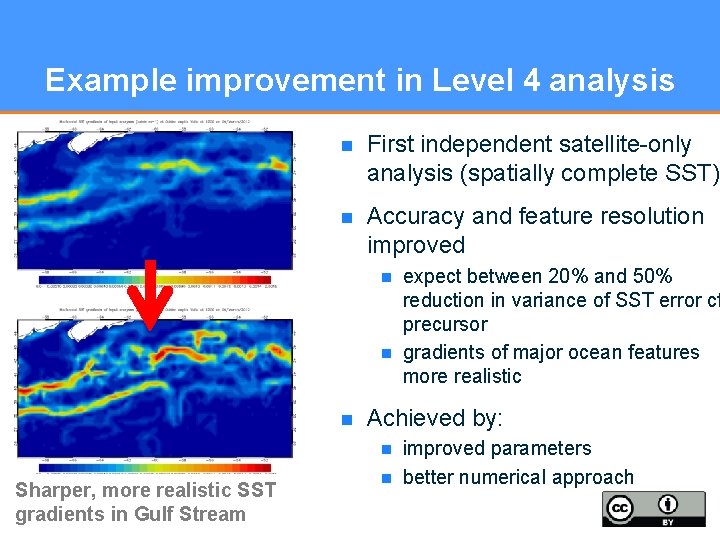
Example improvement in Level 4 analysis n First independent satellite-only analysis (spatially complete SST) n Accuracy and feature resolution improved n n n Achieved by: n Sharper, more realistic SST www. esa-sst-cci. org gradients in Gulf Stream expect between 20% and 50% reduction in variance of SST error cf precursor gradients of major ocean features more realistic n improved parameters better numerical approach
Other expected improvements compared to current products n For ATSR SSTs compared to precursor n n n ATSR Reprocessing for Climate Lower noise SST More stable and consistent cloud detection Longer record (20 years) Improved uncertainty information For AVHRRs cf. US Pathfinder SST from AVHRR n n n n Independence from in situ observations Skin and depth SST estimates Maximum regional biases reduced from ~0. 5 K to ~0. 1 K Lower noise SST from optimal estimation retrieval 100% sensitivity to SST variations (diurnal variations, fronts) Compensated for drift of overpass times relative to diurnal cycle in SST Stable SST observation (0. 05 K/decade) by being tied to ATSR www. esa-sst-cci. org
Comparison to in situ measurements and climate assessment • Validation: • • Using multi-sensor and reference data match ups within the MMS Uses independent and pseudo-independent reference measurements made in situ Uncertainty estimates will be validated and results presented in “degree of confirmation” maps Climate assessment: • • Comparison to other existing century-scale and satellite-era products Impact of use of SST CCI products in model assessment Exploration of fronts in SST CCI and OC CCI products Feedback from trail-blazer users – please email me (nick. rayner@metoffice. gov. uk) if you would like to take part www. esa-sst-cci. org
Phase 2 of the CCI • Three year prototyping phase is almost over • The next three year phase of the programme will: • Revise the products following user feedback • Create a system that can be used to reprocess and update the products easily in the future • Hopefully extend the SST CCI products back to 1978 www. esa-sst-cci. org
How to find out more and provide feedback • Products will be available to download by the end of April • Email me now if you are interested in being a trailblazer user at nick. rayner@metoffice. gov. uk • Please download them and test them in your work, visit • http: //www. esa-sst-cci. org/PUG/home. htm • Then please provide feedback on your experience so that we can further improve them: • Email nick. rayner@metoffice. gov. uk www. esa-sst-cci. org
- Slides: 17