
A Sound Education Good Vibrations An oscilloscope allows

A Sound Education: Good Vibrations An oscilloscope allows non-electric signals, such as sound vibrations, to be converted into voltages and displayed. Top row, left to right: Low pitch, high pitch. Bottom row, left to right: Quiet volume, loud volume. Photos © Tess Watson CC-BY-2. 0. Gregory L. Vogt, Ed. D Center for Educational Outreach Baylor College of Medicine Revised 2014
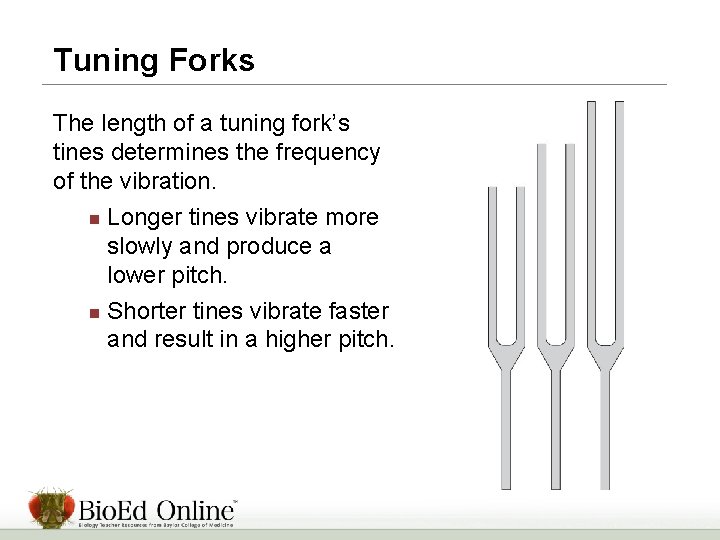
Tuning Forks The length of a tuning fork’s tines determines the frequency of the vibration. n Longer tines vibrate more slowly and produce a lower pitch. n Shorter tines vibrate faster and result in a higher pitch.

Sound Vibrations in Water 1. Fill a glass half full of water. 2. Take a tuning fork and strike the tines against a hard surface. 3. Put the tines into the glass of water. What happens?
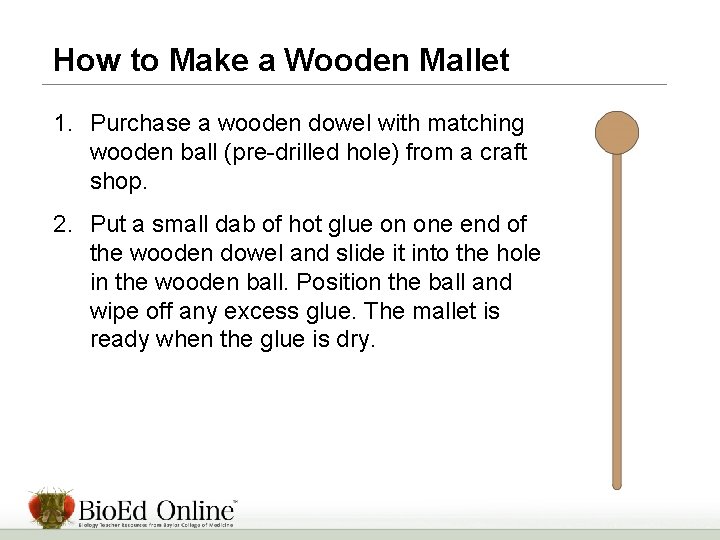
How to Make a Wooden Mallet 1. Purchase a wooden dowel with matching wooden ball (pre-drilled hole) from a craft shop. 2. Put a small dab of hot glue on one end of the wooden dowel and slide it into the hole in the wooden ball. Position the ball and wipe off any excess glue. The mallet is ready when the glue is dry.
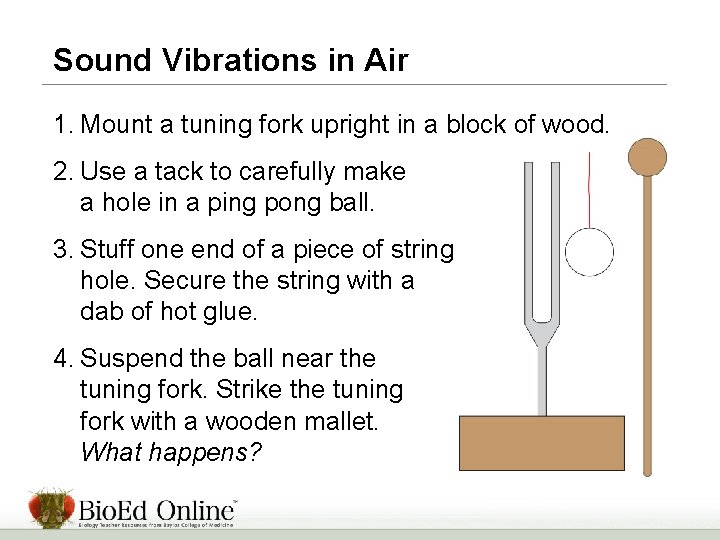
Sound Vibrations in Air 1. Mount a tuning fork upright in a block of wood. 2. Use a tack to carefully make a hole in a ping pong ball. 3. Stuff one end of a piece of string through the hole. Secure the string with a dab of hot glue. 4. Suspend the ball near the tuning fork. Strike the tuning fork with a wooden mallet. What happens?
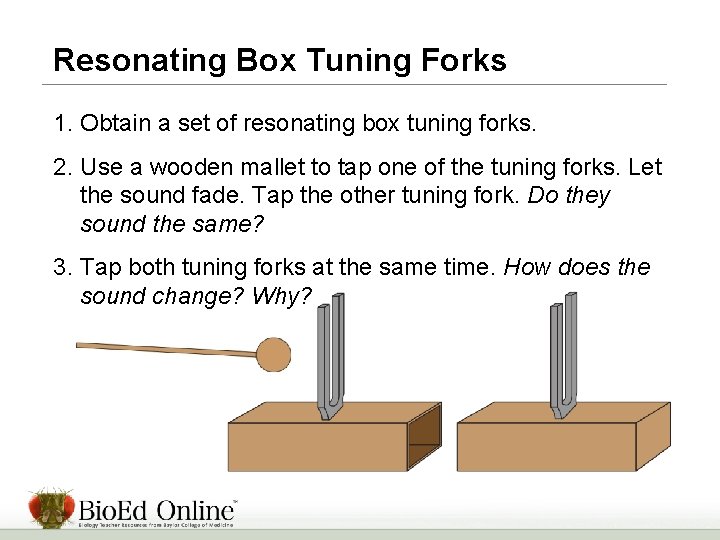
Resonating Box Tuning Forks 1. Obtain a set of resonating box tuning forks. 2. Use a wooden mallet to tap one of the tuning forks. Let the sound fade. Tap the other tuning fork. Do they sound the same? 3. Tap both tuning forks at the same time. How does the sound change? Why?
- Slides: 6