
A Sophomoric Introduction to SharedMemory Parallelism and Concurrency

- Slides: 28
A Sophomoric Introduction to Shared-Memory Parallelism and Concurrency Lecture 4 Shared-Memory Concurrency & Mutual Exclusion Dan Grossman Last Updated: January 2016 For more information, see http: //www. cs. washington. edu/homes/djg/teaching. Materials/
Toward sharing resources (memory) Have been studying parallel algorithms using fork-join – Lower span via parallel tasks Algorithms all had a very simple structure to avoid race conditions – Each thread had memory “only it accessed” • Example: array sub-range – On fork, “loan” some memory to “forkee” and do not access that memory again until after join on the “forkee” Strategy won’t work well when: – Memory accessed by threads is overlapping or unpredictable – Threads are doing independent tasks needing access to same resources (rather than implementing the same algorithm) Sophomoric Parallelism & Concurrency, Lecture 4 2
Concurrent Programming Concurrency: Correctly and efficiently managing access to shared resources from multiple possibly-simultaneous clients Requires coordination, particularly synchronization to avoid incorrect simultaneous access: make somebody block – join is not what we want – Want to block until another thread is “done using what we need” not “completely done executing” Even correct concurrent applications are usually highly -deterministic: how threads are scheduled affects what operations from other threads they see when – non-repeatability complicates testing and debugging Sophomoric Parallelism & Concurrency, Lecture 4 non 3
Examples Multiple threads: 1. Processing different bank-account operations – What if 2 threads change the same account at the same time? 2. Using a shared cache of recent files (e. g. , hashtable) – What if 2 threads insert the same file at the same time? 3. Creating a pipeline (think assembly line) with a queue for handing work to next thread in sequence? – What if enqueuer and dequeuer adjust a circular array queue at the same time? Sophomoric Parallelism & Concurrency, Lecture 4 4
Why threads? Unlike parallelism, not about implementing algorithms faster But threads still useful for: • Code structure for responsiveness – Example: Respond to GUI events in one thread while another thread is performing an expensive computation • Processor utilization (mask I/O latency) – If 1 thread “goes to disk, ” have something else to do • Failure isolation – Convenient structure if want to interleave multiple tasks and do not want an exception in one to stop the other Sophomoric Parallelism & Concurrency, Lecture 4 5
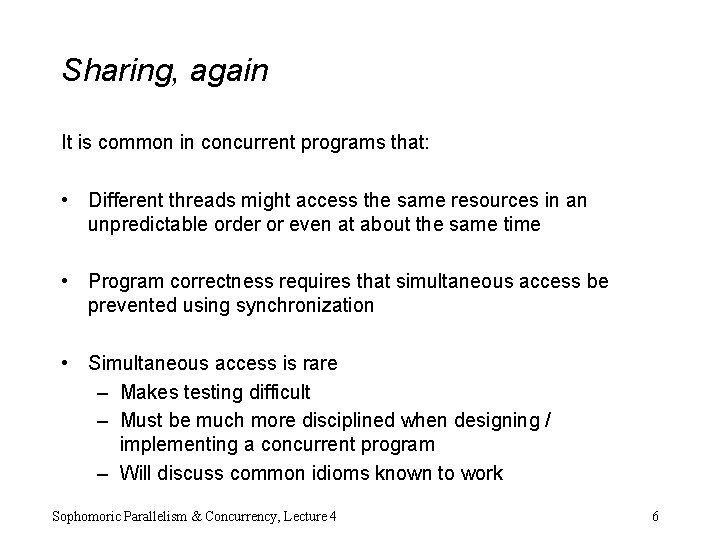
Sharing, again It is common in concurrent programs that: • Different threads might access the same resources in an unpredictable order or even at about the same time • Program correctness requires that simultaneous access be prevented using synchronization • Simultaneous access is rare – Makes testing difficult – Must be much more disciplined when designing / implementing a concurrent program – Will discuss common idioms known to work Sophomoric Parallelism & Concurrency, Lecture 4 6
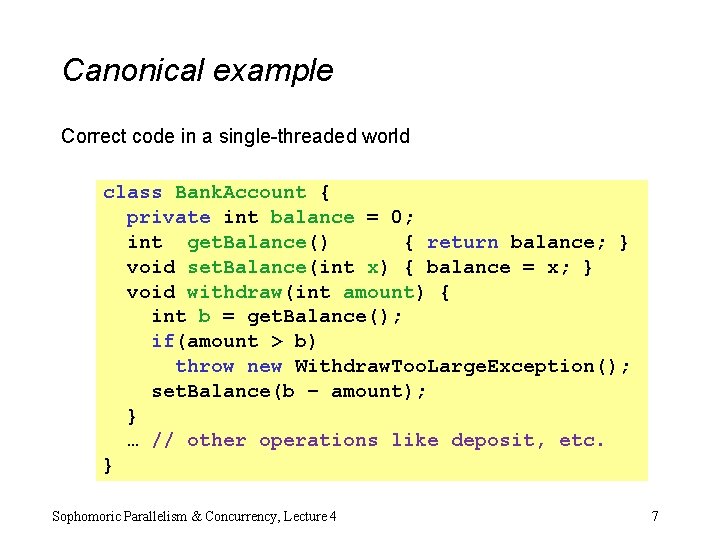
Canonical example Correct code in a single-threaded world class Bank. Account { private int balance = 0; int get. Balance() { return balance; } void set. Balance(int x) { balance = x; } void withdraw(int amount) { int b = get. Balance(); if(amount > b) throw new Withdraw. Too. Large. Exception(); set. Balance(b – amount); } … // other operations like deposit, etc. } Sophomoric Parallelism & Concurrency, Lecture 4 7
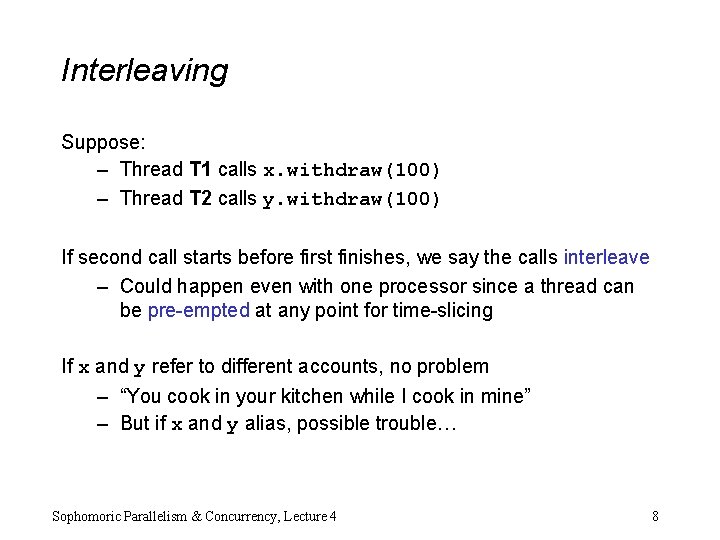
Interleaving Suppose: – Thread T 1 calls x. withdraw(100) – Thread T 2 calls y. withdraw(100) If second call starts before first finishes, we say the calls interleave – Could happen even with one processor since a thread can be pre-empted at any point for time-slicing If x and y refer to different accounts, no problem – “You cook in your kitchen while I cook in mine” – But if x and y alias, possible trouble… Sophomoric Parallelism & Concurrency, Lecture 4 8
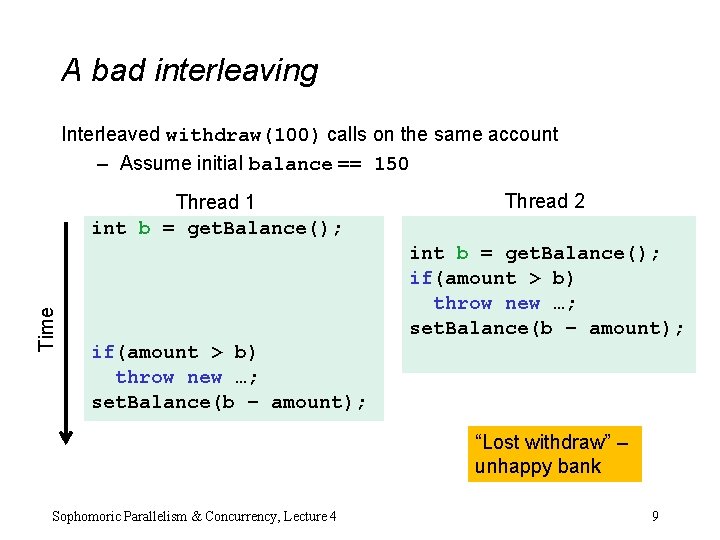
A bad interleaving Interleaved withdraw(100) calls on the same account – Assume initial balance == 150 Time Thread 1 int b = get. Balance(); Thread 2 int b = get. Balance(); if(amount > b) throw new …; set. Balance(b – amount); “Lost withdraw” – unhappy bank Sophomoric Parallelism & Concurrency, Lecture 4 9
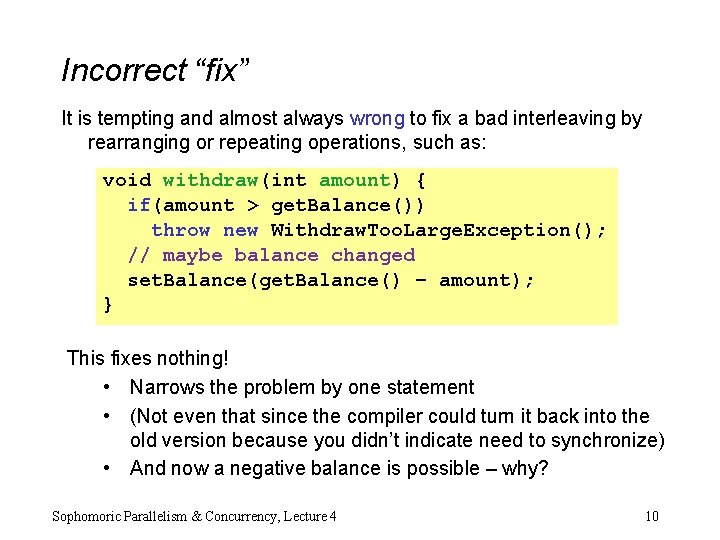
Incorrect “fix” It is tempting and almost always wrong to fix a bad interleaving by rearranging or repeating operations, such as: void withdraw(int amount) { if(amount > get. Balance()) throw new Withdraw. Too. Large. Exception(); // maybe balance changed set. Balance(get. Balance() – amount); } This fixes nothing! • Narrows the problem by one statement • (Not even that since the compiler could turn it back into the old version because you didn’t indicate need to synchronize) • And now a negative balance is possible – why? Sophomoric Parallelism & Concurrency, Lecture 4 10
Mutual exclusion Sane fix: Allow at most one thread to withdraw from account A at a time – Exclude other simultaneous operations on A too (e. g. , deposit) Called mutual exclusion: One thread using a resource (here: an account) means another thread must wait – a. k. a. critical sections, which technically have other requirements Programmer must implement critical sections – “The compiler” has no idea what interleavings should or should not be allowed in your program – Buy you need language primitives to do it! Sophomoric Parallelism & Concurrency, Lecture 4 11
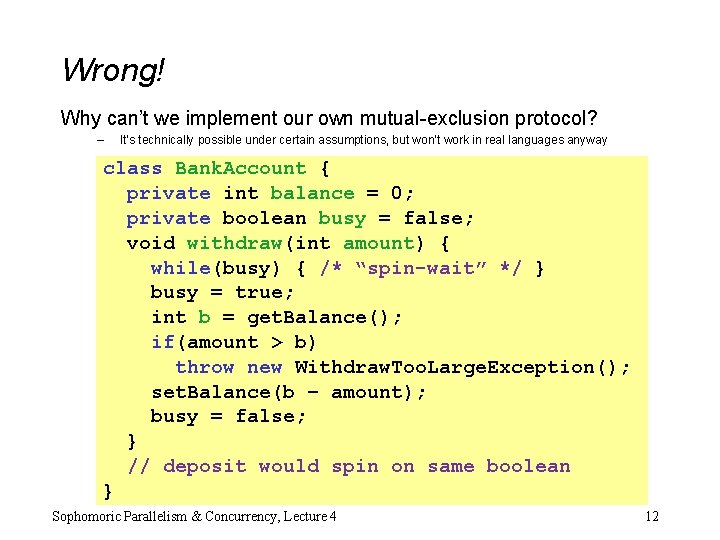
Wrong! Why can’t we implement our own mutual-exclusion protocol? – It’s technically possible under certain assumptions, but won’t work in real languages anyway class Bank. Account { private int balance = 0; private boolean busy = false; void withdraw(int amount) { while(busy) { /* “spin-wait” */ } busy = true; int b = get. Balance(); if(amount > b) throw new Withdraw. Too. Large. Exception(); set. Balance(b – amount); busy = false; } // deposit would spin on same boolean } Sophomoric Parallelism & Concurrency, Lecture 4 12
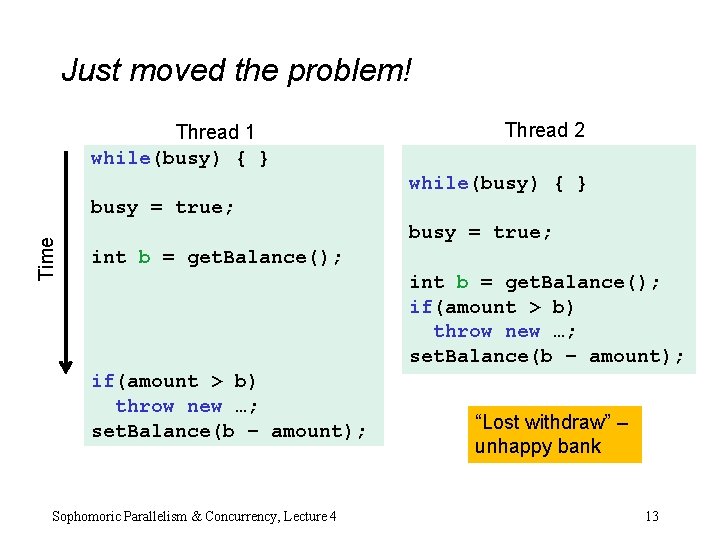
Just moved the problem! Thread 1 while(busy) { } Thread 2 while(busy) { } Time busy = true; int b = get. Balance(); if(amount > b) throw new …; set. Balance(b – amount); Sophomoric Parallelism & Concurrency, Lecture 4 “Lost withdraw” – unhappy bank 13
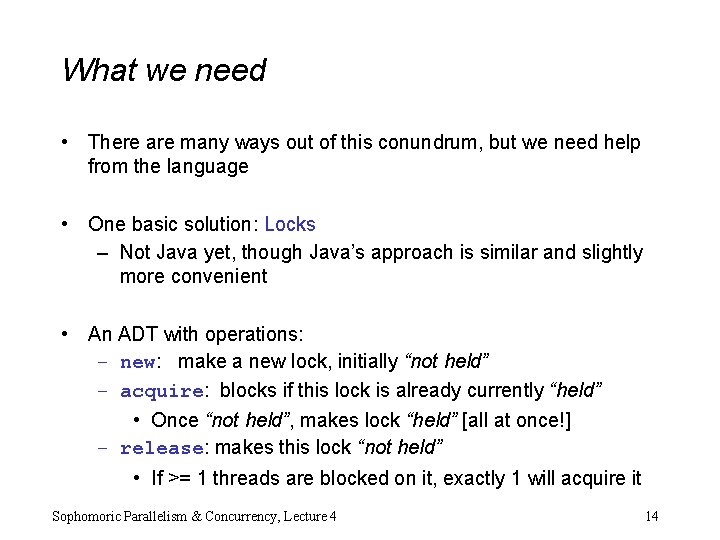
What we need • There are many ways out of this conundrum, but we need help from the language • One basic solution: Locks – Not Java yet, though Java’s approach is similar and slightly more convenient • An ADT with operations: – new: make a new lock, initially “not held” – acquire: blocks if this lock is already currently “held” • Once “not held”, makes lock “held” [all at once!] – release: makes this lock “not held” • If >= 1 threads are blocked on it, exactly 1 will acquire it Sophomoric Parallelism & Concurrency, Lecture 4 14
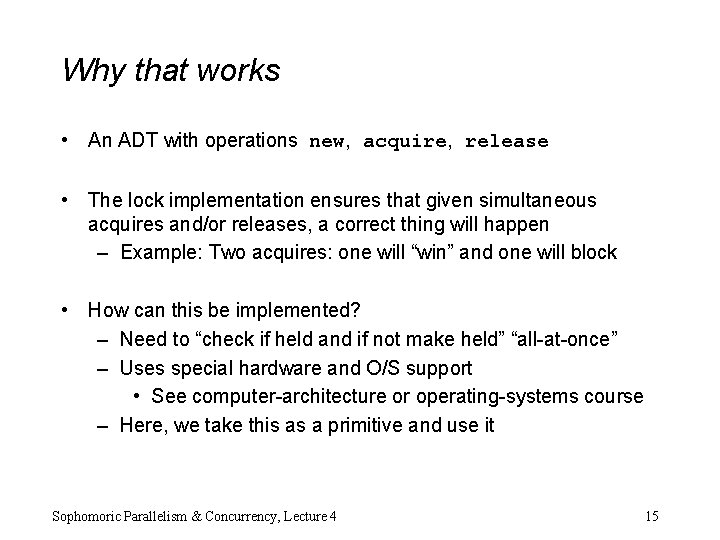
Why that works • An ADT with operations new, acquire, release • The lock implementation ensures that given simultaneous acquires and/or releases, a correct thing will happen – Example: Two acquires: one will “win” and one will block • How can this be implemented? – Need to “check if held and if not make held” “all-at-once” – Uses special hardware and O/S support • See computer-architecture or operating-systems course – Here, we take this as a primitive and use it Sophomoric Parallelism & Concurrency, Lecture 4 15
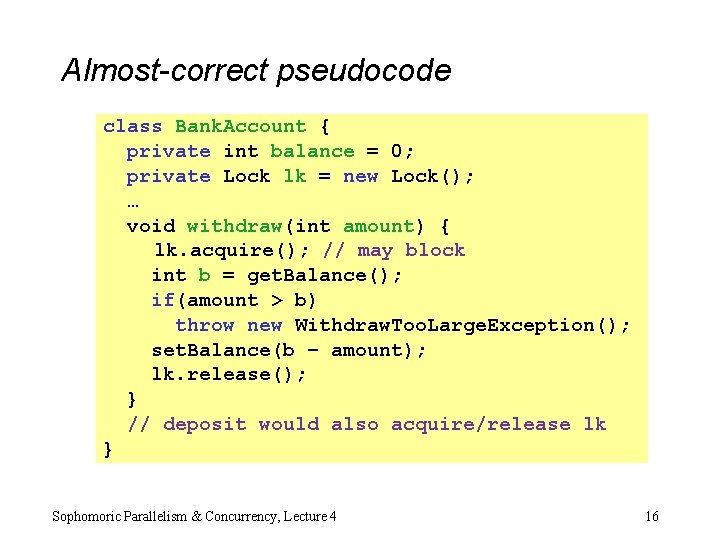
Almost-correct pseudocode class Bank. Account { private int balance = 0; private Lock lk = new Lock(); … void withdraw(int amount) { lk. acquire(); // may block int b = get. Balance(); if(amount > b) throw new Withdraw. Too. Large. Exception(); set. Balance(b – amount); lk. release(); } // deposit would also acquire/release lk } Sophomoric Parallelism & Concurrency, Lecture 4 16
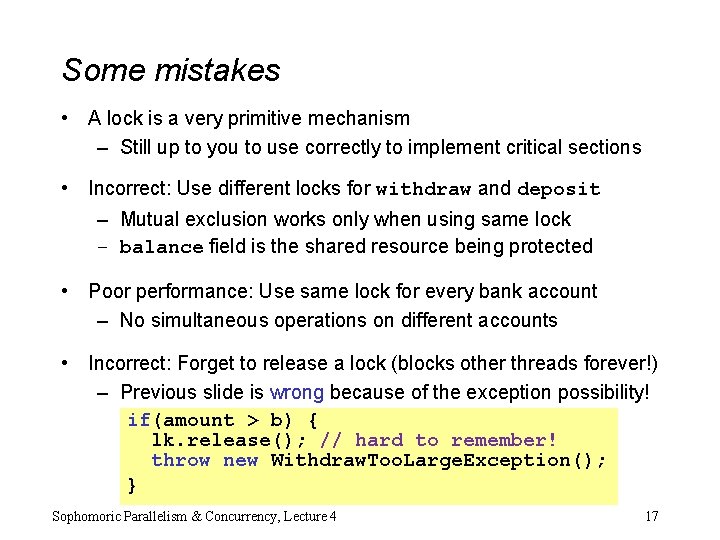
Some mistakes • A lock is a very primitive mechanism – Still up to you to use correctly to implement critical sections • Incorrect: Use different locks for withdraw and deposit – Mutual exclusion works only when using same lock – balance field is the shared resource being protected • Poor performance: Use same lock for every bank account – No simultaneous operations on different accounts • Incorrect: Forget to release a lock (blocks other threads forever!) – Previous slide is wrong because of the exception possibility! if(amount > b) { lk. release(); // hard to remember! throw new Withdraw. Too. Large. Exception(); } Sophomoric Parallelism & Concurrency, Lecture 4 17
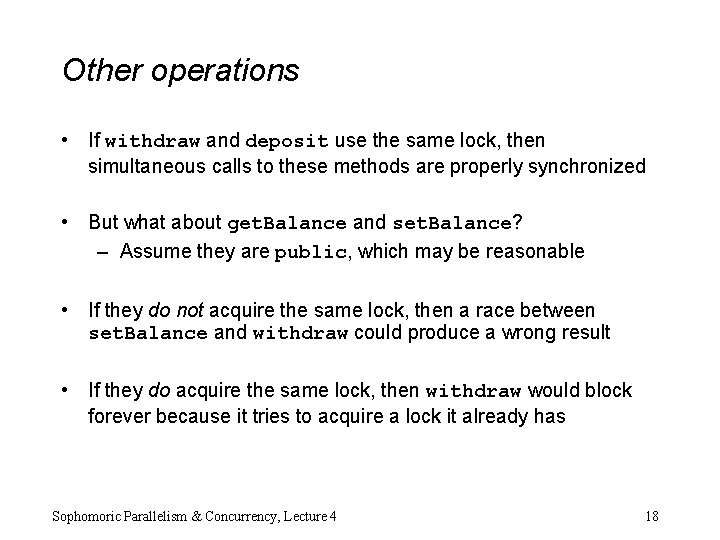
Other operations • If withdraw and deposit use the same lock, then simultaneous calls to these methods are properly synchronized • But what about get. Balance and set. Balance? – Assume they are public, which may be reasonable • If they do not acquire the same lock, then a race between set. Balance and withdraw could produce a wrong result • If they do acquire the same lock, then withdraw would block forever because it tries to acquire a lock it already has Sophomoric Parallelism & Concurrency, Lecture 4 18
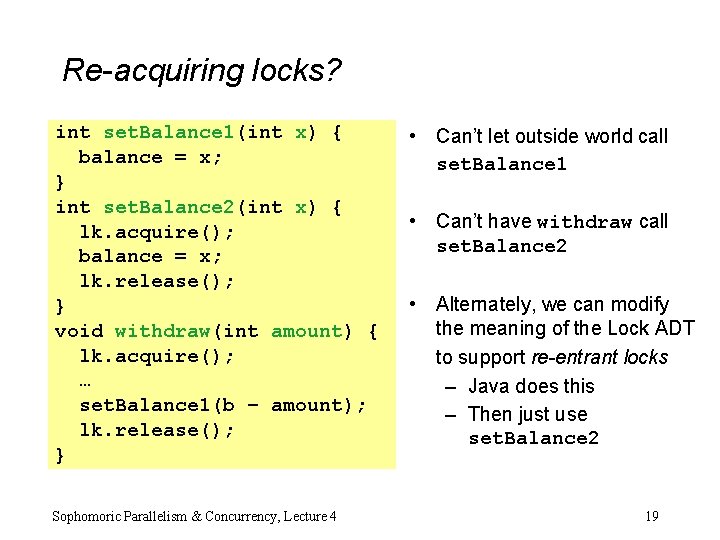
Re-acquiring locks? int set. Balance 1(int x) { balance = x; } int set. Balance 2(int x) { lk. acquire(); balance = x; lk. release(); } void withdraw(int amount) { lk. acquire(); … set. Balance 1(b – amount); lk. release(); } Sophomoric Parallelism & Concurrency, Lecture 4 • Can’t let outside world call set. Balance 1 • Can’t have withdraw call set. Balance 2 • Alternately, we can modify the meaning of the Lock ADT to support re-entrant locks – Java does this – Then just use set. Balance 2 19
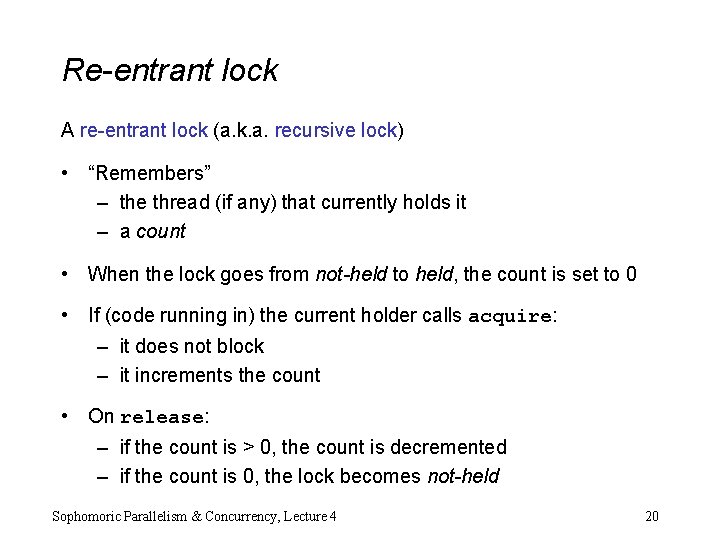
Re-entrant lock A re-entrant lock (a. k. a. recursive lock) • “Remembers” – the thread (if any) that currently holds it – a count • When the lock goes from not-held to held, the count is set to 0 • If (code running in) the current holder calls acquire: – it does not block – it increments the count • On release: – if the count is > 0, the count is decremented – if the count is 0, the lock becomes not-held Sophomoric Parallelism & Concurrency, Lecture 4 20
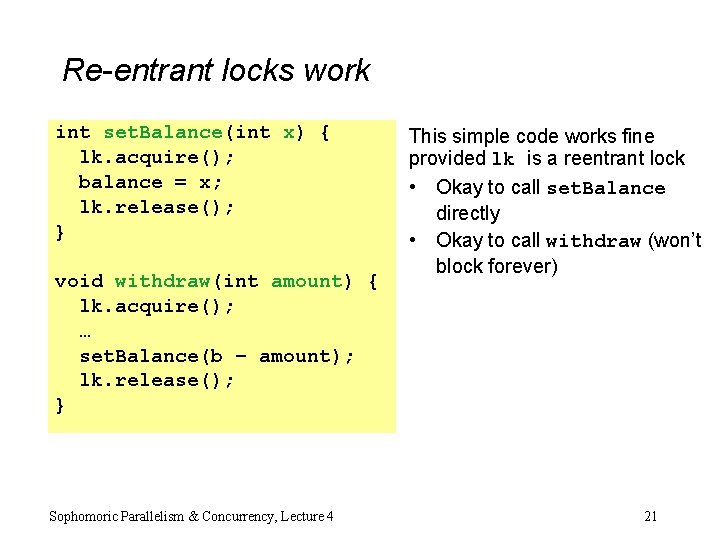
Re-entrant locks work int set. Balance(int x) { lk. acquire(); balance = x; lk. release(); } void withdraw(int amount) { lk. acquire(); … set. Balance(b – amount); lk. release(); } Sophomoric Parallelism & Concurrency, Lecture 4 This simple code works fine provided lk is a reentrant lock • Okay to call set. Balance directly • Okay to call withdraw (won’t block forever) 21
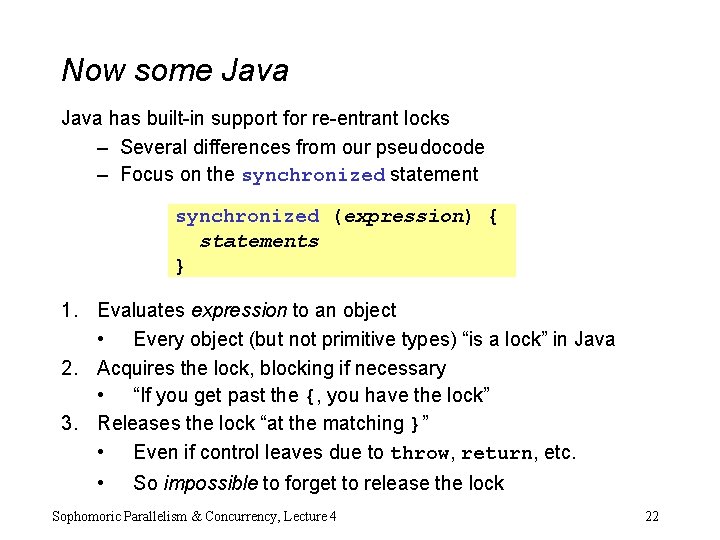
Now some Java has built-in support for re-entrant locks – Several differences from our pseudocode – Focus on the synchronized statement synchronized (expression) { statements } 1. Evaluates expression to an object • Every object (but not primitive types) “is a lock” in Java 2. Acquires the lock, blocking if necessary • “If you get past the {, you have the lock” 3. Releases the lock “at the matching }” • Even if control leaves due to throw, return, etc. • So impossible to forget to release the lock Sophomoric Parallelism & Concurrency, Lecture 4 22
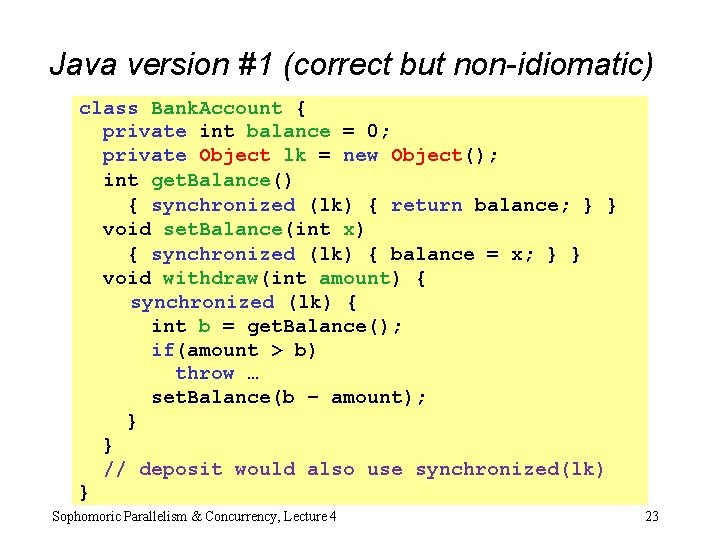
Java version #1 (correct but non-idiomatic) class Bank. Account { private int balance = 0; private Object lk = new Object(); int get. Balance() { synchronized (lk) { return balance; } } void set. Balance(int x) { synchronized (lk) { balance = x; } } void withdraw(int amount) { synchronized (lk) { int b = get. Balance(); if(amount > b) throw … set. Balance(b – amount); } } // deposit would also use synchronized(lk) } Sophomoric Parallelism & Concurrency, Lecture 4 23
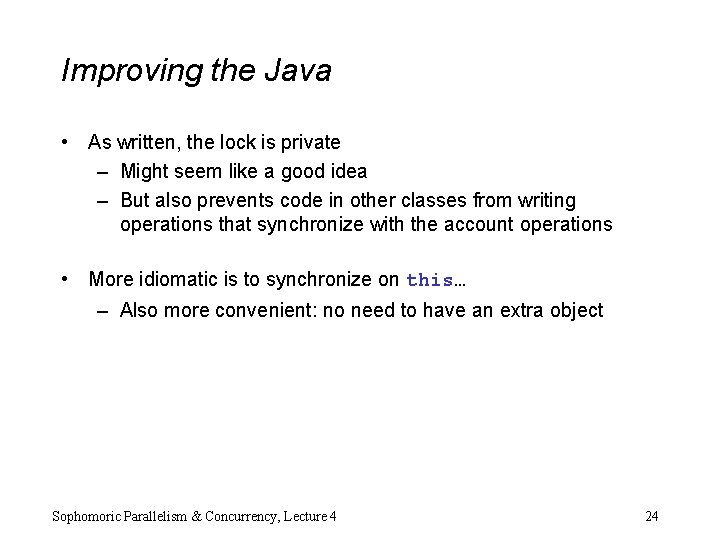
Improving the Java • As written, the lock is private – Might seem like a good idea – But also prevents code in other classes from writing operations that synchronize with the account operations • More idiomatic is to synchronize on this… – Also more convenient: no need to have an extra object Sophomoric Parallelism & Concurrency, Lecture 4 24
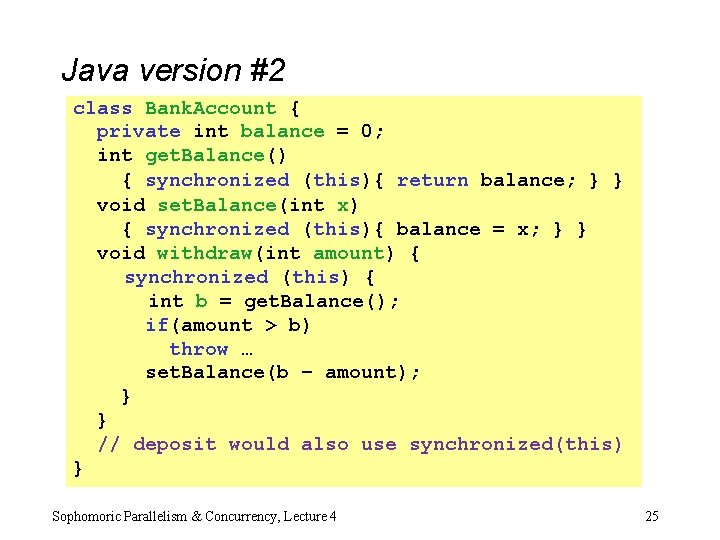
Java version #2 class Bank. Account { private int balance = 0; int get. Balance() { synchronized (this){ return balance; } } void set. Balance(int x) { synchronized (this){ balance = x; } } void withdraw(int amount) { synchronized (this) { int b = get. Balance(); if(amount > b) throw … set. Balance(b – amount); } } // deposit would also use synchronized(this) } Sophomoric Parallelism & Concurrency, Lecture 4 25
Syntactic sugar Version #2 is slightly poor style because there is a shorter way to say the same thing: Putting synchronized before a method declaration means the entire method body is surrounded by synchronized(this){…} Therefore, version #3 (next slide) means exactly the same thing as version #2 but is more concise Sophomoric Parallelism & Concurrency, Lecture 4 26
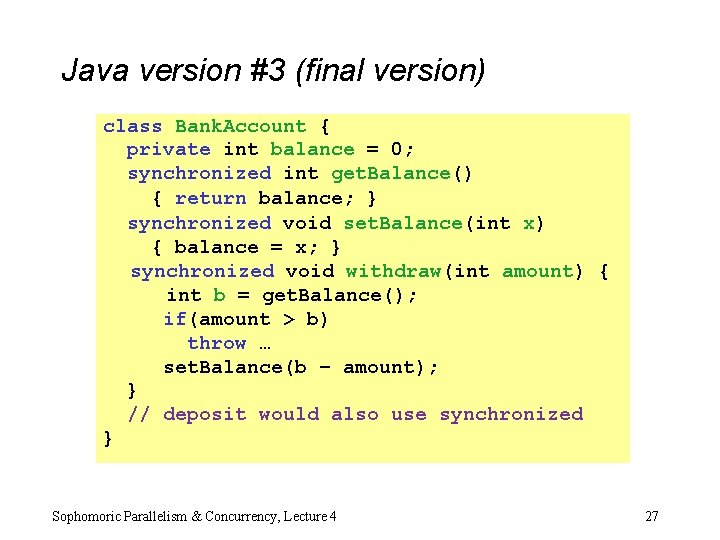
Java version #3 (final version) class Bank. Account { private int balance = 0; synchronized int get. Balance() { return balance; } synchronized void set. Balance(int x) { balance = x; } synchronized void withdraw(int amount) { int b = get. Balance(); if(amount > b) throw … set. Balance(b – amount); } // deposit would also use synchronized } Sophomoric Parallelism & Concurrency, Lecture 4 27
More Java notes • Class java. util. concurrent. locks. Reentrant. Lock works much more like our pseudocode – Often use try { … } finally { … } to avoid forgetting to release the lock if there’s an exception • Also library and/or language support for readers/writer locks and condition variables (future lecture) • Java provides many other features and details. See, for example: – Chapter 14 of Core. Java, Volume 1 by Horstmann/Cornell – Java Concurrency in Practice by Goetz et al Sophomoric Parallelism & Concurrency, Lecture 4 28