
A Sophomoric Introduction to SharedMemory Parallelism and Concurrency
- Slides: 27
A Sophomoric Introduction to Shared-Memory Parallelism and Concurrency Lecture 2 Analysis of Fork-Join Parallel Programs Dan Grossman Last Updated: January 2016 For more information, see http: //www. cs. washington. edu/homes/djg/teaching. Materials/
Outline Done: • How to use fork and join to write a parallel algorithm • Why using divide-and-conquer with lots of small tasks is best – Combines results in parallel • Some Java and Fork. Join Framework specifics – More pragmatics (e. g. , installation) in separate notes Now: • More examples of simple parallel programs • Arrays & balanced trees support parallelism better than linked lists • Asymptotic analysis fork-join parallelism • Amdahl’s Law Sophomoric Parallelism and Concurrency, Lecture 2 2
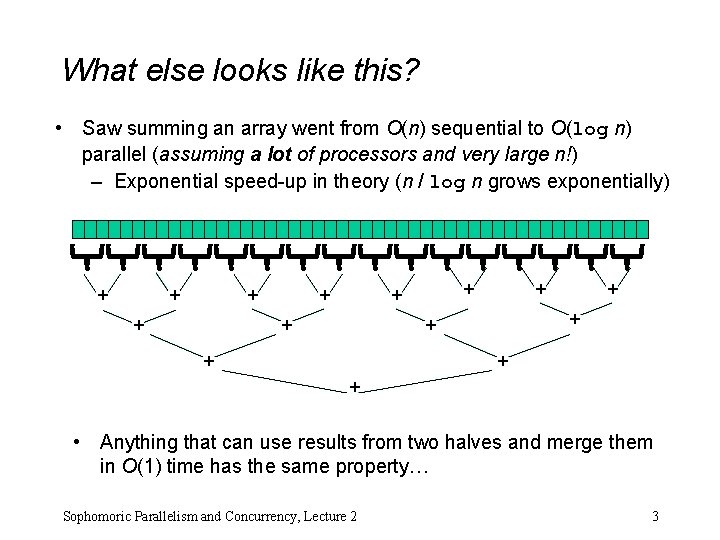
What else looks like this? • Saw summing an array went from O(n) sequential to O(log n) parallel (assuming a lot of processors and very large n!) – Exponential speed-up in theory (n / log n grows exponentially) + + + + • Anything that can use results from two halves and merge them in O(1) time has the same property… Sophomoric Parallelism and Concurrency, Lecture 2 3
Examples • Maximum or minimum element • Is there an element satisfying some property (e. g. , is there a 17)? • Left-most element satisfying some property (e. g. , first 17) – What should the recursive tasks return? – How should we merge the results? • Corners of a rectangle containing all points (a “bounding box”) • Counts, for example, number of strings that start with a vowel – This is just summing with a different base case – Many problems are! Sophomoric Parallelism and Concurrency, Lecture 2 4
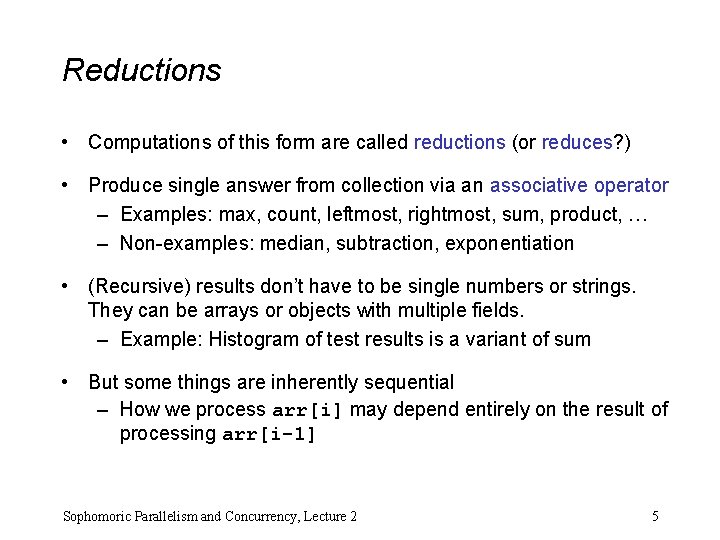
Reductions • Computations of this form are called reductions (or reduces? ) • Produce single answer from collection via an associative operator – Examples: max, count, leftmost, rightmost, sum, product, … – Non-examples: median, subtraction, exponentiation • (Recursive) results don’t have to be single numbers or strings. They can be arrays or objects with multiple fields. – Example: Histogram of test results is a variant of sum • But some things are inherently sequential – How we process arr[i] may depend entirely on the result of processing arr[i-1] Sophomoric Parallelism and Concurrency, Lecture 2 5
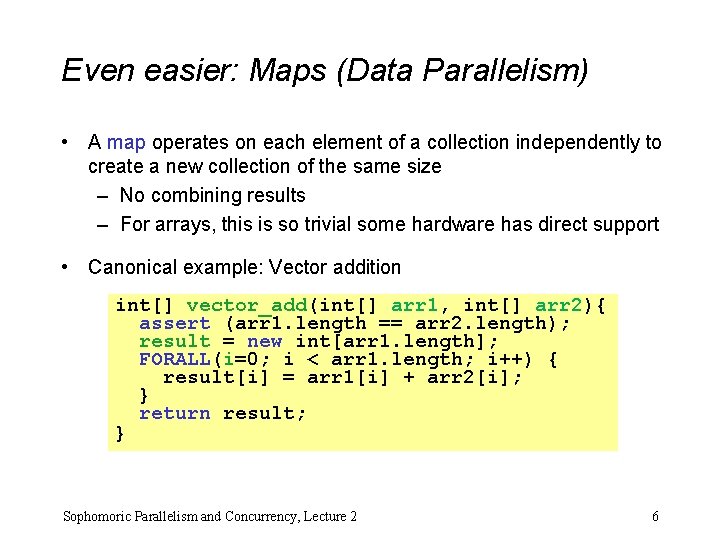
Even easier: Maps (Data Parallelism) • A map operates on each element of a collection independently to create a new collection of the same size – No combining results – For arrays, this is so trivial some hardware has direct support • Canonical example: Vector addition int[] vector_add(int[] arr 1, int[] arr 2){ assert (arr 1. length == arr 2. length); result = new int[arr 1. length]; FORALL(i=0; i < arr 1. length; i++) { result[i] = arr 1[i] + arr 2[i]; } return result; } Sophomoric Parallelism and Concurrency, Lecture 2 6
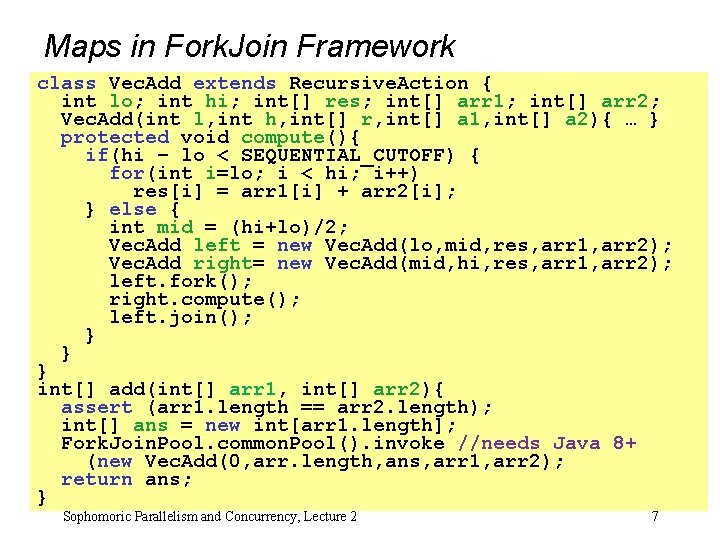
Maps in Fork. Join Framework class Vec. Add extends Recursive. Action { int lo; int hi; int[] res; int[] arr 1; int[] arr 2; Vec. Add(int r, int[] a 1, int[] … } • Even thoughl, int there ish, int[] no result-combining, it still helps a 2){ with load protected void compute(){ balancing to create many small tasks if(hi – lo < SEQUENTIAL_CUTOFF) { –for(int Maybe noti=lo; for vector-add buti++) for more compute-intensive maps i < hi; res[i] =is arr 1[i] + arr 2[i]; – The forking O(log n) whereas theoretically other approaches } else { to vector-add is O(1) int mid = (hi+lo)/2; Vec. Add left = new Vec. Add(lo, mid, res, arr 1, arr 2); Vec. Add right= new Vec. Add(mid, hi, res, arr 1, arr 2); left. fork(); right. compute(); left. join(); } } } int[] add(int[] arr 1, int[] arr 2){ assert (arr 1. length == arr 2. length); int[] ans = new int[arr 1. length]; Fork. Join. Pool. common. Pool(). invoke //needs Java 8+ (new Vec. Add(0, arr. length, ans, arr 1, arr 2); return ans; } Sophomoric Parallelism and Concurrency, Lecture 2 7
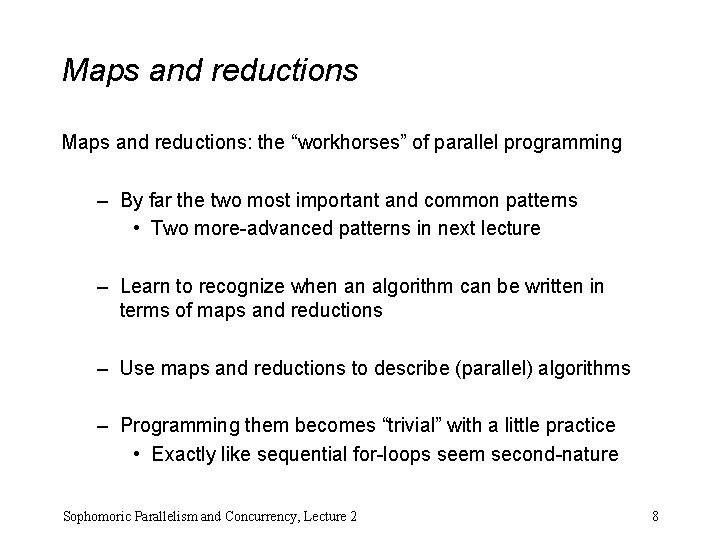
Maps and reductions: the “workhorses” of parallel programming – By far the two most important and common patterns • Two more-advanced patterns in next lecture – Learn to recognize when an algorithm can be written in terms of maps and reductions – Use maps and reductions to describe (parallel) algorithms – Programming them becomes “trivial” with a little practice • Exactly like sequential for-loops seem second-nature Sophomoric Parallelism and Concurrency, Lecture 2 8
Digression: Map. Reduce on clusters • You may have heard of Google’s “map/reduce” – Or the open-source version Hadoop • Idea: Perform maps/reduces on data using many machines – The system takes care of distributing the data and managing fault tolerance – You just write code to map one element and reduce elements to a combined result • Separates how to do recursive divide-and-conquer from what computation to perform – Old idea in higher-order functional programming transferred to large-scale distributed computing – Complementary approach to declarative queries for databases Sophomoric Parallelism and Concurrency, Lecture 2 9
Trees • Maps and reductions work just fine on balanced trees – Divide-and-conquer each child rather than array subranges – Correct for unbalanced trees, but won’t get much speed-up • Example: minimum element in an unsorted but balanced binary tree in O(log n) time given enough processors • How to do the sequential cut-off? – Store number-of-descendants at each node (easy to maintain) – Or could approximate it with, e. g. , AVL-tree height Sophomoric Parallelism and Concurrency, Lecture 2 10
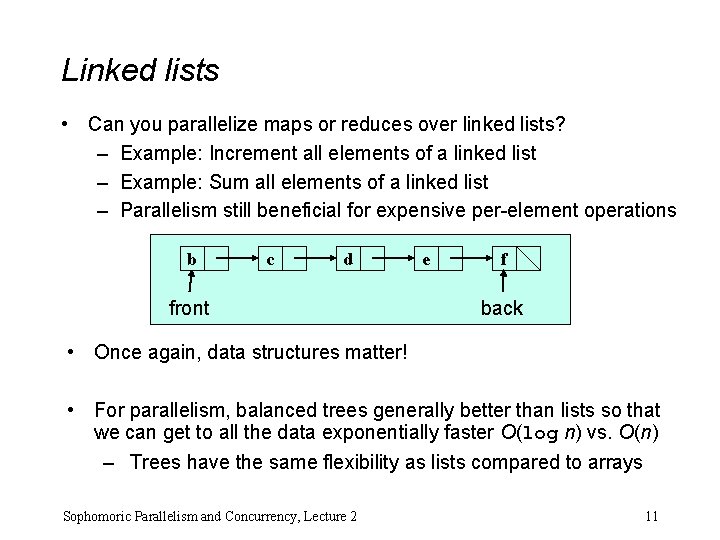
Linked lists • Can you parallelize maps or reduces over linked lists? – Example: Increment all elements of a linked list – Example: Sum all elements of a linked list – Parallelism still beneficial for expensive per-element operations b c d front e f back • Once again, data structures matter! • For parallelism, balanced trees generally better than lists so that we can get to all the data exponentially faster O(log n) vs. O(n) – Trees have the same flexibility as lists compared to arrays Sophomoric Parallelism and Concurrency, Lecture 2 11
Analyzing algorithms • Like all algorithms, parallel algorithms should be: – Correct – Efficient • For our algorithms so far, correctness is “obvious” so we’ll focus on efficiency – Want asymptotic bounds – Want to analyze the algorithm without regard to a specific number of processors – The key “magic” of the Fork. Join Framework is getting expected run-time performance asymptotically optimal for the available number of processors • So we can analyze algorithms assuming this guarantee Sophomoric Parallelism and Concurrency, Lecture 2 12
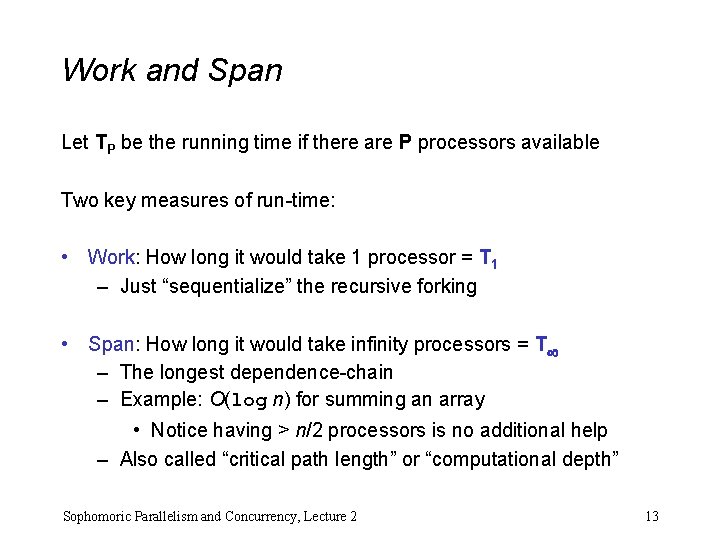
Work and Span Let TP be the running time if there are P processors available Two key measures of run-time: • Work: How long it would take 1 processor = T 1 – Just “sequentialize” the recursive forking • Span: How long it would take infinity processors = T – The longest dependence-chain – Example: O(log n) for summing an array • Notice having > n/2 processors is no additional help – Also called “critical path length” or “computational depth” Sophomoric Parallelism and Concurrency, Lecture 2 13
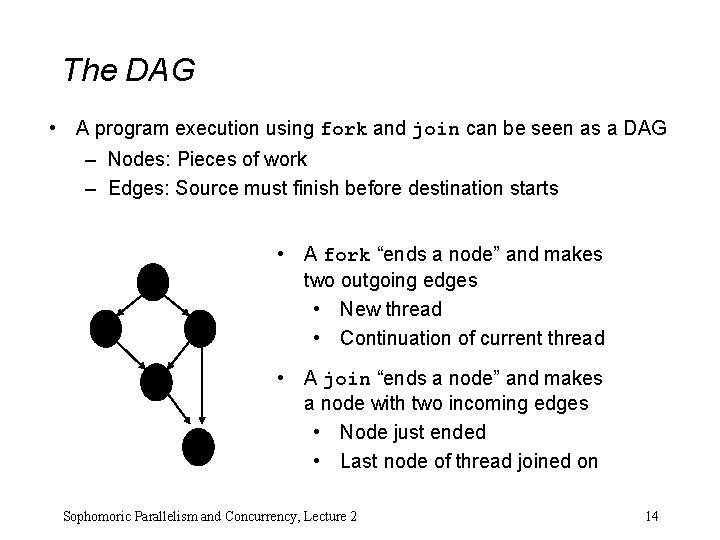
The DAG • A program execution using fork and join can be seen as a DAG – Nodes: Pieces of work – Edges: Source must finish before destination starts • A fork “ends a node” and makes two outgoing edges • New thread • Continuation of current thread • A join “ends a node” and makes a node with two incoming edges • Node just ended • Last node of thread joined on Sophomoric Parallelism and Concurrency, Lecture 2 14
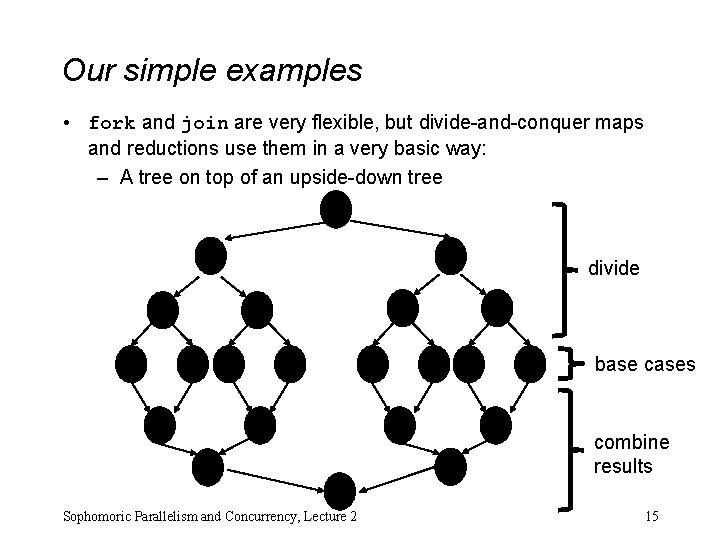
Our simple examples • fork and join are very flexible, but divide-and-conquer maps and reductions use them in a very basic way: – A tree on top of an upside-down tree divide base cases combine results Sophomoric Parallelism and Concurrency, Lecture 2 15
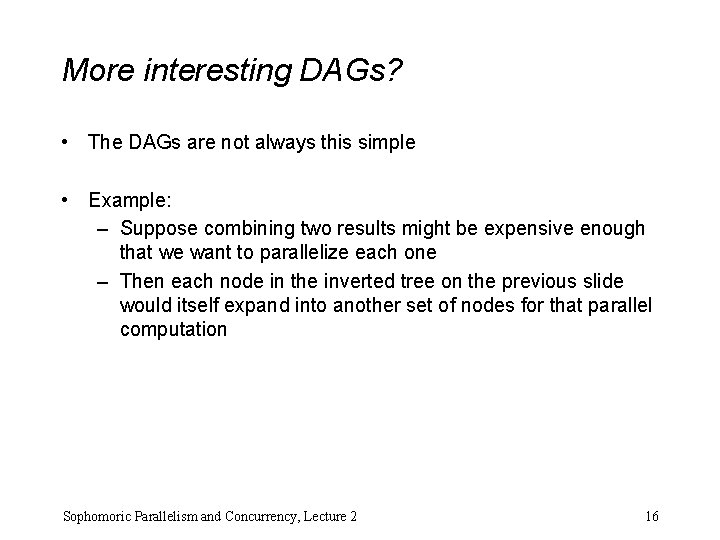
More interesting DAGs? • The DAGs are not always this simple • Example: – Suppose combining two results might be expensive enough that we want to parallelize each one – Then each node in the inverted tree on the previous slide would itself expand into another set of nodes for that parallel computation Sophomoric Parallelism and Concurrency, Lecture 2 16
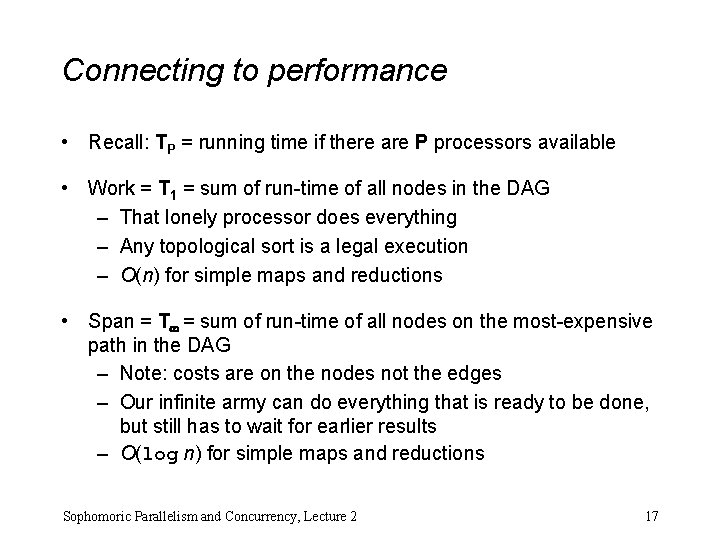
Connecting to performance • Recall: TP = running time if there are P processors available • Work = T 1 = sum of run-time of all nodes in the DAG – That lonely processor does everything – Any topological sort is a legal execution – O(n) for simple maps and reductions • Span = T = sum of run-time of all nodes on the most-expensive path in the DAG – Note: costs are on the nodes not the edges – Our infinite army can do everything that is ready to be done, but still has to wait for earlier results – O(log n) for simple maps and reductions Sophomoric Parallelism and Concurrency, Lecture 2 17
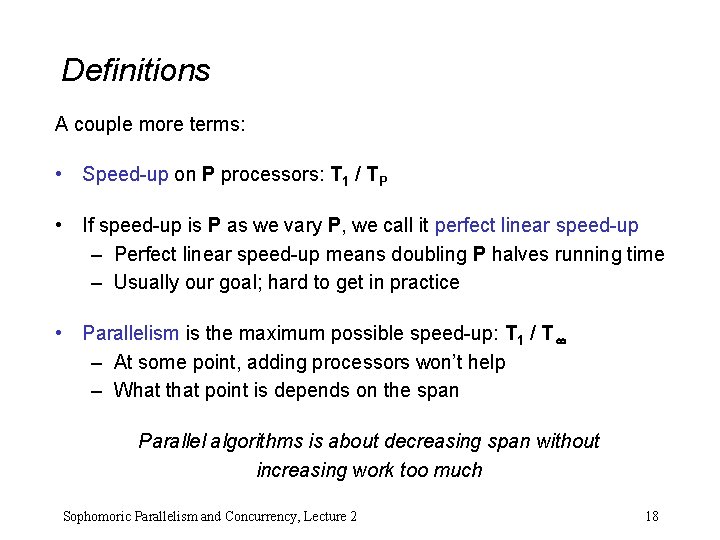
Definitions A couple more terms: • Speed-up on P processors: T 1 / TP • If speed-up is P as we vary P, we call it perfect linear speed-up – Perfect linear speed-up means doubling P halves running time – Usually our goal; hard to get in practice • Parallelism is the maximum possible speed-up: T 1 / T – At some point, adding processors won’t help – What that point is depends on the span Parallel algorithms is about decreasing span without increasing work too much Sophomoric Parallelism and Concurrency, Lecture 2 18
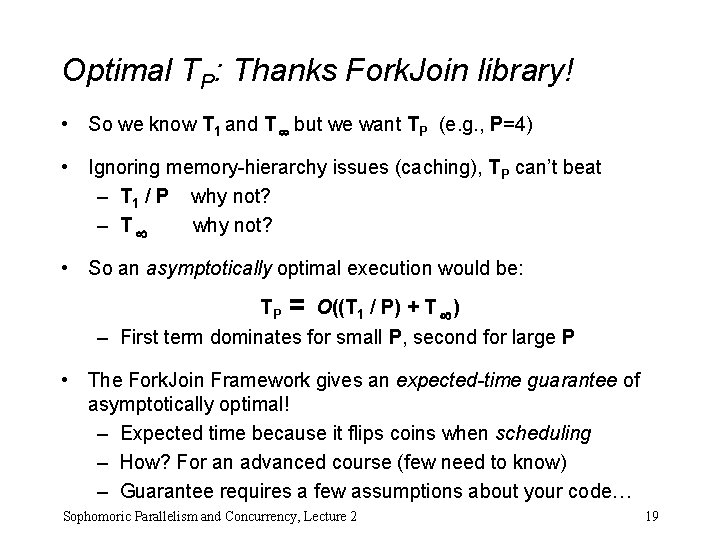
Optimal TP: Thanks Fork. Join library! • So we know T 1 and T but we want TP (e. g. , P=4) • Ignoring memory-hierarchy issues (caching), TP can’t beat – T 1 / P why not? – T why not? • So an asymptotically optimal execution would be: TP = O((T 1 / P) + T ) – First term dominates for small P, second for large P • The Fork. Join Framework gives an expected-time guarantee of asymptotically optimal! – Expected time because it flips coins when scheduling – How? For an advanced course (few need to know) – Guarantee requires a few assumptions about your code… Sophomoric Parallelism and Concurrency, Lecture 2 19
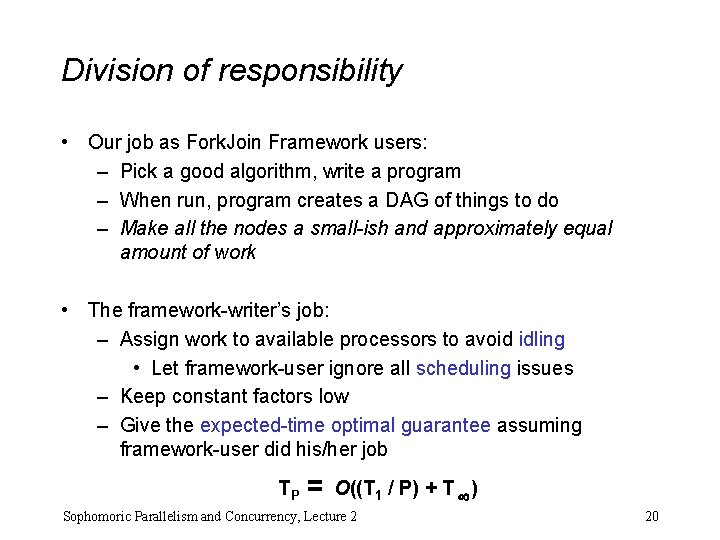
Division of responsibility • Our job as Fork. Join Framework users: – Pick a good algorithm, write a program – When run, program creates a DAG of things to do – Make all the nodes a small-ish and approximately equal amount of work • The framework-writer’s job: – Assign work to available processors to avoid idling • Let framework-user ignore all scheduling issues – Keep constant factors low – Give the expected-time optimal guarantee assuming framework-user did his/her job TP = O((T 1 / P) + T ) Sophomoric Parallelism and Concurrency, Lecture 2 20
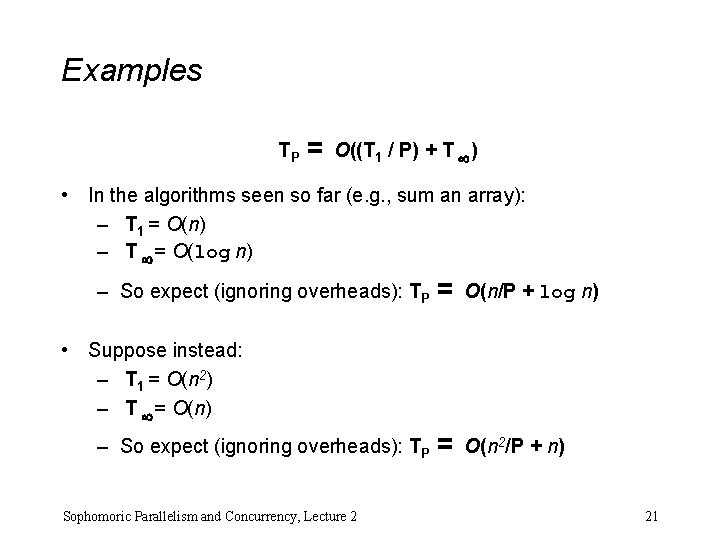
Examples TP = O((T 1 / P) + T ) • In the algorithms seen so far (e. g. , sum an array): – T 1 = O(n) – T = O(log n) – So expect (ignoring overheads): TP = O(n/P + log n) = O(n 2/P + n) • Suppose instead: – T 1 = O(n 2) – T = O(n) – So expect (ignoring overheads): TP Sophomoric Parallelism and Concurrency, Lecture 2 21
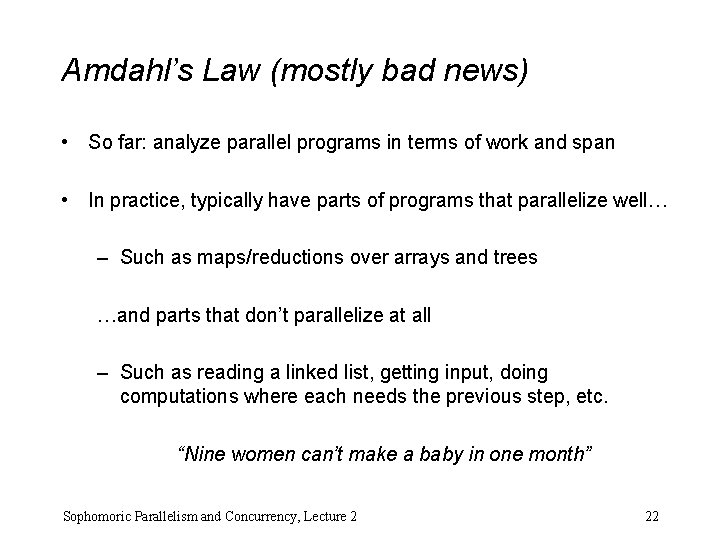
Amdahl’s Law (mostly bad news) • So far: analyze parallel programs in terms of work and span • In practice, typically have parts of programs that parallelize well… – Such as maps/reductions over arrays and trees …and parts that don’t parallelize at all – Such as reading a linked list, getting input, doing computations where each needs the previous step, etc. “Nine women can’t make a baby in one month” Sophomoric Parallelism and Concurrency, Lecture 2 22
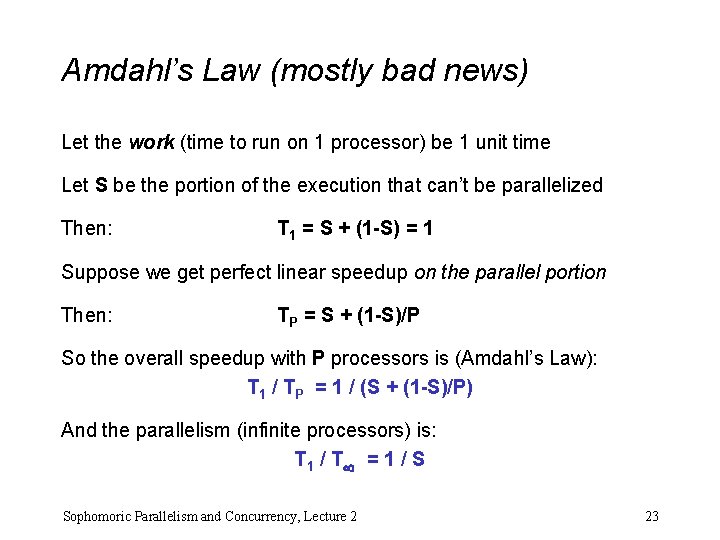
Amdahl’s Law (mostly bad news) Let the work (time to run on 1 processor) be 1 unit time Let S be the portion of the execution that can’t be parallelized Then: T 1 = S + (1 -S) = 1 Suppose we get perfect linear speedup on the parallel portion Then: TP = S + (1 -S)/P So the overall speedup with P processors is (Amdahl’s Law): T 1 / TP = 1 / (S + (1 -S)/P) And the parallelism (infinite processors) is: T 1 / T = 1 / S Sophomoric Parallelism and Concurrency, Lecture 2 23
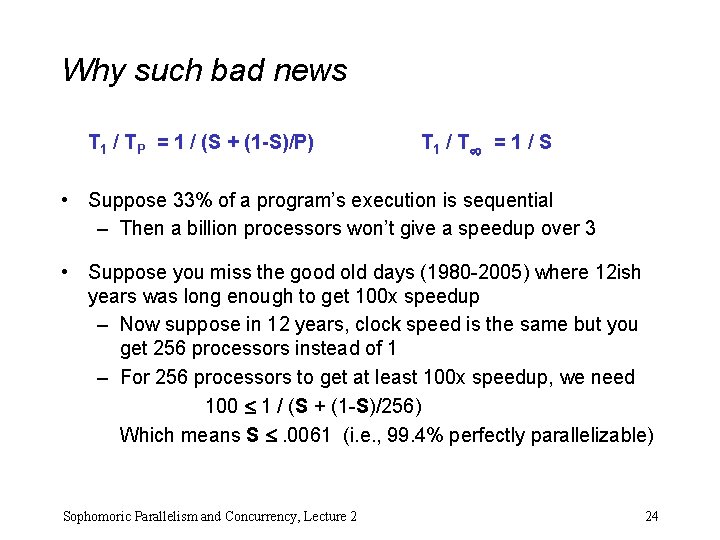
Why such bad news T 1 / TP = 1 / (S + (1 -S)/P) T 1 / T = 1 / S • Suppose 33% of a program’s execution is sequential – Then a billion processors won’t give a speedup over 3 • Suppose you miss the good old days (1980 -2005) where 12 ish years was long enough to get 100 x speedup – Now suppose in 12 years, clock speed is the same but you get 256 processors instead of 1 – For 256 processors to get at least 100 x speedup, we need 100 1 / (S + (1 -S)/256) Which means S . 0061 (i. e. , 99. 4% perfectly parallelizable) Sophomoric Parallelism and Concurrency, Lecture 2 24
Plots you have to see 1. Assume 256 processors – x-axis: sequential portion S, ranging from. 01 to. 25 – y-axis: speedup T 1 / TP (will go down as S increases) 2. Assume S =. 01 or. 25 (three separate lines) – x-axis: number of processors P, ranging from 2 to 32 – y-axis: speedup T 1 / TP (will go up as P increases) Do this as a homework problem! – Chance to use a spreadsheet or other graphing program – Compare against your intuition – A picture is worth 1000 words, especially if you made it Sophomoric Parallelism and Concurrency, Lecture 2 25
All is not lost Amdahl’s Law is a bummer! – Unparallelized parts become a bottleneck very quickly – But it doesn’t mean additional processors are worthless • We can find new parallel algorithms – Some things that seem sequential are actually parallelizable • We can change the problem or do new things – Example: Video games use tons of parallel processors • They are not rendering 10 -year-old graphics faster • They are rendering more beautiful(? ) monsters Sophomoric Parallelism and Concurrency, Lecture 2 26
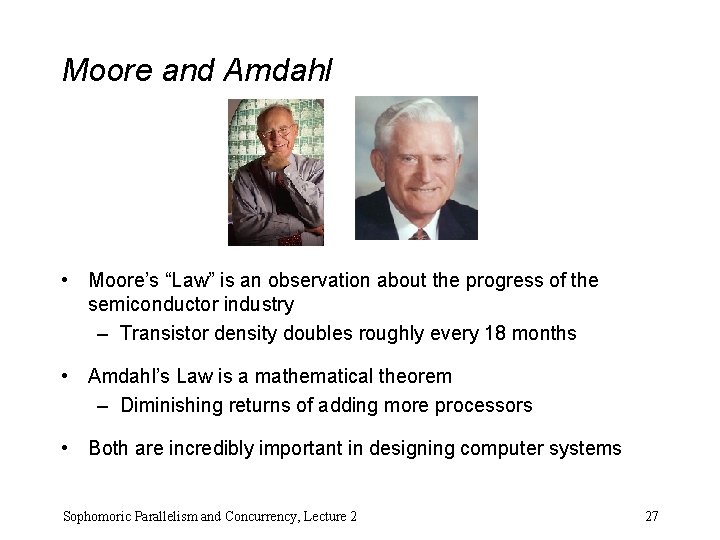
Moore and Amdahl • Moore’s “Law” is an observation about the progress of the semiconductor industry – Transistor density doubles roughly every 18 months • Amdahl’s Law is a mathematical theorem – Diminishing returns of adding more processors • Both are incredibly important in designing computer systems Sophomoric Parallelism and Concurrency, Lecture 2 27