
A solution to the Strong CP problem with
A solution to the Strong CP problem with a softly broken CP symmetry Pedro Ferreira ISEL and CFTC, UL Lisbon, Portugal Harmonia Meeting, 09/09/2019 P. M. Ferreira and L. Lavoura, Eur. Phys. J. C (2019) 79: 552
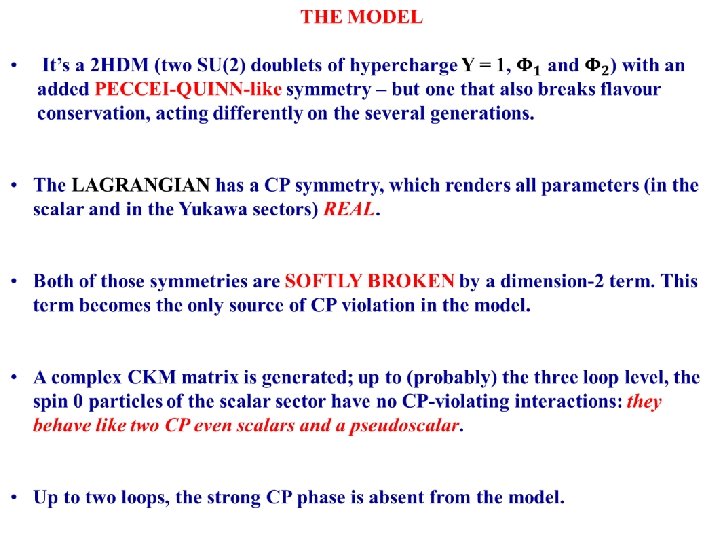
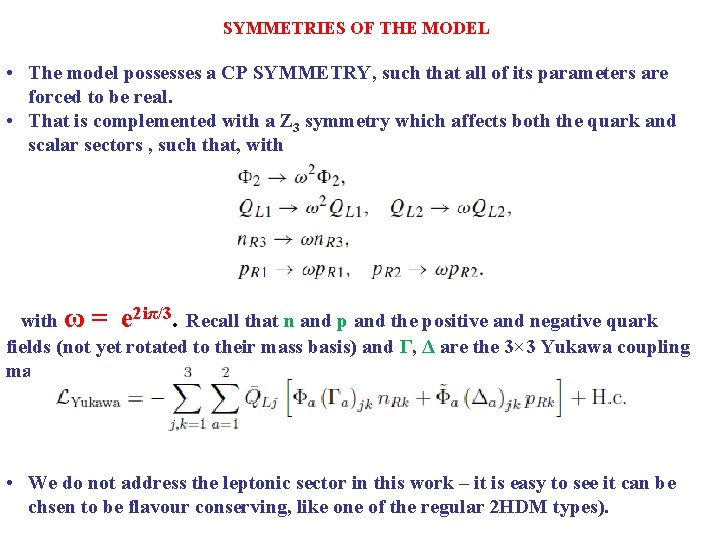
SYMMETRIES OF THE MODEL • The model possesses a CP SYMMETRY, such that all of its parameters are forced to be real. • That is complemented with a Z 3 symmetry which affects both the quark and scalar sectors , such that, with ω = e 2 iπ/3. Recall that n and p and the positive and negative quark fields (not yet rotated to their mass basis) and Γ, Δ are the 3× 3 Yukawa coupling matrices, the Yukawa lagrangian being given by • We do not address the leptonic sector in this work – it is easy to see it can be chsen to be flavour conserving, like one of the regular 2 HDM types).
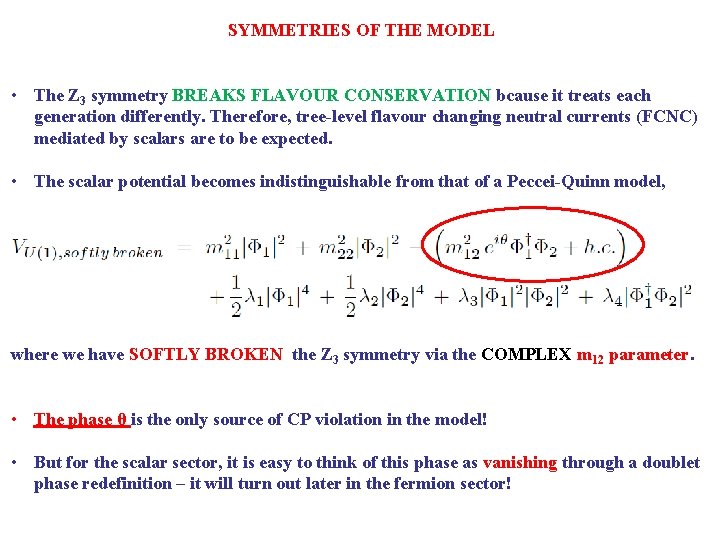
SYMMETRIES OF THE MODEL • The Z 3 symmetry BREAKS FLAVOUR CONSERVATION bcause it treats each generation differently. Therefore, tree-level flavour changing neutral currents (FCNC) mediated by scalars are to be expected. • The scalar potential becomes indistinguishable from that of a Peccei-Quinn model, where we have SOFTLY BROKEN the Z 3 symmetry via the COMPLEX m 12 parameter. • The phase θ is the only source of CP violation in the model! • But for the scalar sector, it is easy to think of this phase as vanishing through a doublet phase redefinition – it will turn out later in the fermion sector!
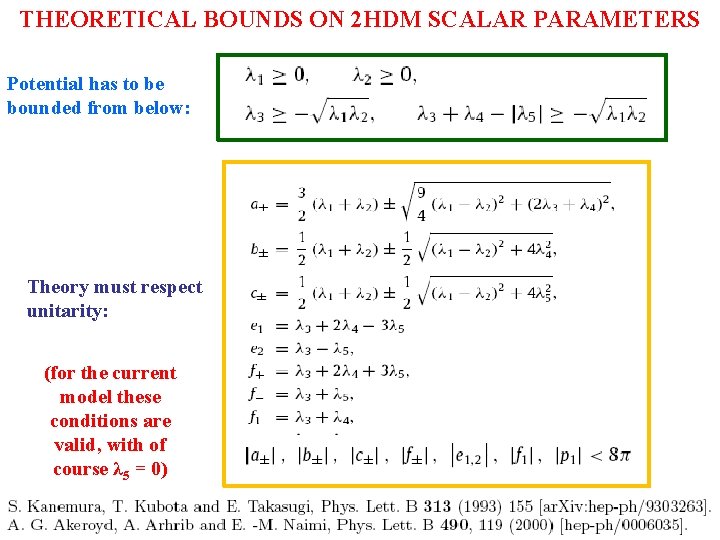
THEORETICAL BOUNDS ON 2 HDM SCALAR PARAMETERS Potential has to be bounded from below: Theory must respect unitarity: (for the current model these conditions are valid, with of course λ 5 = 0)
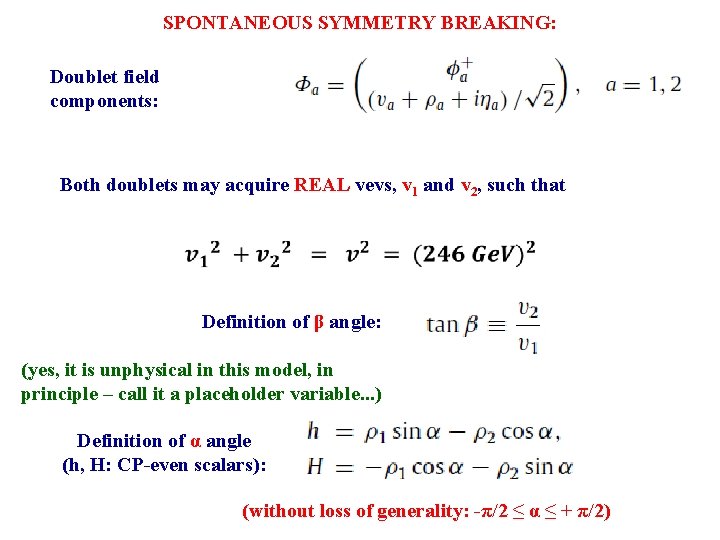
SPONTANEOUS SYMMETRY BREAKING: Doublet field components: Both doublets may acquire REAL vevs, v 1 and v 2, such that Definition of β angle: (yes, it is unphysical in this model, in principle – call it a placeholder variable. . . ) Definition of α angle (h, H: CP-even scalars): (without loss of generality: -π/2 ≤ α ≤ + π/2)
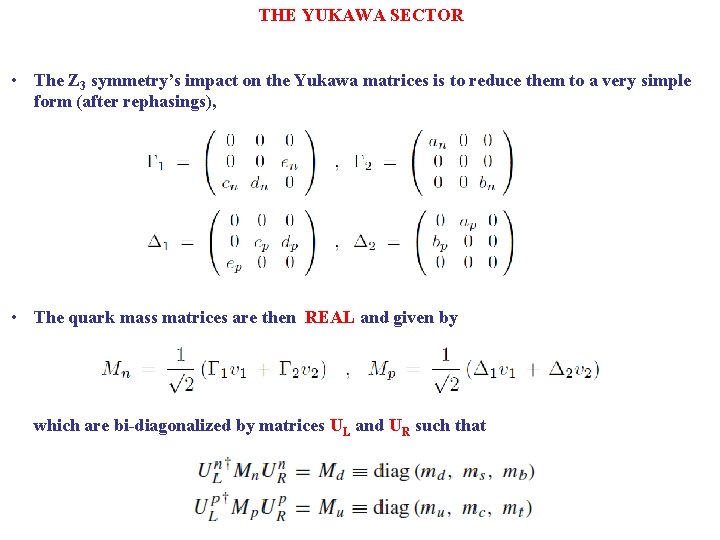
THE YUKAWA SECTOR • The Z 3 symmetry’s impact on the Yukawa matrices is to reduce them to a very simple form (after rephasings), • The quark mass matrices are then REAL and given by which are bi-diagonalized by matrices UL and UR such that


THE YUKAWA SECTOR • But the matrices Nd and Nu are NOT diagonal in the quark mass basis, due to flavour violation, and therefore we have scalar-mediated tree-level FCNC!
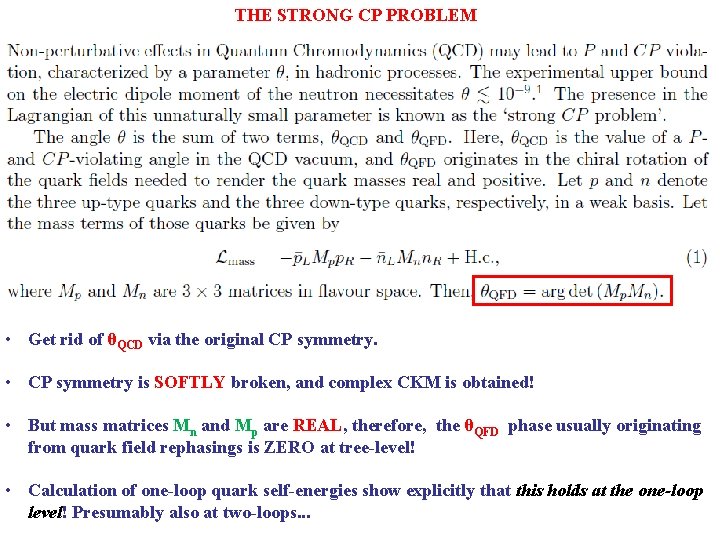
THE STRONG CP PROBLEM • Get rid of θQCD via the original CP symmetry. • CP symmetry is SOFTLY broken, and complex CKM is obtained! • But mass matrices Mn and Mp are REAL, therefore, the θQFD phase usually originating from quark field rephasings is ZERO at tree-level! • Calculation of one-loop quark self-energies show explicitly that this holds at the one-loop level! Presumably also at two-loops. . .
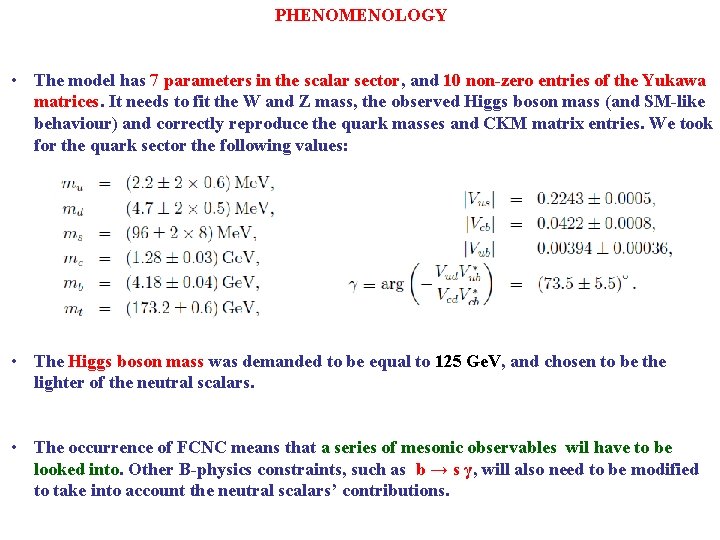
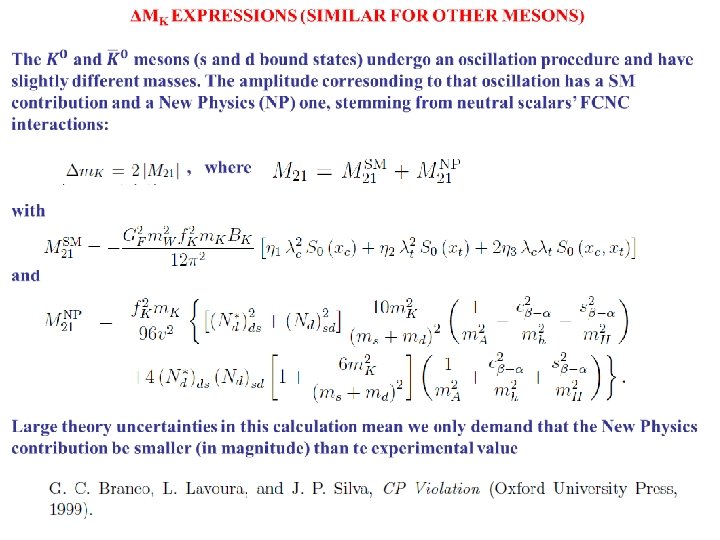
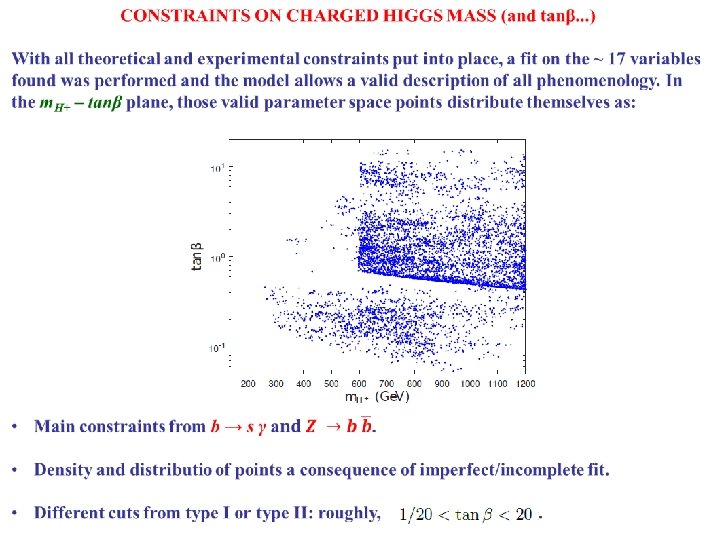
PHENOMENOLOGY • The model has 7 parameters in the scalar sector, and 10 non-zero entries of the Yukawa matrices. It needs to fit the W and Z mass, the observed Higgs boson mass (and SM-like behaviour) and correctly reproduce the quark masses and CKM matrix entries. We took for the quark sector the following values: • The Higgs boson mass was demanded to be equal to 125 Ge. V, and chosen to be the lighter of the neutral scalars. • The occurrence of FCNC means that a series of mesonic observables wil have to be looked into. Other B-physics constraints, such as b → s γ, will also need to be modified to take into account the neutral scalars’ contributions.
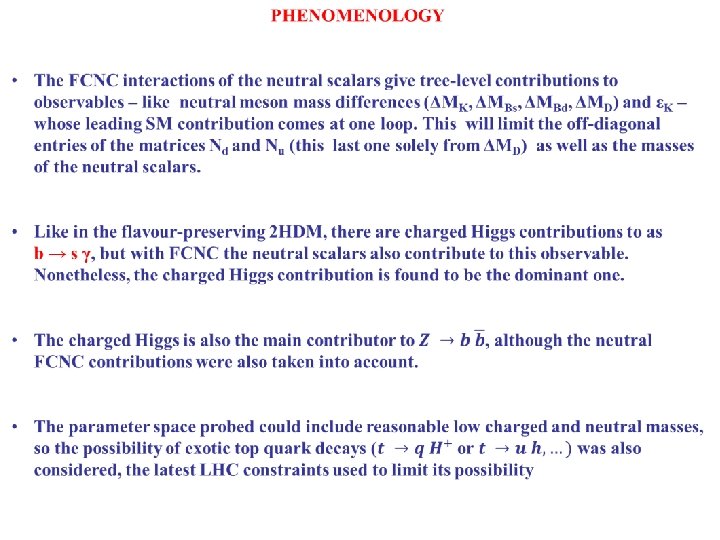
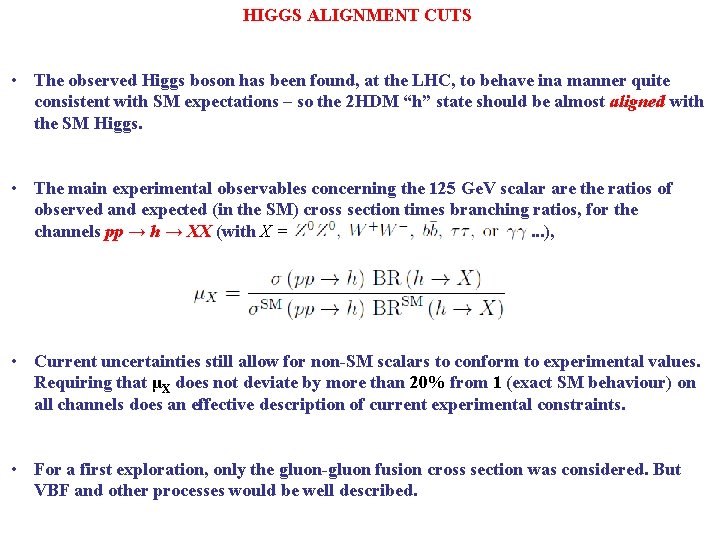
HIGGS ALIGNMENT CUTS • The observed Higgs boson has been found, at the LHC, to behave ina manner quite consistent with SM expectations – so the 2 HDM “h” state should be almost aligned with the SM Higgs. • The main experimental observables concerning the 125 Ge. V scalar are the ratios of observed and expected (in the SM) cross section times branching ratios, for the channels pp → h → XX (with X =. . . ), • Current uncertainties still allow for non-SM scalars to conform to experimental values. Requiring that μX does not deviate by more than 20% from 1 (exact SM behaviour) on all channels does an effective description of current experimental constraints. • For a first exploration, only the gluon-gluon fusion cross section was considered. But VBF and other processes would be well described.
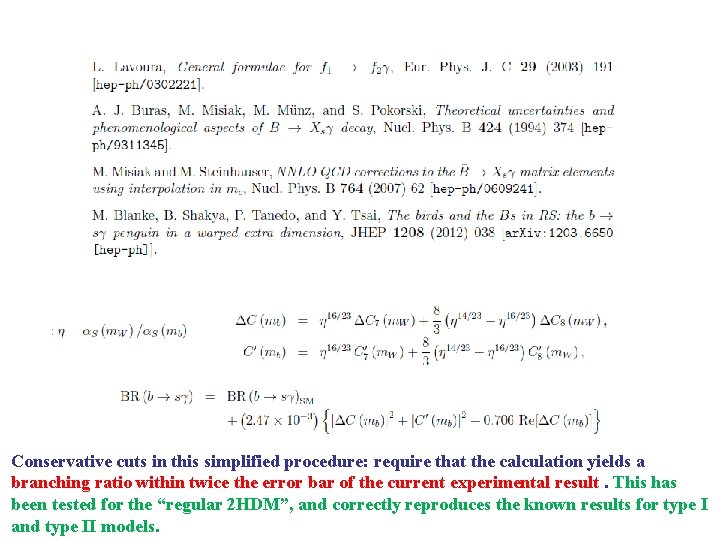
b → s γ EXPRESSIONS Wilson coefficients: Conservative cuts in this simplified procedure: require that the calculation yields a branching ratio within twice the error bar of the current experimental result. This has been tested for the “regular 2 HDM”, and correctly reproduces the known results for type I and type II models.
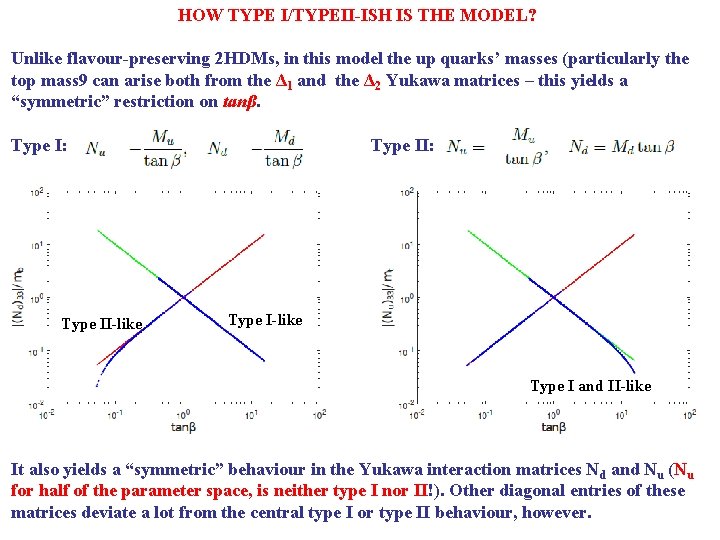
HOW TYPE I/TYPEII-ISH IS THE MODEL? Unlike flavour-preserving 2 HDMs, in this model the up quarks’ masses (particularly the top mass 9 can arise both from the Δ 1 and the Δ 2 Yukawa matrices – this yields a “symmetric” restriction on tanβ. Type I: Type II-like Type II: Type I-like Type I and II-like It also yields a “symmetric” behaviour in the Yukawa interaction matrices Nd and Nu (Nu for half of the parameter space, is neither type I nor II!). Other diagonal entries of these matrices deviate a lot from the central type I or type II behaviour, however.
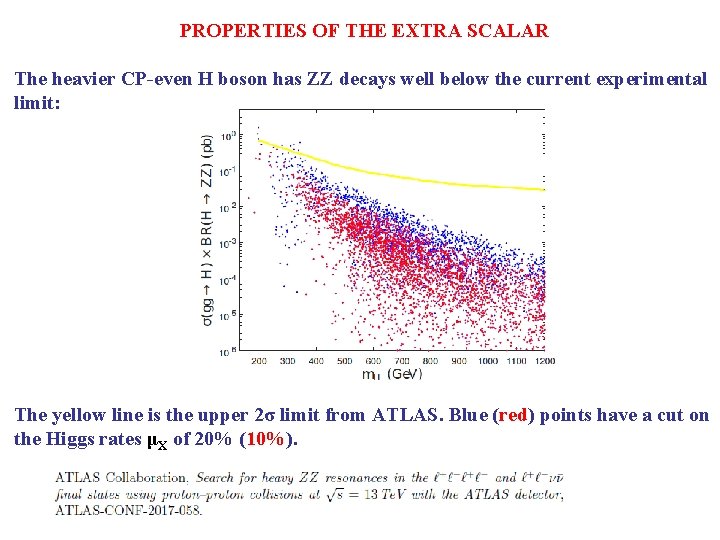
PROPERTIES OF THE EXTRA SCALAR The heavier CP-even H boson has ZZ decays well below the current experimental limit: The yellow line is the upper 2σ limit from ATLAS. Blue (red) points have a cut on the Higgs rates μX of 20% (10%).
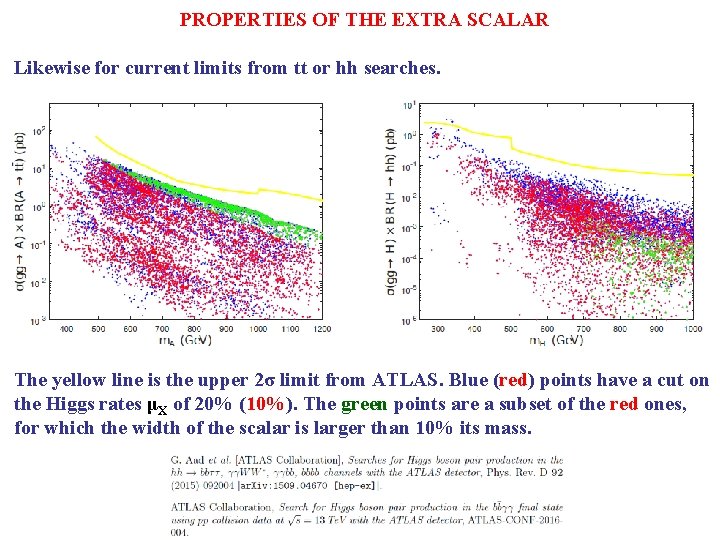
PROPERTIES OF THE EXTRA SCALAR Likewise for current limits from tt or hh searches. The yellow line is the upper 2σ limit from ATLAS. Blue (red) points have a cut on the Higgs rates μX of 20% (10%). The green points are a subset of the red ones, for which the width of the scalar is larger than 10% its mass.
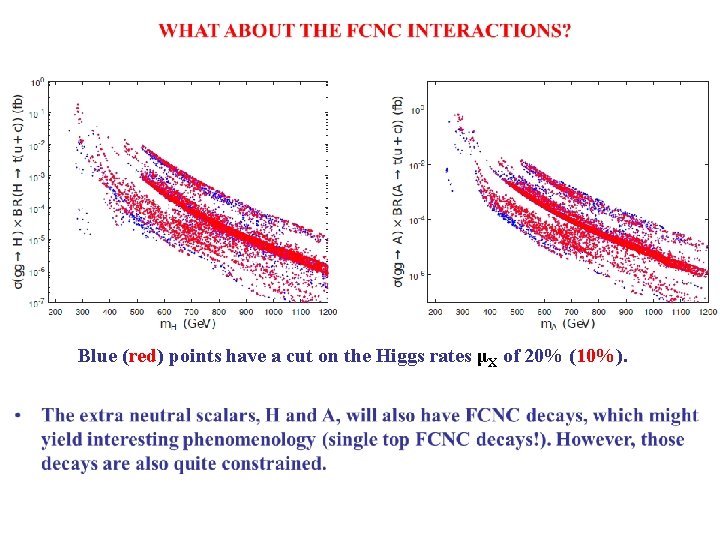
Blue (red) points have a cut on the Higgs rates μX of 20% (10%).
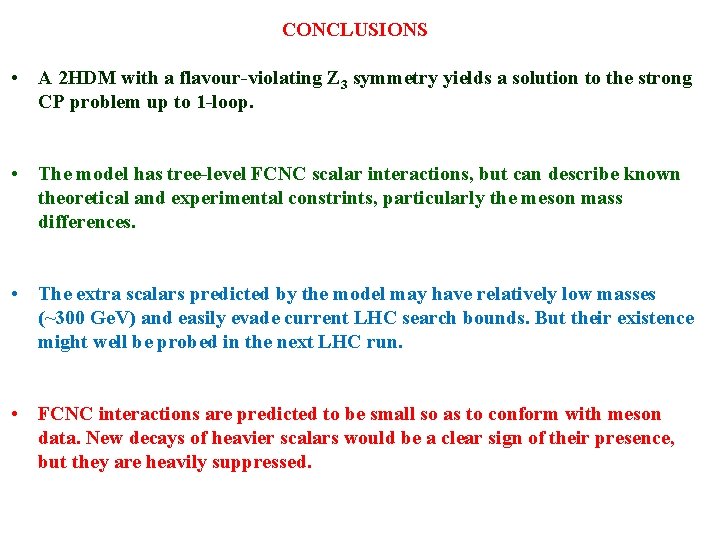
CONCLUSIONS • A 2 HDM with a flavour-violating Z 3 symmetry yields a solution to the strong CP problem up to 1 -loop. • The model has tree-level FCNC scalar interactions, but can describe known theoretical and experimental constrints, particularly the meson mass differences. • The extra scalars predicted by the model may have relatively low masses (~300 Ge. V) and easily evade current LHC search bounds. But their existence might well be probed in the next LHC run. • FCNC interactions are predicted to be small so as to conform with meson data. New decays of heavier scalars would be a clear sign of their presence, but they are heavily suppressed.
- Slides: 21