
A Software Defined Radio for the Masses Part
- Slides: 6
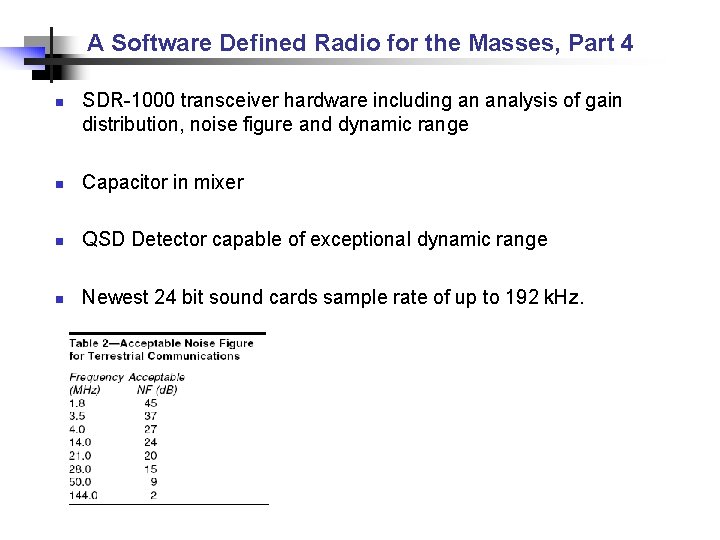
A Software Defined Radio for the Masses, Part 4 n SDR-1000 transceiver hardware including an analysis of gain distribution, noise figure and dynamic range n Capacitor in mixer n QSD Detector capable of exceptional dynamic range n Newest 24 bit sound cards sample rate of up to 192 k. Hz.
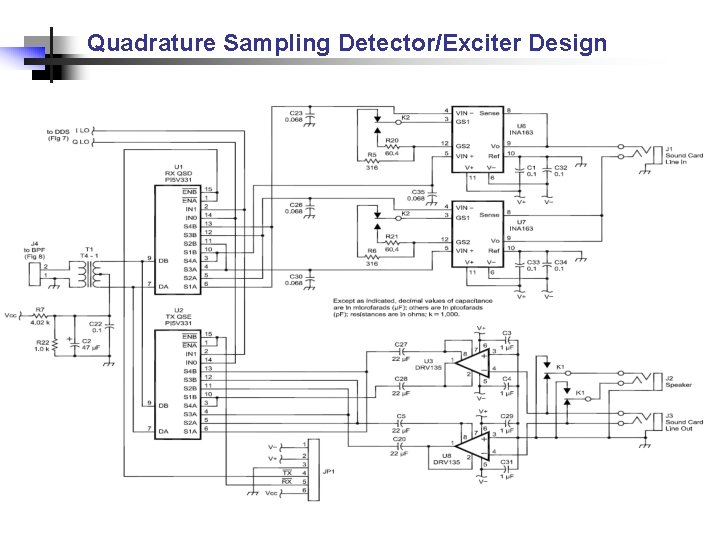
Quadrature Sampling Detector/Exciter Design
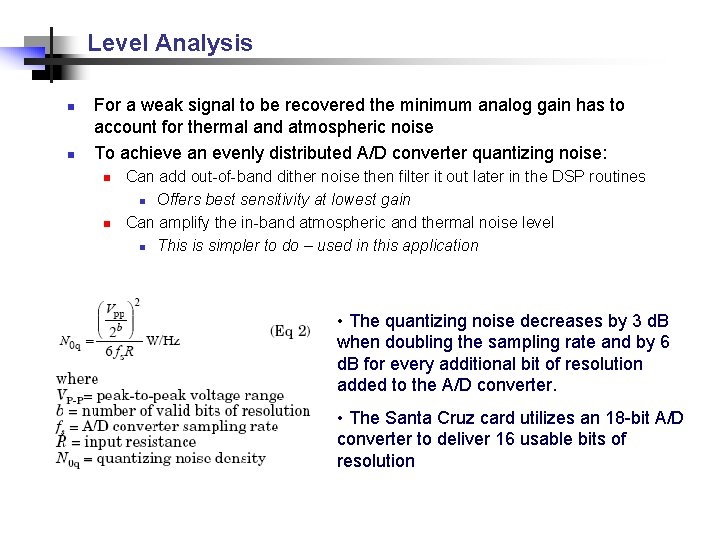
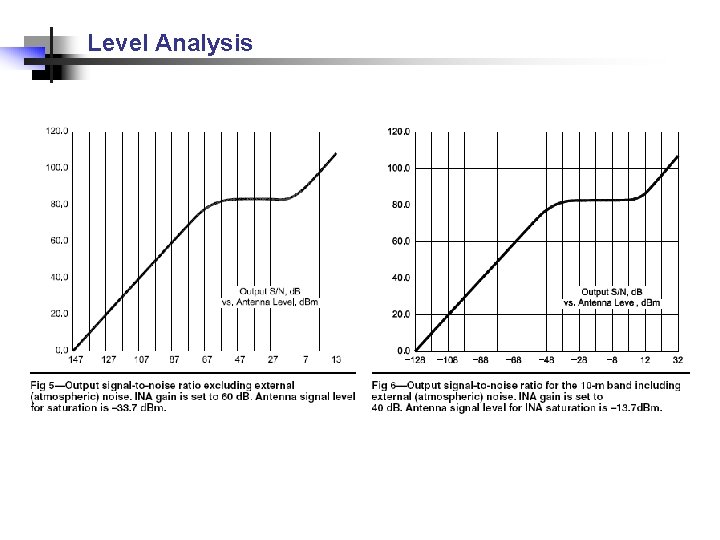
Level Analysis n n For a weak signal to be recovered the minimum analog gain has to account for thermal and atmospheric noise To achieve an evenly distributed A/D converter quantizing noise: n n Can add out-of-band dither noise then filter it out later in the DSP routines n Offers best sensitivity at lowest gain Can amplify the in-band atmospheric and thermal noise level n This is simpler to do – used in this application • The quantizing noise decreases by 3 d. B when doubling the sampling rate and by 6 d. B for every additional bit of resolution added to the A/D converter. • The Santa Cruz card utilizes an 18 -bit A/D converter to deliver 16 usable bits of resolution
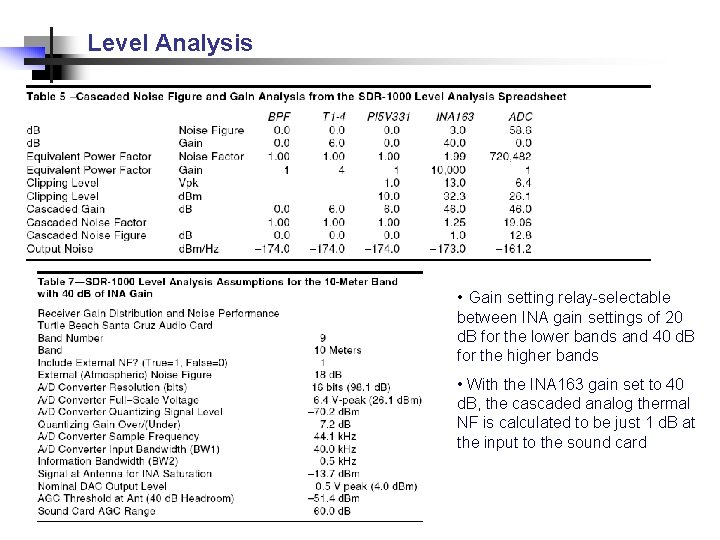
Level Analysis • Gain setting relay-selectable between INA gain settings of 20 d. B for the lower bands and 40 d. B for the higher bands • With the INA 163 gain set to 40 d. B, the cascaded analog thermal NF is calculated to be just 1 d. B at the input to the sound card
Level Analysis
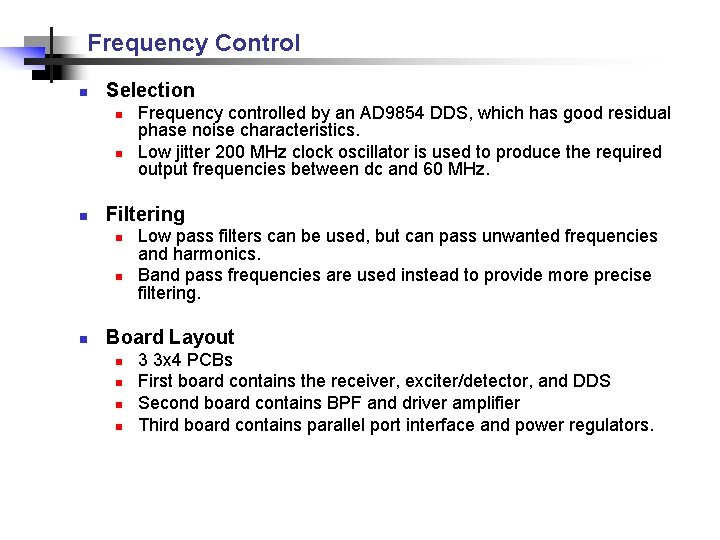
Frequency Control n Selection n Filtering n n n Frequency controlled by an AD 9854 DDS, which has good residual phase noise characteristics. Low jitter 200 MHz clock oscillator is used to produce the required output frequencies between dc and 60 MHz. Low pass filters can be used, but can pass unwanted frequencies and harmonics. Band pass frequencies are used instead to provide more precise filtering. Board Layout n n 3 3 x 4 PCBs First board contains the receiver, exciter/detector, and DDS Second board contains BPF and driver amplifier Third board contains parallel port interface and power regulators.