
A socket API to control Multipath TCP drafthesmansmptcpsocket00
- Slides: 12
A socket API to control Multipath TCP draft-hesmans-mptcp-socket-00 Benjamin Hesmans Olivier Bonaventure UCL, Belgium
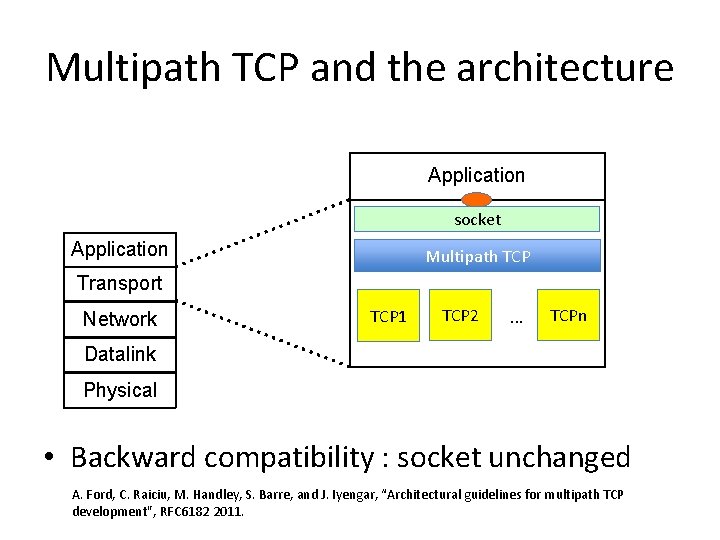
Multipath TCP and the architecture Application socket Application Multipath TCP Transport Network TCP 1 TCP 2 . . . TCPn Datalink Physical • Backward compatibility : socket unchanged A. Ford, C. Raiciu, M. Handley, S. Barre, and J. Iyengar, “Architectural guidelines for multipath TCP development", RFC 6182 2011.
Multipath TCP deployments • Initial assumption – Backward compatible replacement for TCP • Use by some researchers and multipath-tcp. org • Existing deployments – Siri (Apple) – SOCKS (KT, OVH, …) – Hybrid Access Networks (Tessares, …) • Current Multipath TCP users need to control the utilisation of the subflows
How to control the subflows ? • Current reference implementation on Linux – Unmodified standard socket API to support existing applications • Subflows are managed by the path manager kernel module – Full-mesh • use all available interfaces as soon as they are available – NDiffports • Use N flows per interface (assumes single-homed hosts)
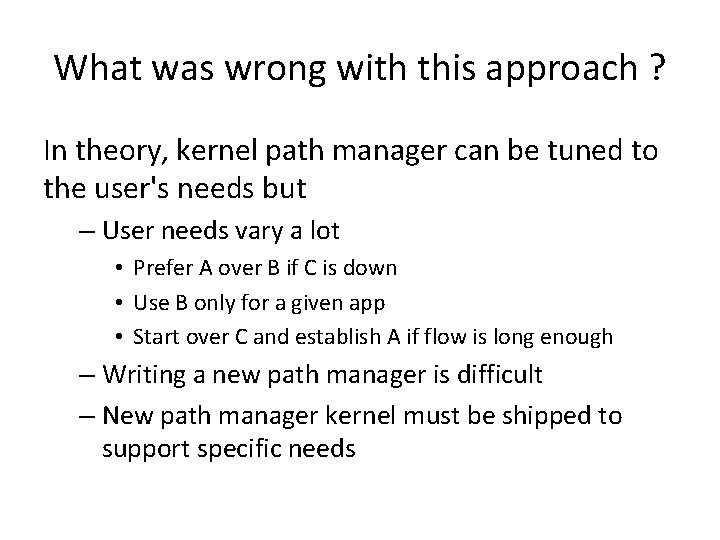
What was wrong with this approach ? In theory, kernel path manager can be tuned to the user's needs but – User needs vary a lot • Prefer A over B if C is down • Use B only for a given app • Start over C and establish A if flow is long enough – Writing a new path manager is difficult – New path manager kernel must be shipped to support specific needs
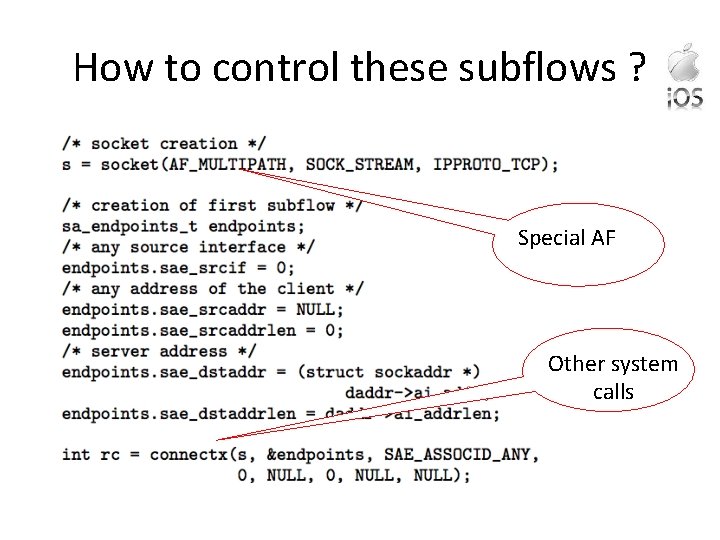
How to control these subflows ? Special AF Other system calls
Towards a standardised MPTCP API using socket options • Why socket options ? – getsockopt and setsockopt are well-known and extensible – Relatively easy to implement a new socket option – Can pass information from app to stack as memory buffer – Can retrieve information from stack to app as memory buffer • Initially suggested in RFC 6897, but not supported by any implementation
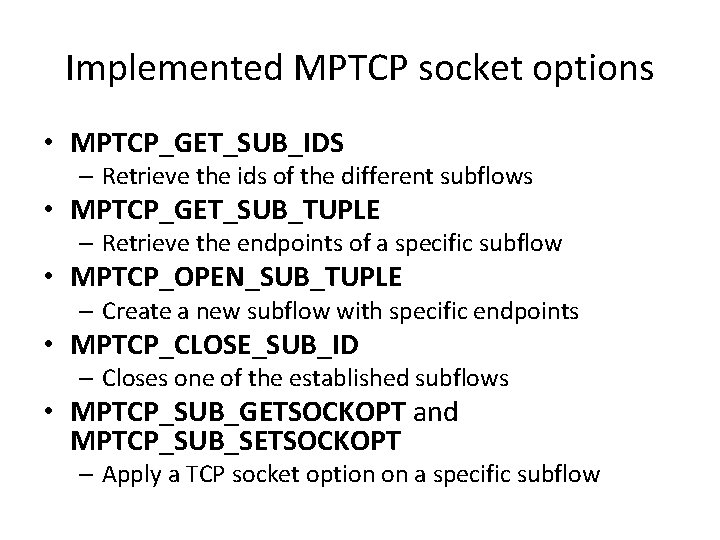
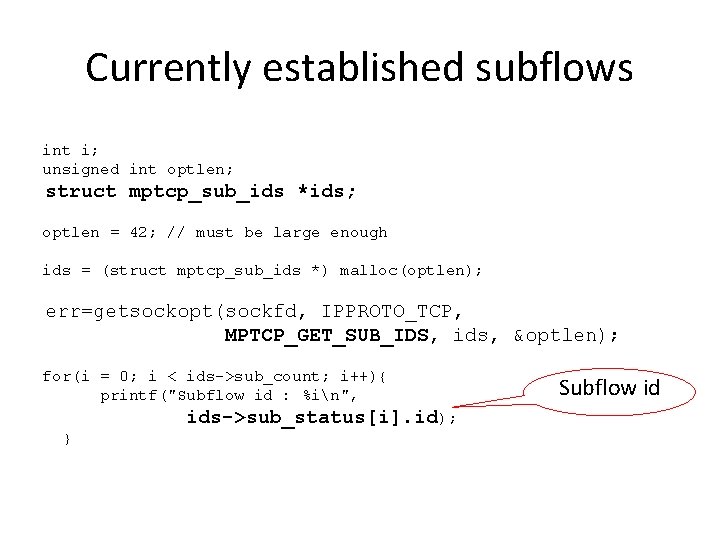
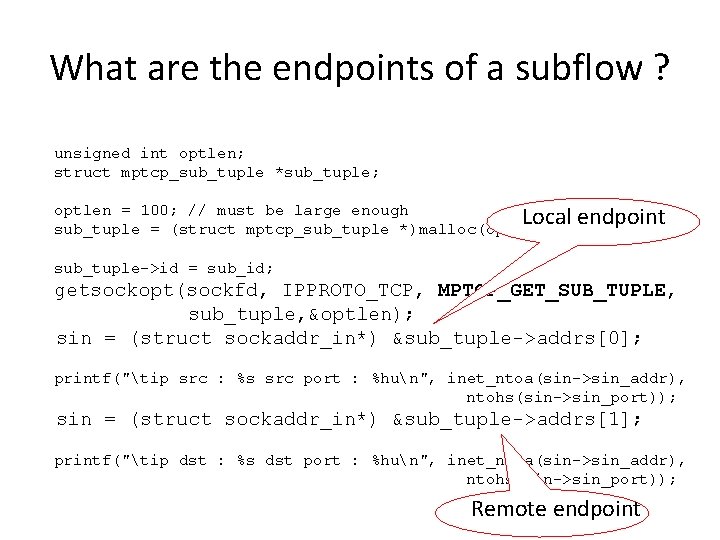
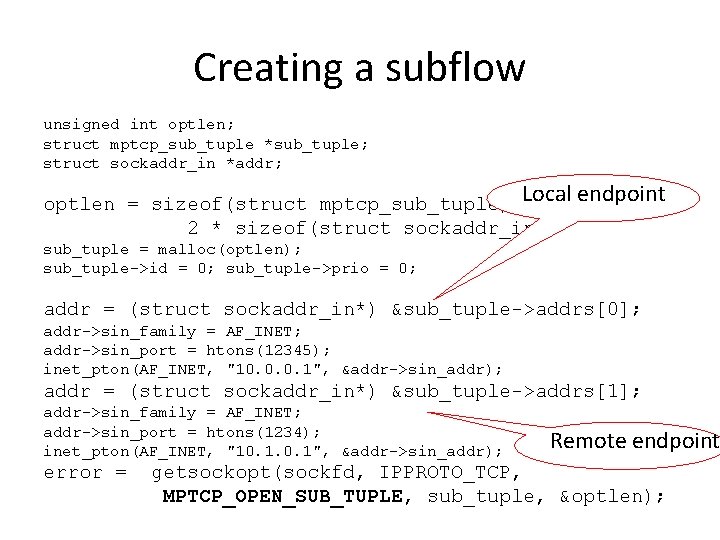
Implemented MPTCP socket options • MPTCP_GET_SUB_IDS – Retrieve the ids of the different subflows • MPTCP_GET_SUB_TUPLE – Retrieve the endpoints of a specific subflow • MPTCP_OPEN_SUB_TUPLE – Create a new subflow with specific endpoints • MPTCP_CLOSE_SUB_ID – Closes one of the established subflows • MPTCP_SUB_GETSOCKOPT and MPTCP_SUB_SETSOCKOPT – Apply a TCP socket option on a specific subflow
Currently established subflows int i; unsigned int optlen; struct mptcp_sub_ids *ids; optlen = 42; // must be large enough ids = (struct mptcp_sub_ids *) malloc(optlen); err=getsockopt(sockfd, IPPROTO_TCP, MPTCP_GET_SUB_IDS, ids, &optlen); for(i = 0; i < ids->sub_count; i++){ printf("Subflow id : %in", ids->sub_status[i]. id); } Subflow id
What are the endpoints of a subflow ? unsigned int optlen; struct mptcp_sub_tuple *sub_tuple; optlen = 100; // must be large enough Local sub_tuple = (struct mptcp_sub_tuple *)malloc(optlen); endpoint sub_tuple->id = sub_id; getsockopt(sockfd, IPPROTO_TCP, MPTCP_GET_SUB_TUPLE, sub_tuple, &optlen); sin = (struct sockaddr_in*) &sub_tuple->addrs[0]; printf("tip src : %s src port : %hun", inet_ntoa(sin->sin_addr), ntohs(sin->sin_port)); sin = (struct sockaddr_in*) &sub_tuple->addrs[1]; printf("tip dst : %s dst port : %hun", inet_ntoa(sin->sin_addr), ntohs(sin->sin_port)); Remote endpoint
Creating a subflow unsigned int optlen; struct mptcp_sub_tuple *sub_tuple; struct sockaddr_in *addr; endpoint optlen = sizeof(struct mptcp_sub_tuple) Local + 2 * sizeof(struct sockaddr_in); sub_tuple = malloc(optlen); sub_tuple->id = 0; sub_tuple->prio = 0; addr = (struct sockaddr_in*) &sub_tuple->addrs[0]; addr->sin_family = AF_INET; addr->sin_port = htons(12345); inet_pton(AF_INET, "10. 0. 0. 1", &addr->sin_addr); addr = (struct sockaddr_in*) &sub_tuple->addrs[1]; addr->sin_family = AF_INET; addr->sin_port = htons(1234); inet_pton(AF_INET, "10. 1", &addr->sin_addr); error = Remote endpoint getsockopt(sockfd, IPPROTO_TCP, MPTCP_OPEN_SUB_TUPLE, sub_tuple, &optlen);
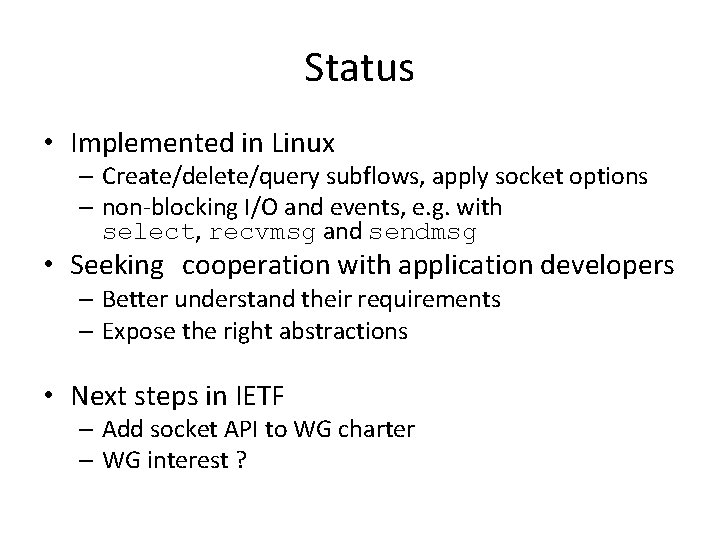
Status • Implemented in Linux – Create/delete/query subflows, apply socket options – non-blocking I/O and events, e. g. with select, recvmsg and sendmsg • Seeking cooperation with application developers – Better understand their requirements – Expose the right abstractions • Next steps in IETF – Add socket API to WG charter – WG interest ?