
A Sociocultural Model of Impairment Disability DEVVA KASNITZ
A Sociocultural Model of © Impairment Disability DEVVA KASNITZ AND RUSSELL SHUTTLEWORTH University of California, Berkeley December, 2003 Shuttleruss@msn. com * Devva@earthlink. net 1
Goals of this Project ◄ to create a model of impairment-disability committed to the inherent value of human difference, and of equal access to social, cultural and material goods ◄ to create a model that enables us to recognize, map, and analyze disability oppression in diverse cultures ◄ to develop our model incorporating sociopolitical, cultural, ecological, and existentialphenomenological theories of impairmentdisability ◄ to create a processual, temporal, spatial, and contextual model of impairment-disability 2
Impairment Disability Why the hyphen? ◄to problematize anthropologists’ prior use of these terms ◄to highlight the processual nature of the relationship between these and other terms in our model ◄to stress the need for analytical specificity within this process 3
Review and Critique of Models and Theories of Impairment-Disability 4
SOCIOPOLITICAL DISABILITY MODELS Independent Living Model (De Jong) ◄ states that current sociopolitical structures produce access barriers for and dependency in impaired people resulting in disability ◄ is based on a consumer driven movement that fosters autonomy, self-help and the removal of societal barriers and disincentives Minority Group Model (Hahn) ◄ describes how current sociopolitical structures produce access barriers for and discrimination against impaired people resulting in disability ◄ is motivated by a political and research strategy used to counter discrimination and advocate for civil rights British Social Model (Oliver) ◄ sees the historical convergence of industrialization and capitalism as restricting impaired people’s access to material and social goods, which results in their economic dependency and creates the category of disability ◄ is motivated by a political and research strategy used to combat socioeconomic oppression and to transform the material structures that marginalize and devalue the capabilities of impaired people 5
Theories of Impairment Disability Postmodern Theory ◄ Scott-Hill (Corker) and Shakespeare • see disability as constructed via discursive practices • add a discursive theory of communication to the current materialistic focus on structure • perceives disability identity as fluid and its boundaries dependent on context and the dynamic interaction of other self-identities • emphasizes a dialogic relation between impairment and disability (not an analytical privileging of one over the other) 6
THEORIES OF DISABILITY …continued Phenomenological Theories ◄Hughes and Paterson • sees disability as the embodiment of negative cultural • • • perceptions and attitudes perceive impairment as socioculturally constructed posit that the non-disabled structure of embodied contexts of meaning creates disabled people’s social dys-appearance advocate for a cultural-phenomenological restructuring of carnal contexts of meaning along more inclusive lines ◄Shuttleworth • posits that embodied sensitivities to certain social situations • reveal disability oppression analyzes lived metaphors of embodiment (i. e blocked, trapped) as felt remembrances of past disability oppression/empowerment 7
THEORIES OF DISABILITY …continued Ecological Contextual Community Based Theories ◄Seekins • perceives impairment as situational and contextually constructed • sees disability as a response to environmental systems and • pressures advocates for community development strategies to restructure disabling barriers to access and increased participation ◄Kasnitz • analyzes systemic and situational ethno-embodiment • perceives impairment as one culturally constructed resolution to • the tension of embodied anomaly posits that disability and handicap are unique systemic constructions of differential access throughout the life course and in valued cultural domains 8
Anthropology 9
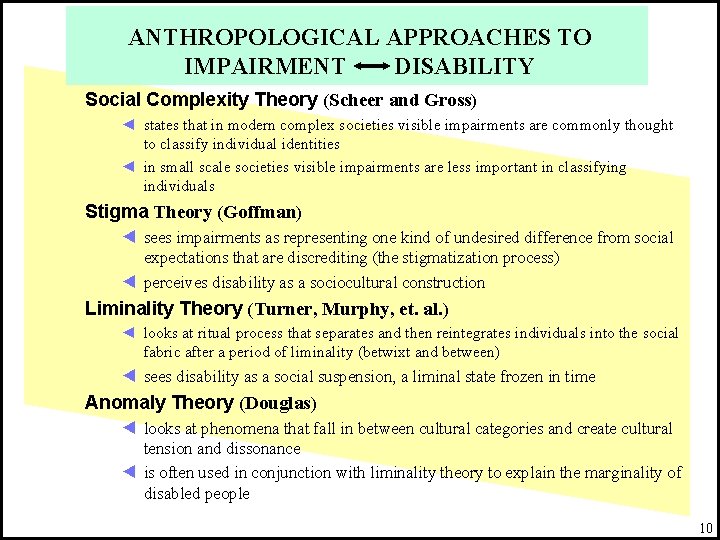
ANTHROPOLOGICAL APPROACHES TO IMPAIRMENT DISABILITY Social Complexity Theory (Scheer and Gross) ◄ states that in modern complex societies visible impairments are commonly thought to classify individual identities ◄ in small scale societies visible impairments are less important in classifying individuals Stigma Theory (Goffman) ◄ sees impairments as representing one kind of undesired difference from social expectations that are discrediting (the stigmatization process) ◄ perceives disability as a sociocultural construction Liminality Theory (Turner, Murphy, et. al. ) ◄ looks at ritual process that separates and then reintegrates individuals into the social fabric after a period of liminality (betwixt and between) ◄ sees disability as a social suspension, a liminal state frozen in time Anomaly Theory (Douglas) ◄ looks at phenomena that fall in between cultural categories and create cultural tension and dissonance ◄ is often used in conjunction with liminality theory to explain the marginality of disabled people 10
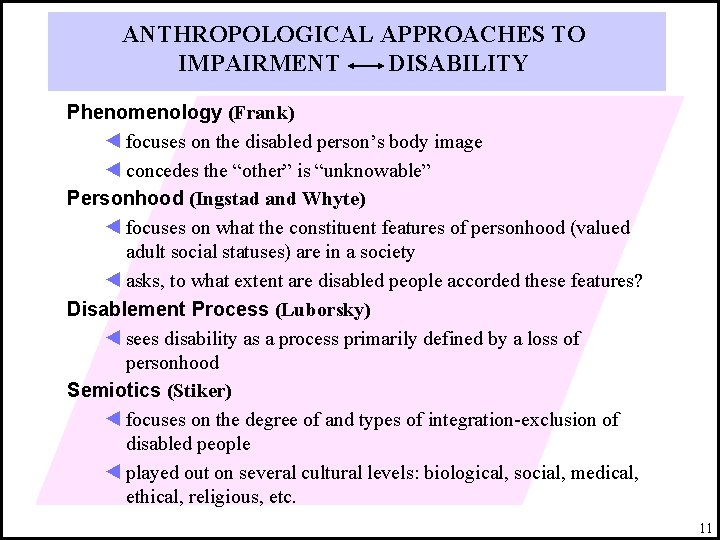
ANTHROPOLOGICAL APPROACHES TO IMPAIRMENT DISABILITY Phenomenology (Frank) ◄ focuses on the disabled person’s body image ◄ concedes the “other” is “unknowable” Personhood (Ingstad and Whyte) ◄ focuses on what the constituent features of personhood (valued adult social statuses) are in a society ◄ asks, to what extent are disabled people accorded these features? Disablement Process (Luborsky) ◄ sees disability as a process primarily defined by a loss of personhood Semiotics (Stiker) ◄ focuses on the degree of and types of integration-exclusion of disabled people ◄ played out on several cultural levels: biological, social, medical, ethical, religious, etc. 11
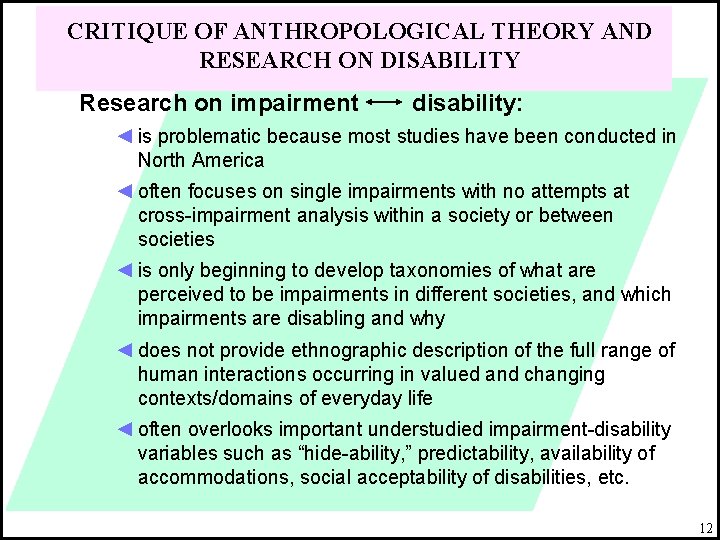
CRITIQUE OF ANTHROPOLOGICAL THEORY AND RESEARCH ON DISABILITY Research on impairment disability: ◄ is problematic because most studies have been conducted in North America ◄ often focuses on single impairments with no attempts at cross-impairment analysis within a society or between societies ◄ is only beginning to develop taxonomies of what are perceived to be impairments in different societies, and which impairments are disabling and why ◄ does not provide ethnographic description of the full range of human interactions occurring in valued and changing contexts/domains of everyday life ◄ often overlooks important understudied impairment-disability variables such as “hide-ability, ” predictability, availability of accommodations, social acceptability of disabilities, etc. 12
CRITIQUE OF ANTHROPOLOGICAL THEORY AND RESEARCH ON DISABILITY …. continued Research on impairment-disability: ◄often over generalizes across the life-course from the perspective of one age group to others ◄is terminologically imprecise ◄is parochial and does not engage disability studies literature ◄subscribes to a radical relativistic approach and minimally analyzes relations of power ◄in general is undertheorized 13
Sociocultural Model of Impairment Disability 14
Sociocultural Model of Impairment-Disability: The Perceptual-Conceptual Layers Posit Bio-Physics 15
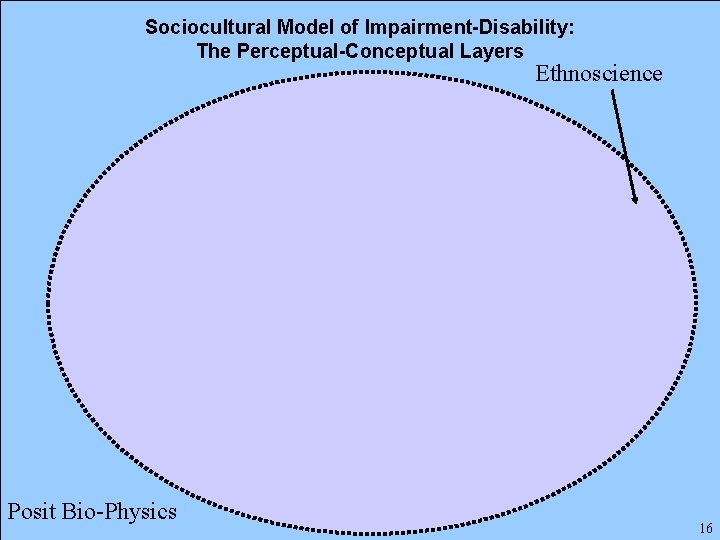
Sociocultural Model of Impairment-Disability: The Perceptual-Conceptual Layers Ethnoscience Posit Bio-Physics 16
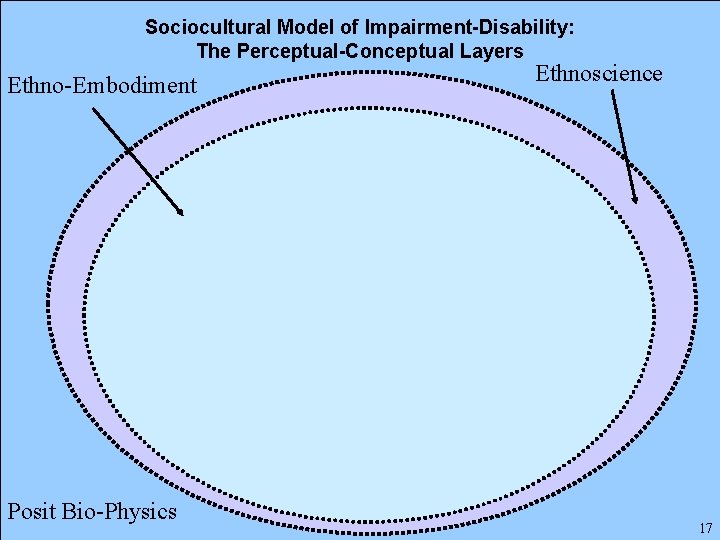
Sociocultural Model of Impairment-Disability: The Perceptual-Conceptual Layers Ethno-Embodiment Posit Bio-Physics Ethnoscience 17
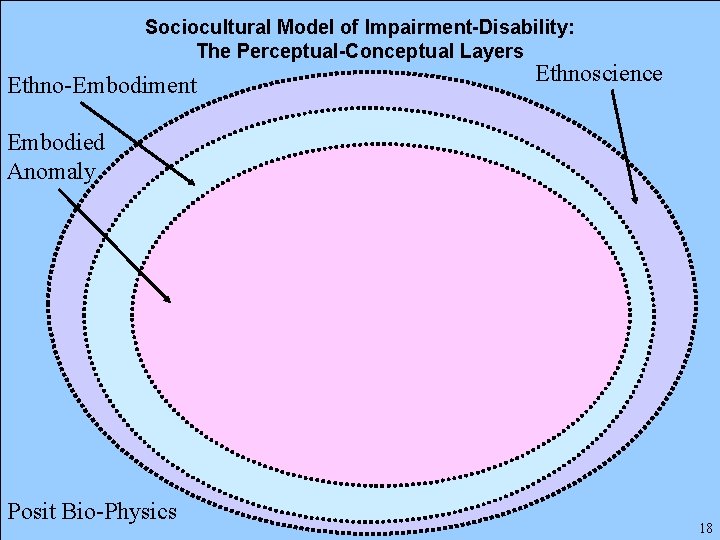
Sociocultural Model of Impairment-Disability: The Perceptual-Conceptual Layers Ethno-Embodiment Ethnoscience Embodied Anomaly Posit Bio-Physics 18
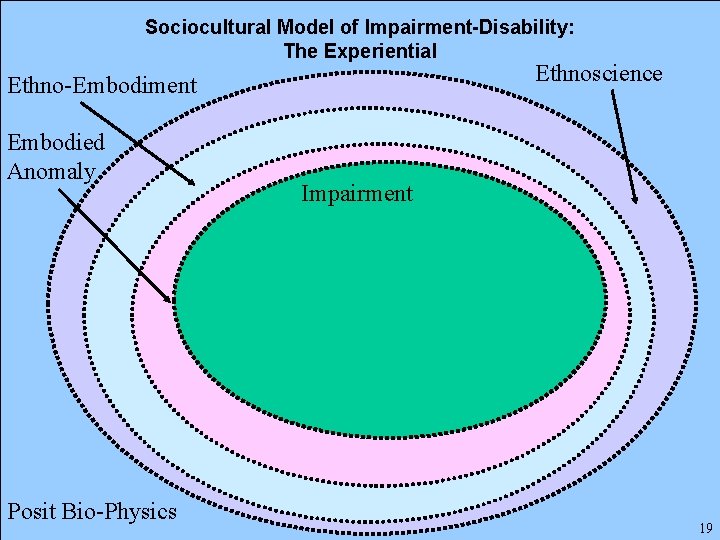
Sociocultural Model of Impairment-Disability: The Experiential Ethnoscience Ethno-Embodiment Embodied Anomaly Posit Bio-Physics Impairment 19
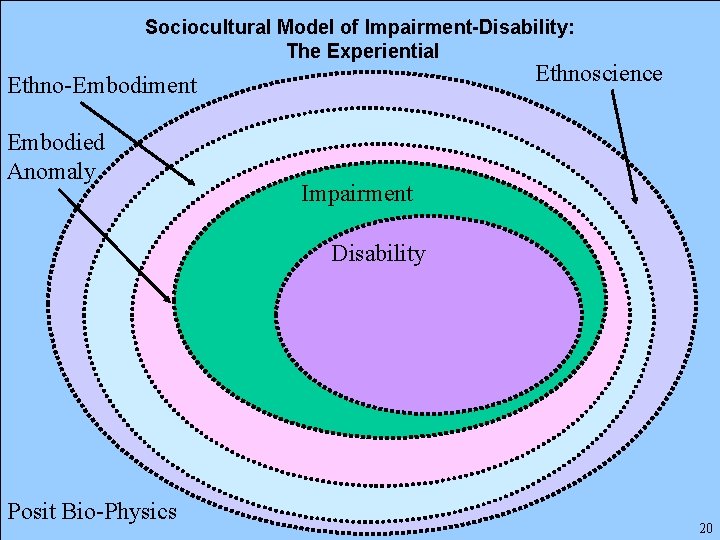
Sociocultural Model of Impairment-Disability: The Experiential Ethnoscience Ethno-Embodiment Embodied Anomaly Impairment Disability Posit Bio-Physics 20
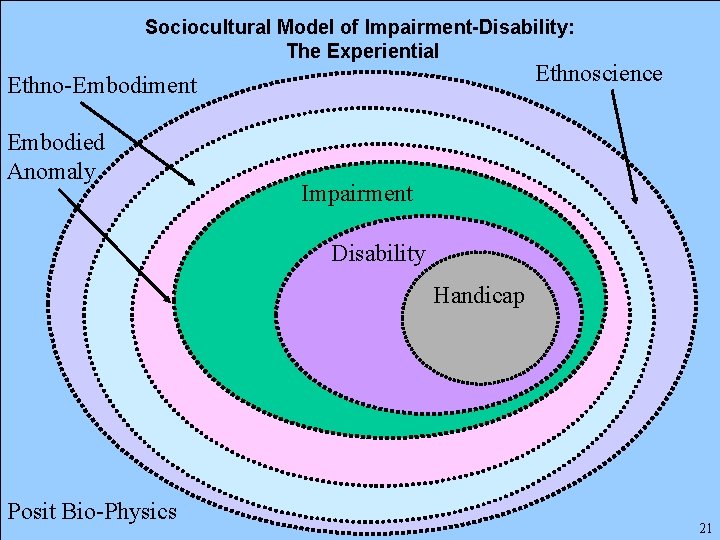
Sociocultural Model of Impairment-Disability: The Experiential Ethnoscience Ethno-Embodiment Embodied Anomaly Impairment Disability Handicap Posit Bio-Physics 21
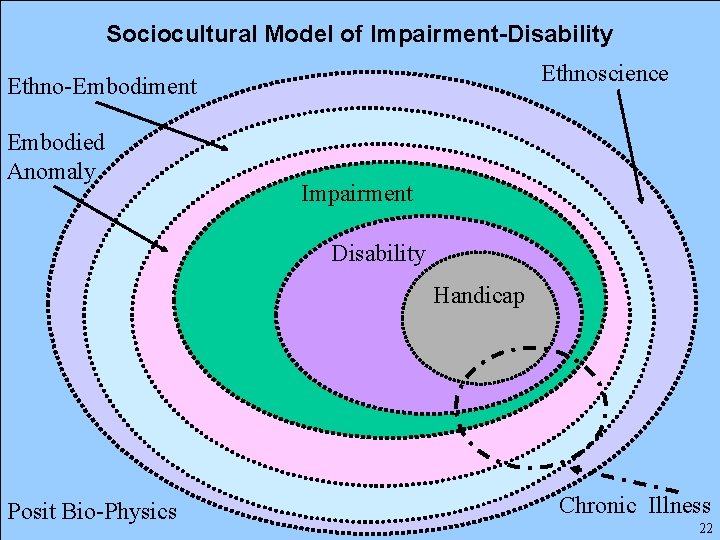
Sociocultural Model of Impairment-Disability Ethnoscience Ethno-Embodiment Embodied Anomaly Impairment Disability Handicap Posit Bio-Physics Chronic Illness 22
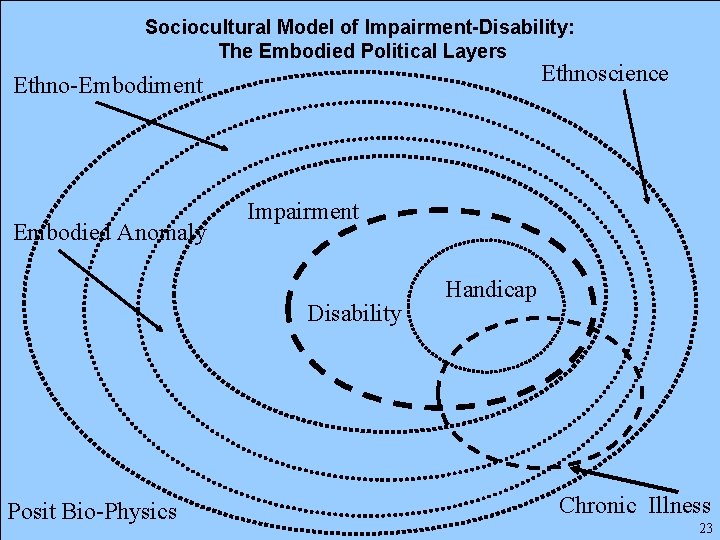
Sociocultural Model of Impairment-Disability: The Embodied Political Layers Ethnoscience Ethno-Embodiment Embodied Anomaly Impairment Disability Posit Bio-Physics Handicap Chronic Illness 23
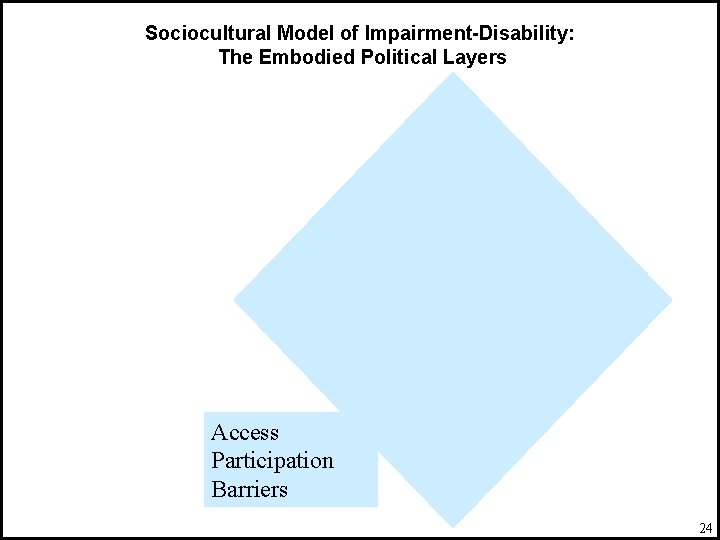
Sociocultural Model of Impairment-Disability: The Embodied Political Layers Access Barriers Participation Barriers 24
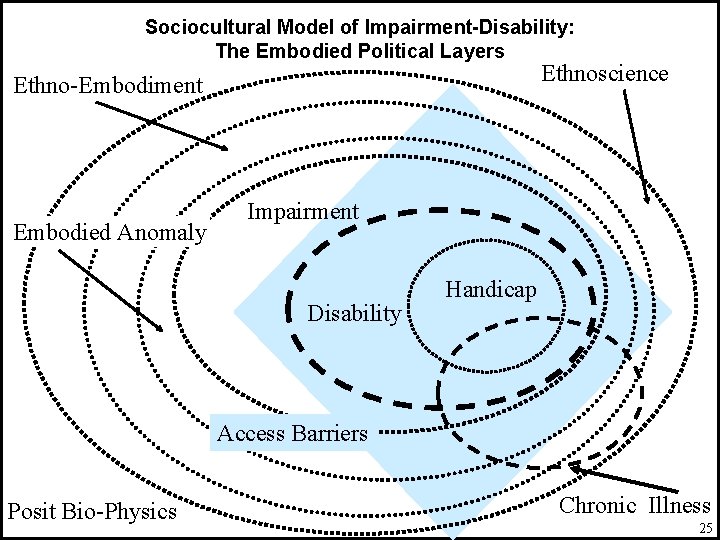
Sociocultural Model of Impairment-Disability: The Embodied Political Layers Ethnoscience Ethno-Embodiment Embodied Anomaly Impairment Disability Handicap Access Barriers Posit Bio-Physics Chronic Illness 25
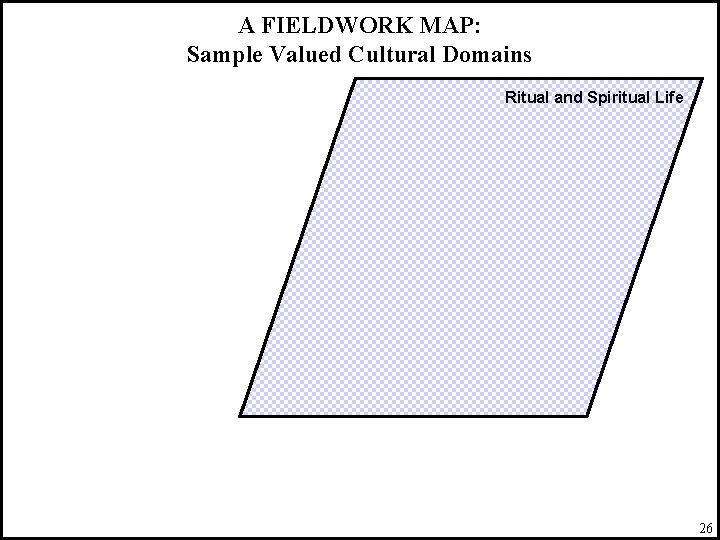
A FIELDWORK MAP: Sample Valued Cultural Domains Ritual and Spiritual Life 26
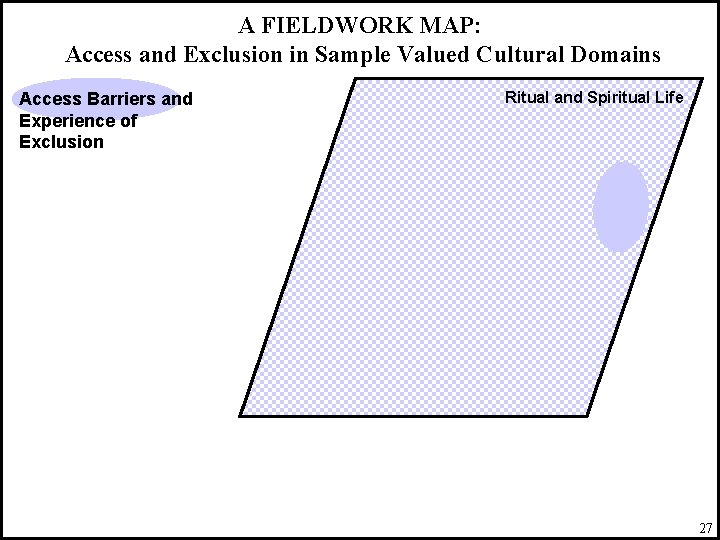
A FIELDWORK MAP: Access and Exclusion in Sample Valued Cultural Domains Access Barriers and Experience of Exclusion Ritual and Spiritual Life 27
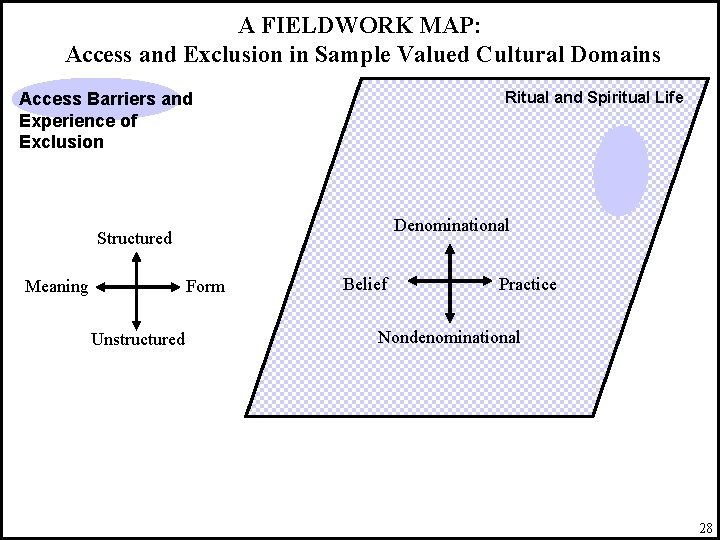
A FIELDWORK MAP: Access and Exclusion in Sample Valued Cultural Domains Ritual and Spiritual Life Access Barriers and Experience of Exclusion Denominational Structured Meaning Form Unstructured Belief Practice Nondenominational 28
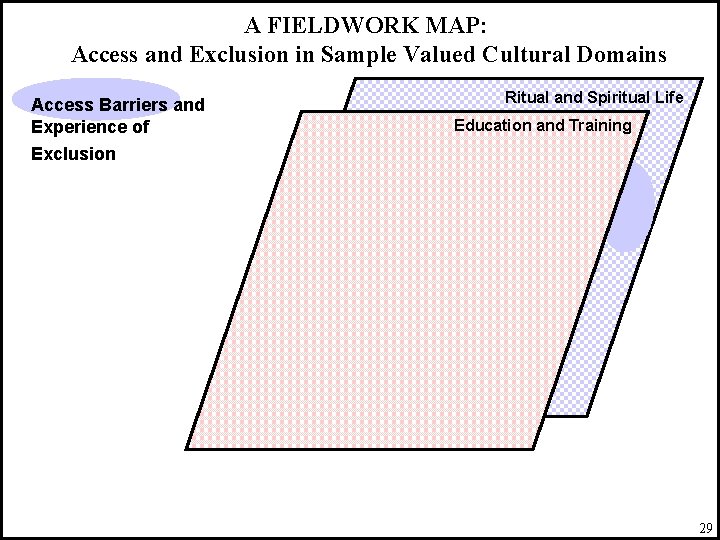
A FIELDWORK MAP: Access and Exclusion in Sample Valued Cultural Domains Access Barriers and Experience of Ritual and Spiritual Life Education and Training Exclusion 29
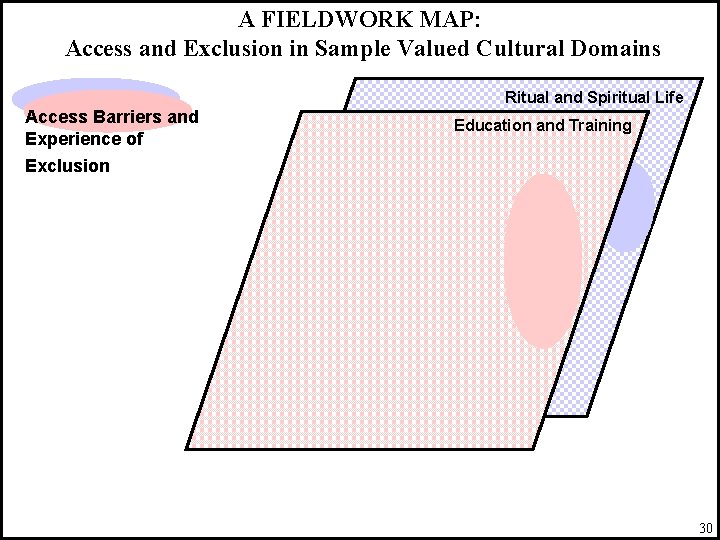
A FIELDWORK MAP: Access and Exclusion in Sample Valued Cultural Domains Ritual and Spiritual Life Access Barriers and Experience of Education and Training Exclusion 30
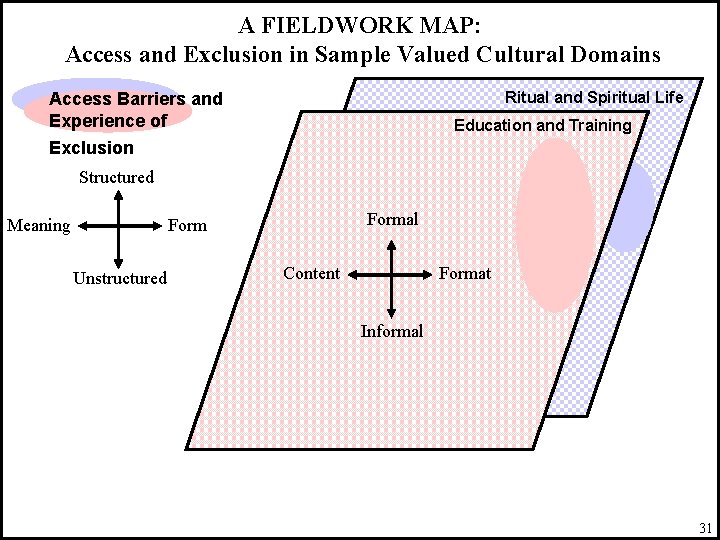
A FIELDWORK MAP: Access and Exclusion in Sample Valued Cultural Domains Ritual and Spiritual Life Access Barriers and Experience of Education and Training Exclusion Structured Meaning Formal Form Unstructured Content Format Informal 31

A FIELDWORK MAP: Access and Exclusion in Sample Valued Cultural Domains Ritual and Spiritual Life Access Barriers and Experience of Exclusion Education and Training Family and Household Life 32
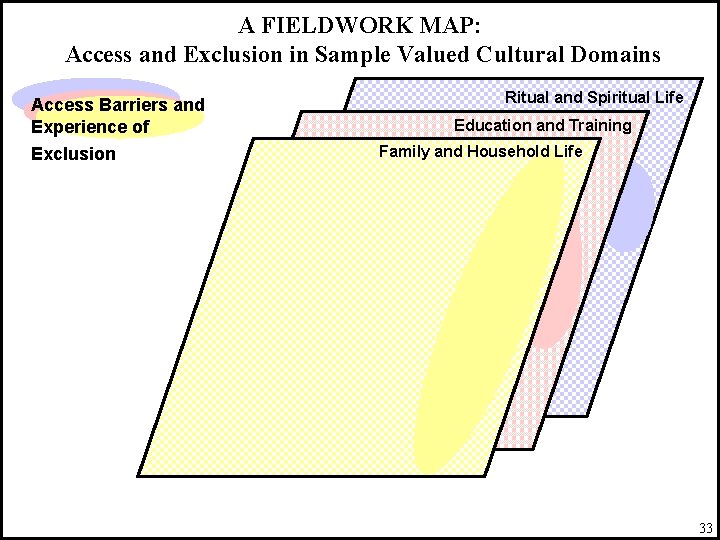
A FIELDWORK MAP: Access and Exclusion in Sample Valued Cultural Domains Access Barriers and Experience of Exclusion Ritual and Spiritual Life Education and Training Family and Household Life 33
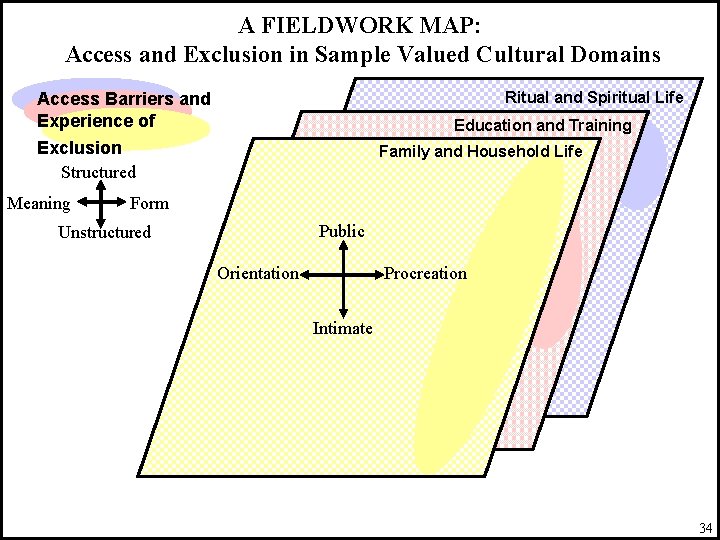
A FIELDWORK MAP: Access and Exclusion in Sample Valued Cultural Domains Ritual and Spiritual Life Access Barriers and Experience of Education and Training Exclusion Structured Meaning Family and Household Life Form Public Unstructured Orientation Procreation Intimate 34
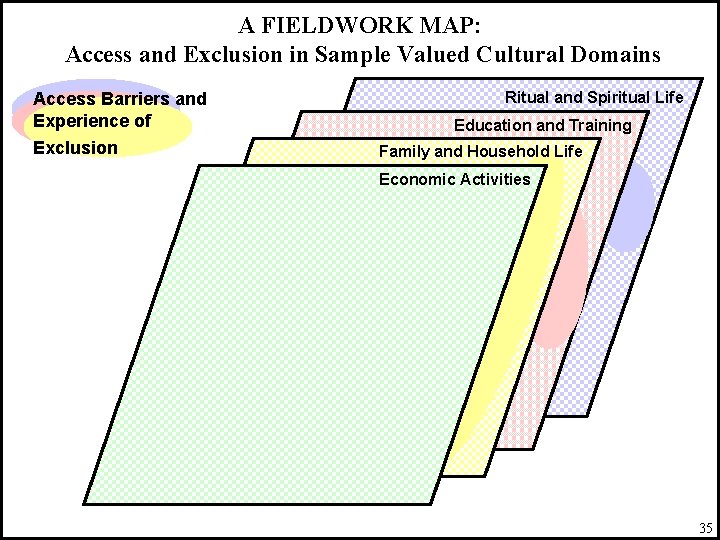
A FIELDWORK MAP: Access and Exclusion in Sample Valued Cultural Domains Access Barriers and Experience of Exclusion Ritual and Spiritual Life Education and Training Family and Household Life Economic Activities 35
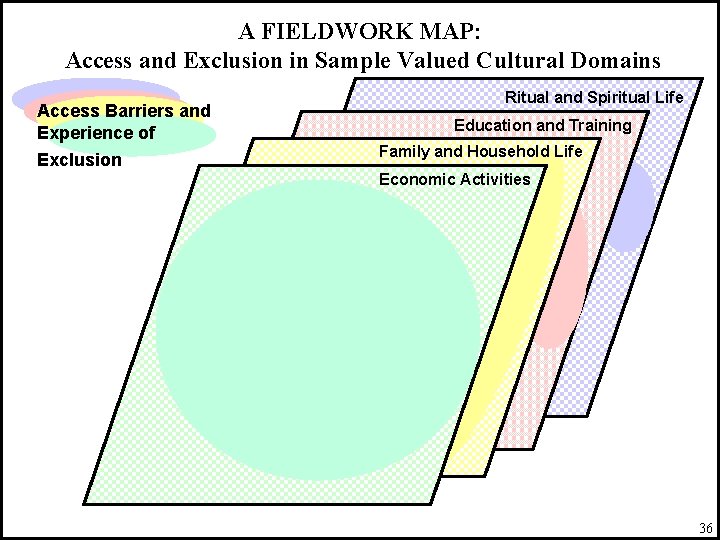
A FIELDWORK MAP: Access and Exclusion in Sample Valued Cultural Domains Access Barriers and Experience of Exclusion Ritual and Spiritual Life Education and Training Family and Household Life Economic Activities 36
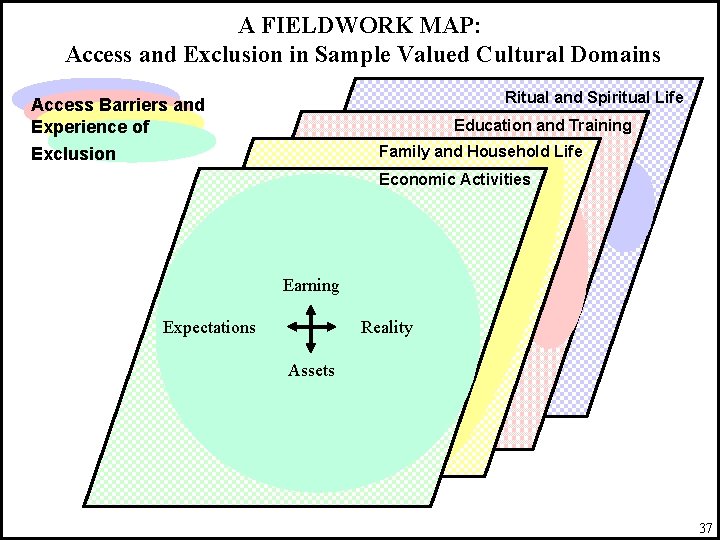
A FIELDWORK MAP: Access and Exclusion in Sample Valued Cultural Domains Ritual and Spiritual Life Access Barriers and Experience of Education and Training Family and Household Life Exclusion Economic Activities Earning Expectations Reality Assets 37
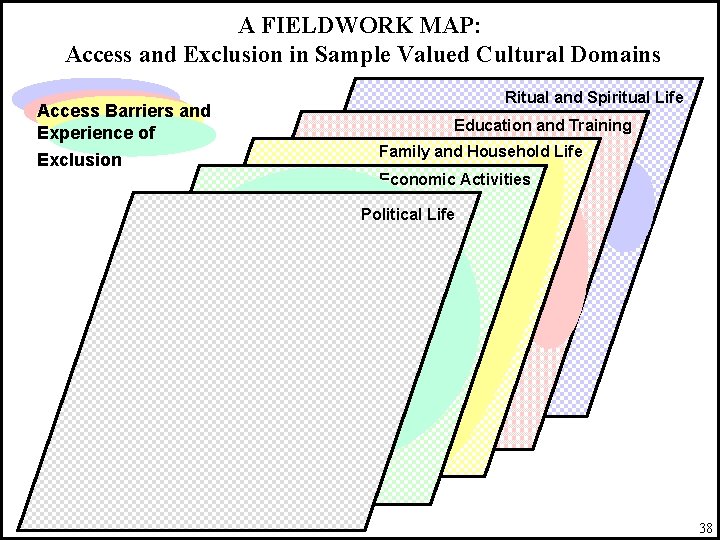
A FIELDWORK MAP: Access and Exclusion in Sample Valued Cultural Domains Access Barriers and Experience of Exclusion Ritual and Spiritual Life Education and Training Family and Household Life Economic Activities Political Life 38
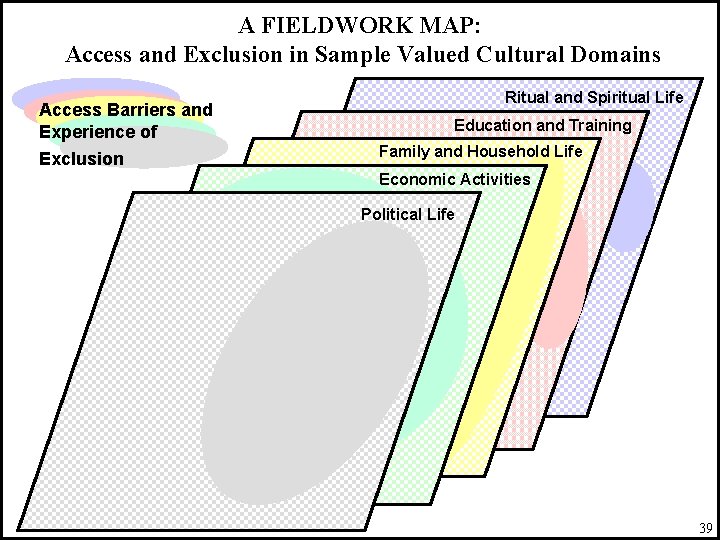
A FIELDWORK MAP: Access and Exclusion in Sample Valued Cultural Domains Access Barriers and Experience of Exclusion Ritual and Spiritual Life Education and Training Family and Household Life Economic Activities Political Life 39
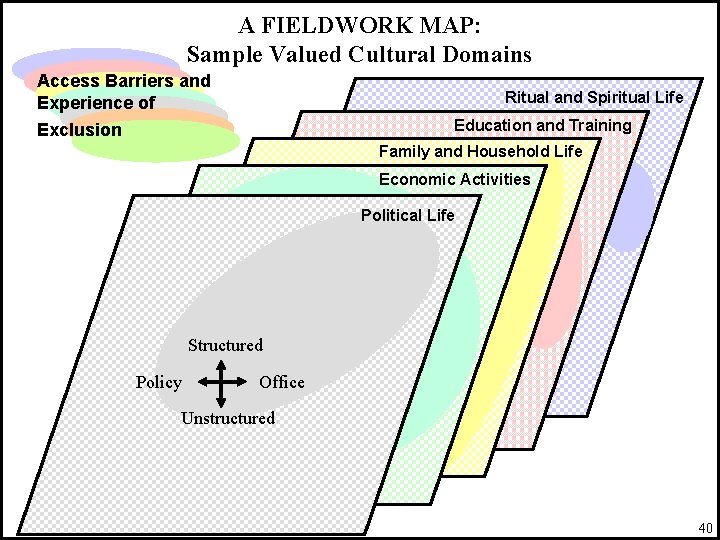
A FIELDWORK MAP: Sample Valued Cultural Domains Access Barriers and Experience of Ritual and Spiritual Life Education and Training Exclusion Family and Household Life Economic Activities Political Life Structured Policy Office Unstructured 40

A FIELDWORK MAP: Access and Exclusion in Sample Valued Cultural Domains Access Barriers and Experience of Ritual and Spiritual Life Education and Training Exclusion Family and Household Life Economic. Activities Political Life Sexuality Communication 41
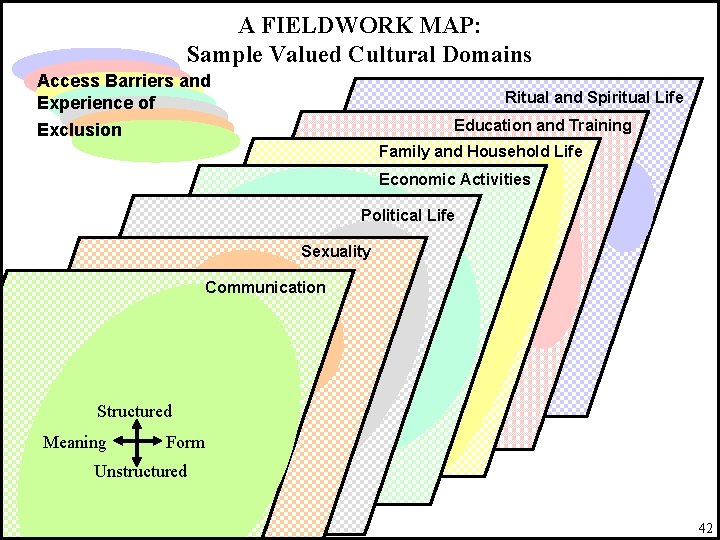
A FIELDWORK MAP: Sample Valued Cultural Domains Access Barriers and Experience of Ritual and Spiritual Life Education and Training Exclusion Family and Household Life Economic Activities Political Life Sexuality Communication Structured Meaning Form Unstructured 42
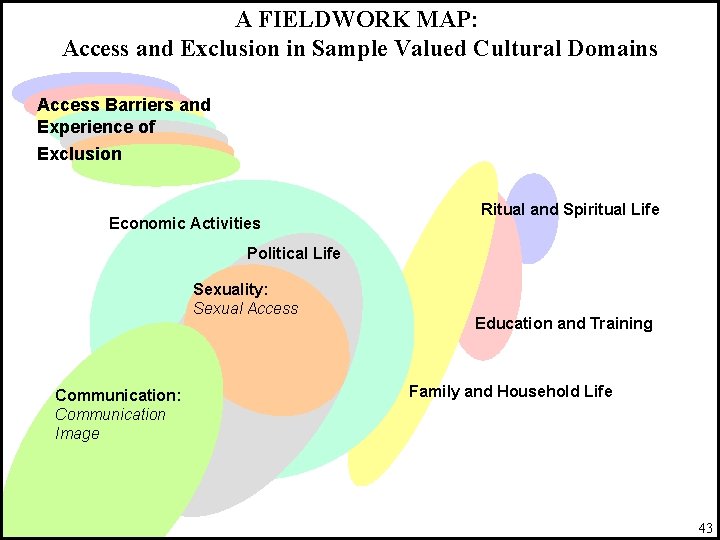
A FIELDWORK MAP: Access and Exclusion in Sample Valued Cultural Domains Access Barriers and Experience of Exclusion Economic Activities Ritual and Spiritual Life Political Life Sexuality: Sexual Access Communication: Communication Image Education and Training Family and Household Life 43
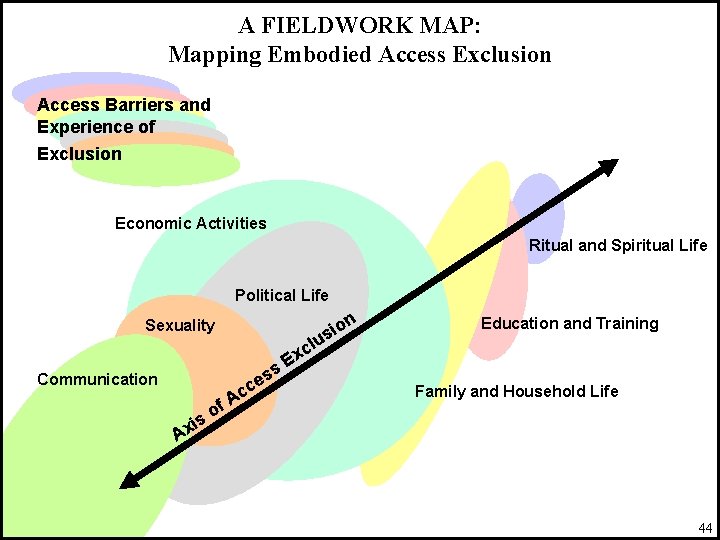
A FIELDWORK MAP: Mapping Embodied Access Exclusion Access Barriers and Experience of Exclusion Economic Activities Ritual and Spiritual Life Political Life n o i s Sexuality lu c x E s Communication xis o f. A es c c Education and Training Family and Household Life A 44
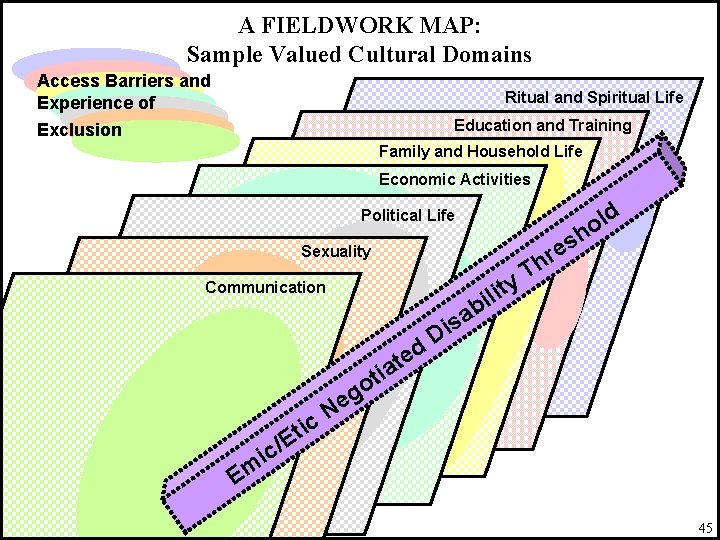
A FIELDWORK MAP: Sample Valued Cultural Domains Access Barriers and Experience of Ritual and Spiritual Life Education and Training Exclusion Family and Household Life Economic Activities d Political Life es r h Sexuality Communication T y it l i b a d t o g e c. N l o h e t a i s i D i t E / c i m E 45
Individual Approach 46
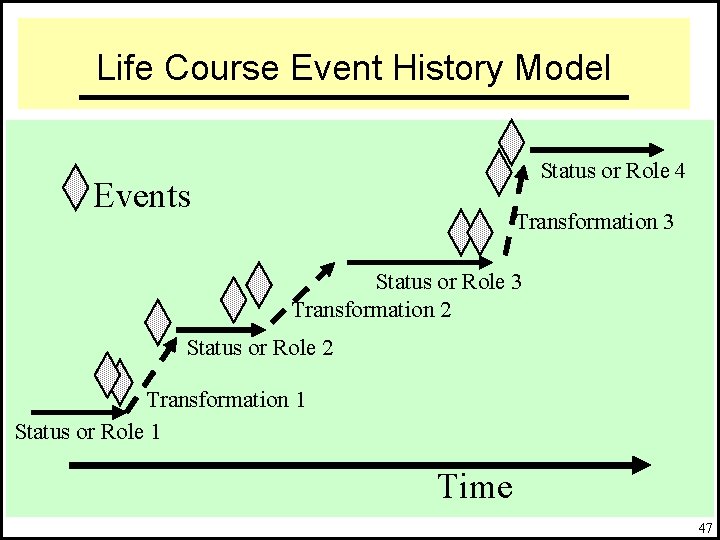
Life Course Event History Model Status or Role 4 Events Transformation 3 Status or Role 3 Transformation 2 Status or Role 2 Transformation 1 Status or Role 1 Time 47

Historical Context Participation Barrier Domains: Ritual and Spiritual Life Education and Training old sh re Family and Household Life Th Economic Activities Political Life Sexuality Communication ◄b Experience of Disability Access Participation Barriers 1950 Birth old h es r Th Impairment s re Th ld ho 1960 Adolescence 1970 Graduate School Devva’s Life Course Trajectory 1980 -90 Career 2000 Aging 48
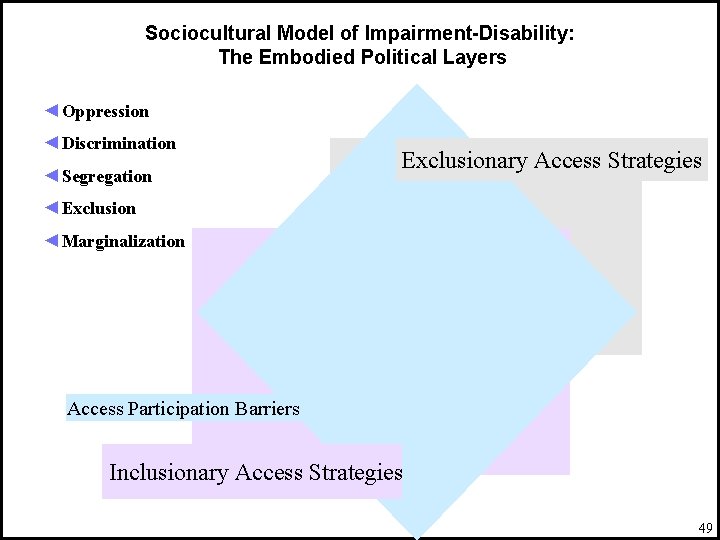
Sociocultural Model of Impairment-Disability: The Embodied Political Layers ◄Oppression ◄Discrimination ◄Segregation Exclusionary Access Strategies ◄Exclusion ◄Marginalization Access Participation Barriers Inclusionary Access Strategies 49
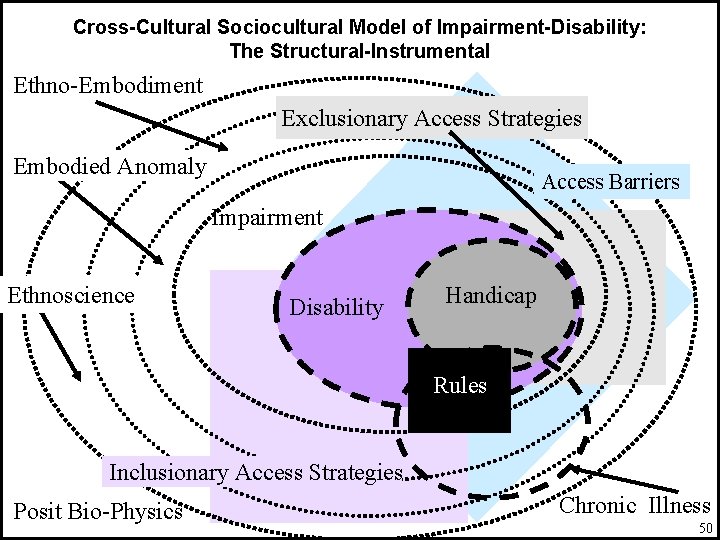
Cross-Cultural Sociocultural Model of Impairment-Disability: The Structural-Instrumental Ethno-Embodiment Exclusionary Access Strategies Embodied Anomaly Access Barriers Impairment Ethnoscience Disability Handicap Rules Inclusionary Access Strategies Posit Bio-Physics Chronic Illness 50
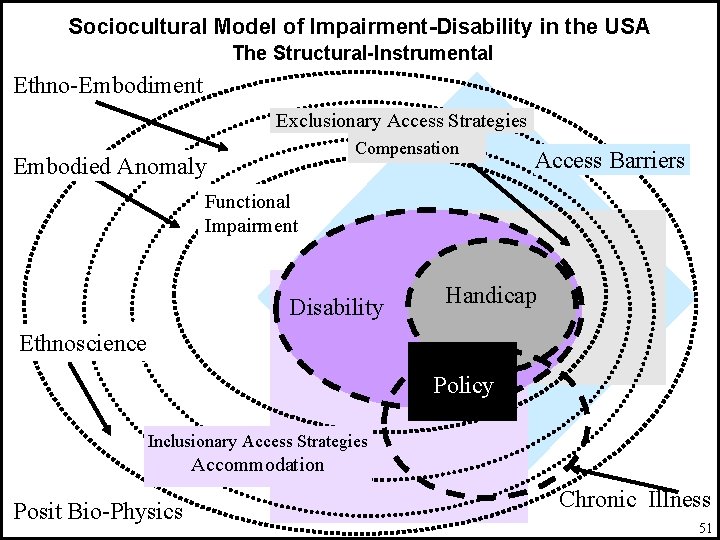
Sociocultural Model of Impairment-Disability in the USA The Structural-Instrumental Ethno-Embodiment Exclusionary Access Strategies Compensation Embodied Anomaly Access Barriers Functional Impairment Disability Handicap Ethnoscience Policy Inclusionary Access Strategies Accommodation Posit Bio-Physics Chronic Illness 51
Closing Devva on Fieldwork: ◄ Our Fieldwork Map could also be used in literature, history, and even in technology. ◄ It provides concrete places to start data collection that can help negotiate hidden and stated researcher bias without the DISappearance of disability that occurs in a radical relativistic approach or in a DISmodernism universalizing approach. Russ on Epistemology and Theoretical Development: ◄ In this working model we want to engage our colleagues in a true interdisciplinary approach not constrained by different epistemological validities. ◄ We want to celebrate the complexity of concepts of impairmentdisability because therein lie there staying power. 52
- Slides: 52