
A Small Muon Tomography Station with GEM Detectors
- Slides: 1
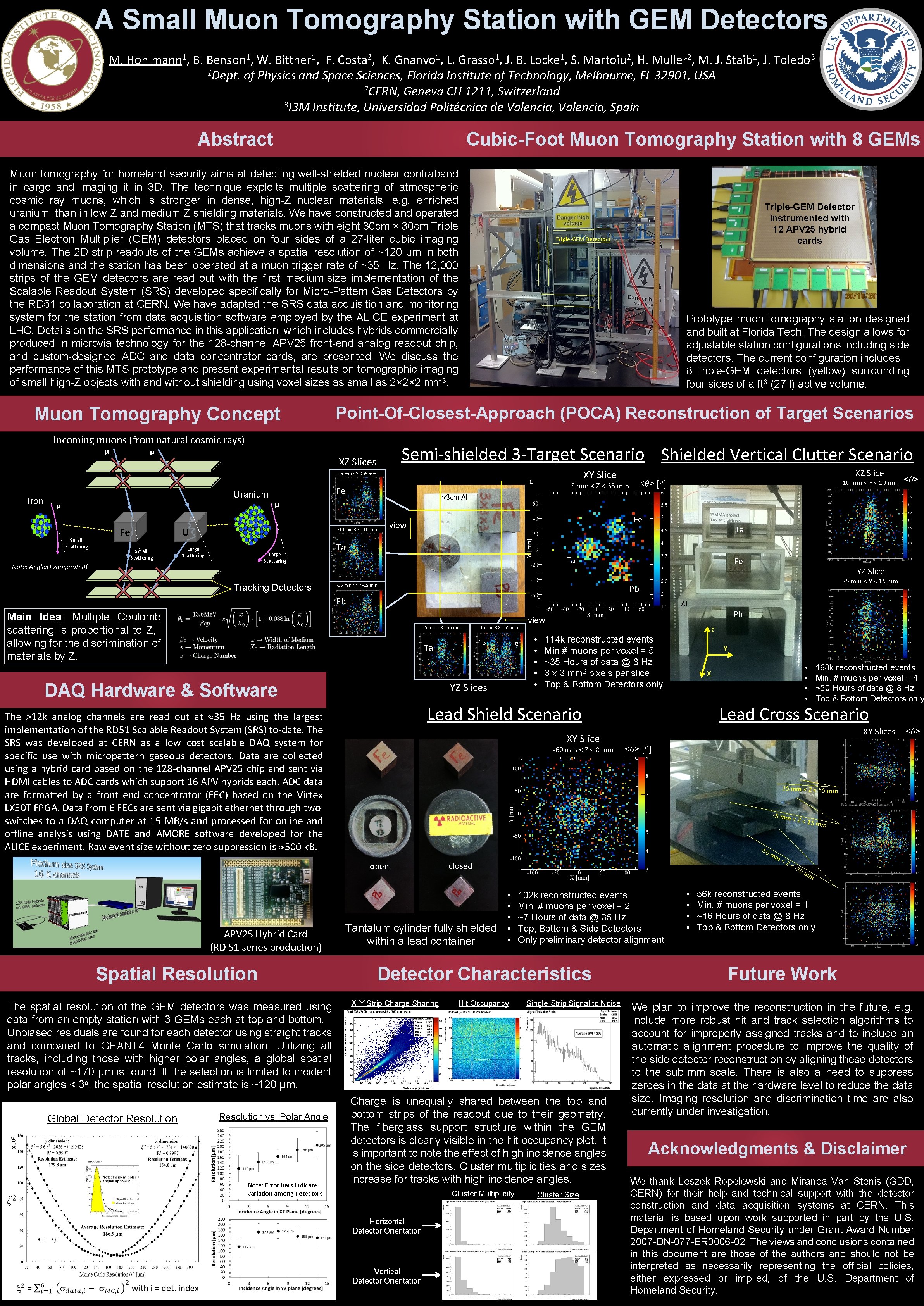
A Small Muon Tomography Station with GEM Detectors M. Hohlmann 1, B. Benson 1, W. Bittner 1, F. Costa 2, K. Gnanvo 1, L. Grasso 1, J. B. Locke 1, S. Martoiu 2, H. Muller 2, M. J. Staib 1, J. Toledo 3 1 Dept. of Physics and Space Sciences, Florida Institute of Technology, Melbourne, FL 32901, USA 2 CERN, Geneva CH 1211, Switzerland 3 I 3 M Institute, Universidad Politécnica de Valencia, Spain Abstract Cubic-Foot Muon Tomography Station with 8 GEMs Muon tomography for homeland security aims at detecting well-shielded nuclear contraband in cargo and imaging it in 3 D. The technique exploits multiple scattering of atmospheric cosmic ray muons, which is stronger in dense, high-Z nuclear materials, e. g. enriched uranium, than in low-Z and medium-Z shielding materials. We have constructed and operated a compact Muon Tomography Station (MTS) that tracks muons with eight 30 cm × 30 cm Triple Gas Electron Multiplier (GEM) detectors placed on four sides of a 27 -liter cubic imaging volume. The 2 D strip readouts of the GEMs achieve a spatial resolution of ~120 μm in both dimensions and the station has been operated at a muon trigger rate of ~35 Hz. The 12, 000 strips of the GEM detectors are read out with the first medium-size implementation of the Scalable Readout System (SRS) developed specifically for Micro-Pattern Gas Detectors by the RD 51 collaboration at CERN. We have adapted the SRS data acquisition and monitoring system for the station from data acquisition software employed by the ALICE experiment at LHC. Details on the SRS performance in this application, which includes hybrids commercially produced in microvia technology for the 128 -channel APV 25 front-end analog readout chip, and custom-designed ADC and data concentrator cards, are presented. We discuss the performance of this MTS prototype and present experimental results on tomographic imaging of small high-Z objects with and without shielding using voxel sizes as small as 2× 2× 2 mm 3. Muon Tomography Concept μ Triple-GEM Detectors Prototype muon tomography station designed and built at Florida Tech. The design allows for adjustable station configurations including side detectors. The current configuration includes 8 triple-GEM detectors (yellow) surrounding four sides of a ft 3 (27 l) active volume. Point-Of-Closest-Approach (POCA) Reconstruction of Target Scenarios Incoming muons (from natural cosmic rays) μ Semi-shielded 3 -Target Scenario Shielded Vertical Clutter Scenario XZ Slices XY Slice 15 mm < Y < 35 mm Iron Small Scattering Fe U Small Scattering Large Scattering Note: Angles Exaggerated! Tracking Detectors Fe view -10 mm < Y < 10 mm Large Scattering Ta Ta -35 mm < Y < -15 mm Fe Pb 15 mm < X < 35 mm DAQ Hardware & Software Global Detector Resolution vs. Polar Angle Note: Error bars indicate variation among detectors Fe YZ Slices Pb view • • • z 114 k reconstructed events Min # muons per voxel = 5 ~35 Hours of data @ 8 Hz 3 x 3 mm 2 pixels per slice Top & Bottom Detectors only Y XY Slice -60 mm < Z < 0 mm • • X Lead Shield Scenario 168 k reconstructed events Min. # muons per voxel = 4 ~50 Hours of data @ 8 Hz Top & Bottom Detectors only Lead Cross Scenario XY Slices <θ> [o] 35 mm < Z < 55 mm -50 open The spatial resolution of the GEM detectors was measured using data from an empty station with 3 GEMs each at top and bottom. Unbiased residuals are found for each detector using straight tracks and compared to GEANT 4 Monte Carlo simulation. Utilizing all tracks, including those with higher polar angles, a global spatial resolution of ~170 μm is found. If the selection is limited to incident polar angles < 3 o, the spatial resolution estimate is ~120 μm. 15 mm < X < 35 mm Pb Ta The >12 k analog channels are read out at 35 Hz using the largest implementation of the RD 51 Scalable Readout System (SRS) to-date. The SRS was developed at CERN as a low–cost scalable DAQ system for specific use with micropattern gaseous detectors. Data are collected using a hybrid card based on the 128 -channel APV 25 chip and sent via HDMI cables to ADC cards which support 16 APV hybrids each. ADC data are formatted by a front end concentrator (FEC) based on the Virtex LX 50 T FPGA. Data from 6 FECs are sent via gigabit ethernet through two switches to a DAQ computer at 15 MB/s and processed for online and offline analysis using DATE and AMORE software developed for the ALICE experiment. Raw event size without zero suppression is 500 k. B. YZ Slice -5 mm < Y < 15 mm Al Main Idea: Multiple Coulomb scattering is proportional to Z, allowing for the discrimination of materials by Z. Spatial Resolution <θ> Ta Pb APV 25 Hybrid Card (RD 51 series production) -10 mm < Y < 10 mm <θ> [o] 3 cm Al μ μ XZ Slice 5 mm < Z < 35 mm Fe Uranium Triple-GEM Detector instrumented with 12 APV 25 hybrid cards closed Tantalum cylinder fully shielded within a lead container • • • 102 k reconstructed events Min. # muons per voxel = 2 ~7 Hours of data @ 35 Hz Top, Bottom & Side Detectors Only preliminary detector alignment Detector Characteristics X-Y Strip Charge Sharing Hit Occupancy Single-Strip Signal to Noise Charge is unequally shared between the top and bottom strips of the readout due to their geometry. The fiberglass support structure within the GEM detectors is clearly visible in the hit occupancy plot. It is important to note the effect of high incidence angles on the side detectors. Cluster multiplicities and sizes increase for tracks with high incidence angles. Cluster Multiplicity Horizontal Detector Orientation Vertical Detector Orientation Cluster Size • • mm <Z <Z<1 < -3 5 mm 0 m m 56 k reconstructed events Min. # muons per voxel = 1 ~16 Hours of data @ 8 Hz Top & Bottom Detectors only Future Work We plan to improve the reconstruction in the future, e. g. include more robust hit and track selection algorithms to account for improperly assigned tracks and to include an automatic alignment procedure to improve the quality of the side detector reconstruction by aligning these detectors to the sub-mm scale. There is also a need to suppress zeroes in the data at the hardware level to reduce the data size. Imaging resolution and discrimination time are also currently under investigation. Acknowledgments & Disclaimer We thank Leszek Ropelewski and Miranda Van Stenis (GDD, CERN) for their help and technical support with the detector construction and data acquisition systems at CERN. This material is based upon work supported in part by the U. S. Department of Homeland Security under Grant Award Number 2007 -DN-077 -ER 0006 -02. The views and conclusions contained in this document are those of the authors and should not be interpreted as necessarily representing the official policies, either expressed or implied, of the U. S. Department of Homeland Security.