
A SimulationBased Optimization Model to Schedule Periodic Maintenance

A Simulation-Based Optimization Model to Schedule Periodic Maintenance of a Fleet of Aircraft Ville Mattila and Kai Virtanen Systems Analysis Laboratory, Helsinki University of Technology S ystems Analysis Laboratory Helsinki University of Technology 1

Contents • Scheduling the periodic maintenance (PM) of the aircraft fleet of the Finnish Air Force (Fi. AF) • Objective of scheduling: Improve aircraft availability • A simulation-based optimization model for the scheduling task – A discrete-event simulation model – A genetic algorithm S ystems Analysis Laboratory Helsinki University of Technology 2

Aircraft usage and maintenance Usage Different forms of pilot and tactical training A number of aircraft chosen each day to flight duty Maintenance Failure repairs Unplanned Periodic maintenance Based on usage Several missions during one day Different level maintenance facilities S ystems Analysis Laboratory Helsinki University of Technology 3
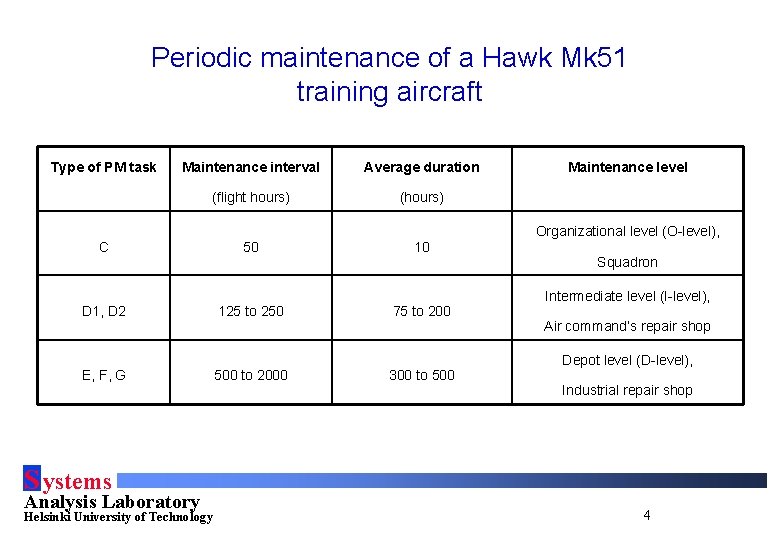
Periodic maintenance of a Hawk Mk 51 training aircraft Type of PM task Maintenance interval Average duration (flight hours) (hours) C 50 10 D 1, D 2 125 to 250 75 to 200 E, F, G 500 to 2000 300 to 500 Maintenance level Organizational level (O-level), Squadron Intermediate level (I-level), Air command’s repair shop Depot level (D-level), Industrial repair shop S ystems Analysis Laboratory Helsinki University of Technology 4
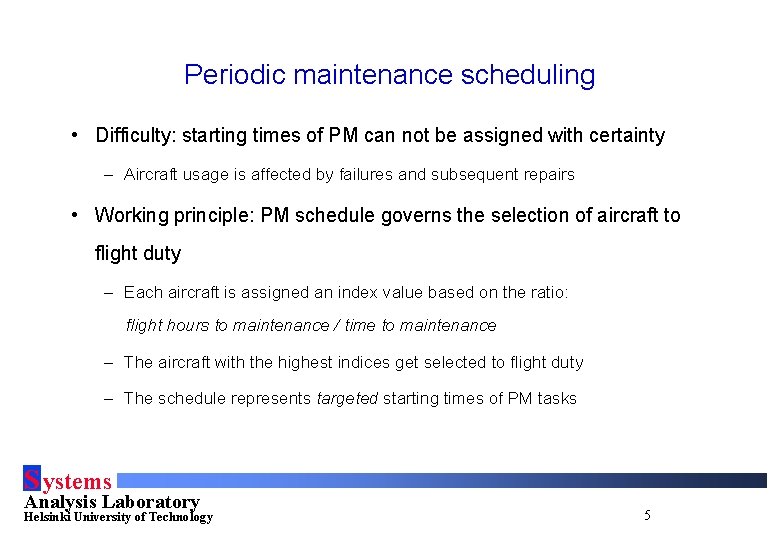
Periodic maintenance scheduling • Difficulty: starting times of PM can not be assigned with certainty – Aircraft usage is affected by failures and subsequent repairs • Working principle: PM schedule governs the selection of aircraft to flight duty – Each aircraft is assigned an index value based on the ratio: flight hours to maintenance / time to maintenance – The aircraft with the highest indices get selected to flight duty – The schedule represents targeted starting times of PM tasks S ystems Analysis Laboratory Helsinki University of Technology 5
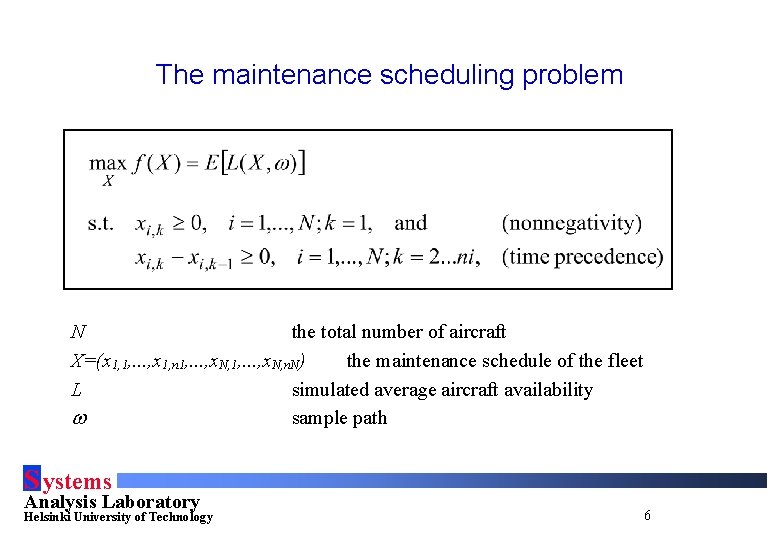
The maintenance scheduling problem N the total number of aircraft X=(x 1, 1, . . . , x 1, n 1, . . . , x. N, n. N) the maintenance schedule of the fleet L simulated average aircraft availability sample path S ystems Analysis Laboratory Helsinki University of Technology 6
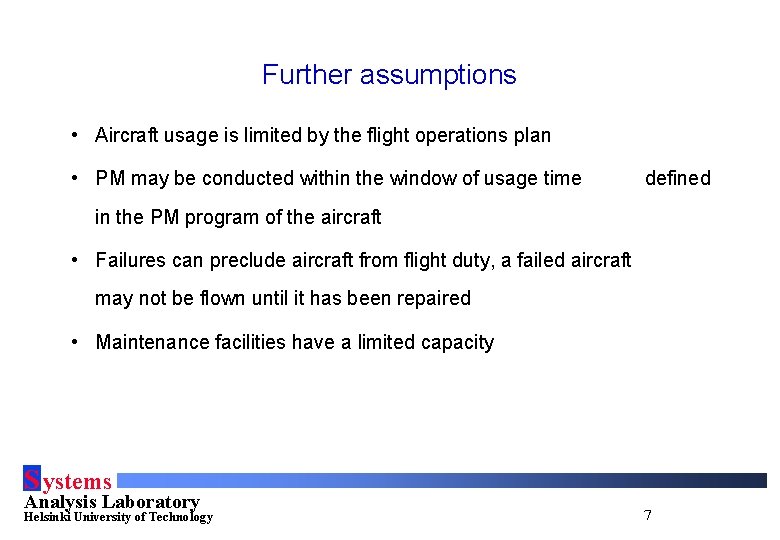
Further assumptions • Aircraft usage is limited by the flight operations plan • PM may be conducted within the window of usage time defined in the PM program of the aircraft • Failures can preclude aircraft from flight duty, a failed aircraft may not be flown until it has been repaired • Maintenance facilities have a limited capacity S ystems Analysis Laboratory Helsinki University of Technology 7
The simulation optimization model • A discrete-event simulation model – Describes aircraft usage and maintenance – Evaluates aircraft availability related to a given candidate solution, i. e. , a maintenance schedule • A genetic algorithm – Produces new candidate solutions utilizing the simulated availabilities S ystems Analysis Laboratory Helsinki University of Technology 8
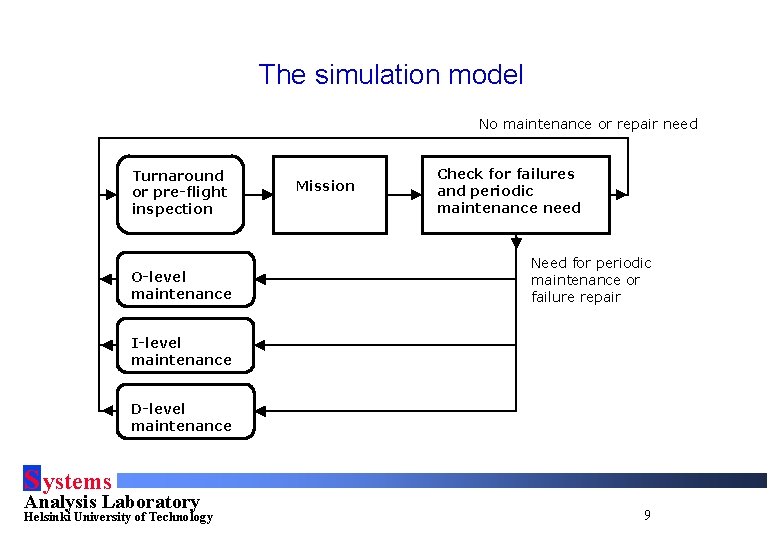
The simulation model No maintenance or repair need Turnaround or pre-flight inspection O-level maintenance Mission Check for failures and periodic maintenance need Need for periodic maintenance or failure repair I-level maintenance D-level maintenance S ystems Analysis Laboratory Helsinki University of Technology 9
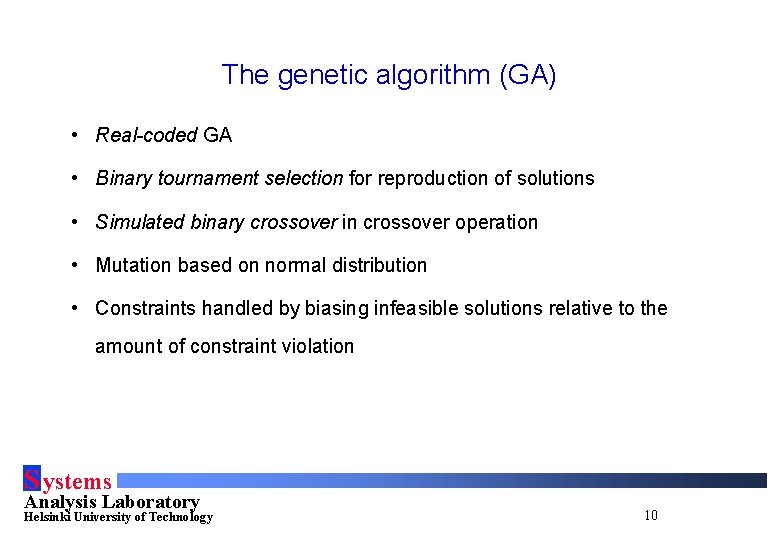
The genetic algorithm (GA) • Real-coded GA • Binary tournament selection for reproduction of solutions • Simulated binary crossover in crossover operation • Mutation based on normal distribution • Constraints handled by biasing infeasible solutions relative to the amount of constraint violation S ystems Analysis Laboratory Helsinki University of Technology 10
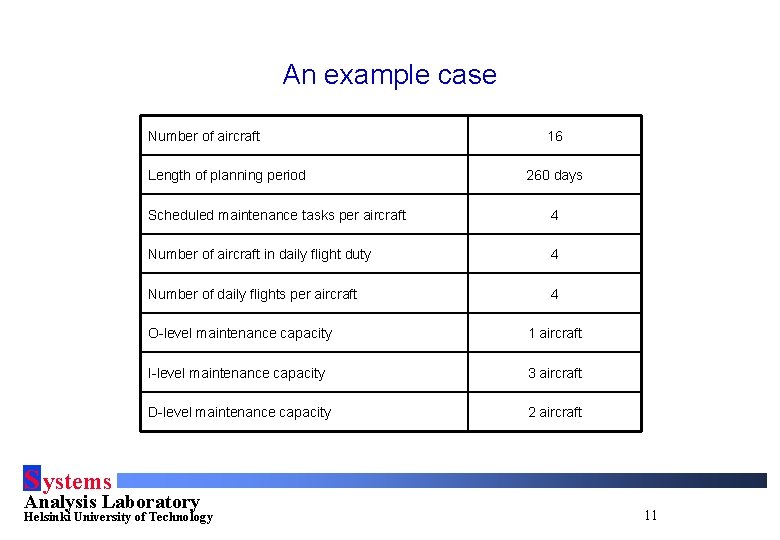
An example case Number of aircraft Length of planning period 16 260 days Scheduled maintenance tasks per aircraft 4 Number of aircraft in daily flight duty 4 Number of daily flights per aircraft 4 O-level maintenance capacity 1 aircraft I-level maintenance capacity 3 aircraft D-level maintenance capacity 2 aircraft S ystems Analysis Laboratory Helsinki University of Technology 11
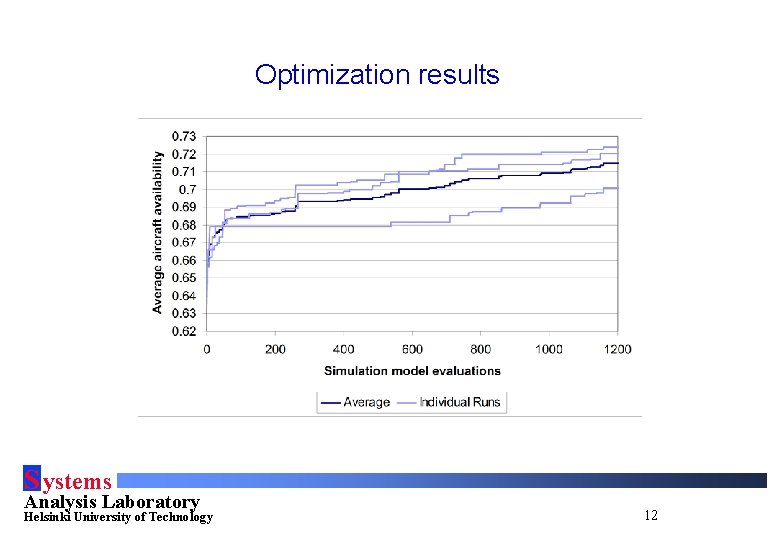
Optimization results S ystems Analysis Laboratory Helsinki University of Technology 12
The performance of the model • The simulation-optimization model produces viable maintenence schedules • The best example solution has an average aircraft availability of 0. 72 • This level of availability is obtained with 1200 simulation model evaluations using random initial solutions S ystems Analysis Laboratory Helsinki University of Technology 13
How good is the solution? • Simulation output for evaluating the quality of the solution – Queing times at maintenance facilities • Indicate the maximum amount of improvement obtainable by means of scheduling • In the example case, queuing is almost entirely eliminated – The timely development of aircraft availability illustrates the impact of an efficient solution S ystems Analysis Laboratory Helsinki University of Technology 14
Scheduling vs. no scheduling in the example case S ystems Analysis Laboratory Helsinki University of Technology 15
Future work • Ranking and selection procedures in comparison of candidate solutions to enhance the efficiency of optimization • Extensions to the example case: – Different patterns of flight activity – Time varying resource availability – Larger fleet sizes • Implementation of the model as a design-tool for maintenance designers S ystems Analysis Laboratory Helsinki University of Technology 16
- Slides: 16