
A Simple Unit Commitment Problem Valentn Petrov James
A Simple Unit Commitment Problem Valentín Petrov, James Nicolaisen 18 / Oct / 1999 NSF meeting
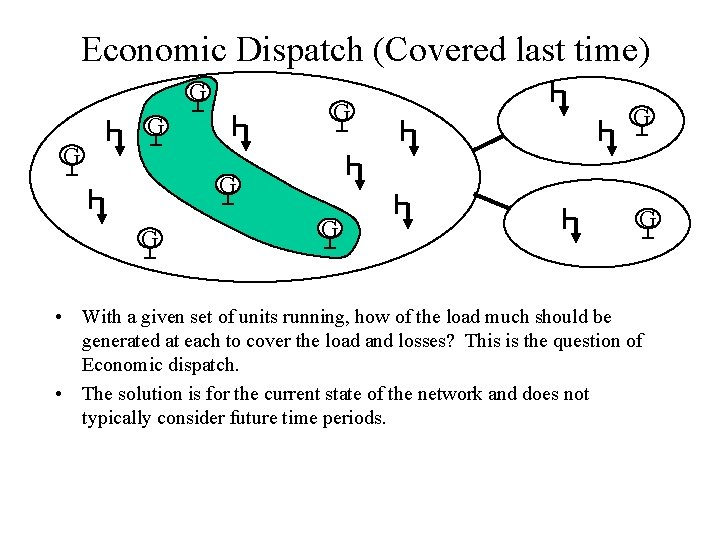
Economic Dispatch (Covered last time) G G G G G • With a given set of units running, how of the load much should be generated at each to cover the load and losses? This is the question of Economic dispatch. • The solution is for the current state of the network and does not typically consider future time periods.
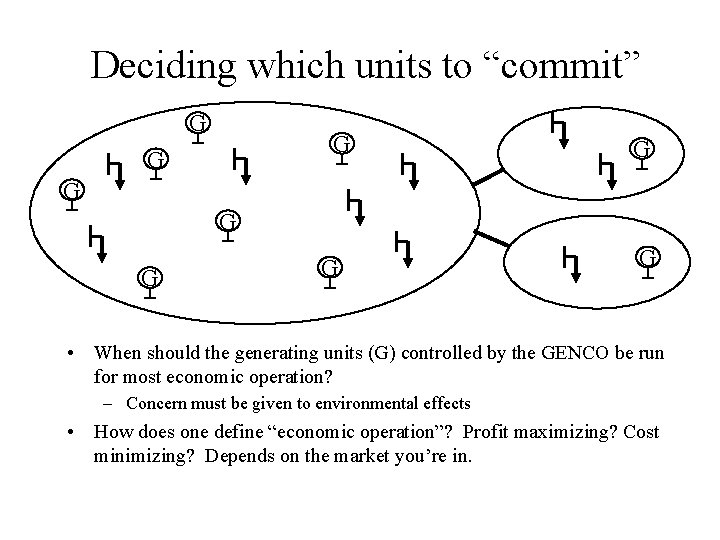
Deciding which units to “commit” G G G G G • When should the generating units (G) controlled by the GENCO be run for most economic operation? – Concern must be given to environmental effects • How does one define “economic operation”? Profit maximizing? Cost minimizing? Depends on the market you’re in.
Problem Setup • Last meeting we discussed the economic dispatch problem • Now we will see how the unit commitment fits into the general picture • Unit commitment is bound to the economic dispatch • Use similar optimization methods
What is Unit Commitment (1) • We have a few generators (units) • Also we have some forecasted load • Besides the cost of running the units we have additional costs and constraints – start-up cost – shut-down cost – spinning reserve – ramp-up time. . . and more
What is Unit Commitment (2) • It turns out that we cannot just flip the switch of certain units on and use them! • We need to think ahead, and based on the forecasted load and unit constraints, determine which units to turn on (commit) and which ones to keep down • Minimize cost, cheap units play first • Expensive ones run only when demand is high
How Do We Solve the Problem • If a unit is on, we designate this with 1 and respectively, the off unit is 0 • So, somehow we decide that for the next hour we will have "0 1 1 0 1" if we have five units • Based on that, we solve the economic dispatch problem for unit 2, 3 and 5 • We start turning on U 2, U 3, U 5 • When the next hour comes, we have them up and running
To Come Up With Unit Commitment • The question is, _how_ do we come up with this unit commitment "0 1 1 0 1" ? • One very simplistic way: if we have very few units, go over all combinations from hour to hour • For each combination at a given hour, solve the economic dispatch • For each hour, pick the combination giving the lowest cost!
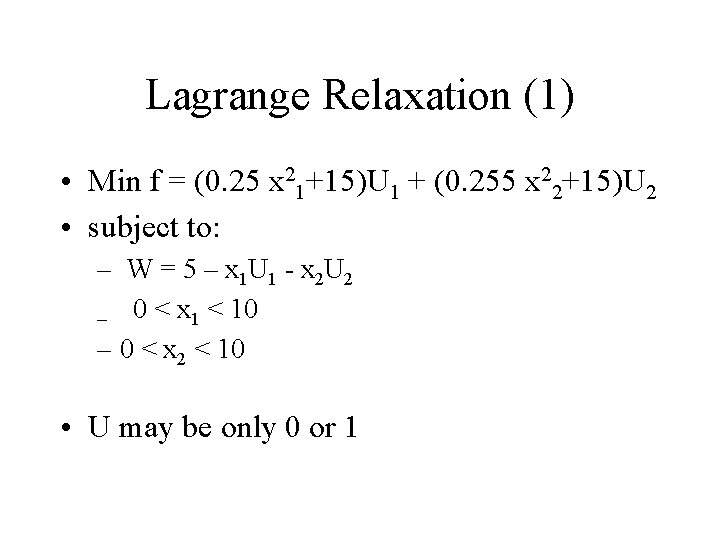
Lagrange Relaxation (1) • Min f = (0. 25 x 21+15)U 1 + (0. 255 x 22+15)U 2 • subject to: – W = 5 – x 1 U 1 - x 2 U 2 – 0 < x 1 < 10 – 0 < x 2 < 10 • U may be only 0 or 1
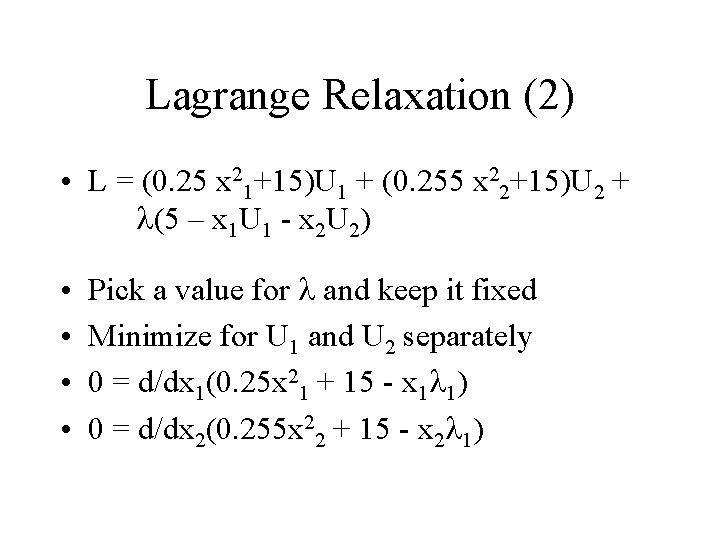
Lagrange Relaxation (2) • L = (0. 25 x 21+15)U 1 + (0. 255 x 22+15)U 2 + l(5 – x 1 U 1 - x 2 U 2) • • Pick a value for l and keep it fixed Minimize for U 1 and U 2 separately 0 = d/dx 1(0. 25 x 21 + 15 - x 1 l 1) 0 = d/dx 2(0. 255 x 22 + 15 - x 2 l 1)
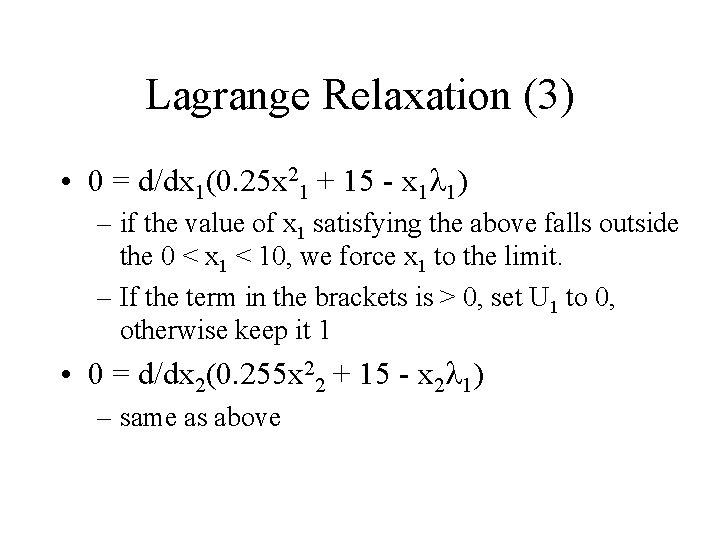
Lagrange Relaxation (3) • 0 = d/dx 1(0. 25 x 21 + 15 - x 1 l 1) – if the value of x 1 satisfying the above falls outside the 0 < x 1 < 10, we force x 1 to the limit. – If the term in the brackets is > 0, set U 1 to 0, otherwise keep it 1 • 0 = d/dx 2(0. 255 x 22 + 15 - x 2 l 1) – same as above
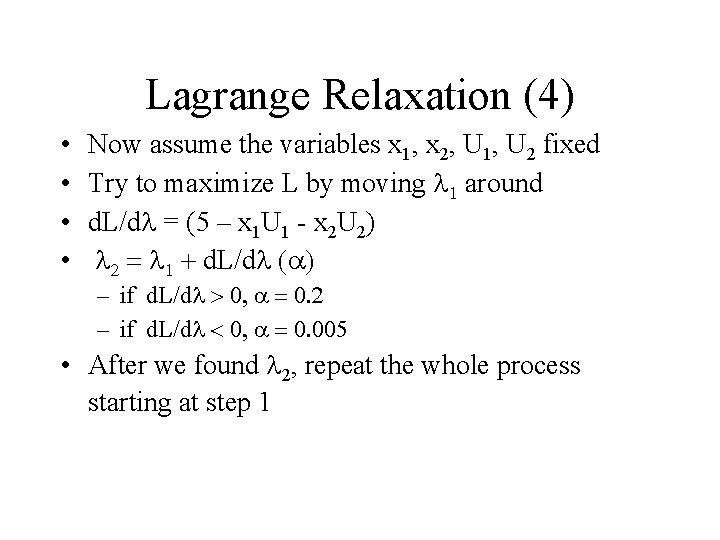
Lagrange Relaxation (4) • • Now assume the variables x 1, x 2, U 1, U 2 fixed Try to maximize L by moving l 1 around d. L/dl = (5 – x 1 U 1 - x 2 U 2) l 2 = l 1 + d. L/dl (a) – if d. L/dl > 0, a = 0. 2 – if d. L/dl < 0, a = 0. 005 • After we found l 2, repeat the whole process starting at step 1
- Slides: 12