
A simple construction of twodimensional suffix trees in

![Previous Works (1) • Gonnet[88] : – First introduced a notion of suffix tree](https://slidetodoc.com/presentation_image_h2/2d82a92d378a24de893cf9e947e66a71/image-5.jpg "Previous Works (1) • Gonnet[88] : – First introduced a notion of suffix tree")
![Previous Works (2) • Kim & Park [99] – Proposed the first linear-time construction](https://slidetodoc.com/presentation_image_h2/2d82a92d378a24de893cf9e947e66a71/image-6.jpg "Previous Works (2) • Kim & Park [99] – Proposed the first linear-time construction")

![2 -D Case In constructing two-dimensional suffix trees, • Kim and Park [99] :](https://slidetodoc.com/presentation_image_h2/2d82a92d378a24de893cf9e947e66a71/image-10.jpg "2 -D Case In constructing two-dimensional suffix trees, • Kim and Park [99] :")
![4 Types of Matrices A A 3 = A [1: n , 2: m]](https://slidetodoc.com/presentation_image_h2/2d82a92d378a24de893cf9e947e66a71/image-19.jpg "4 Types of Matrices A A 3 = A [1: n , 2: m]")
![Difference from the previous algorithm • In previous algorithm (Kim&Park[99]), – Isuffix tree for](https://slidetodoc.com/presentation_image_h2/2d82a92d378a24de893cf9e947e66a71/image-20.jpg "Difference from the previous algorithm • In previous algorithm (Kim&Park[99]), – Isuffix tree for")
- Slides: 30
A simple construction of twodimensional suffix trees in linear time Dong Kyue Kim*, Joong Chae Na Jeong Seop Sim, Kunsoo Park * Division of Electronics and Computer Engineering Hanyang University, Korea
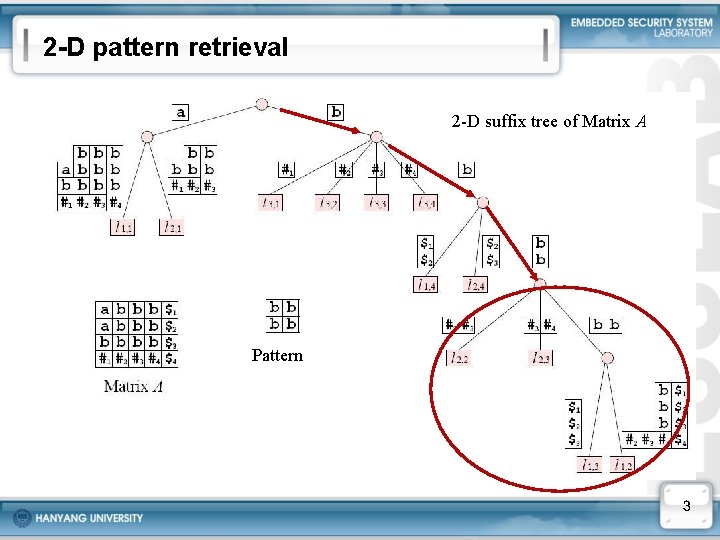
Suffix Tree & 2 -D Suffix Tree • Suffix tree of a string S is a compacted trie that represents all substrings of S. – It has been a fundamental data structure not only for computer science, but also for engineering and bioinformatics applications • Two dimensional suffix tree of a matrix A is a compacted trie that represents all square submatrices of A. – Useful for 2 -D pattern retrieval • low-level image processing, data compression, visual databases in multimedia systems 2
2 -D pattern retrieval 2 -D suffix tree of Matrix A Pattern 3
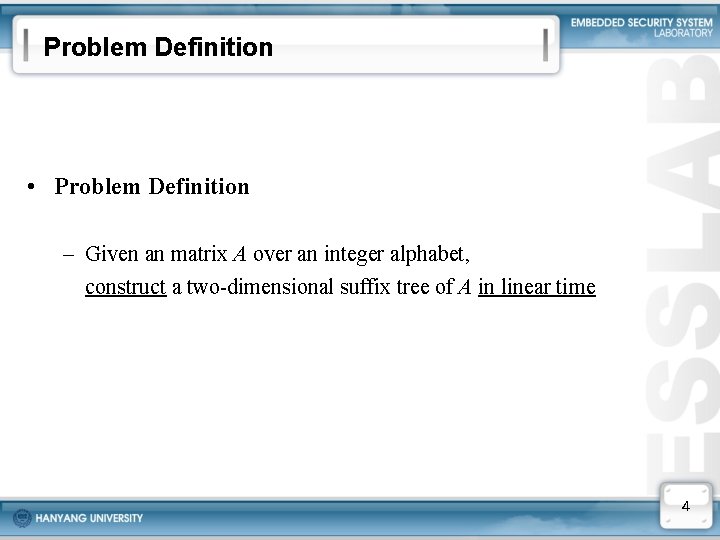
Problem Definition • Problem Definition – Given an matrix A over an integer alphabet, construct a two-dimensional suffix tree of A in linear time 4
Previous Works (1) • Gonnet[88] : – First introduced a notion of suffix tree for a matrix, called the PAT-tree. • Giancarlo[95] : – Proposed Lsuffix tree (2 -D suffix trees), compactly storing all square submatrices of an n×n matrix. – Construction : O(n 2 log n) time and O(n 2) space. • Giancarlo & Grossi [96, 97] : – Introduced the general frameworks of 2 -D suffix tree families and proposed an expected linear-time construction algorithm. 5
Previous Works (2) • Kim & Park [99] – Proposed the first linear-time construction algorithm, called Isuffix tree, for integer alphabets – Using Farach’ the paradigm [Farach 97]. • Cole & Hariharan [2000] – Proposed a randomized linear-time construction algorithm • Giancarlo & Guaina [99], and Na et al. [2005] – Presented on-line construction algorithms. 6
Motivations & Contributions
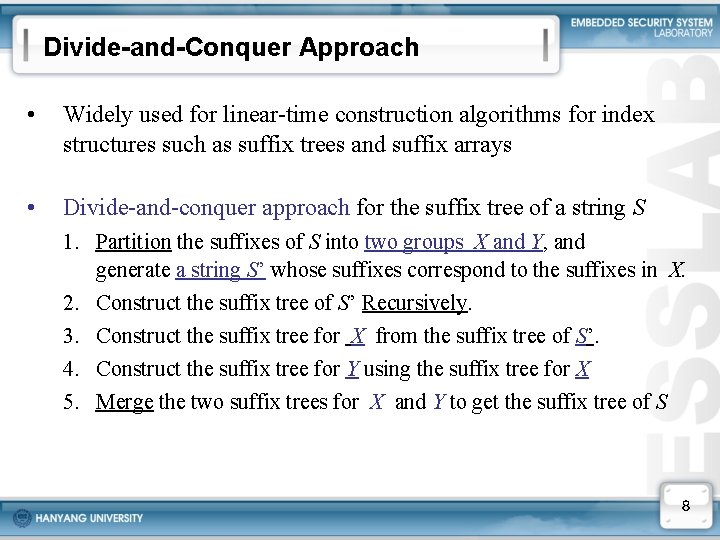
Divide-and-Conquer Approach • Widely used for linear-time construction algorithms for index structures such as suffix trees and suffix arrays • Divide-and-conquer approach for the suffix tree of a string S 1. Partition the suffixes of S into two groups X and Y, and generate a string S’ whose suffixes correspond to the suffixes in X. 2. Construct the suffix tree of S’ Recursively. 3. Construct the suffix tree for X from the suffix tree of S’. 4. Construct the suffix tree for Y using the suffix tree for X 5. Merge the two suffix trees for X and Y to get the suffix tree of S 8
Odd-Even Scheme vs. Skew Scheme • There are two kinds of scheme according to the method of partitioning the suffixes. • The odd-even scheme (Suffix tree-Farach [97], suffix array-Kim et al. [03]) – Divide the suffixes of S into odd suffixes (group X) and even suffixes (group Y) ( ½-recursion) – Most of steps in the odd-even scheme are simple, but its merging step is quite complicated. • The skew scheme (Kärkkäinen and Sanders [03]) – Divide the suffixes of S into three sets, and regard two sets as group X and the remaining set as group Y ( ⅔-recursion) – Its merging step is simple and elegant. 9
2 -D Case In constructing two-dimensional suffix trees, • Kim and Park [99] : extended the odd-even scheme to an n×n (=N) matrix. – Partition the suffixes into 4 sets of size ¼ (= ½×½) N each, i. e. , three sets of suffixes are regarded as group X and the remaining set as group Y, and performs ¾-recursion. – Since this algorithm uses the odd-even scheme, the merging step is performed three times for each recursion and quite complicated. 10
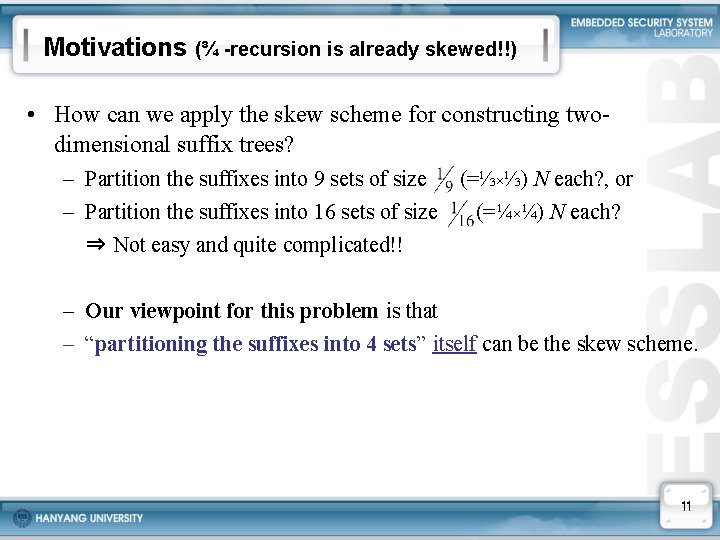
Motivations (¾ -recursion is already skewed!!) • How can we apply the skew scheme for constructing twodimensional suffix trees? – Partition the suffixes into 9 sets of size (=⅓×⅓) N each? , or – Partition the suffixes into 16 sets of size (=¼×¼) N each? ⇒ Not easy and quite complicated!! – Our viewpoint for this problem is that – “partitioning the suffixes into 4 sets” itself can be the skew scheme. 11
Contributions • A new and simple algorithm for constructing two-dimensional suffix trees in linear time. – By applying the skew scheme to matrices – Thus, the merging step is quite simple. 12
Overview of our algorithm
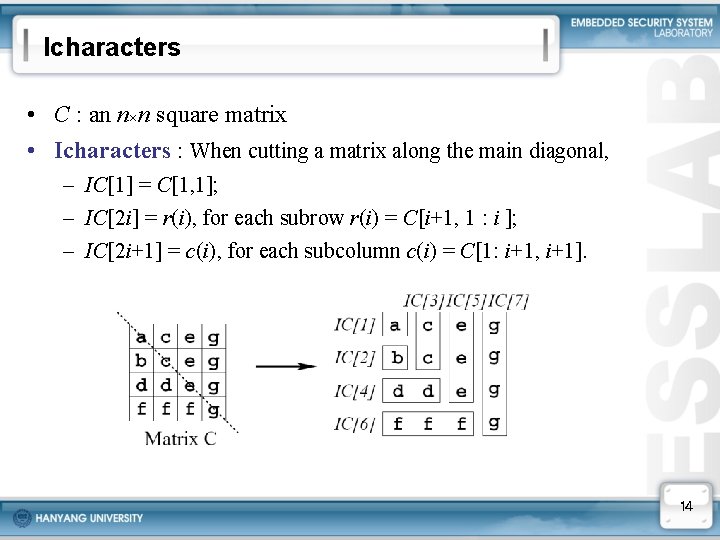
Icharacters • C : an n×n square matrix • Icharacters : When cutting a matrix along the main diagonal, – IC[1] = C[1, 1]; – IC[2 i] = r(i), for each subrow r(i) = C[i+1, 1 : i ]; – IC[2 i+1] = c(i), for each subcolumn c(i) = C[1: i+1, i+1]. 14
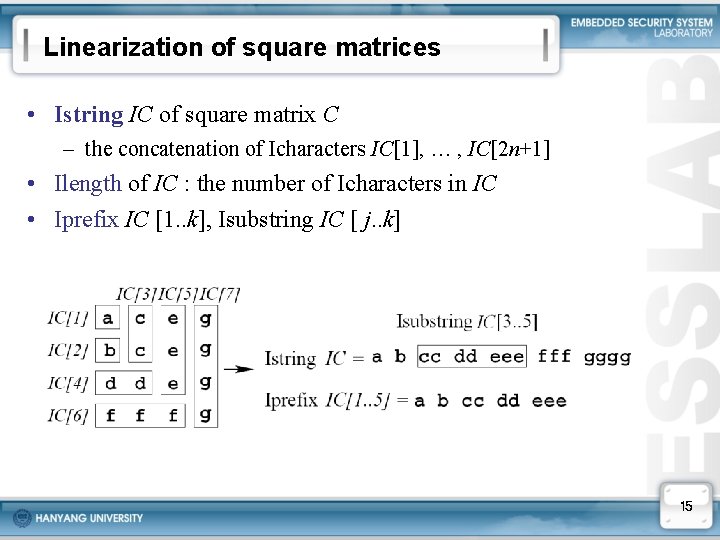
Linearization of square matrices • Istring IC of square matrix C – the concatenation of Icharacters IC[1], … , IC[2 n+1] • Ilength of IC : the number of Icharacters in IC • Iprefix IC [1. . k], Isubstring IC [ j. . k] 15
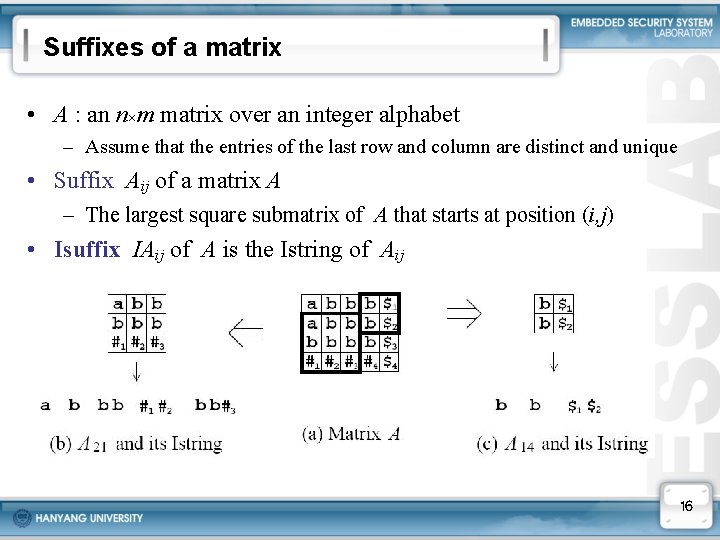
Suffixes of a matrix • A : an n×m matrix over an integer alphabet – Assume that the entries of the last row and column are distinct and unique • Suffix Aij of a matrix A – The largest square submatrix of A that starts at position (i, j) • Isuffix IAij of A is the Istring of Aij 16
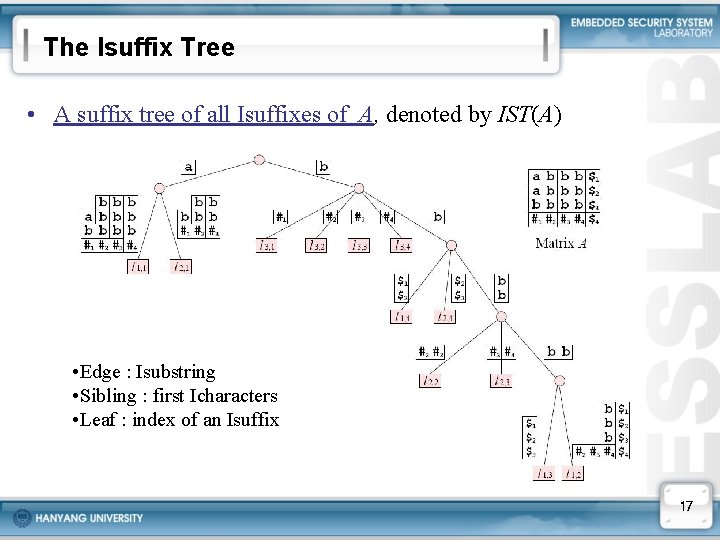
The Isuffix Tree • A suffix tree of all Isuffixes of A, denoted by IST(A) • Edge : Isubstring • Sibling : first Icharacters • Leaf : index of an Isuffix 17
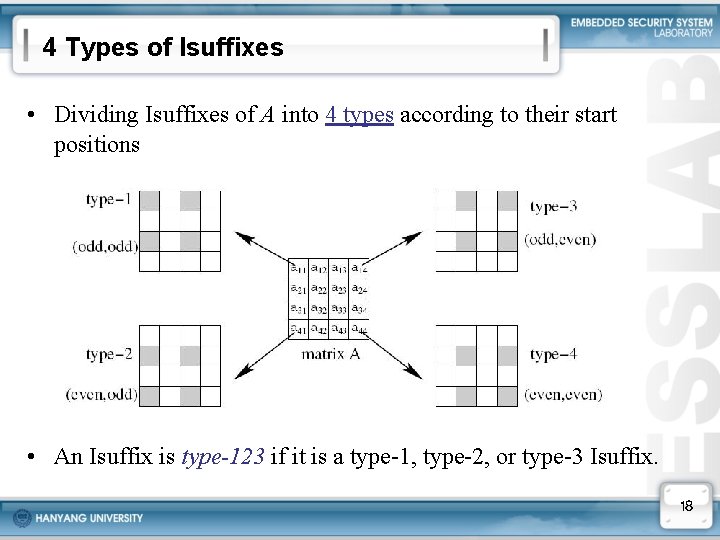
4 Types of Isuffixes • Dividing Isuffixes of A into 4 types according to their start positions • An Isuffix is type-123 if it is a type-1, type-2, or type-3 Isuffix. 18
4 Types of Matrices A A 3 = A [1: n , 2: m] A 1 = A dummyrow A 2 = A [2: n , 1: m] dummy column A 4 = A [2: n , 2: m] * Type-1 Isuffixes of Ar correspond to type-r Isuffixes of A 19
Difference from the previous algorithm • In previous algorithm (Kim&Park[99]), – Isuffix tree for each Ar, (1 ≤ r ≤ 3) is constructed recursively, i. e. , – Three Isuffix trees are constructed separately in a recursion step. • In our algorithm, – Isuffix tree for the concatenation of A 1, A 2, and A 3 will be constructed recursively, i. e. , – One Isuffix tree is constructed in a recursion step 20
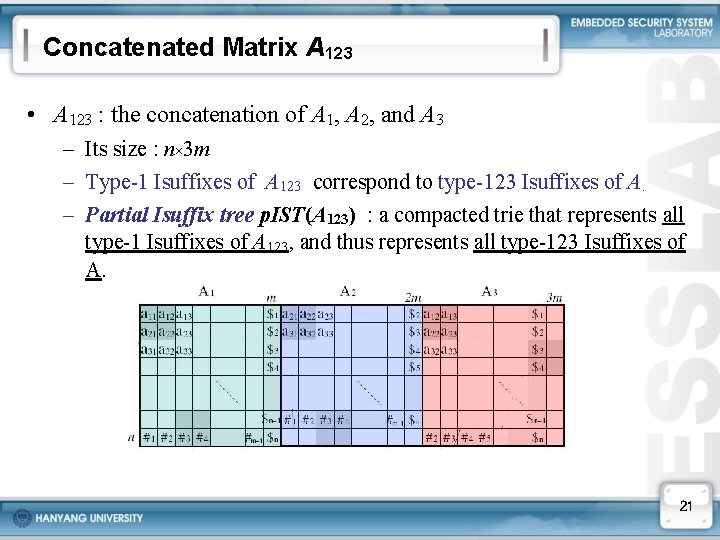
Concatenated Matrix A 123 • A 123 : the concatenation of A 1, A 2, and A 3 – Its size : n× 3 m – Type-1 Isuffixes of A 123 correspond to type-123 Isuffixes of A. – Partial Isuffix tree p. IST(A 123) : a compacted trie that represents all type-1 Isuffixes of A 123, and thus represents all type-123 Isuffixes of A. 21
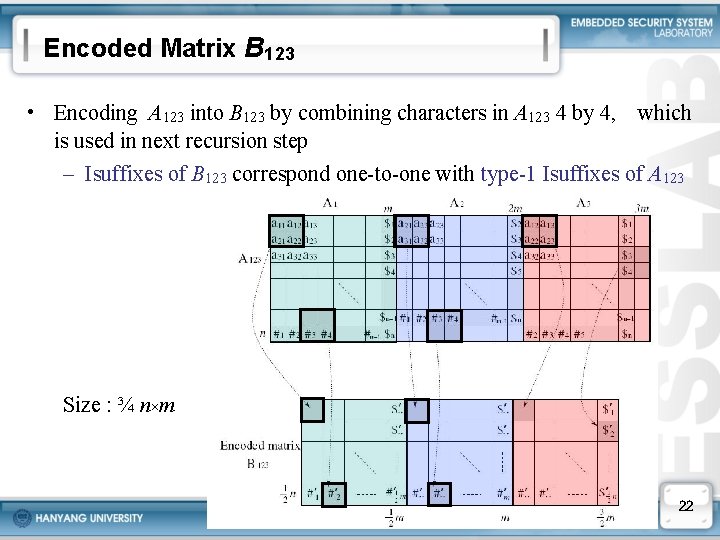
Encoded Matrix B 123 • Encoding A 123 into B 123 by combining characters in A 123 4 by 4, which is used in next recursion step – Isuffixes of B 123 correspond one-to-one with type-1 Isuffixes of A 123 Size : ¾ n×m 22
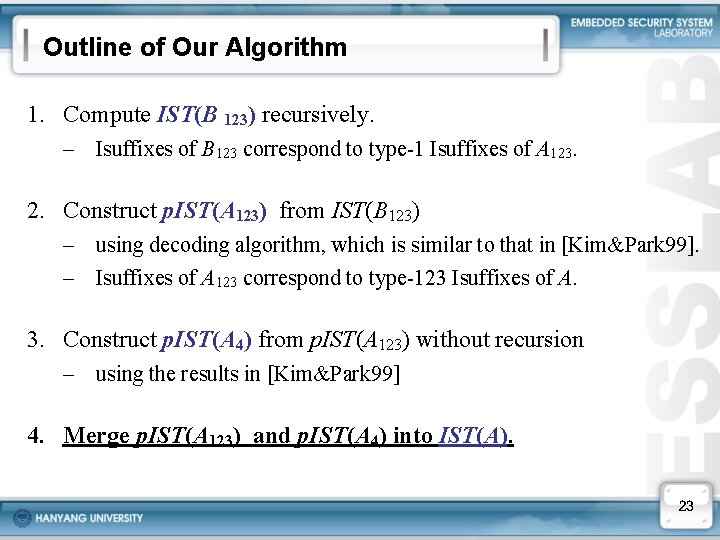
Outline of Our Algorithm 1. Compute IST(B 123) recursively. – Isuffixes of B 123 correspond to type-1 Isuffixes of A 123. 2. Construct p. IST(A 123) from IST(B 123) – using decoding algorithm, which is similar to that in [Kim&Park 99]. – Isuffixes of A 123 correspond to type-123 Isuffixes of A. 3. Construct p. IST(A 4) from p. IST(A 123) without recursion – using the results in [Kim&Park 99] 4. Merge p. IST(A 123) and p. IST(A 4) into IST(A). 23
Step 4: Merging
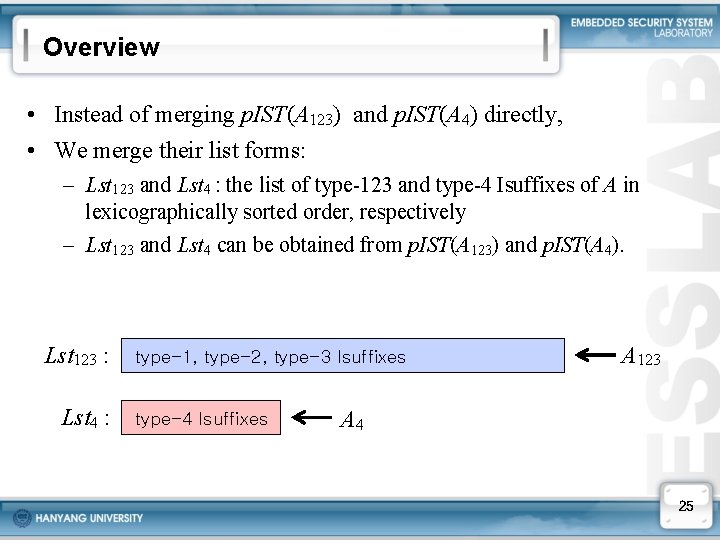
Overview • Instead of merging p. IST(A 123) and p. IST(A 4) directly, • We merge their list forms: – Lst 123 and Lst 4 : the list of type-123 and type-4 Isuffixes of A in lexicographically sorted order, respectively – Lst 123 and Lst 4 can be obtained from p. IST(A 123) and p. IST(A 4). Lst 123 : Lst 4 : type-1, type-2, type-3 Isuffixes type-4 Isuffixes A 123 A 4 25
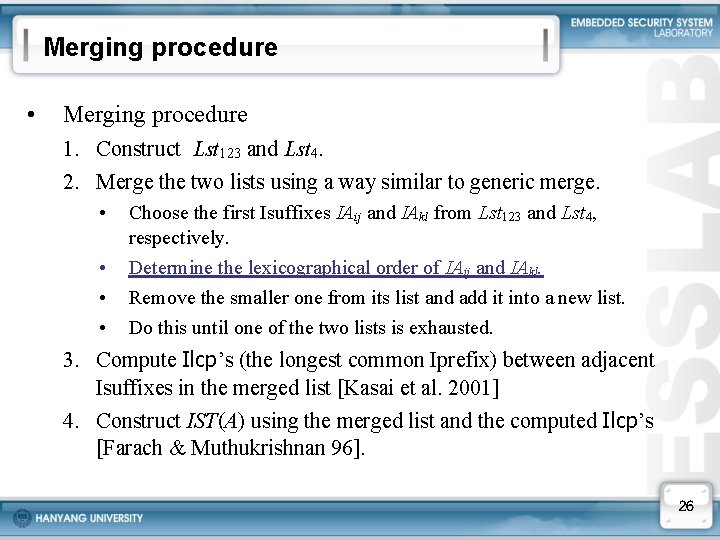
Merging procedure • Merging procedure 1. Construct Lst 123 and Lst 4. 2. Merge the two lists using a way similar to generic merge. • • Choose the first Isuffixes IAij and IAkl from Lst 123 and Lst 4, respectively. Determine the lexicographical order of IAij and IAkl. Remove the smaller one from its list and add it into a new list. Do this until one of the two lists is exhausted. 3. Compute Ilcp’s (the longest common Iprefix) between adjacent Isuffixes in the merged list [Kasai et al. 2001] 4. Construct IST(A) using the merged list and the computed Ilcp’s [Farach & Muthukrishnan 96]. 26
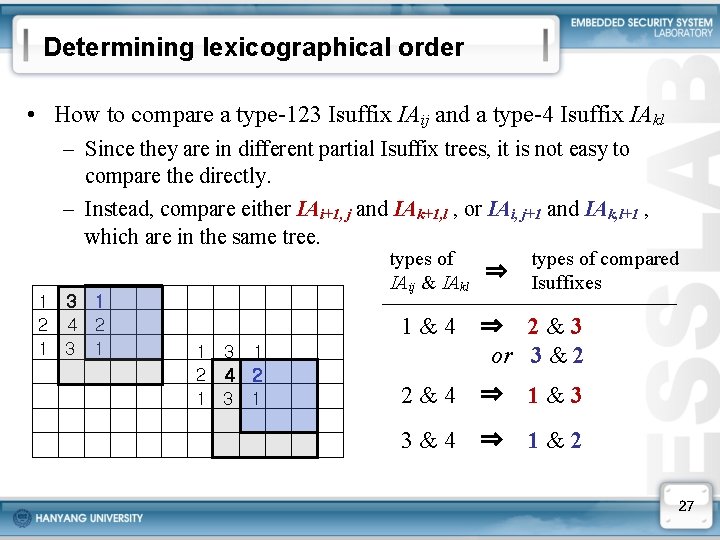
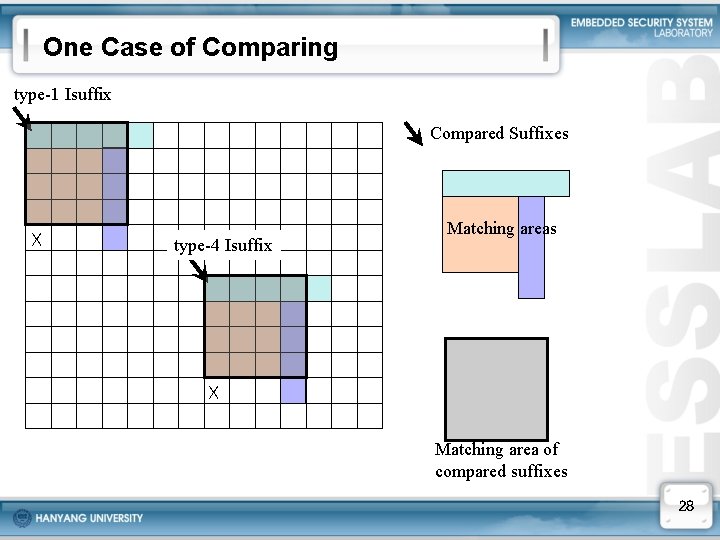
Determining lexicographical order • How to compare a type-123 Isuffix IAij and a type-4 Isuffix IAkl – Since they are in different partial Isuffix trees, it is not easy to compare the directly. – Instead, compare either IAi+1, j and IAk+1, l , or IAi, j+1 and IAk, l+1 , which are in the same tree. 1 3 1 2 4 2 1 3 1 types of IAij & IAkl 1 3 1 2 4 2 1 3 1 types of compared ⇒ Isuffixes 1&4 ⇒ 2&3 or 3 & 2 2&4 ⇒ 1&3 3&4 ⇒ 1&2 27
One Case of Comparing type-1 Isuffix Compared Suffixes X type-4 Isuffix Matching areas X Matching area of compared suffixes 28
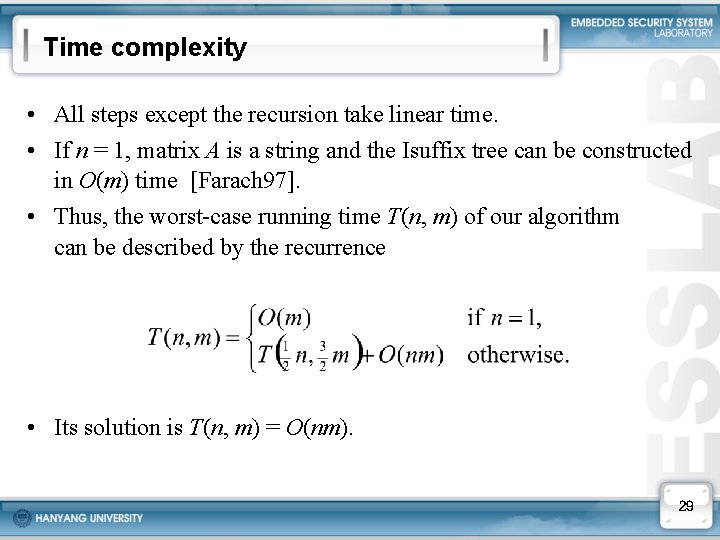
Time complexity • All steps except the recursion take linear time. • If n = 1, matrix A is a string and the Isuffix tree can be constructed in O(m) time [Farach 97]. • Thus, the worst-case running time T(n, m) of our algorithm can be described by the recurrence • Its solution is T(n, m) = O(nm). 29
Conclusion • A new and simple algorithm to construct two-dimensional suffix trees in linear time – How to apply the skew scheme to matrices. – How to merge Isuffixes in two groups • Future works – Directly constructing the 2 -D suffix array in linear time. – On-line constructing the 2 -D suffix tree in linear time. 30