
A Short Look at Earth History The big
A Short Look at Earth History The big perspective of ‘us in the universe’ E&ES 199
Formation of Everything • Formation of Universe (Big Bang): 15 Ga (making H, He , little bit of Li, B, Be) • Element formation (inside stars up to Iron, during supernovas the heavier elements, radioactive decay makes a few more) • Formation of Galaxy: 11 Ga • Formation of Solar System (includes earth): 4. 6 Ga • Sun is probably a third generation star (initially feeble)
Formation of Planets • Planets made of same material as Sun, minus elements that remain mostly in gases • Inner Rocky Planets (M, V, E, M): iron and magnesium silicates • Outer gas giants (J, S, U, N) and moons: H, He, water, ice
Our Solar System is Not Unique (but we are) • Over 100 extra-solar planets known • We can barely detect Jupiter-sized planets, no technology yet available to see small planets

Formation of Earth • Planets formed by accretion of smaller objects = impacts/clustering of ‘planetesimals’ • When planets got bigger, gravity got stronger, and planets ‘sweep up’ surrounding debris • Early earth heats up and a‘Magma ocean’ formed • Formation of core early in earth history as iron sank to the center, and frothy light stuff floated to the surface (continents) • Core formation associated with catastrophic degassing of the early atmosphere (Big Burp)
Unstable Early Earth There may have been several moon-forming events through mega-impacts: • 1000 -km impactors can melt crust • 100 -km impactors create temporary atmosphere of vaporized rock, vaporize oceans • Life not possible until large impacts ceased (around 4. 2 Ga)
Conditions on Early Earth • Oldest existing minerals on earth: 4. 1 Ga • Oldest dated rocks: 3. 9 Ga • Oxygen-absent early atmosphere (oxygen is created by photosynthesizing organisms) • Faint Early Sun: perhaps 30 per cent less bright • Evidence for liquid water already early on
Early Environments • • • Very early earth had thin, unstable crust Large areas of continental crust by 2. 5 Ga Plate tectonics since at least two Ga Early magmas very hot (up to 1700 C? ) Early oceans oxygen poor, Fe-rich bottom waters, some oxygen in surface waters ==> deposition of Banded iron Formations (rocks with thin ‘rust layers’)
What Is Life? • "Life is what dies when you stomp on it” (Dave Barry) • A force that prevents tissue oxidation (JCV) • A self-replicating chemical system (the common non-religious scientific view) • A force that allows you to take E&ES 199 (the intellectual view)
How Did Life Originate? • Simple organic molecules that came with meteorites or formed in the early earth? • Early organisms were extremophilic chemoautotrophs? • Minerals served as catalysts and templates? • At least around since 3 Ga, probably much earlier
Major Events in the History of Life • Oxygen levels in atmosphere – Autotrophic organisms release waste O 2 – Eventually other organisms developed a way to live with/utilize O 2 • Snowball Earth (0. 8 Ga): why, how did the earth recover, and what survived? • Cambrian (0. 5 Ga) "Explosion of life"
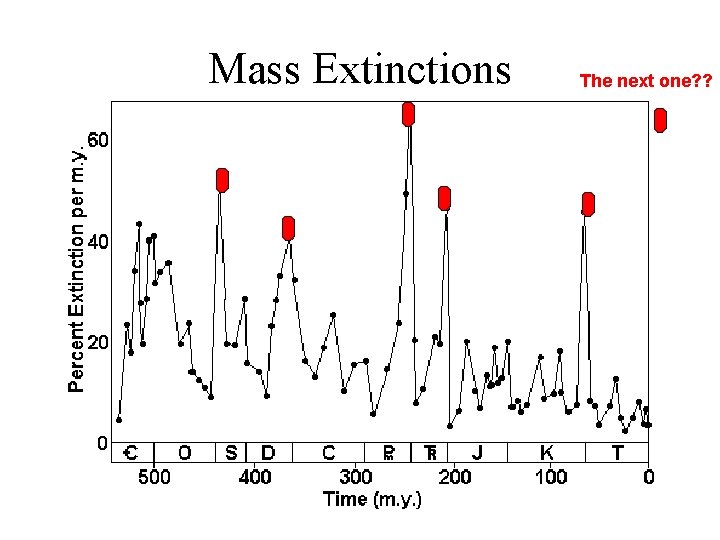
Mass Extinctions The next one? ?
Humans • • Earliest Personkind 6. 5 Ma? Australopithecus > 2 Ma Homo erectus 1 -2 Ma Homo neanderthalensis 500, 00030, 000 yr. • Homo sapiens<100, 000 years
THE LAST CHAPTER IN EARTH HISTORY? ANTHROPOGENIC ENVIRONMENTS • Kill many beasties and plants - next mass extinction? • Mess up climate - as hot as 55 Ma? • Pollute the exosphere - unprecedented? • Exhaust natural resources - unprecedented? • Overpopulate the globe till we are the only species left but unable to take care of business? • WE CAN DO BETTER
- Slides: 14