
A Short History of the PC Prolog Before
A Short History of the PC
Prolog • Before the IBM, there were many PC vendors. – These were typically garage-shop start-ups with shaky financing. – The big names were Radio Shack and Apple. • Early personal computers were crude. – CPUs were 8 -bit, usually and 8080 or Z 80. – Storage was usually on audio cassette tape as diskette drives were expensive. – Monitors were TV sets with a maximum of 64 characters per line. – Printers were very expensive and often were upper-case only. – The big applications were Word. Star and Visi. Calc.
IBM PC – 1981
1981 IBM PC Features • CPU – Intel 8088 – 16 -bit CPU, 8 -bit I/O, 4. 77 MHz clock – 8 -bit Industry Standard Architecture (ISA) expansion bus. – 16 K to 64 K RAM (up to 640 K with a RAM expansion card) • ROM BASIC • Operating systems – PC-DOS ($40) – CP/M ($450) – UCSD p-System ($550) • $1265 (plus monitor, video controller, operating system, serial port, floppy disk, and printer)
1981 IBM PC Accessories • Displays – “High-resolution” character-only (80 per line) with a monochrome monitor. – Low-resolution graphics controller with a color display. • RAM cards were needed to expand memory beyond 64 K. • Diskette drives held of 360 Kbytes. • Modems had speeds of 100 to 300 bps. • Printers used matrix-impact technology and ribbons.
IBM PC Open Architecture • IBM published its hardware interface specifications. – This allowed other companies to develop expansion cards, keyboards, mice, etc. • IBM decided that they would profit only from the hardware. – All software was developed by other companies. • IBM published its BIOS specifications. – As a result other companies reversed-engineered the BIOS, which allowed PC clones into the market. • IBM allowed Microsoft to sell DOS to others.
MS-DOS Screen
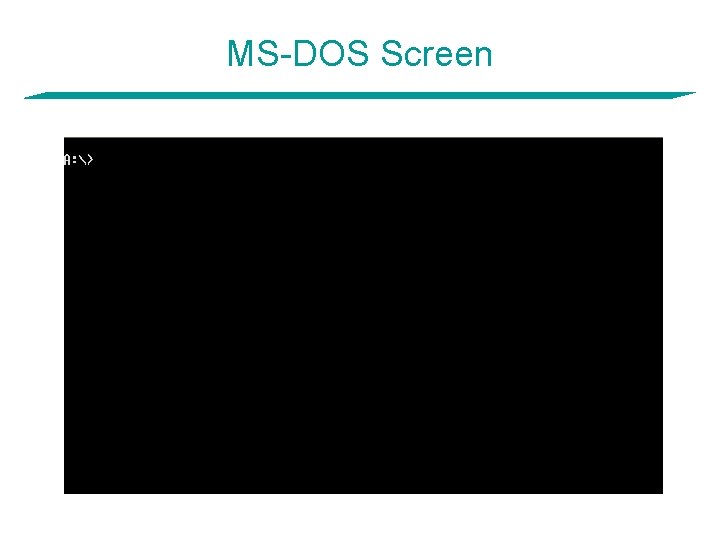
MS-DOS • The basic operating-system commands were in ROM so you could swap your program diskette with one containing data. • DOS contained few services. For example, an editor had to know how to control your printer. • Users had to configure peripherals (e. g. , modems, ports, and printers) by editing control files, such as autoexec. bat and config. sys. • The simple software of the day easily fit on a 360 -K diskette.
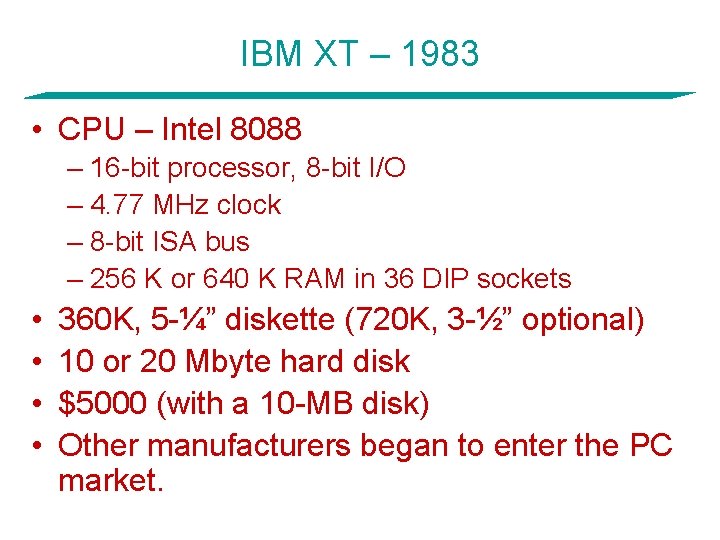
IBM XT – 1983 • CPU – Intel 8088 – 16 -bit processor, 8 -bit I/O – 4. 77 MHz clock – 8 -bit ISA bus – 256 K or 640 K RAM in 36 DIP sockets • • 360 K, 5 -¼” diskette (720 K, 3 -½” optional) 10 or 20 Mbyte hard disk $5000 (with a 10 -MB disk) Other manufacturers began to enter the PC market.
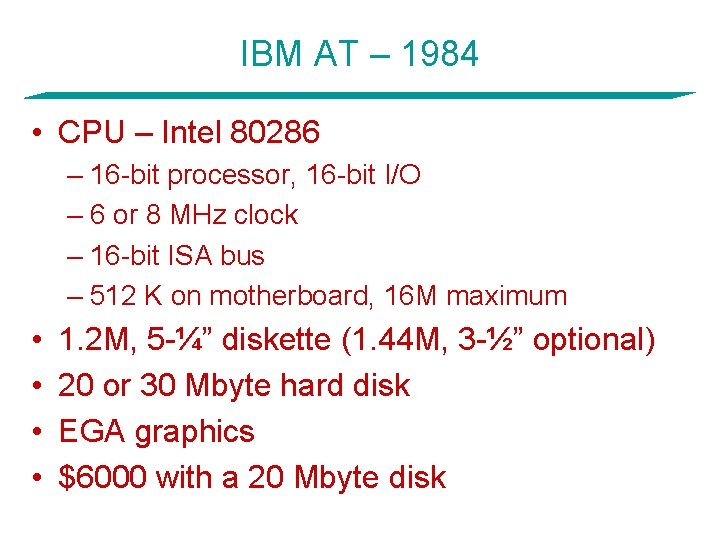
IBM AT – 1984 • CPU – Intel 80286 – 16 -bit processor, 16 -bit I/O – 6 or 8 MHz clock – 16 -bit ISA bus – 512 K on motherboard, 16 M maximum • • 1. 2 M, 5 -¼” diskette (1. 44 M, 3 -½” optional) 20 or 30 Mbyte hard disk EGA graphics $6000 with a 20 Mbyte disk
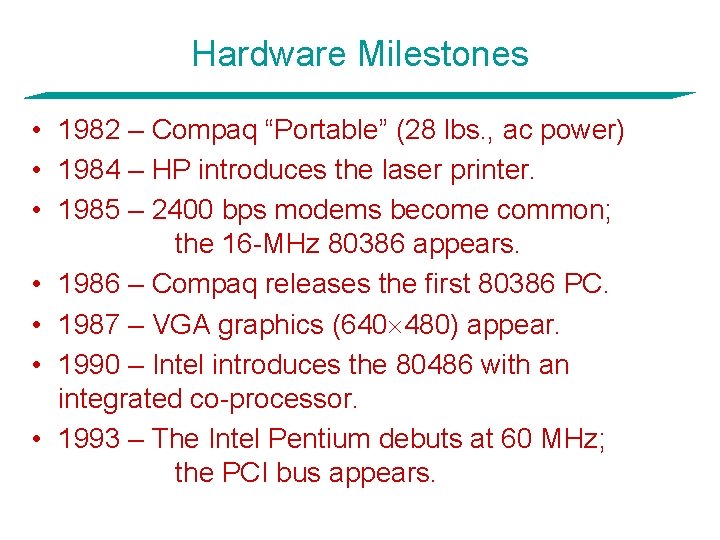
Hardware Milestones • 1982 – Compaq “Portable” (28 lbs. , ac power) • 1984 – HP introduces the laser printer. • 1985 – 2400 bps modems become common; the 16 -MHz 80386 appears. • 1986 – Compaq releases the first 80386 PC. • 1987 – VGA graphics (640 480) appear. • 1990 – Intel introduces the 80486 with an integrated co-processor. • 1993 – The Intel Pentium debuts at 60 MHz; the PCI bus appears.
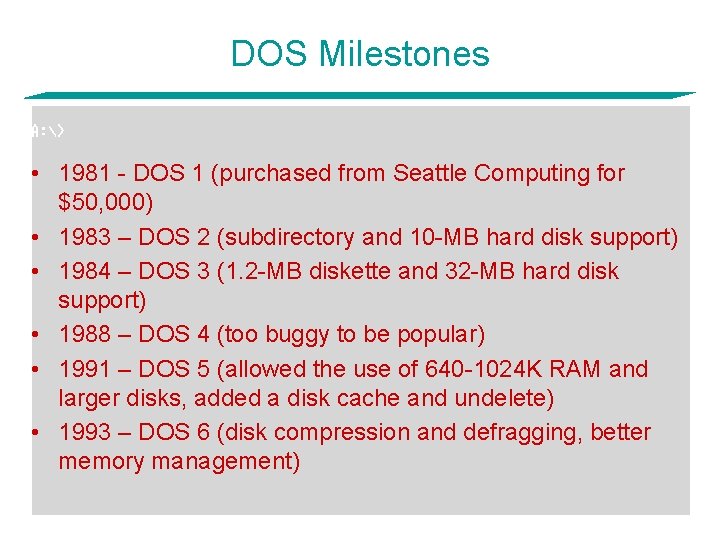
DOS Milestones • 1981 - DOS 1 (purchased from Seattle Computing for $50, 000) • 1983 – DOS 2 (subdirectory and 10 -MB hard disk support) • 1984 – DOS 3 (1. 2 -MB diskette and 32 -MB hard disk support) • 1988 – DOS 4 (too buggy to be popular) • 1991 – DOS 5 (allowed the use of 640 -1024 K RAM and larger disks, added a disk cache and undelete) • 1993 – DOS 6 (disk compression and defragging, better memory management)
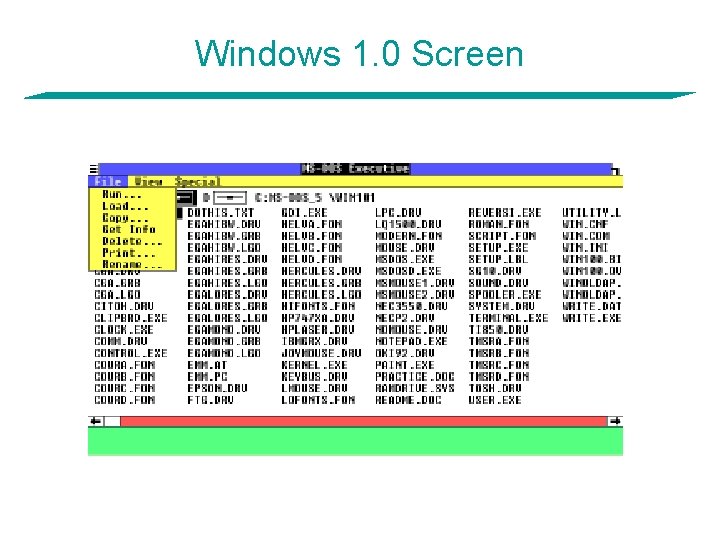
Windows 1. 0 Screen
MS Windows Milestones • 1985 – Windows 1. 0 (a DOS shell, crude and slow) • 1987 – Windows 2. 0 (icons, overlapping windows) • 1990 – Windows 3. 0 (16 colors, new file manager, the first successful version) • 1992 – Windows 3. 1 (drag-and-drop, better integration) • 1995 – Windows 95 (long filenames, dial-up networking) • 1998 – Windows 98 (USB support, Internet Explorer 4 built- in) • 2001 – Windows XP (32 -bit architecture, DOS independence)
Epilog
- Slides: 15