
A Shared Story Narrative Therapy Reframing Brain Injury
A Shared Story Narrative Therapy: Reframing Brain Injury to Support Healing Dede Norungolo, MRC, CRC, LPC, m. TBI
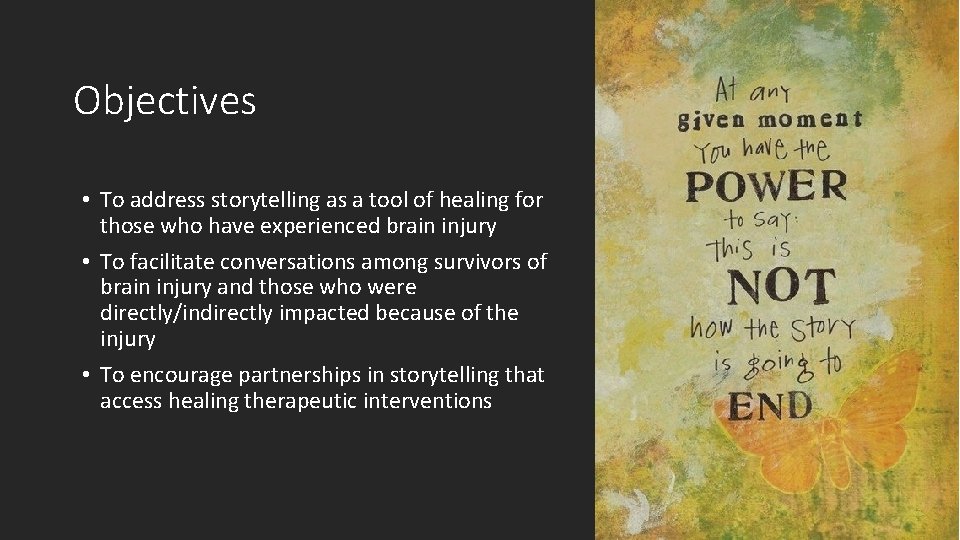
Objectives • To address storytelling as a tool of healing for those who have experienced brain injury • To facilitate conversations among survivors of brain injury and those who were directly/indirectly impacted because of the injury • To encourage partnerships in storytelling that access healing therapeutic interventions
Complexities of Psychotherapy Eclectic approach Patience for patients • Disturbances in number of systems [motor, cognitive, emotional] • Diverse treatment therapies • Medication management • Pre-, post-injury assessment • Meaningful, goal-directed activities • Therapists may have limited exposure to persons who experienced brain injury • Requisite abilities: abstract thinking, self-awareness, ability to self-monitor, tolerance • Cognitive flexibility, memory recall
The story begins … • Events • Linked in sequence • Across time • According to a plot

Narrative Therapy • Narrative therapy seeks to be a respectful, non-blaming approach to counseling and community work, which centers people as the experts in their own lives. • Narrative Therapy views problems as separate from people and assumes people have many skills, competencies, beliefs, values, commitments and abilities that will assist them to reduce the influence of problems in their lives. Alice Morgan/Dulwich Centre

Narrative Therapy • Curiosity and a willingness to ask questions to which we genuinely don’t know the answers are important principles of this work. • There are many possible directions that any conversation can take (there is no single correct direction). • The person consulting therapist plays a significant part in determining the directions that are taken. Alice Morgan/Dulwich Centre
Stories • Created through linking certain events together • In a particular sequence • Across a time period • Forming a plot of the story • A narrative is like a thread that weaves the events together, forming a story
Stories • Stories can contain simultaneous occurrences • Stories are about ourselves, our abilities, our struggles, our competencies, our actions, our desires, our relationships, our work, our interests, our conquests, our achievements, our failures • Story development is determined by how we have linked certain events together in a sequence and by the meaning we have attributed to them

Sharing Group • The sharing of both life and traumatic stories works on verbal and written communication. • In addition, it also allows people to process their feelings regarding their accident, injuries, and life changes. • Participants may talk as well as narrate their lives and prepare an autobiography for an inhouse flier/publication, which can be distributed. • Those, who are interested and able to share their stories (about TBI, drinking and driving, bicycle safety, etc. ), may also perform a public service by speaking at local schools and hospitals.

Life Story • Writing a story about your life can help you find greater meaning • Writing a story about your life can help you find value in experiences
Past, Present, Future • Describe challenge you have overcome • Write of personal strengths that allowed you to do so • Repetition is retention – don’t be afraid to repeat yourself • Some stories will have positive effects • Some stories will have negative effects Let’s start writing …
Effective psychotherapy • Person who has experienced brain injury must be encouraged to lead the way • Group sharing experiences are important • Family members should be involved in treatment • Reasonable “risk” taking should be encouraged “The road that brain injury patients must travel to reestablish an acceptable sense of self is uncertain and therefore cannot be risk free. ”

Resources • What is narrative therapy? An easy-to-read introduction is available from The Narrative Therapy Library and Bookshop and we strongly recommend it to anyone who is trying to, or is wanting to, apply narrative ideas in their own work context. • The book Retelling the stories of our lives: Everyday narrative therapy to draw inspiration and transform experience by David Denborough was written to introduce narrative ideas to the general public. Other key texts include that introduce the story metaphor include: • Freedman, J. & Combs, G. 1996: ‘Shifting paradigms: From systems to stories. ’ In Freedman, J. & Combs, G. , Narrative therapy: The social construction of preferred realities, chapter 1. New York: Norton. • Epston, D. & White, M. 1990: ‘Story, knowledge, power. ’ In Epston, D. & White, M. , Narrative means to therapeutic ends, chapter 1. New York: Norton. • White, M. 1997: ‘The culture of professional disciplines. ’ In White, M. , Narratives of therapists’ lives, chapter 1. Adelaide: Dulwich Centre Publications. • https: //www. neuropsychonline. com/loni/jcrarchives/vol 22/V 22 I 3 Perna. pdf
- Slides: 13