
A shared design facilitation approach to codesigning games



- Slides: 12
A shared design facilitation approach to codesigning games for learning Matthew Bates, Nottingham Trent University, UK
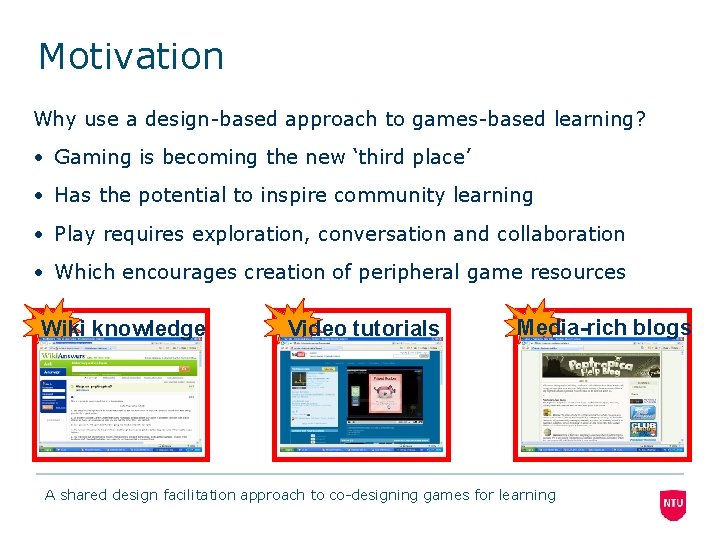
Motivation Why use a design-based approach to games-based learning? • Gaming is becoming the new ‘third place’ • Has the potential to inspire community learning • Play requires exploration, conversation and collaboration • Which encourages creation of peripheral game resources Wiki knowledge Video tutorials Media-rich blogs A shared design facilitation approach to co-designing games for learning
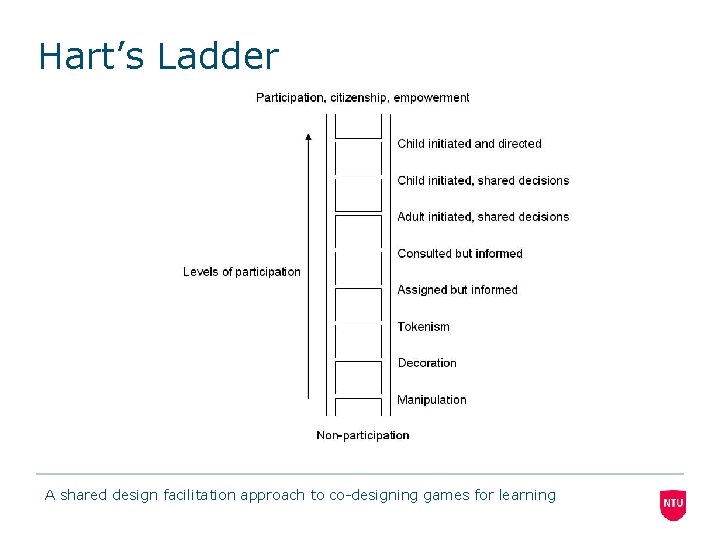
Hart’s Ladder A shared design facilitation approach to co-designing games for learning
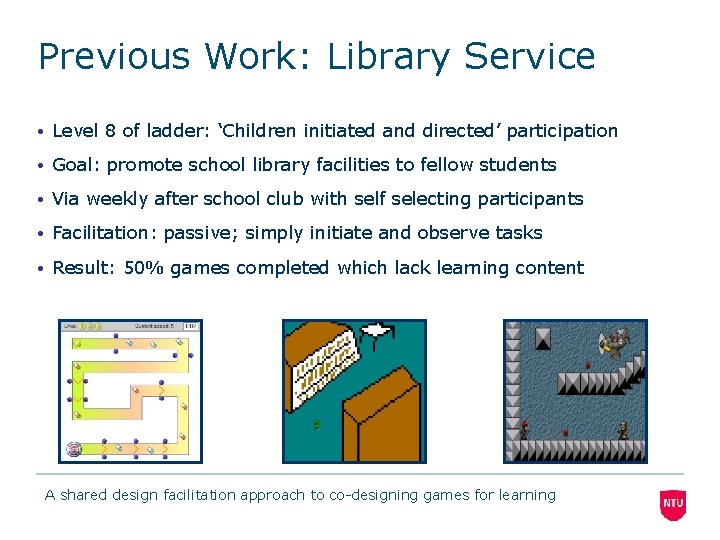
Previous Work: Library Service • Level 8 of ladder: ‘Children initiated and directed’ participation • Goal: promote school library facilities to fellow students • Via weekly after school club with self selecting participants • Facilitation: passive; simply initiate and observe tasks • Result: 50% games completed which lack learning content A shared design facilitation approach to co-designing games for learning
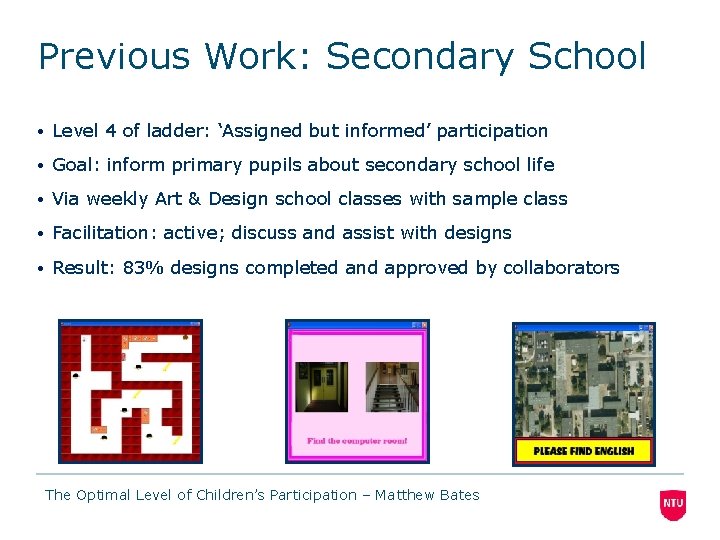
Previous Work: Secondary School • Level 4 of ladder: ‘Assigned but informed’ participation • Goal: inform primary pupils about secondary school life • Via weekly Art & Design school classes with sample class • Facilitation: active; discuss and assist with designs • Result: 83% designs completed and approved by collaborators The Optimal Level of Children’s Participation – Matthew Bates
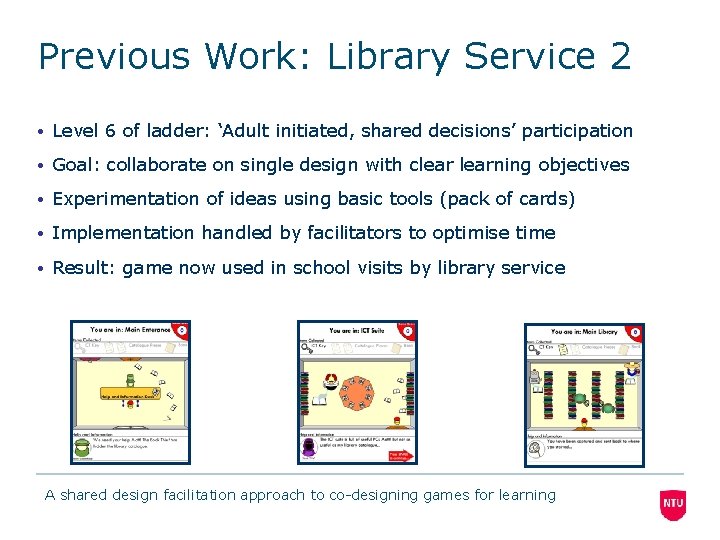
Previous Work: Library Service 2 • Level 6 of ladder: ‘Adult initiated, shared decisions’ participation • Goal: collaborate on single design with clearning objectives • Experimentation of ideas using basic tools (pack of cards) • Implementation handled by facilitators to optimise time • Result: game now used in school visits by library service A shared design facilitation approach to co-designing games for learning
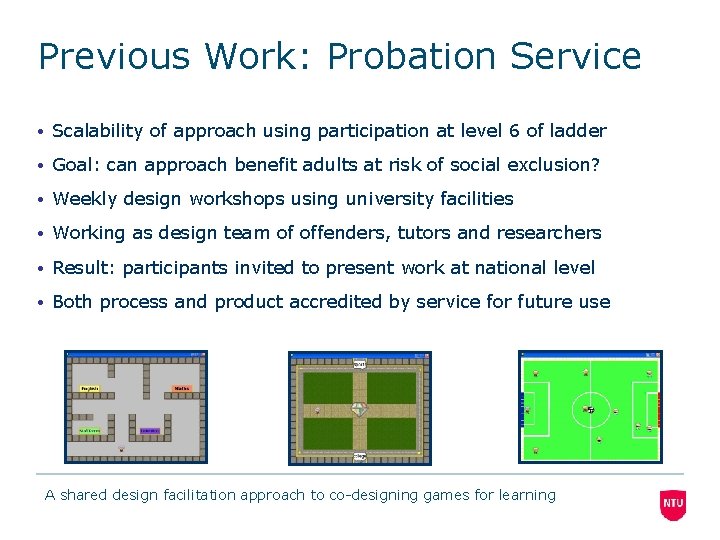
Previous Work: Probation Service • Scalability of approach using participation at level 6 of ladder • Goal: can approach benefit adults at risk of social exclusion? • Weekly design workshops using university facilities • Working as design team of offenders, tutors and researchers • Result: participants invited to present work at national level • Both process and product accredited by service for future use A shared design facilitation approach to co-designing games for learning
A Comparison of Approaches Workshop Design A shared design facilitation approach to co-designing games for learning
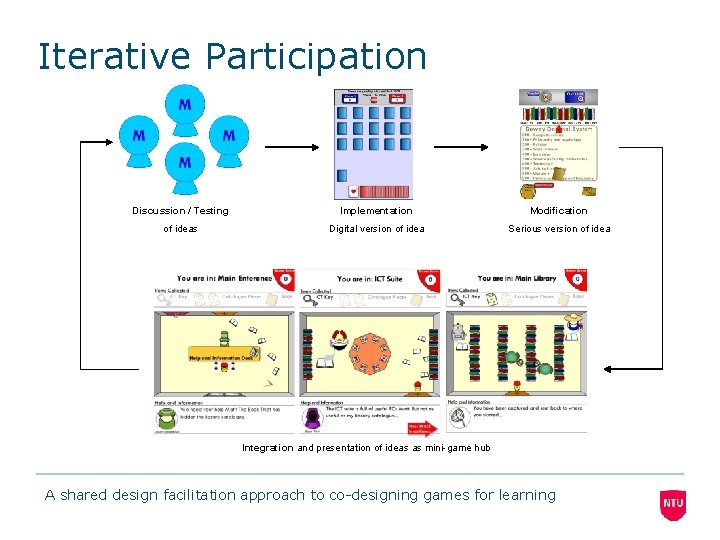
A Comparison of Approaches Iterative Participation Discussion / Testing Implementation Modification of ideas Digital version of idea Serious version of idea Integration and presentation of ideas as mini-game hub A shared design facilitation approach to co-designing games for learning
Objectives for Participatory Design A shared design facilitation approach to co-designing games for learning
Conclusions Elevating learners to design partners: • creates powerful learning environments • but requires facilitation regardless of age and experience • must balance of learner input with educator experience • balanced approach applicable and scalable to a range of students A shared design facilitation approach to co-designing games for learning
References • Bates, M. , Brown, D. , Cranton, W. , and Lewis, J. (2008). Playing to win: motivation for teaching and learning in today’s gaming culture. Paper presented at Interactive Technologies and Games (ITAG), November 2008, Nottingham, UK. • Bates, M. , Brown, D. , Cranton, W. , and Lewis, J. (2009). A design for learning: exploring serious games design with children. Paper presented at Interactive Technologies and Games (ITAG), October 2009, Nottingham, UK. • Bates, M. , Brown, D. , Cranton, W. , and Lewis, J. (2010). Formulating a serious games design project for adult offenders with the probation service. Paper presented at Interactive Technologies and Games (ITAG), October 2010, Nottingham, UK. • Druin, A. (2002). The role of children in the design of new technology. Behaviour and Information Technology, 21(1), pp. 1– 25. • Steinkuehler, C. (2004). Learning in massively multi-player online games. Proceedings of the 6 th international conference on learning sciences (ICLS), June 2004, Santa Monica, CA, USA, pp. 521 -528. A shared design facilitation approach to co-designing games for learning