
A Seymour Cray Perspective Supercomputing 1999 12 November
A Seymour Cray Perspective Supercomputing 1999 12 November 1998 Gordon Bell Microsoft Corp. See also: http: //www. si. edu/resource/tours/comphist/cray. htm http: //www. cray. com/hpc/seymour/essay. html Cray
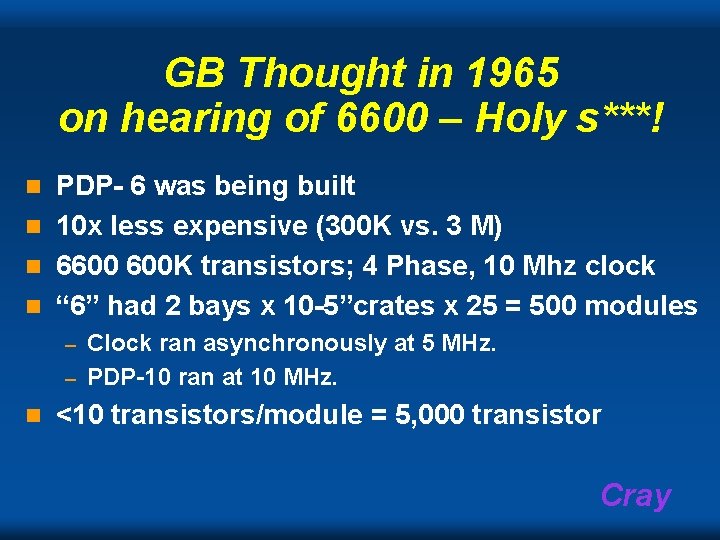
GB Thought in 1965 on hearing of 6600 – Holy s***! PDP- 6 was being built n 10 x less expensive (300 K vs. 3 M) n 6600 600 K transistors; 4 Phase, 10 Mhz clock n “ 6” had 2 bays x 10 -5”crates x 25 = 500 modules n Clock ran asynchronously at 5 MHz. – PDP-10 ran at 10 MHz. – n <10 transistors/module = 5, 000 transistor Cray
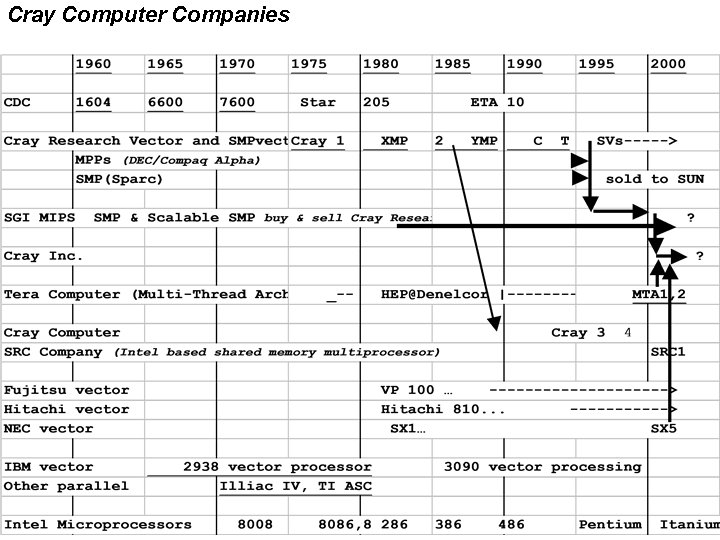
Cray Computer Companies
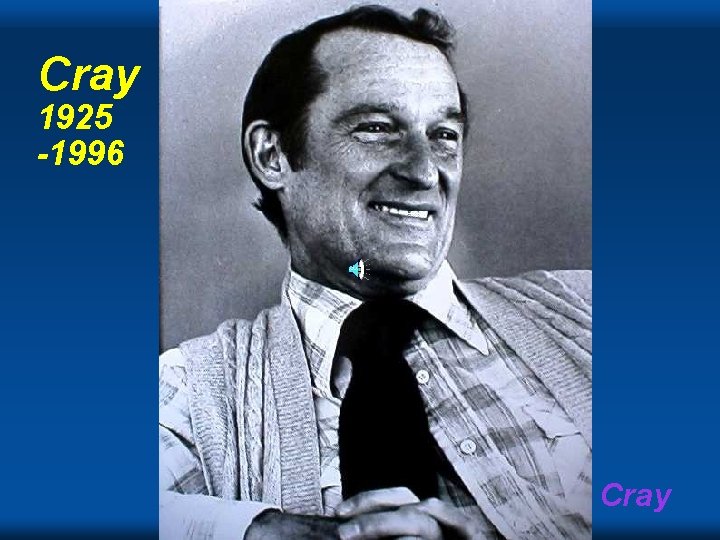
Cray 1925 -1996 Cray
Circuits and Packaging, Plumbing (bits and atoms) & Parallelism… plus Programming and Problems n n n Packaging, including heat removal High level bit plumbing… getting the bits from I/O, into memory through a processor and back to memory and to I/O Parallelism Programming: O/S and compiler Cray Problems being solved
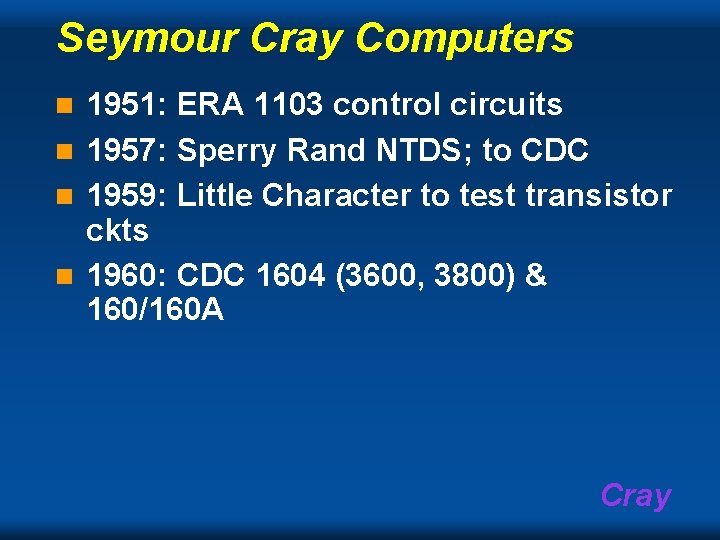
Seymour Cray Computers 1951: ERA 1103 control circuits n 1957: Sperry Rand NTDS; to CDC n 1959: Little Character to test transistor ckts n 1960: CDC 1604 (3600, 3800) & 160/160 A n Cray
CDC: The Dawning era of Supercomputers 1964: CDC 6600 (6 xxx series) n 1969: CDC 7600 n Cray
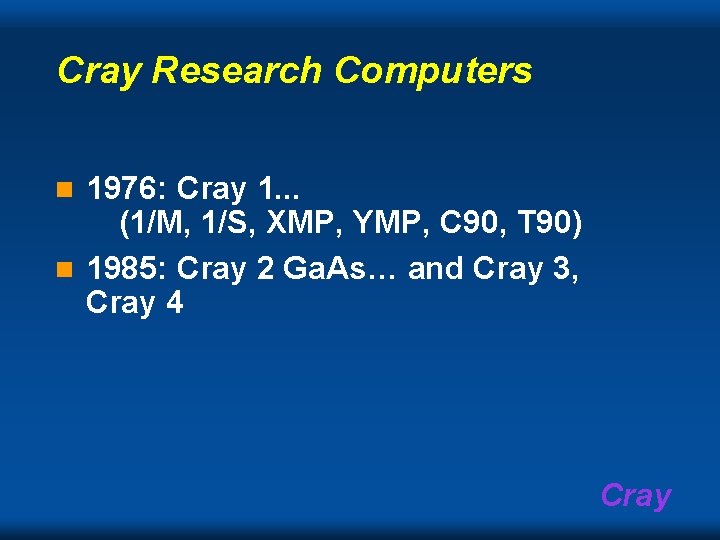
Cray Research Computers 1976: Cray 1. . . (1/M, 1/S, XMP, YMP, C 90, T 90) n 1985: Cray 2 Ga. As… and Cray 3, Cray 4 n Cray
Cray Computer Corp. And SRC Corp. Computers 1993: Cray Computer Cray 3 n 1998? : SRC Company large scale, shared memory multiprocessor n Cray
Cray contributions… Creative and productive during his entire career 1951 -1996. n Creator and un-disputed designer of supers from c 1960 1604 to Cray 1, 1 s, 1 m c 1977… XMP, YMP, T 90, C 90, 2, 3 n Circuits, packaging, and cooling… n “the mini” as a peripheral computer n Cray
Cray Contribution Use I/O computers Versus n Use the main processor and interrupt it for I/O n Use I/O channels aka IBM Channels n Cray
Cray Contributions n n n Multi-theaded processor (6600 PPUs) CDC 6600 functional parallelism leading to RISC… software control Pipelining in the 7600 leading to. . . Use of vector registers: adopted by 10+ companies. Mainstream for technical computing Established the template for vector supercomputer architecture SRC Company use of x 86 micro in Cray 1986 that could lead to largest, sm. P?
Cray attitudes n n n Didn’t go with paging & segmentation because it slowed computation In general, would cut loss and move on when an approach didn’t work… Les Davis is credited with making his designs work and manufacturable Ignored CMOS and microprocessors until SRC Company design Went against conventional wisdom… but this may have been a downfall. Cray
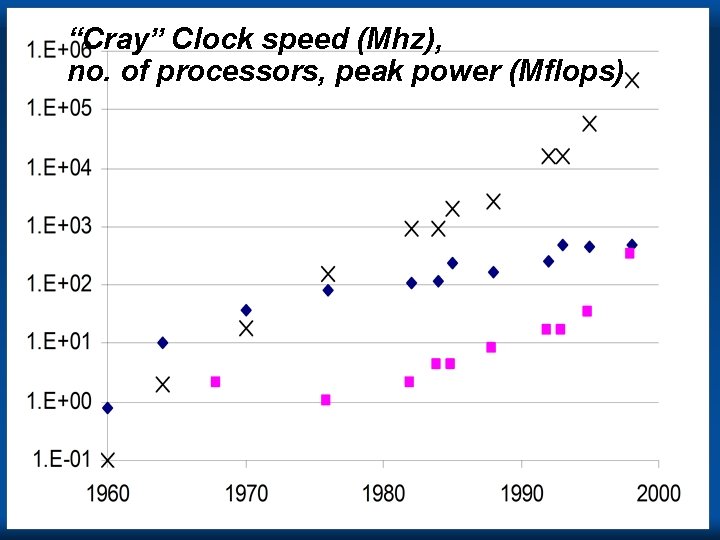
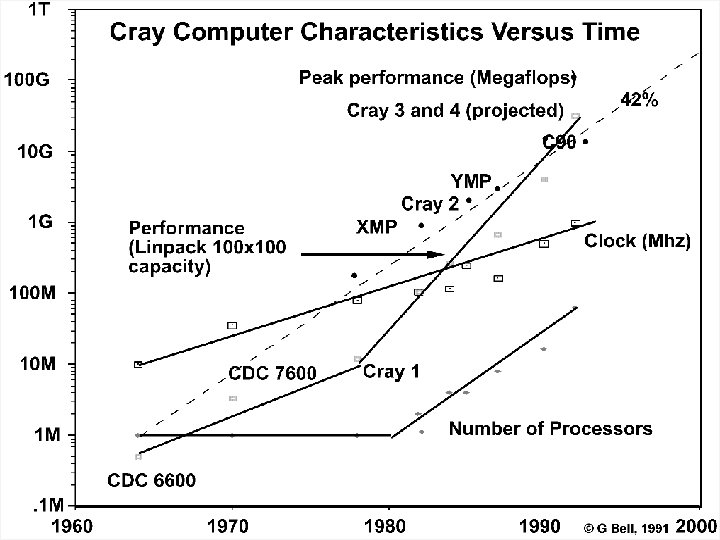
“Cray” Clock speed (Mhz), no. of processors, peak power (Mflops) Cray
Univac NTDS for U. S. Navy. Cray’s first computer Cray
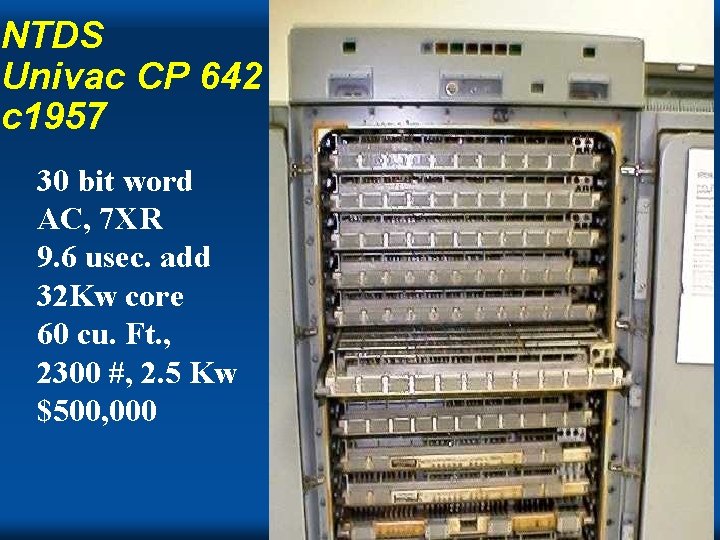
NTDS Univac CP 642 c 1957 30 bit word AC, 7 XR 9. 6 usec. add 32 Kw core 60 cu. Ft. , 2300 #, 2. 5 Kw $500, 000 Cray
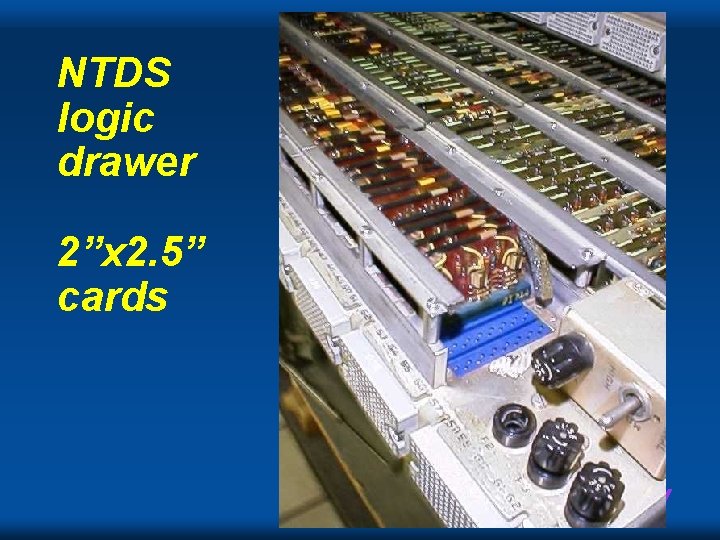
NTDS logic drawer 2”x 2. 5” cards Cray
Control Data Corporation Little Character circuit test, CDC 1604 Cray
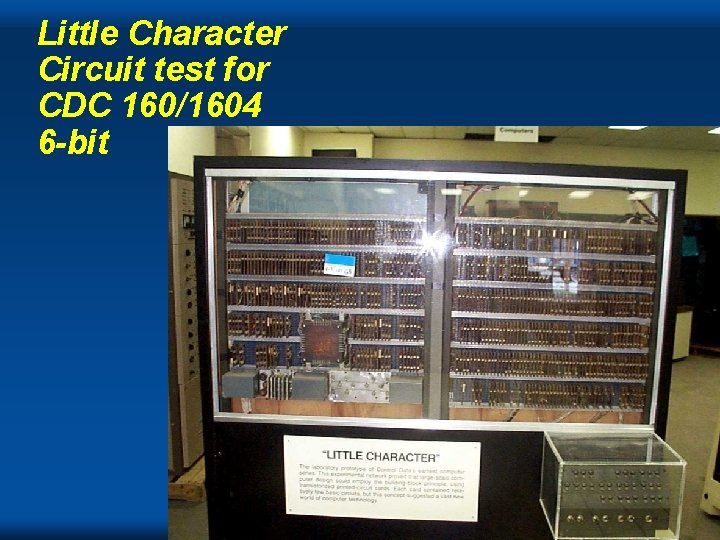
Little Character Circuit test for CDC 160/1604 6 -bit Cray
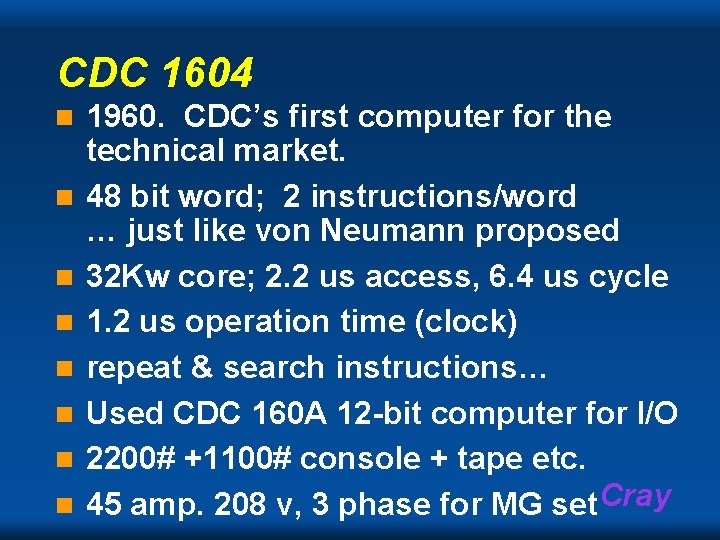
CDC 1604 n n n n 1960. CDC’s first computer for the technical market. 48 bit word; 2 instructions/word … just like von Neumann proposed 32 Kw core; 2. 2 us access, 6. 4 us cycle 1. 2 us operation time (clock) repeat & search instructions… Used CDC 160 A 12 -bit computer for I/O 2200# +1100# console + tape etc. 45 amp. 208 v, 3 phase for MG set Cray
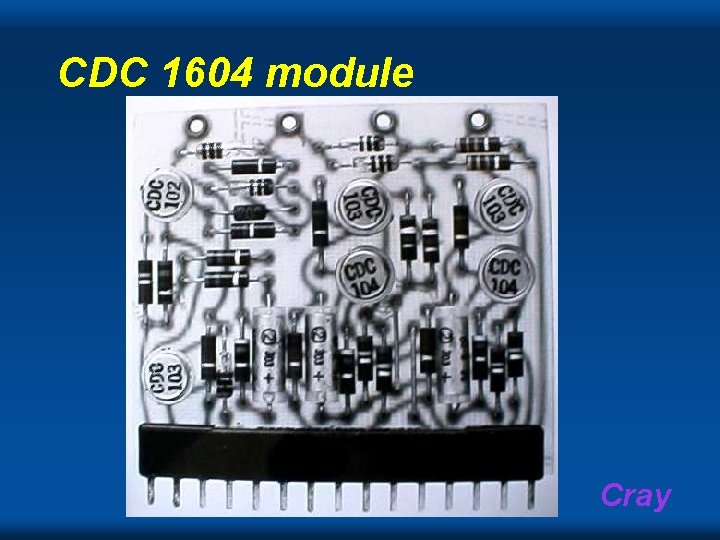
CDC 1604 module Cray
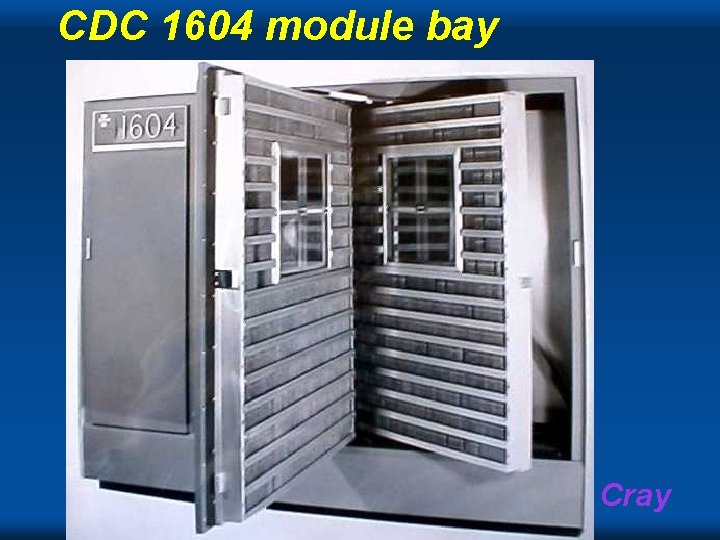
CDC 1604 module bay Cray
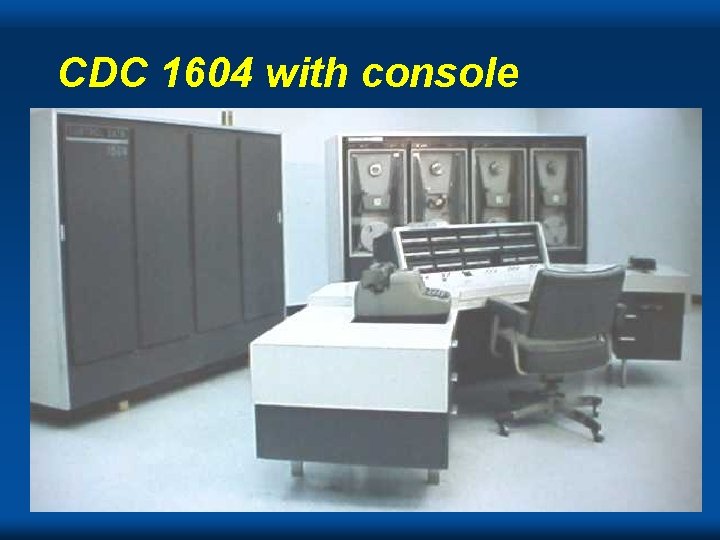
CDC 1604 with console Cray
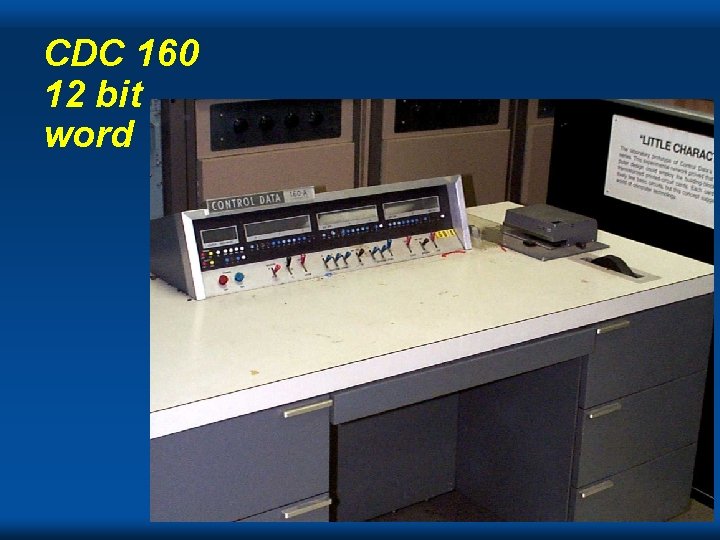
CDC 160 12 bit word Cray
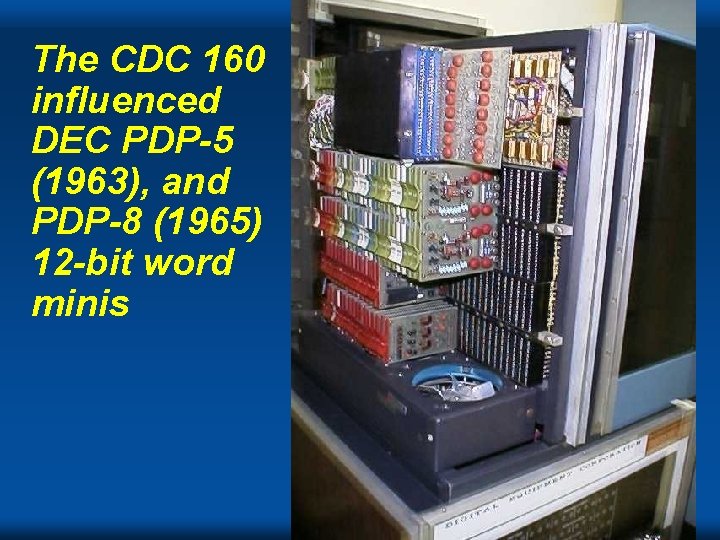
The CDC 160 influenced DEC PDP-5 (1963), and PDP-8 (1965) 12 -bit word minis Cray
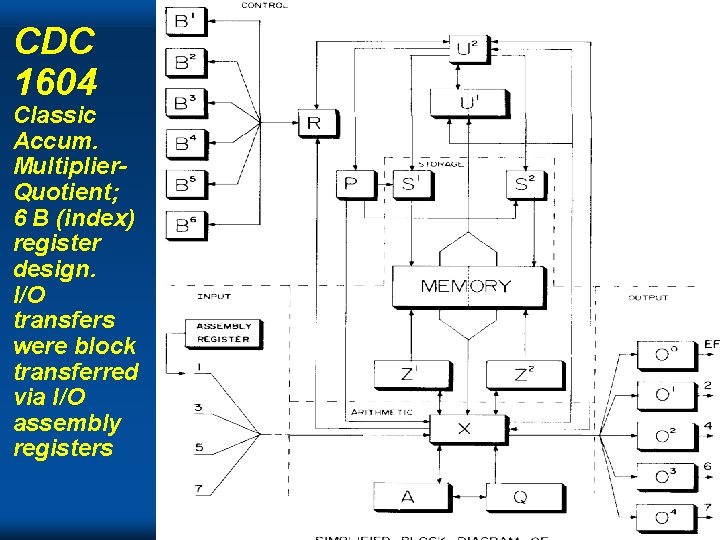
CDC 1604 Classic Accum. Multiplier. Quotient; 6 B (index) register design. I/O transfers were block transferred via I/O assembly registers Cray
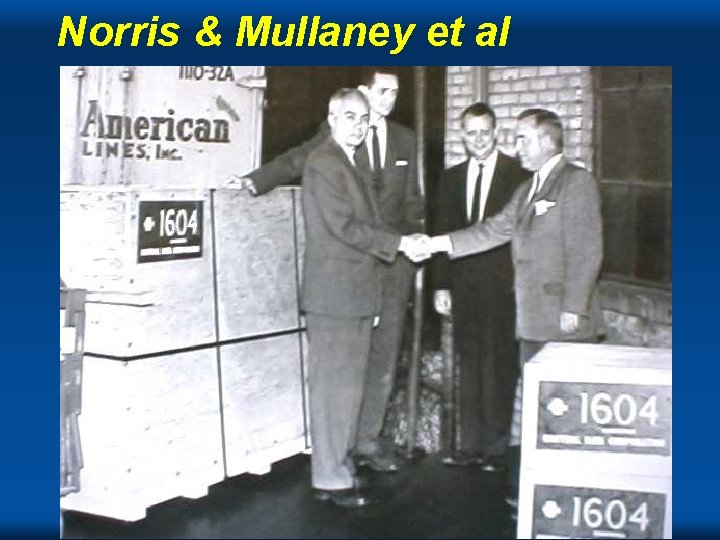
Norris & Mullaney et al Cray
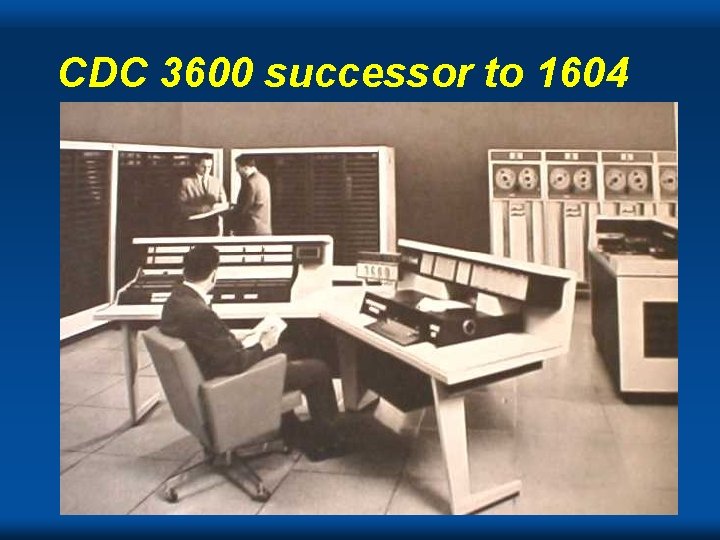
CDC 3600 successor to 1604 Cray
CDC 6600 (and 7600) Cray
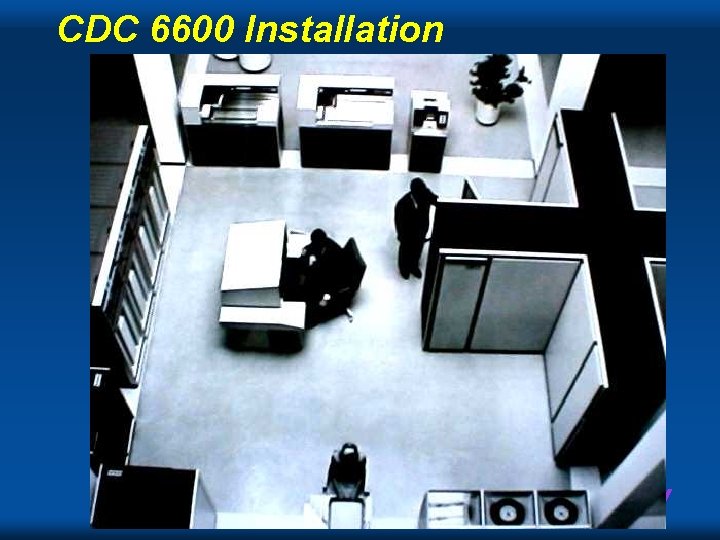
CDC 6600 Installation Cray
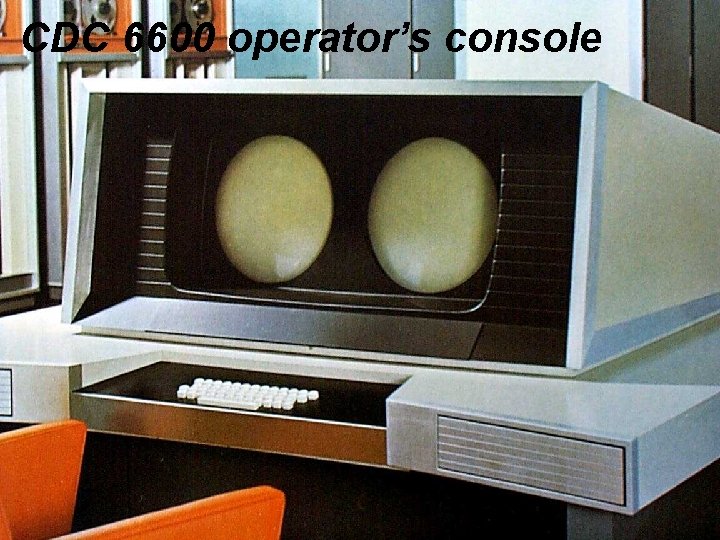
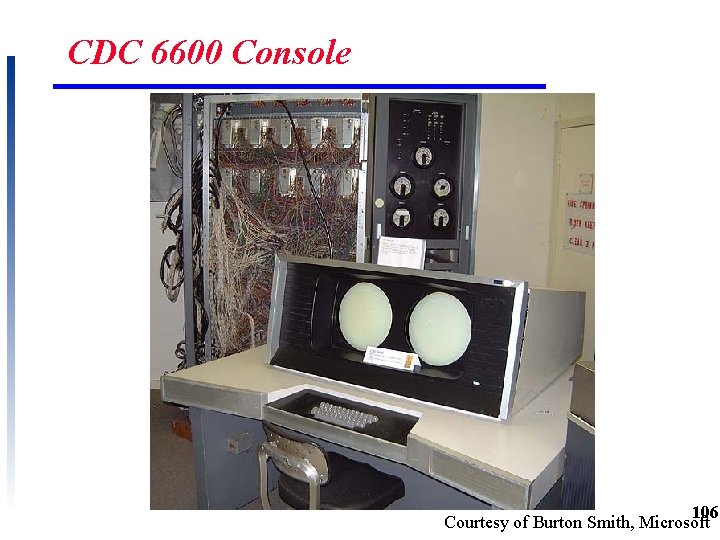
CDC 6600 operator’s console Cray
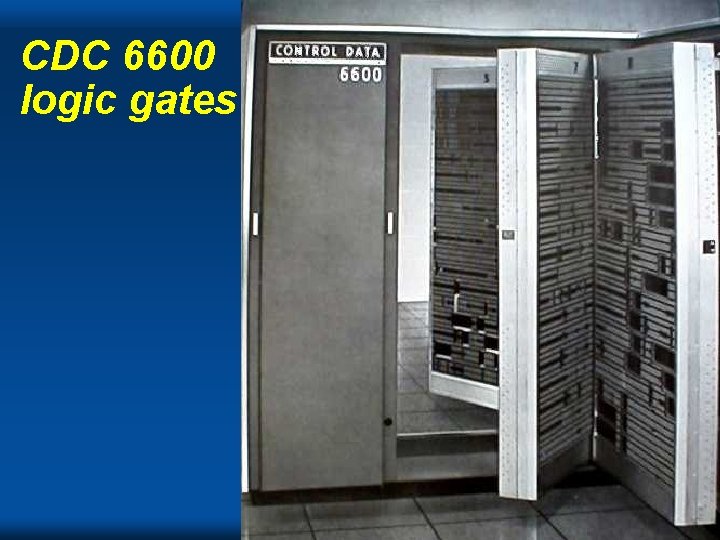
CDC 6600 logic gates Cray
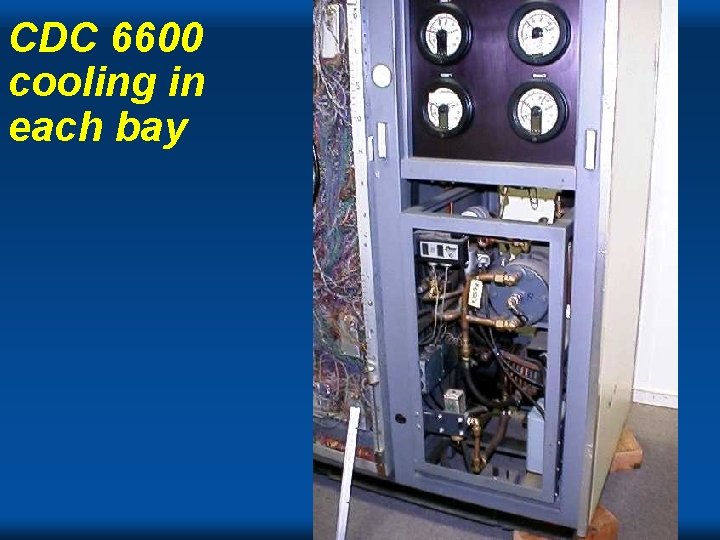
CDC 6600 cooling in each bay Cray
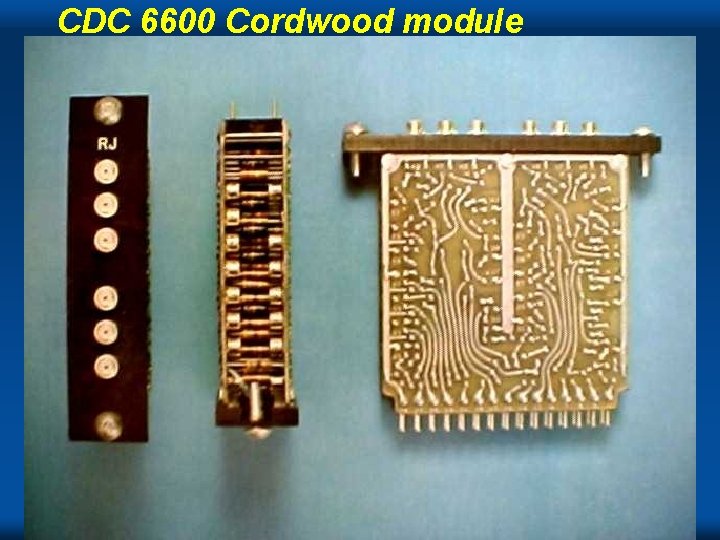
CDC 6600 Cordwood module Cray
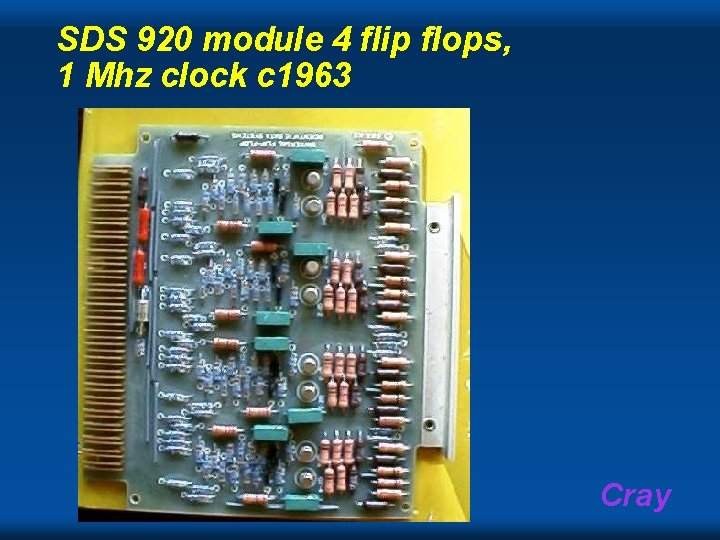
SDS 920 module 4 flip flops, 1 Mhz clock c 1963 Cray
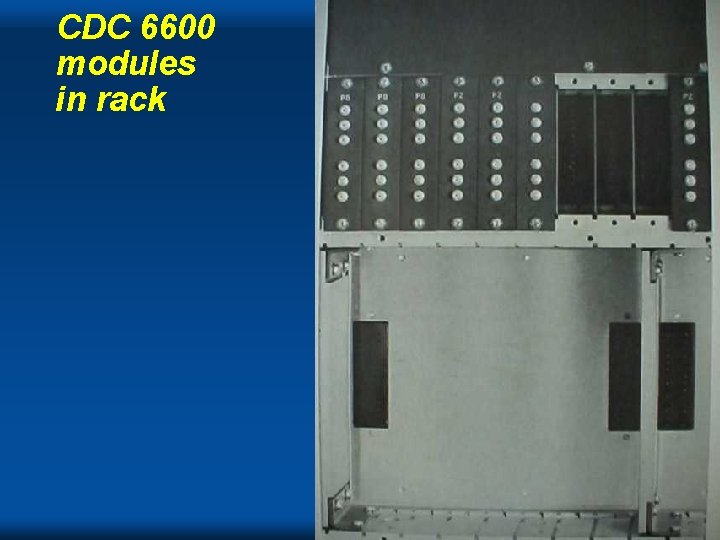
CDC 6600 modules in rack Cray
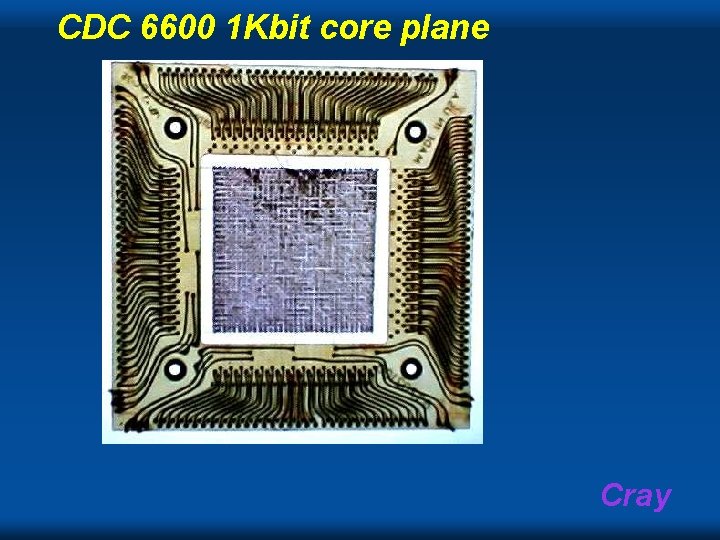
CDC 6600 1 Kbit core plane Cray
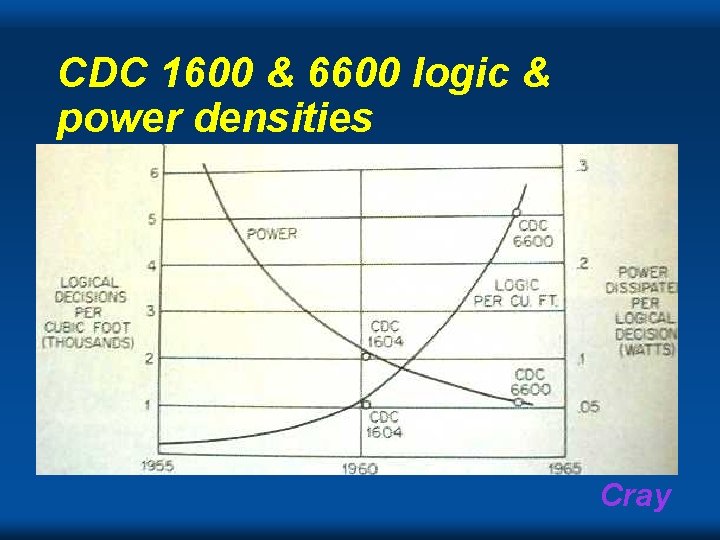
CDC 1600 & 6600 logic & power densities Cray
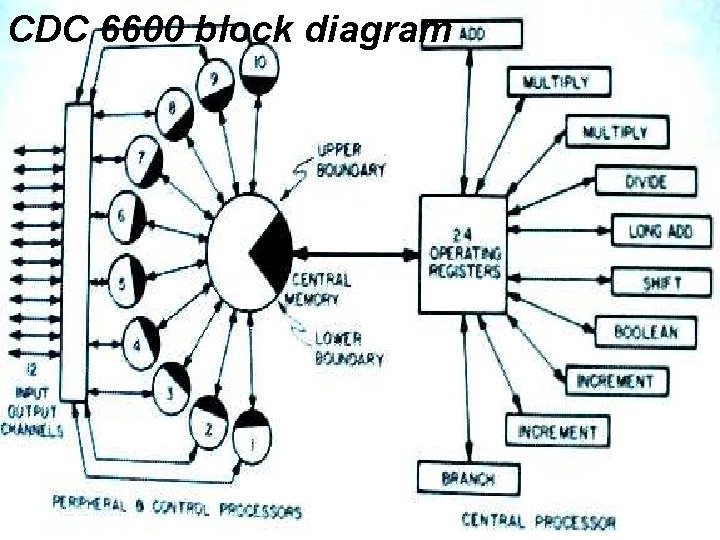
CDC 6600 block diagram Cray
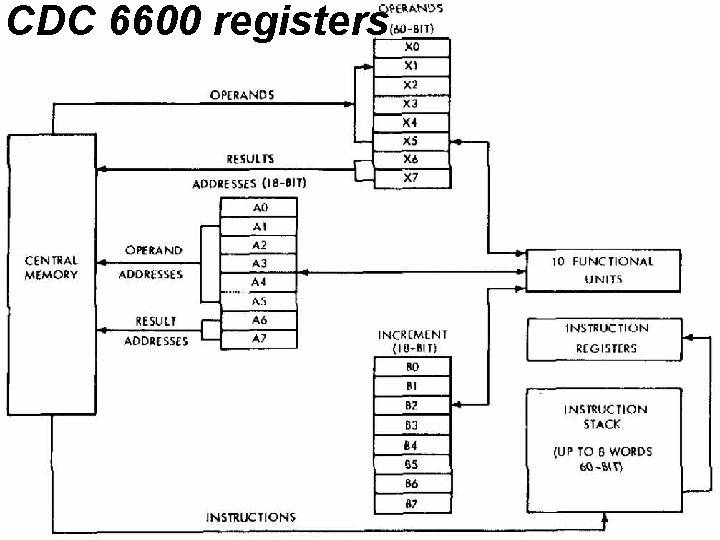
CDC 6600 registers Cray
Dave Patterson… who coined the word, RISC “The single person most responsible for supercomputers. Not swayed by conventional wisdom, Cray single-mindedly determined every aspect of a machine to achieve the goal of building the world's fastest computer. Cray was a unique personality who built unique computers. ” Cray
Blaauw -Brooks 6600 comments n n n n Architecturally, the 6600 is a “dirty” machine -- so it is hard to compile efficient code Lack of generality. 15 & 30 bit insts Specialized registers: integer, address, floating-point! Lack of instruction symmetry. Incomplete fixed point arithmetic … Cray Too few PPUs
John Mashey, VP software, MIPS team (first commercial RISC outside of IBM) “Seymour Cray is the Kelly Johnson of computing. Growing up not far apart (Wisconsin, Upper Michigan), one built the fastest computers, the other built the fastest airplanes, project after project. Both fought bureaucracy, both led small teams, year after year, in creating aweinspiration technology progress. Both will be remembered for many years. ” Cray
Thomas Watson, IBM CEO 8/63 “Last week Control Data … announced the 6600 system. I understand that in the laboratory developing the system there are only 34 people including the janitor. Of these, 14 are engineers and 4 are programmers … Contrasting this modest effort with our vast development activities, I fail to understand why we have lost our industry leadership position by letting someone else offer the world’s most powerful Cray computer. ”
Cray’s response: “It seems like Mr. Watson has answered his own question. ” Cray
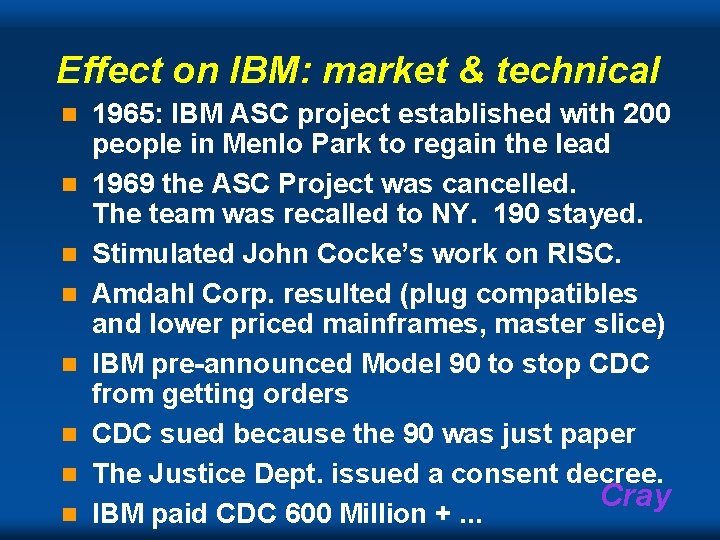
Effect on IBM: market & technical n n n n 1965: IBM ASC project established with 200 people in Menlo Park to regain the lead 1969 the ASC Project was cancelled. The team was recalled to NY. 190 stayed. Stimulated John Cocke’s work on RISC. Amdahl Corp. resulted (plug compatibles and lower priced mainframes, master slice) IBM pre-announced Model 90 to stop CDC from getting orders CDC sued because the 90 was just paper The Justice Dept. issued a consent decree. Cray IBM paid CDC 600 Million +. . .
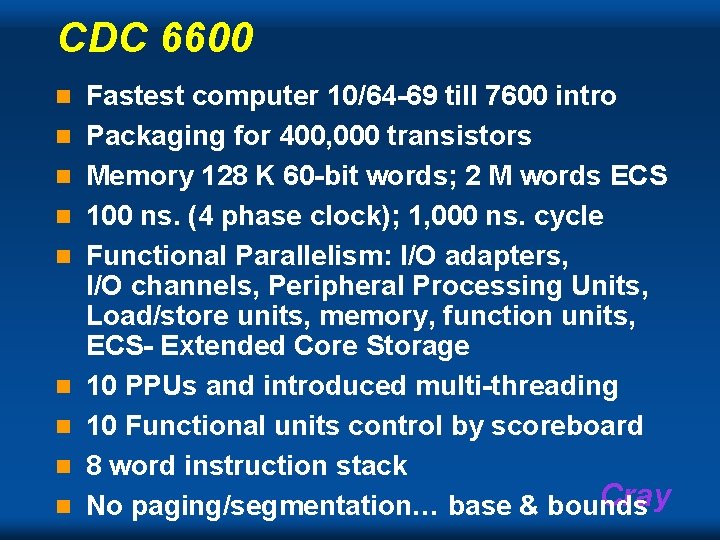
CDC 6600 n n n n n Fastest computer 10/64 -69 till 7600 intro Packaging for 400, 000 transistors Memory 128 K 60 -bit words; 2 M words ECS 100 ns. (4 phase clock); 1, 000 ns. cycle Functional Parallelism: I/O adapters, I/O channels, Peripheral Processing Units, Load/store units, memory, function units, ECS- Extended Core Storage 10 PPUs and introduced multi-threading 10 Functional units control by scoreboard 8 word instruction stack Cray No paging/segmentation… base & bounds
John Cocke “All round good computer man…” n “When the 6600 was described to me, I saw it as doing in software what we tried to do in hardware with Stretch. ” n Cray
CDC 7600 Cray
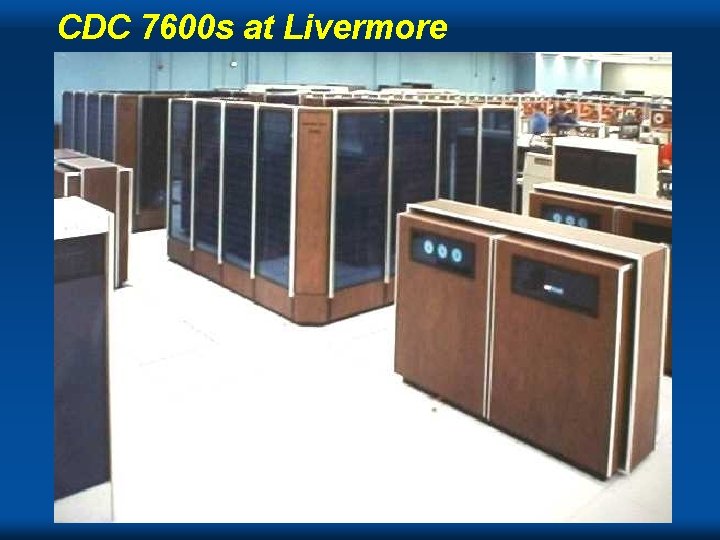
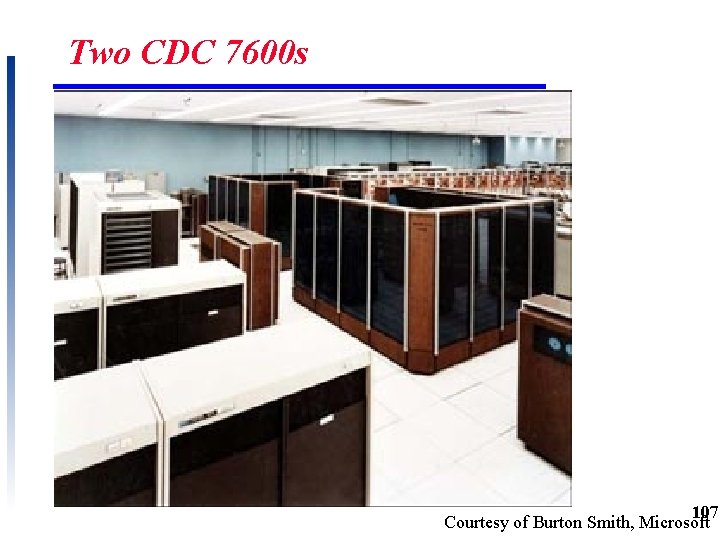
CDC 7600 s at Livermore Cray
Butler Lampson “I visited Livermore in 1971 and they showed me a 7600. I had just designed a character generator for a high-resolution CRT with 27 ns pixels, which I thought was pretty fast. It was a shock to realize that the 7600 could do a floating-point multiply for every dot that I could display! In 1975 or 1976, when the Cray 1 was introduced, . . . I heard him at Livermore. He said that he had always hated the population count unit, and left it out of the Cray 1. However, a very important customer said that it had to be there, so he put it back. This was the first time I realized that its purpose was cryptanalysis. ” Cray
CDC 7600 n n n n n “culturally” compatible with 6600 27. 5 ns clock period (36 Mhz. ) 3360 modules 120 miles of wire 36 Mega(fl)ops PEAK 60 -bit words. Achieved via extensive pipelining of 9 Central processor’s functional units Serial 1 operated 1/69 -10/88 at LLNL 65 Kw Small core (less memory than its predecessor. 512 Kw Large core 15 Peripheral Processing Units $5. 1 M Cray
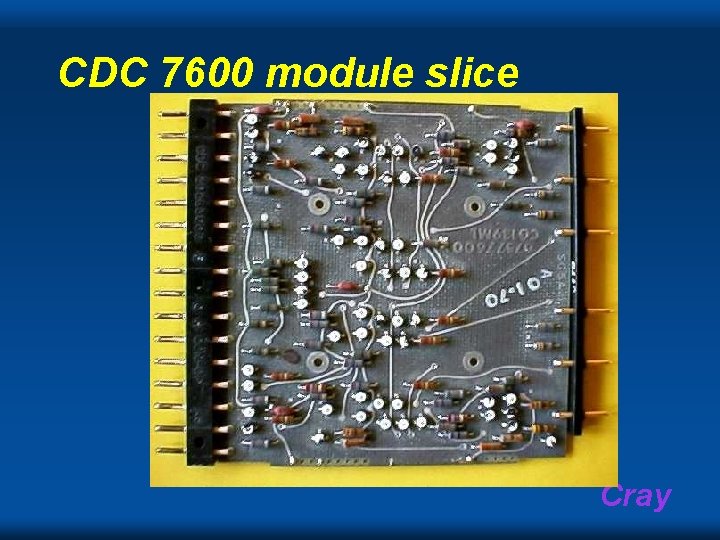
CDC 7600 module slice Cray
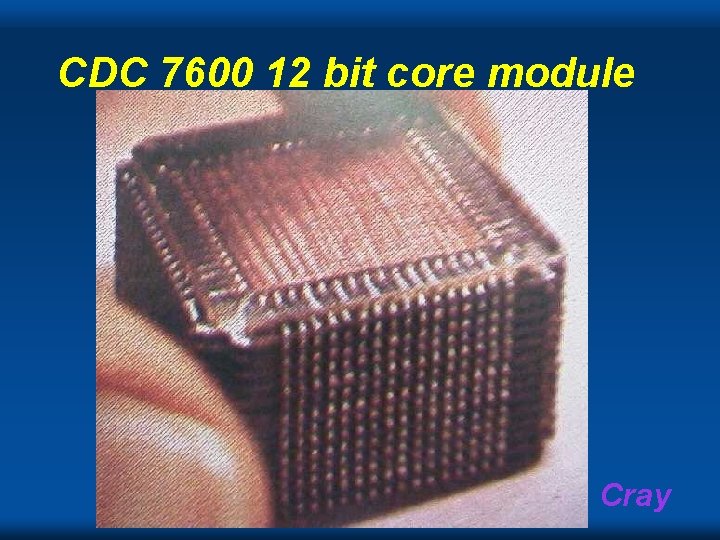
CDC 7600 12 bit core module Cray
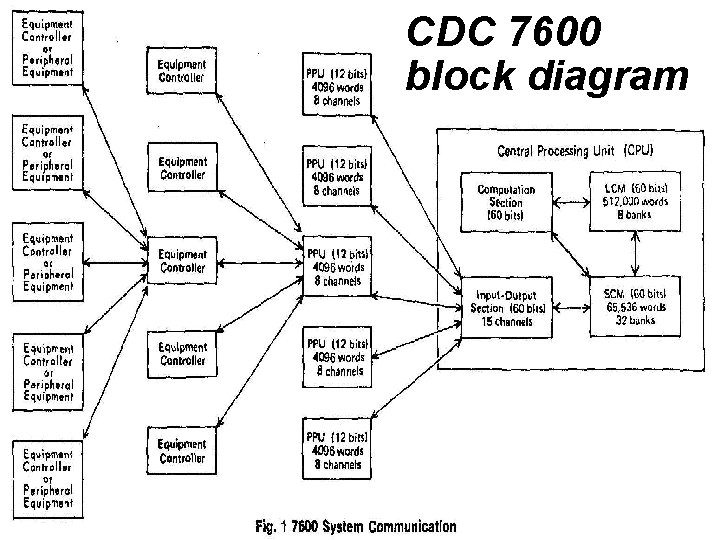
CDC 7600 block diagram Cray
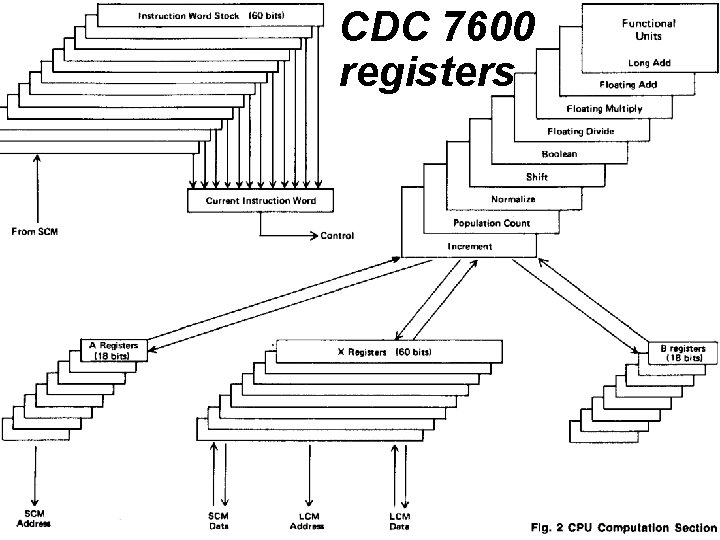
CDC 7600 registers Cray
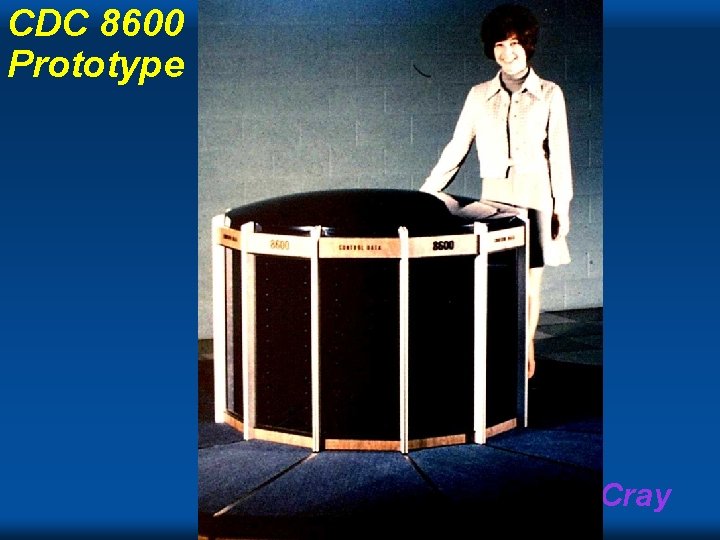
CDC 8600 Prototype Cray
Forming Cray Research n n n The STAR 100 >> Cyber 205 >> ETA 10 was the “new mainline” in response to DOE & NASA RFQs Other investments: IBM anti-trust suit, Business data-processing, and new ventures e. g. U of IL Plato The 8600 packaging hit a “dead end” and unable to attain its speed Emergence of MSI ECL. A catalyst? Unclear how the notion of “vectors” came into the decision Easy decision to leave… given CDC Cray bureaucracy
Cray Research… Cray 1 n n n Started in 1972, Cray 1 operated in 1974 12 ns. Three ECL I/C types: 2 gates, 16 and 1 K bit memories 144 ICs on each side of a board; approximately 300 K gates/computer 8 Scalar, 8 Address, 8 Vector (64 w), 64 scalar Temps, 64 address B temps 12 function units 1 Mword memory; 4 clock cycle Scalar speed: 2 x 7600 Cray Vector speed: 80 Mflops
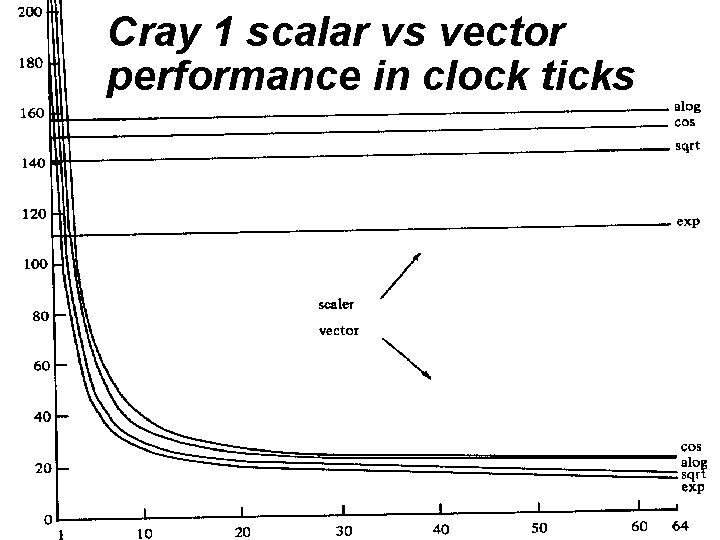
Cray 1 scalar vs vector performance in clock ticks Cray
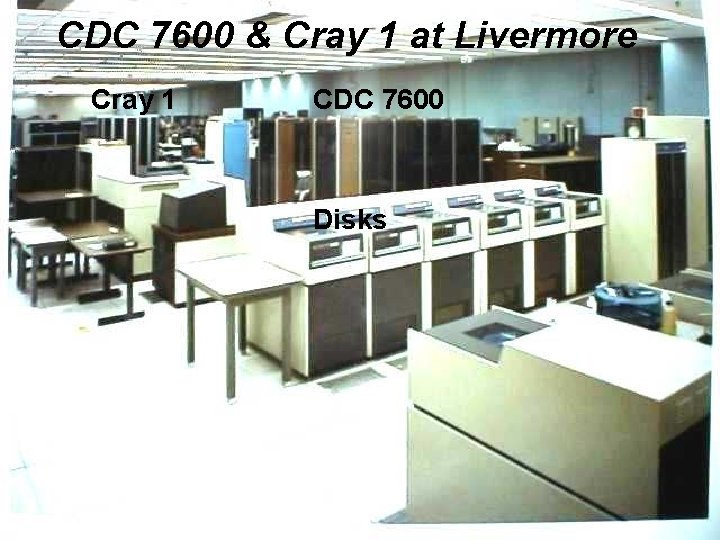
CDC 7600 & Cray 1 at Livermore Cray 1 CDC 7600 Disks Cray
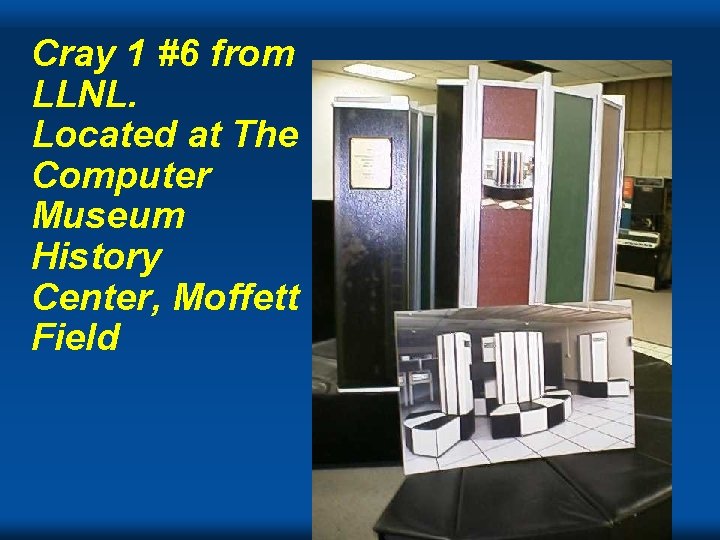
Cray 1 #6 from LLNL. Located at The Computer Museum History Center, Moffett Field Cray
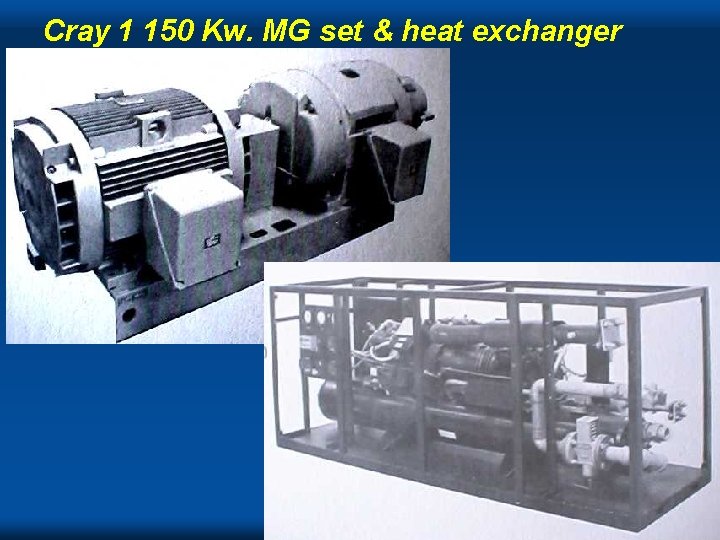
Cray 1 150 Kw. MG set & heat exchanger Cray
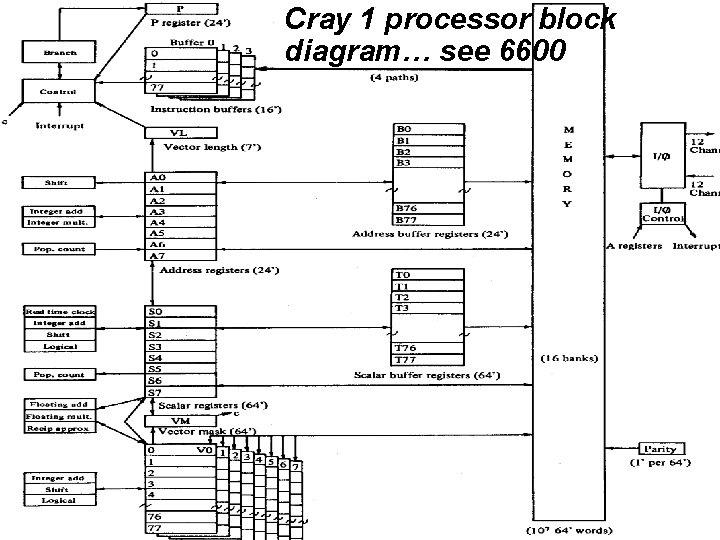
Cray 1 processor block diagram… see 6600 Cray
Steve Wallach, founder Convex “I began working on vector architecture in 1972 for military computers including APL. n “I fell in love with the Cray 1. – Continue to value Cray’s Livermore talk – Raised the awareness and need for bandwidth – Kuck & Kennedy work on parallelization and vectorization was critical n 1984: Convex was founded to build the C-1 mini -supercomputer. Convex followed the Cray formula including m. Ps and Ga. As Cray n
George Spix comments on Cray 1 “But these machines were a delight to code by hand with significant performance rewards for tight and well scheduled assembly. His use of address (A) registers to trigger reading and writing of computational (X) registers brought us optimally scheduled loads and stores driven by a space and time efficient increment, demonstrating again Seymour's intuitive if not intimate understanding of applications' data flow in a minimalist partitioning of function in logic that was, in a word, beautiful. ” Cray
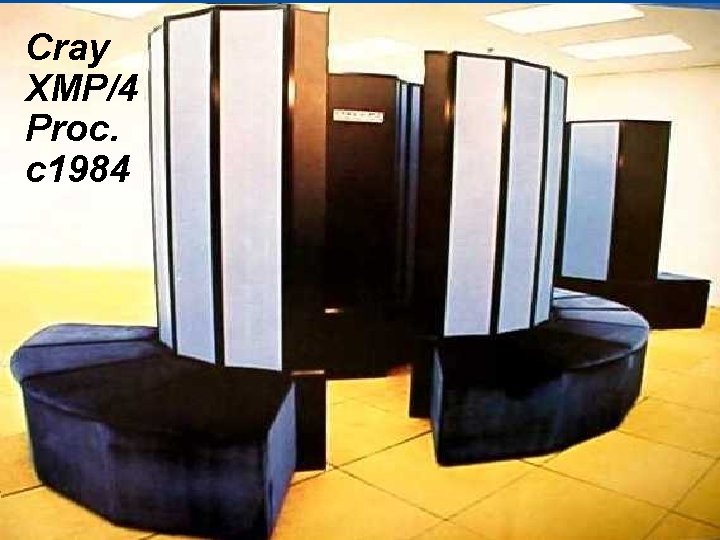
Cray XMP/4 Proc. c 1984 Cray
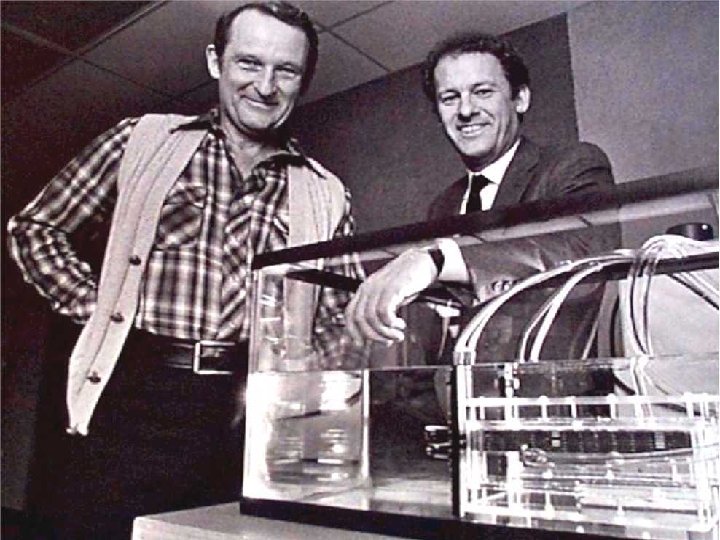
Cray, Cray 2 Proto, & Rollwagen Cray
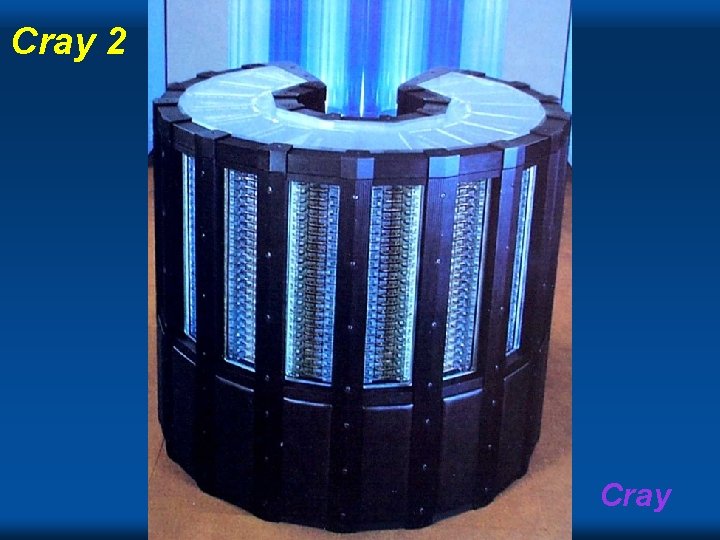
Cray 2 Cray
Cray Computer Corporation Cray 3 and Cray 4 Ga. As based computers Cray
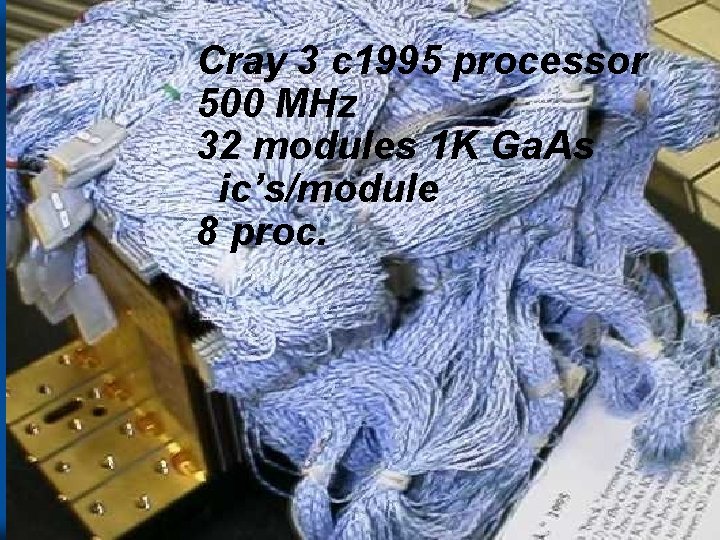
Cray 3 c 1995 processor 500 MHz 32 modules 1 K Ga. As ic’s/module 8 proc. Cray
“ Petaflops by 2010 ” 1994 DOE Accelerated Strategic Computing Initiative (ASCI) Cray
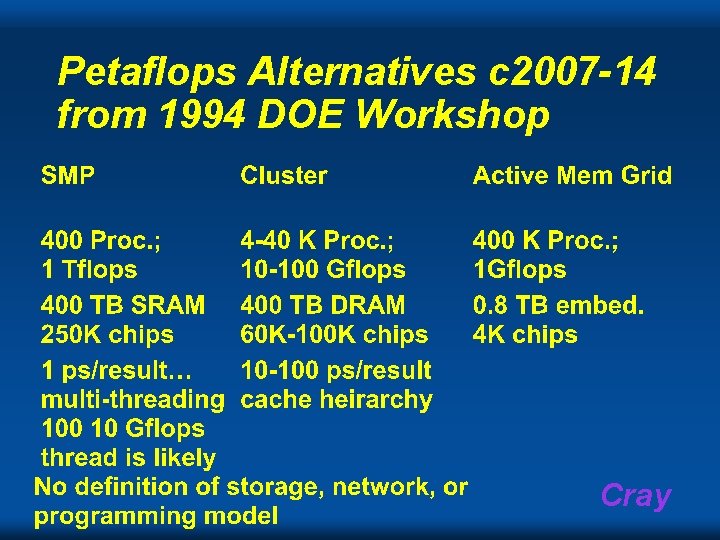
Petaflops Alternatives c 2007 -14 from 1994 DOE Workshop Cray
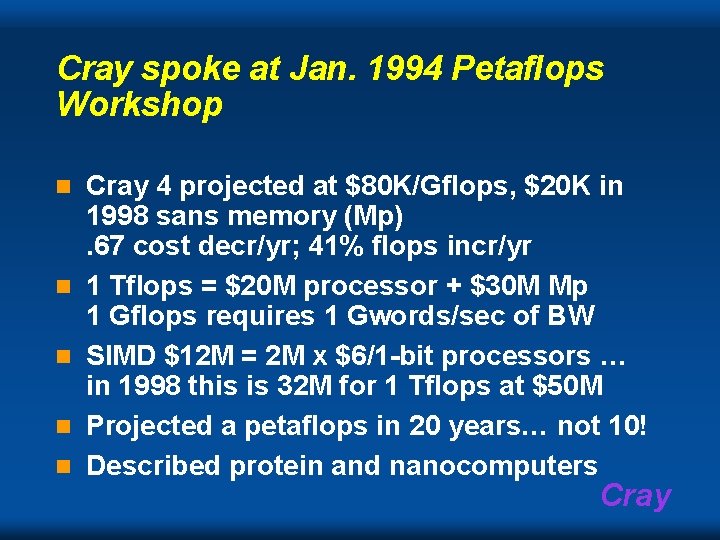
Cray spoke at Jan. 1994 Petaflops Workshop n n n Cray 4 projected at $80 K/Gflops, $20 K in 1998 sans memory (Mp). 67 cost decr/yr; 41% flops incr/yr 1 Tflops = $20 M processor + $30 M Mp 1 Gflops requires 1 Gwords/sec of BW SIMD $12 M = 2 M x $6/1 -bit processors … in 1998 this is 32 M for 1 Tflops at $50 M Projected a petaflops in 20 years… not 10! Described protein and nanocomputers Cray
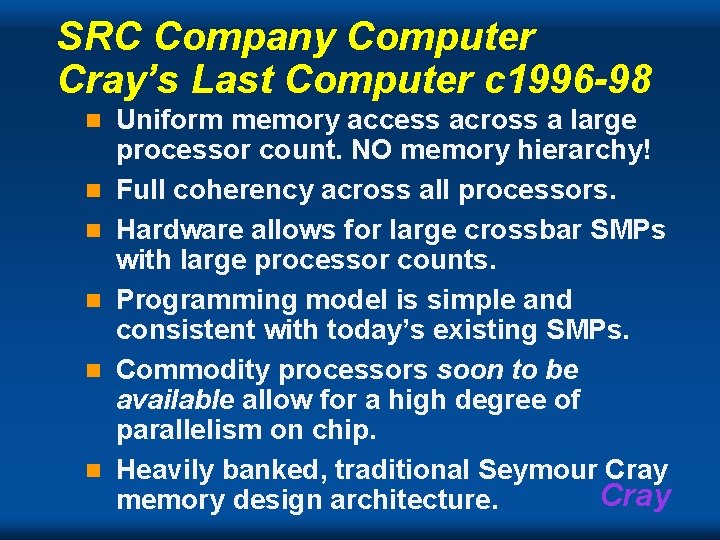
SRC Company Computer Cray’s Last Computer c 1996 -98 n n n Uniform memory access across a large processor count. NO memory hierarchy! Full coherency across all processors. Hardware allows for large crossbar SMPs with large processor counts. Programming model is simple and consistent with today’s existing SMPs. Commodity processors soon to be available allow for a high degree of parallelism on chip. Heavily banked, traditional Seymour Cray memory design architecture.
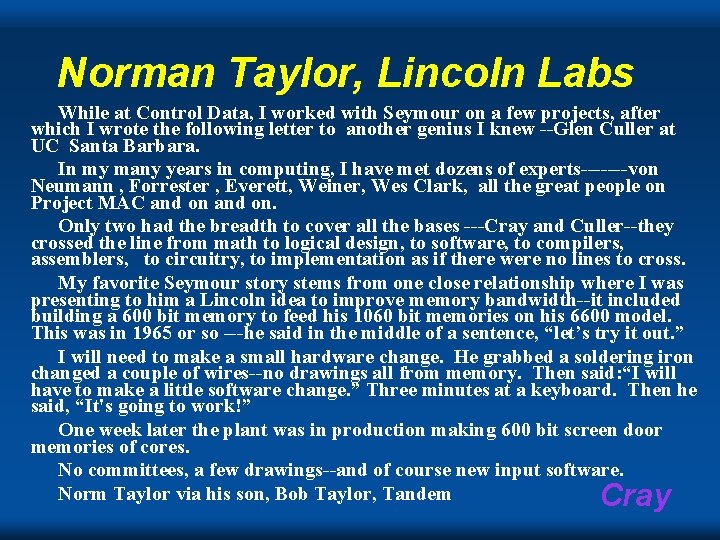
Norman Taylor, Lincoln Labs While at Control Data, I worked with Seymour on a few projects, after which I wrote the following letter to another genius I knew --Glen Culler at UC Santa Barbara. In my many years in computing, I have met dozens of experts-------von Neumann , Forrester , Everett, Weiner, Wes Clark, all the great people on Project MAC and on. Only two had the breadth to cover all the bases ---Cray and Culler--they crossed the line from math to logical design, to software, to compilers, assemblers, to circuitry, to implementation as if there were no lines to cross. My favorite Seymour story stems from one close relationship where I was presenting to him a Lincoln idea to improve memory bandwidth--it included building a 600 bit memory to feed his 1060 bit memories on his 6600 model. This was in 1965 or so ---he said in the middle of a sentence, “let’s try it out. ” I will need to make a small hardware change. He grabbed a soldering iron changed a couple of wires--no drawings all from memory. Then said: “I will have to make a little software change. ” Three minutes at a keyboard. Then he said, “It's going to work!” One week later the plant was in production making 600 bit screen door memories of cores. No committees, a few drawings--and of course new input software. Norm Taylor via his son, Bob Taylor, Tandem Cray
The End Cray
Supercomputing Next Steps Cray
Battle for speed through parallelism and massive parallelism Cray
“ Parallel processing computer architectures will be in use by 1975. ” Navy Delphi Panel 1969 Cray
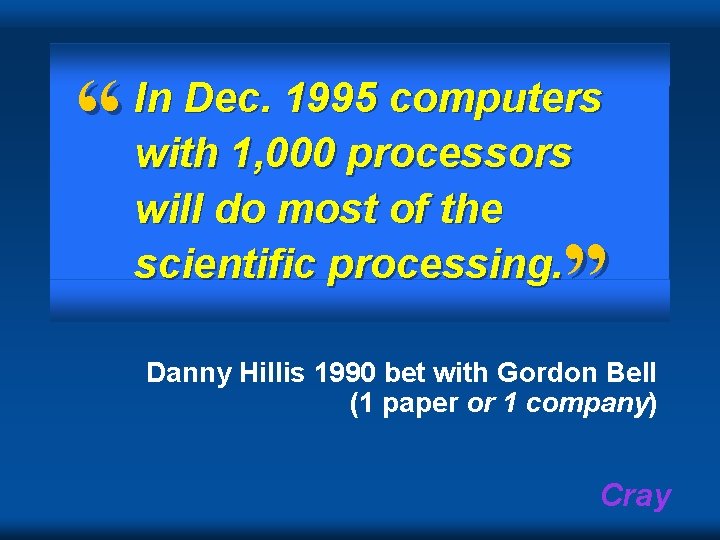
“ In Dec. 1995 computers with 1, 000 processors will do most of the scientific processing. ” Danny Hillis 1990 bet with Gordon Bell (1 paper or 1 company) Cray
“ In Dec. 1995 computers with 1, 000 processors will do most of the scientific processing. ” Danny Hillis 1990 (1 paper or 1 company) Cray
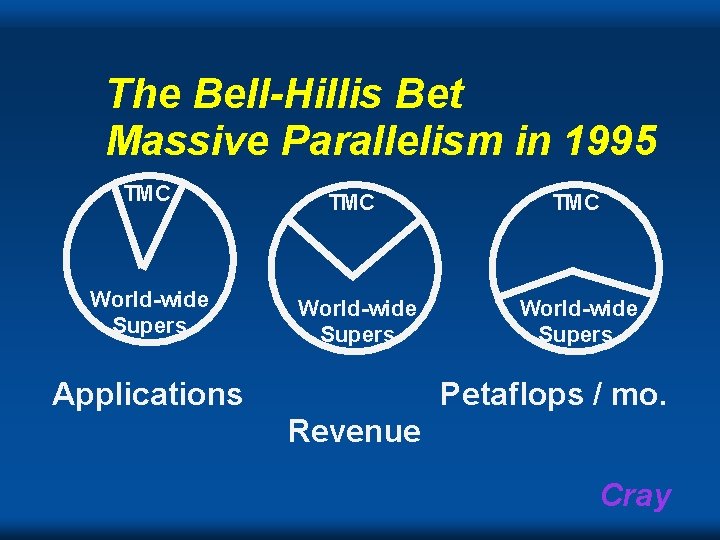
The Bell-Hillis Bet Massive Parallelism in 1995 TMC TMC World-wide Supers Applications Petaflops / mo. Revenue Cray
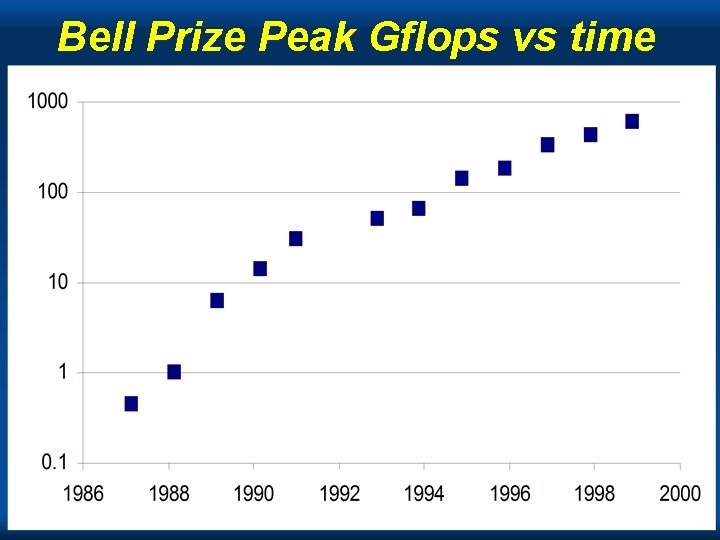
Bell Prize Peak Gflops vs time Cray
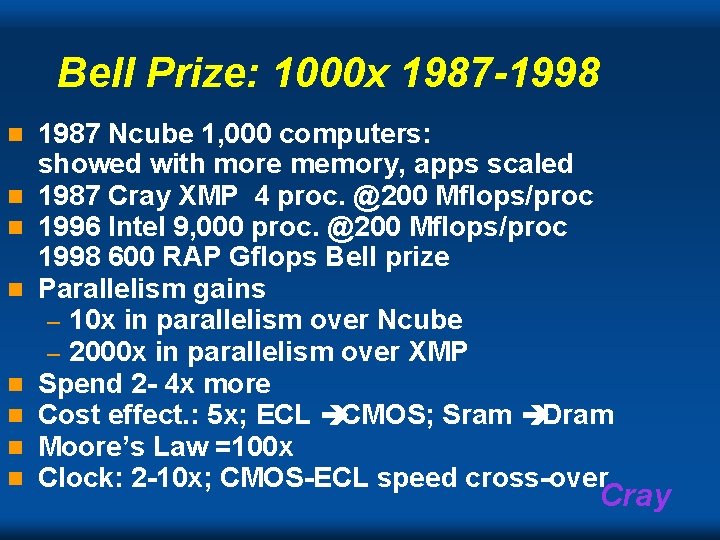
Bell Prize: 1000 x 1987 -1998 n n n n 1987 Ncube 1, 000 computers: showed with more memory, apps scaled 1987 Cray XMP 4 proc. @200 Mflops/proc 1996 Intel 9, 000 proc. @200 Mflops/proc 1998 600 RAP Gflops Bell prize Parallelism gains – 10 x in parallelism over Ncube – 2000 x in parallelism over XMP Spend 2 - 4 x more Cost effect. : 5 x; ECL èCMOS; Sram èDram Moore’s Law =100 x Clock: 2 -10 x; CMOS-ECL speed cross-over Cray
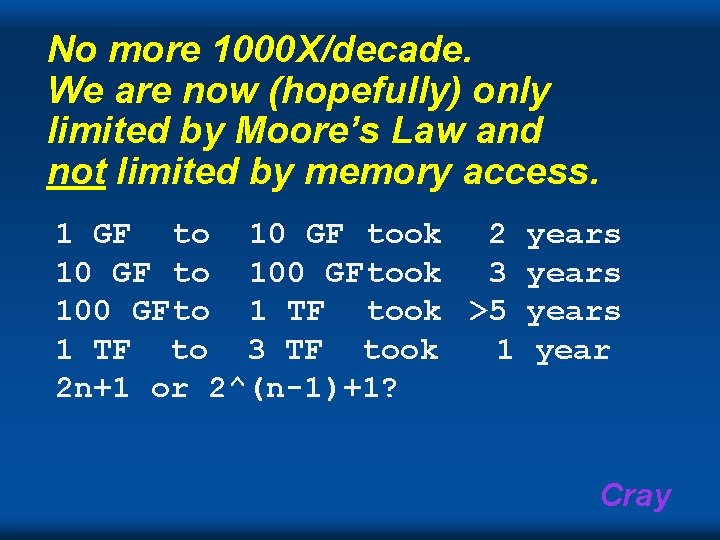
No more 1000 X/decade. We are now (hopefully) only limited by Moore’s Law and not limited by memory access. 1 GF to 10 GF took 2 years 10 GF to 100 GFtook 3 years 100 GFto 1 TF took >5 years 1 TF to 3 TF took 1 year 2 n+1 or 2^(n-1)+1? Cray
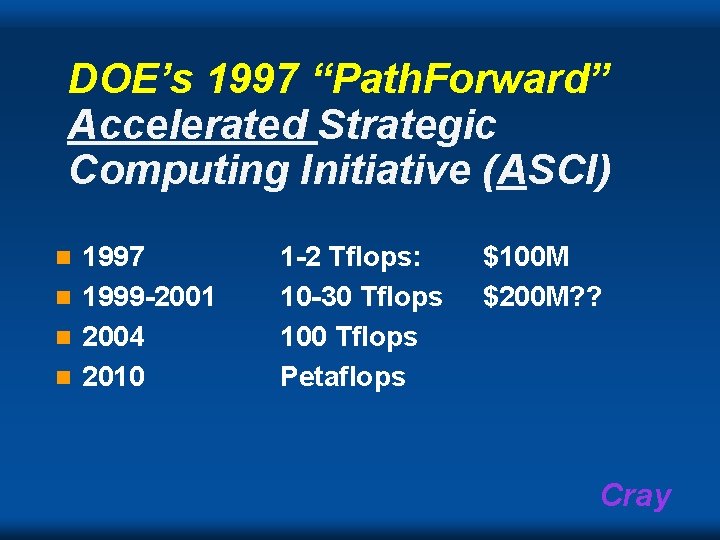
DOE’s 1997 “Path. Forward” Accelerated Strategic Computing Initiative (ASCI) 1997 n 1999 -2001 n 2004 n 2010 n 1 -2 Tflops: 10 -30 Tflops 100 Tflops Petaflops $100 M $200 M? ? Cray
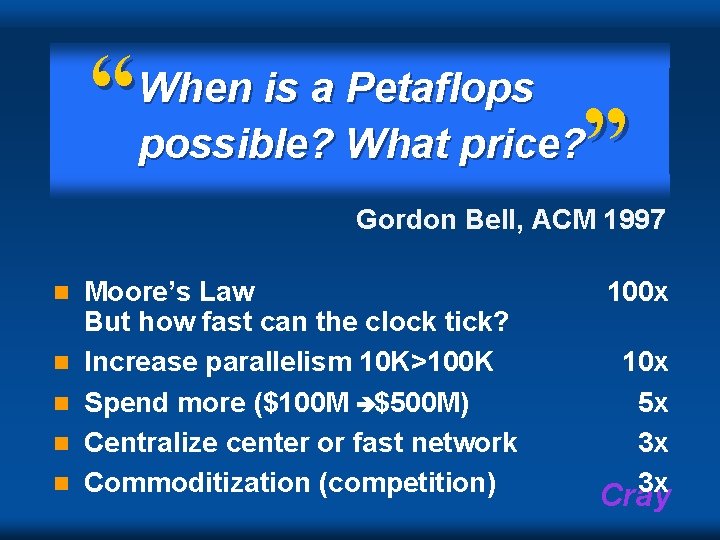
“ When is a Petaflops possible? What price? ” Gordon Bell, ACM 1997 n n n Moore’s Law But how fast can the clock tick? Increase parallelism 10 K>100 K Spend more ($100 M è$500 M) Centralize center or fast network Commoditization (competition) 100 x 10 x 5 x 3 x 3 x Cray
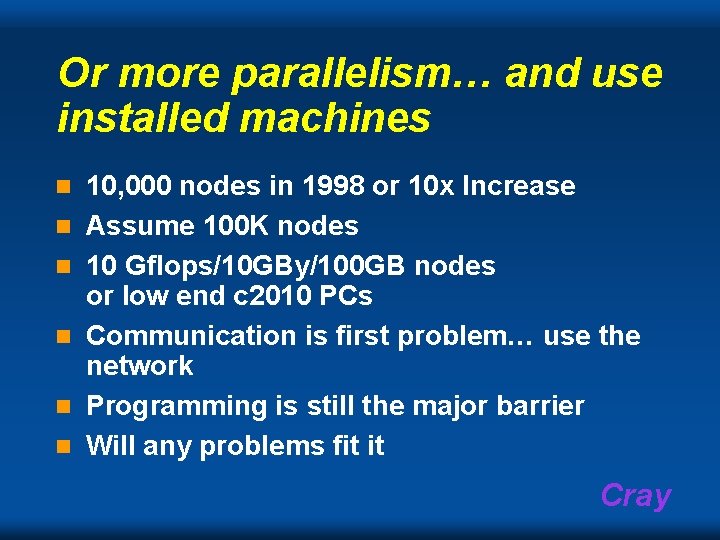
Or more parallelism… and use installed machines n n n 10, 000 nodes in 1998 or 10 x Increase Assume 100 K nodes 10 Gflops/10 GBy/100 GB nodes or low end c 2010 PCs Communication is first problem… use the network Programming is still the major barrier Will any problems fit it Cray
End 2 Cray
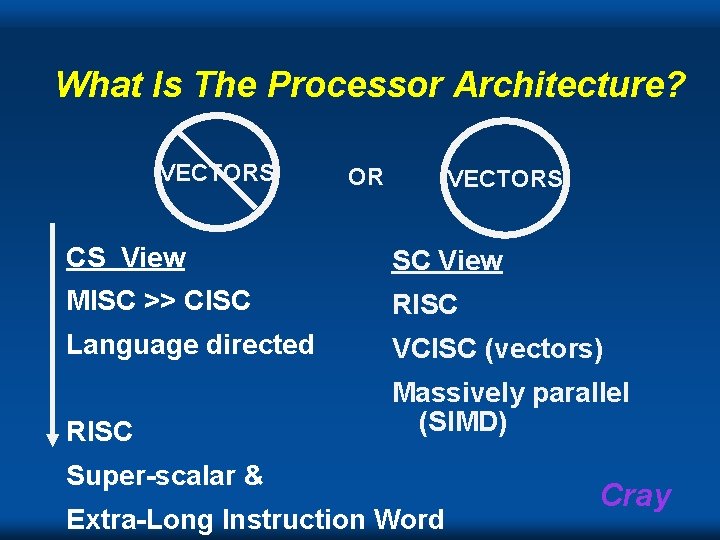
What Is The Processor Architecture? VECTORS OR VECTORS CS View SC View MISC >> CISC RISC Language directed VCISC (vectors) RISC Massively parallel (SIMD) Super-scalar & Extra-Long Instruction Word Cray
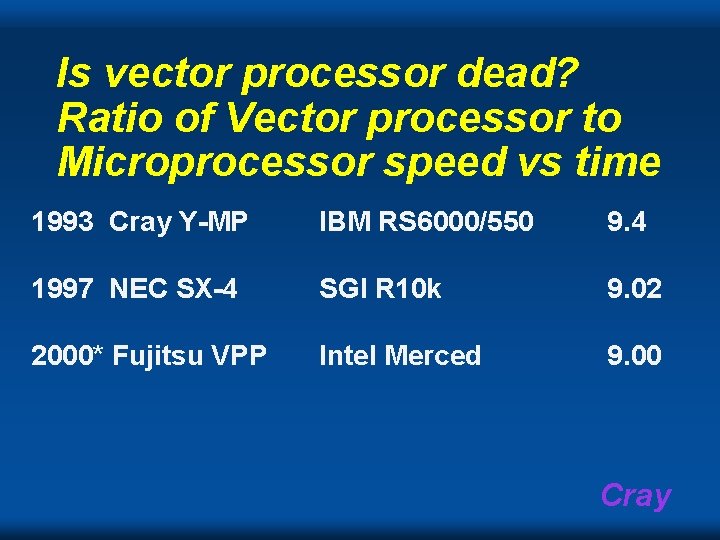
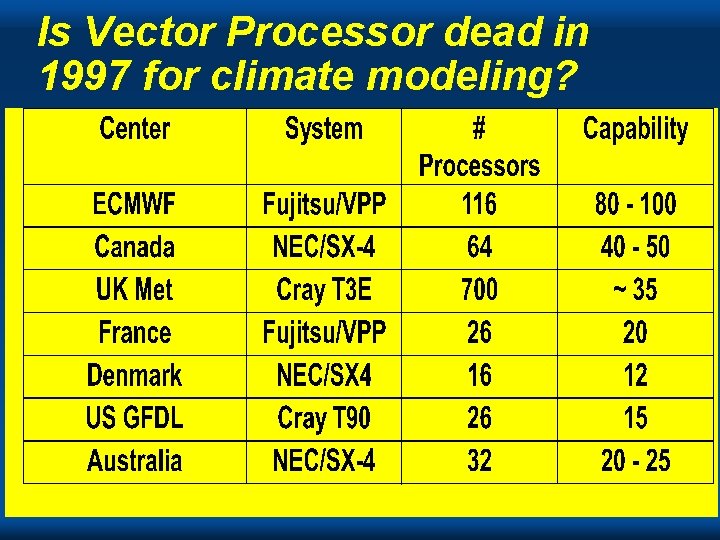
Is vector processor dead? Ratio of Vector processor to Microprocessor speed vs time 1993 Cray Y-MP IBM RS 6000/550 9. 4 1997 NEC SX-4 SGI R 10 k 9. 02 2000* Fujitsu VPP Intel Merced 9. 00 Cray
Is Vector Processor dead in 1997 for climate modeling? Cray
Cray computers vs time Cray
CDC 6600 Console 106 Courtesy of Burton Smith, Microsoft
Two CDC 7600 s 107 Courtesy of Burton Smith, Microsoft
Vector Pipelining: Cray-1 l Unlike the CDC Star-100, there was no development contract for the Cray-1 ¡ Mr. Cray disliked government’s looking over his shoulder Instead, Cray gave Los Alamos a one-year free trial l Almost no software was provided by Cray Research l ¡ l After the year was up, Los Alamos leased the system ¡ l The lease was financed by a New Mexico petroleum person The Cray-1 definitely did not suffer from Amdahl’s law ¡ ¡ l Los Alamos developed or adapted existing software Its scalar performance was twice that of the 7600 Once vector software matured, 2 x became 8 x or more When people say “supercomputer”, they think Cray-1 108 Courtesy of Burton Smith, Microsoft
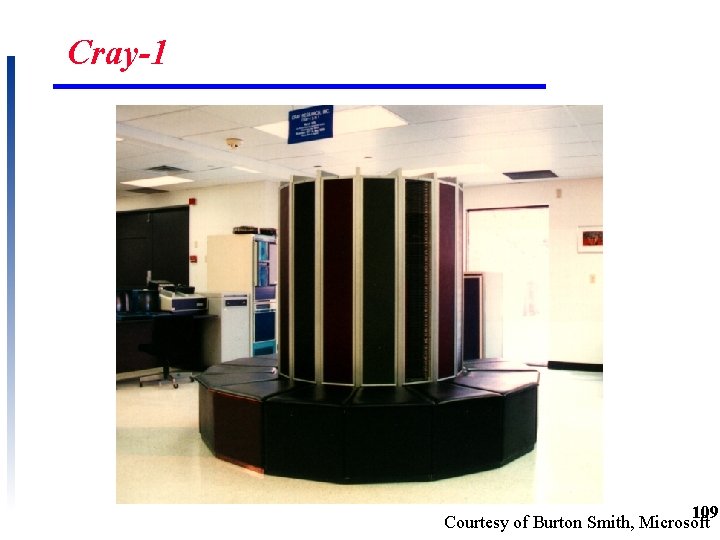
Cray-1 109 Courtesy of Burton Smith, Microsoft
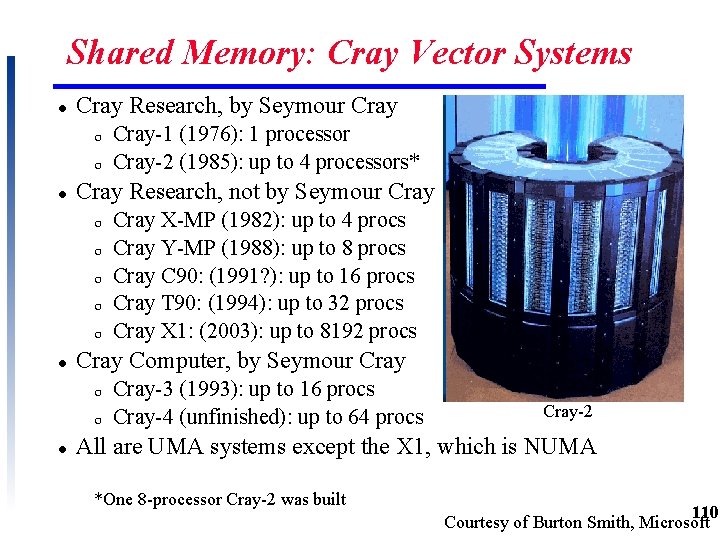
Shared Memory: Cray Vector Systems l Cray Research, by Seymour Cray ¡ ¡ l Cray Research, not by Seymour Cray ¡ ¡ ¡ l Cray X-MP (1982): up to 4 procs Cray Y-MP (1988): up to 8 procs Cray C 90: (1991? ): up to 16 procs Cray T 90: (1994): up to 32 procs Cray X 1: (2003): up to 8192 procs Cray Computer, by Seymour Cray ¡ ¡ l Cray-1 (1976): 1 processor Cray-2 (1985): up to 4 processors* Cray-3 (1993): up to 16 procs Cray-4 (unfinished): up to 64 procs Cray-2 All are UMA systems except the X 1, which is NUMA *One 8 -processor Cray-2 was built 110 Courtesy of Burton Smith, Microsoft
- Slides: 99