
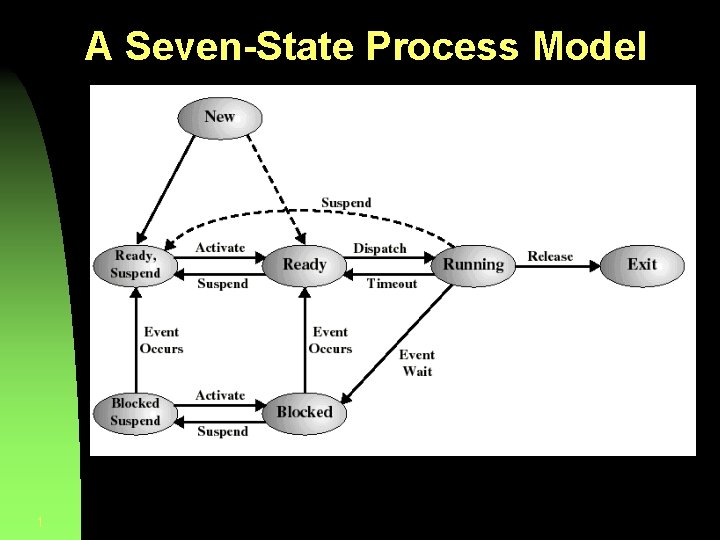
A SevenState Process Model 1 CPU Switch From
![The process executes fork(). . n=write(STDOUT_FILENO, "ninput command: ", 17); n=read(STDIN_FILENO, buf, BUFFSIZE); buf[n-1]](https://slidetodoc.com/presentation_image/45947b93eced2faa0367ebbb19fb00c4/image-18.jpg "The process executes fork(). . n=write(STDOUT_FILENO, \"ninput command: \", 17); n=read(STDIN_FILENO, buf, BUFFSIZE); buf[n-1]")
![n=write(STDOUT_FILENO, "ninput command: ", 17); n=read(STDIN_FILENO, buf, BUFFSIZE); buf[n-1] = 0; sscanf(buf, "%s", commandname);](https://slidetodoc.com/presentation_image/45947b93eced2faa0367ebbb19fb00c4/image-19.jpg "n=write(STDOUT_FILENO, \"ninput command: \", 17); n=read(STDIN_FILENO, buf, BUFFSIZE); buf[n-1] = 0; sscanf(buf, \"%s\", commandname);")
![n=write(STDOUT_FILENO, "ninput command: ", 17); n=read(STDIN_FILENO, buf, BUFFSIZE); buf[n-1] = 0; sscanf(buf, "%s", commandname);](https://slidetodoc.com/presentation_image/45947b93eced2faa0367ebbb19fb00c4/image-20.jpg "n=write(STDOUT_FILENO, \"ninput command: \", 17); n=read(STDIN_FILENO, buf, BUFFSIZE); buf[n-1] = 0; sscanf(buf, \"%s\", commandname);")
![n=write(STDOUT_FILENO, "ninput command: ", 17); n=read(STDIN_FILENO, buf, BUFFSIZE); buf[n-1] = 0; sscanf(buf, "%s", commandname);](https://slidetodoc.com/presentation_image/45947b93eced2faa0367ebbb19fb00c4/image-21.jpg "n=write(STDOUT_FILENO, \"ninput command: \", 17); n=read(STDIN_FILENO, buf, BUFFSIZE); buf[n-1] = 0; sscanf(buf, \"%s\", commandname);")
![n=write(STDOUT_FILENO, "ninput command: ", 17); n=read(STDIN_FILENO, buf, BUFFSIZE); buf[n-1] = 0; sscanf(buf, "%s", commandname);](https://slidetodoc.com/presentation_image/45947b93eced2faa0367ebbb19fb00c4/image-22.jpg "n=write(STDOUT_FILENO, \"ninput command: \", 17); n=read(STDIN_FILENO, buf, BUFFSIZE); buf[n-1] = 0; sscanf(buf, \"%s\", commandname);")
![n=write(STDOUT_FILENO, "ninput command: ", 17); n=read(STDIN_FILENO, buf, BUFFSIZE); buf[n-1] = 0; sscanf(buf, "%s", commandname);](https://slidetodoc.com/presentation_image/45947b93eced2faa0367ebbb19fb00c4/image-23.jpg "n=write(STDOUT_FILENO, \"ninput command: \", 17); n=read(STDIN_FILENO, buf, BUFFSIZE); buf[n-1] = 0; sscanf(buf, \"%s\", commandname);")
- Slides: 23
A Seven-State Process Model 1
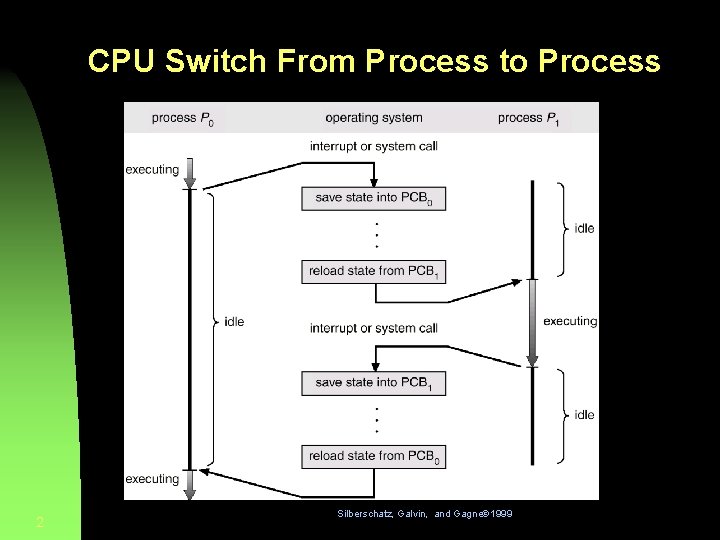
CPU Switch From Process to Process 2 Silberschatz, Galvin, and Gagne 1999
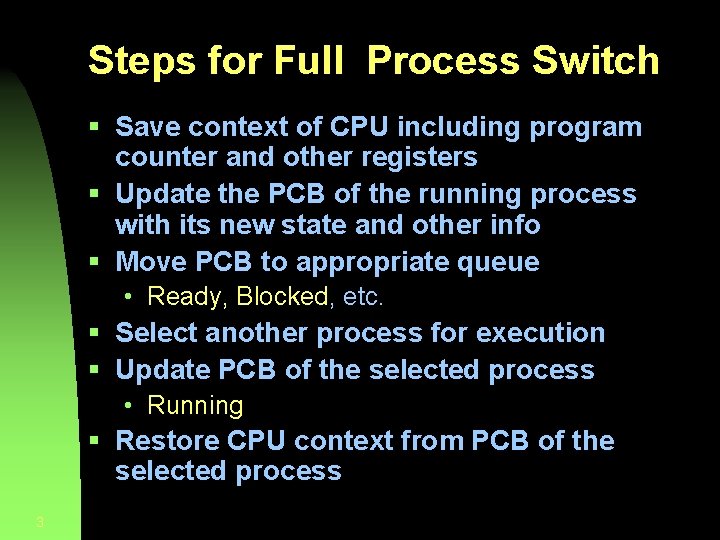
Steps for Full Process Switch § Save context of CPU including program counter and other registers § Update the PCB of the running process with its new state and other info § Move PCB to appropriate queue • Ready, Blocked, etc. § Select another process for execution § Update PCB of the selected process • Running § Restore CPU context from PCB of the selected process 3
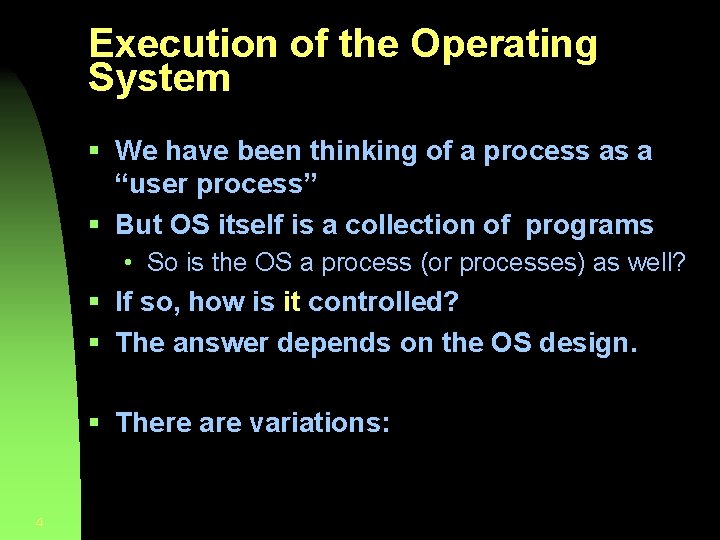
Execution of the Operating System § We have been thinking of a process as a “user process” § But OS itself is a collection of programs • So is the OS a process (or processes) as well? § If so, how is it controlled? § The answer depends on the OS design. § There are variations: 4
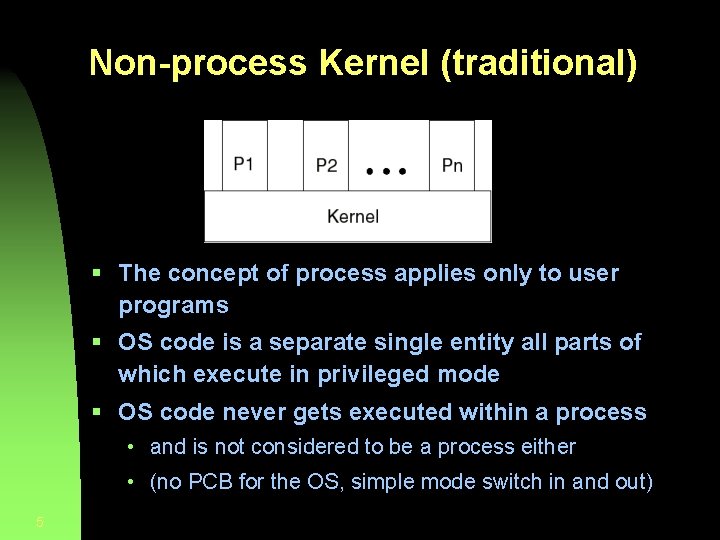
Non-process Kernel (traditional) § The concept of process applies only to user programs § OS code is a separate single entity all parts of which execute in privileged mode § OS code never gets executed within a process • and is not considered to be a process either • (no PCB for the OS, simple mode switch in and out) 5
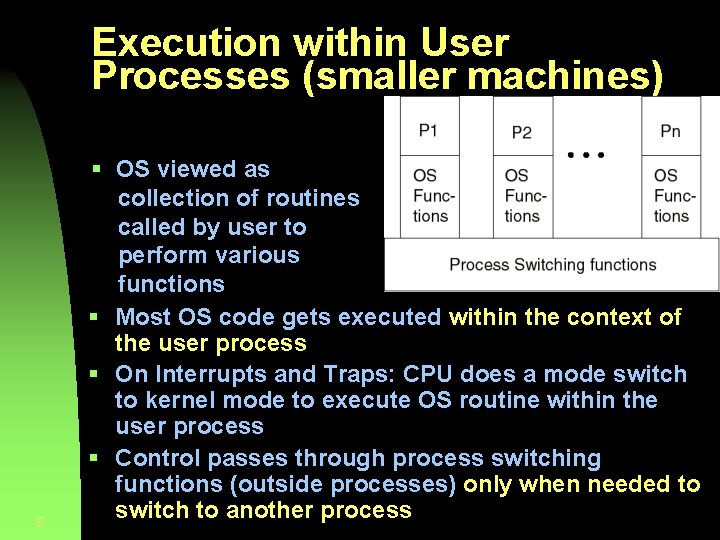
Execution within User Processes (smaller machines) 6 § OS viewed as collection of routines called by user to perform various functions § Most OS code gets executed within the context of the user process § On Interrupts and Traps: CPU does a mode switch to kernel mode to execute OS routine within the user process § Control passes through process switching functions (outside processes) only when needed to switch to another process
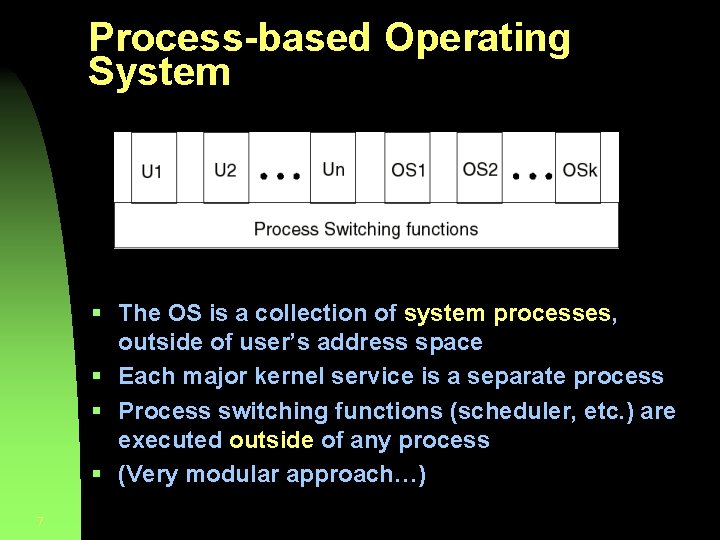
Process-based Operating System § The OS is a collection of system processes, outside of user’s address space § Each major kernel service is a separate process § Process switching functions (scheduler, etc. ) are executed outside of any process § (Very modular approach…) 7
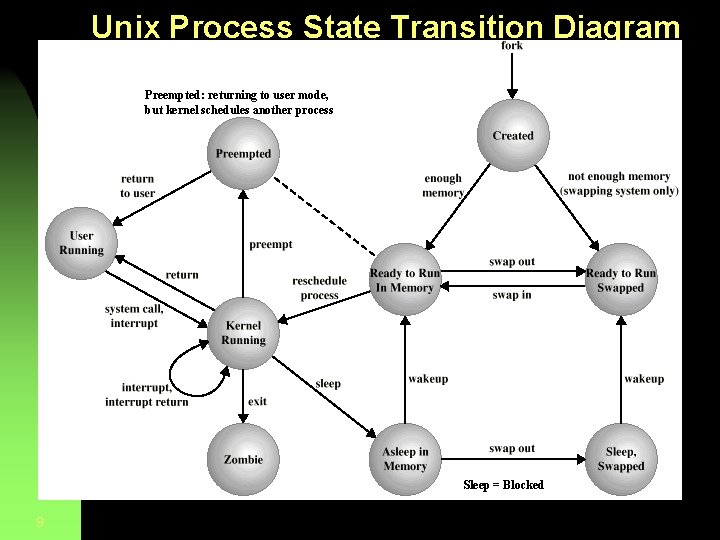
UNIX Process Management § Most of OS executes within user processes § Uses two categories of processes: • System “processes” § run in kernel mode for housekeeping functions (memory allocation, process swapping. . . ) • User processes § run in user mode for user programs § run in kernel mode for system calls, traps, and interrupts inside the user’s process image 8
Unix Process State Transition Diagram Preempted: returning to user mode, but kernel schedules another process Sleep = Blocked 9
Process Creation (Unix) 10 Chapter 4
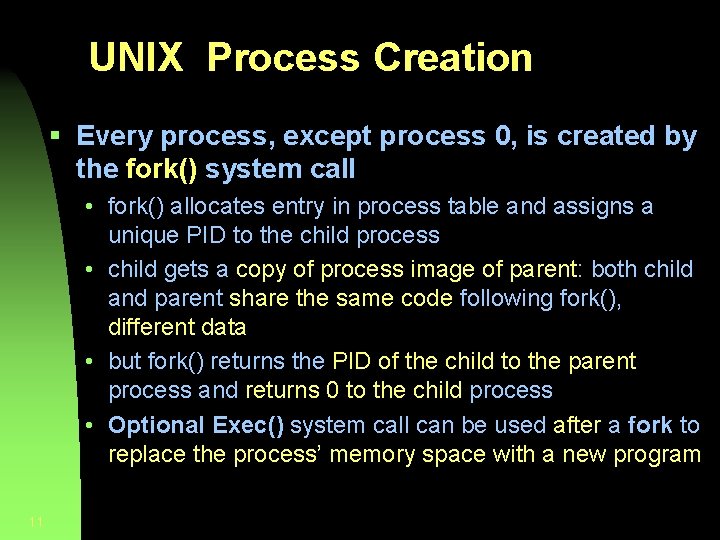
UNIX Process Creation § Every process, except process 0, is created by the fork() system call • fork() allocates entry in process table and assigns a unique PID to the child process • child gets a copy of process image of parent: both child and parent share the same code following fork(), different data • but fork() returns the PID of the child to the parent process and returns 0 to the child process • Optional Exec() system call can be used after a fork to replace the process’ memory space with a new program 11
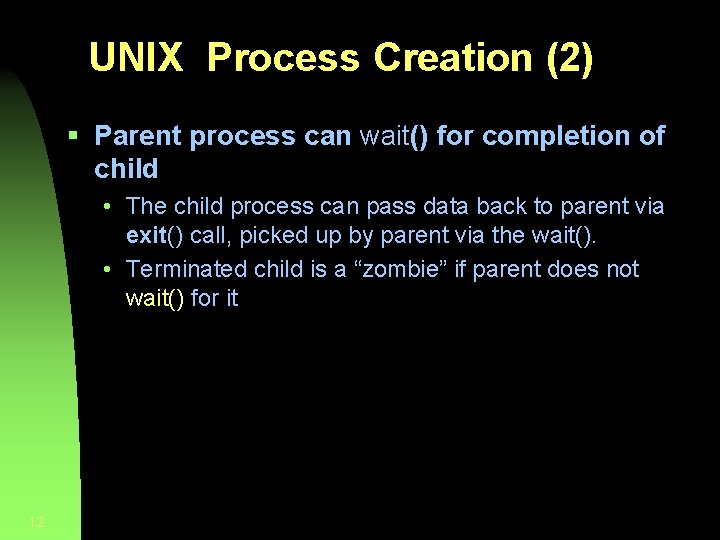
UNIX Process Creation (2) § Parent process can wait() for completion of child • The child process can pass data back to parent via exit() call, picked up by parent via the wait(). • Terminated child is a “zombie” if parent does not wait() for it 12
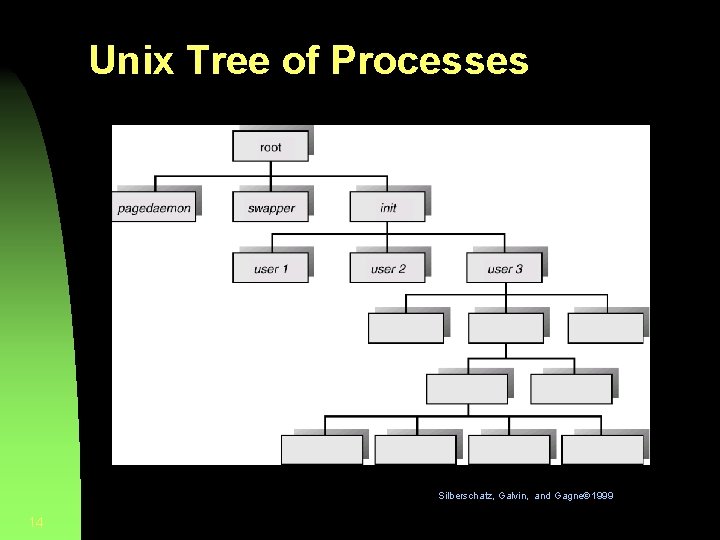
UNIX System Processes § “Boot” loads the kernel image § Process 0 is created at boot time and becomes the “swapper” after forking process 1 (the INIT process) § When a user logs in: process 1 creates a process for that user 13
Unix Tree of Processes Silberschatz, Galvin, and Gagne 1999 14
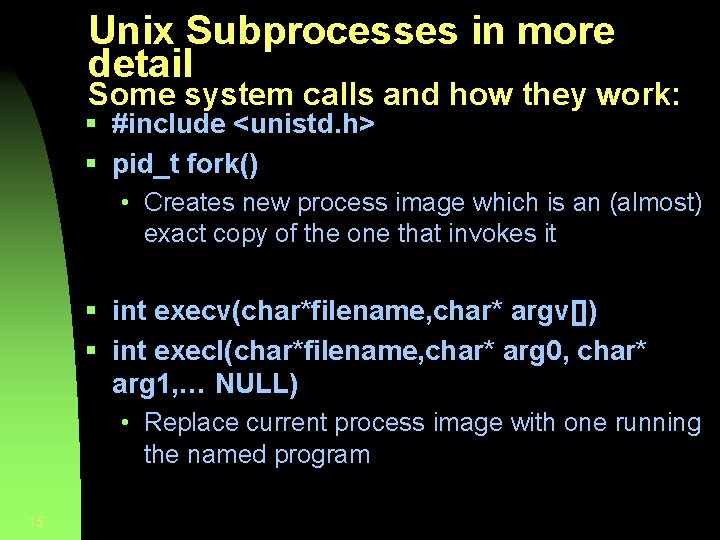
Unix Subprocesses in more detail Some system calls and how they work: § #include <unistd. h> § pid_t fork() • Creates new process image which is an (almost) exact copy of the one that invokes it § int execv(char*filename, char* argv[]) § int execl(char*filename, char* arg 0, char* arg 1, … NULL) • Replace current process image with one running the named program 15
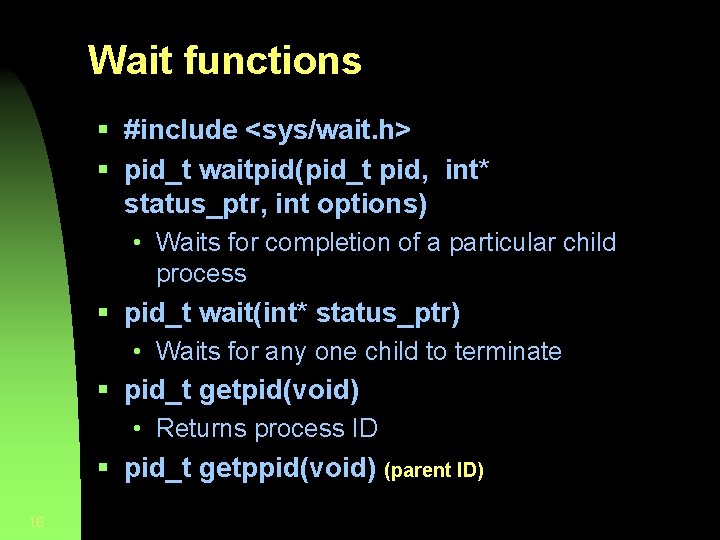
Wait functions § #include <sys/wait. h> § pid_t waitpid(pid_t pid, int* status_ptr, int options) • Waits for completion of a particular child process § pid_t wait(int* status_ptr) • Waits for any one child to terminate § pid_t getpid(void) • Returns process ID § pid_t getppid(void) (parent ID) 16
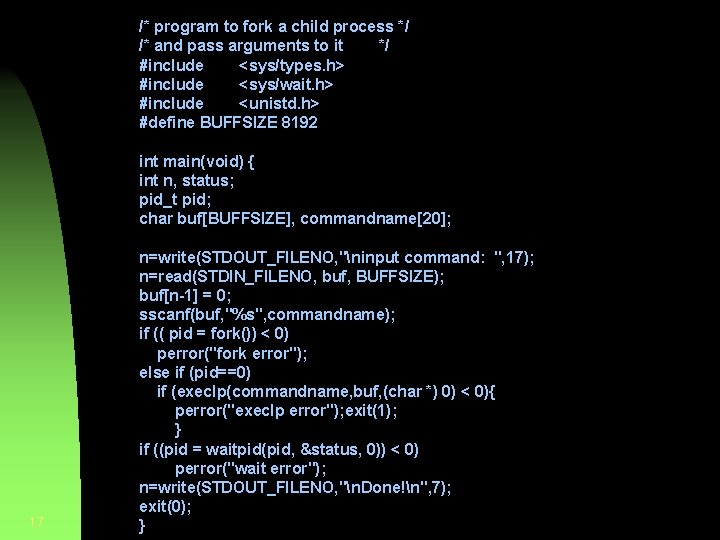
/* program to fork a child process */ /* and pass arguments to it */ #include <sys/types. h> #include <sys/wait. h> #include <unistd. h> #define BUFFSIZE 8192 int main(void) { int n, status; pid_t pid; char buf[BUFFSIZE], commandname[20]; 17 n=write(STDOUT_FILENO, "ninput command: ", 17); n=read(STDIN_FILENO, buf, BUFFSIZE); buf[n-1] = 0; sscanf(buf, "%s", commandname); if (( pid = fork()) < 0) perror("fork error"); else if (pid==0) if (execlp(commandname, buf, (char *) 0) < 0){ perror("execlp error"); exit(1); } if ((pid = waitpid(pid, &status, 0)) < 0) perror("wait error"); n=write(STDOUT_FILENO, "n. Done!n", 7); exit(0); }
The process executes fork(). . n=write(STDOUT_FILENO, "ninput command: ", 17); n=read(STDIN_FILENO, buf, BUFFSIZE); buf[n-1] = 0; sscanf(buf, "%s", commandname); if (( pid = fork()) < 0) perror("fork error"); else if (pid==0) if (execlp(commandname, buf, (char *) 0) < 0) { perror("execlp error"); exit(1); /* Exit child process! */ } if ((pid = waitpid(pid, &status, 0)) < 0) perror("wait error"); n=write(STDOUT_FILENO, "n. Done!n", 7); exit(0); } 18
n=write(STDOUT_FILENO, "ninput command: ", 17); n=read(STDIN_FILENO, buf, BUFFSIZE); buf[n-1] = 0; sscanf(buf, "%s", commandname); if (( pid = fork()) < 0) perror("fork error"); else if (pid==0) if (execlp(commandname, buf, (char *) 0) < 0){ perror("execlp error"); exit(1); } if ((pid = waitpid(pid, &status, 0)) < 0) perror("wait error"); n=write(STDOUT_FILENO, "n. Done!n", 7); exit(0); } 19 And now there are two! (identical process images running the same program) n=write(STDOUT_FILENO, "ninput command: ", 17); n=read(STDIN_FILENO, buf, BUFFSIZE); buf[n-1] = 0; sscanf(buf, "%s", commandname); if (( pid = fork()) < 0) perror("fork error"); else if (pid==0) if (execlp(commandname, buf, (char *)0) < 0){ perror("execlp error"); exit(1); } if ((pid = waitpid(pid, &status, 0)) < 0) perror("wait error"); n=write(STDOUT_FILENO, "n. Done!n", 7); exit(0); }
n=write(STDOUT_FILENO, "ninput command: ", 17); n=read(STDIN_FILENO, buf, BUFFSIZE); buf[n-1] = 0; sscanf(buf, "%s", commandname); if (( pid = fork()) < 0) perror("fork error"); else if (pid==0) if (execlp(commandname, buf, (char *) 0) < 0) { perror("execlp error"); exit(1); } if ((pid = waitpid(pid, &status, 0)) < 0) perror("wait error"); n=write(STDOUT_FILENO, "n. Done!n", 7); exit(0); } And one is the child. . The child exec’s. . 20 One is the parent. . n=write(STDOUT_FILENO, "ninput command: ", 17); n=read(STDIN_FILENO, buf, BUFFSIZE); buf[n-1] = 0; sscanf(buf, "%s", commandname); if (( pid = fork()) < 0) perror("fork error"); else if (pid==0) if (execlp(commandname, buf, (char *)0) < 0){ perror("execlp error"); exit(1); } if ((pid = waitpid(pid, &status, 0)) < 0) perror("wait error"); n=write(STDOUT_FILENO, "n. Done!n", 7); exit(0); }
n=write(STDOUT_FILENO, "ninput command: ", 17); n=read(STDIN_FILENO, buf, BUFFSIZE); buf[n-1] = 0; sscanf(buf, "%s", commandname); if (( pid = fork()) < 0) perror("fork error"); else if (pid==0) if (execlp(commandname, buf, (char *)0) < 0){ perror("execlp error"); exit(1); } if ((pid = waitpid(pid, &status, 0)) < 0) perror("wait error"); n=write(STDOUT_FILENO, "n. Done!n", 7); exit(0); } And the child substitutes a whole new process image running a different program (but same process id). . 21 Now the parent is waiting. . /* mychild. c */ /* child program prints out argument vector */ #include <sys/types. h> #include <sys/wait. h> #include <stdio. h> #include <unistd. h> int main(int argc, char *argv[]) { int i; printf ("number of arguments is %d: n", argc); for (i=0; i<argc; i++) printf ("argv[%d]: %sn", i, argv[i]); exit(0); }
n=write(STDOUT_FILENO, "ninput command: ", 17); n=read(STDIN_FILENO, buf, BUFFSIZE); buf[n-1] = 0; sscanf(buf, "%s", commandname); if (( pid = fork()) < 0) perror("fork error"); else if (pid==0) if (execlp(commandname, buf, (char *)0) < 0) { perror("execlp error"); exit(1); } if ((pid = waitpid(pid, &status, 0)) < 0) perror("wait error"); n=write(STDOUT_FILENO, "n. Done!n", 7); exit(0); } The parent waits until. . . the child eventually exits (with an exit status). . 22 /* mychild. c */ /* child program prints out argument vector */ #include <sys/types. h> #include <sys/wait. h> #include <stdio. h> #include <unistd. h> int main(int argc, char *argv[]) { int i; printf ("number of arguments is %d: n", argc); for (i=0; i<argc; i++) printf ("argv[%d]: %sn", i, argv[i]); exit(0); }
n=write(STDOUT_FILENO, "ninput command: ", 17); n=read(STDIN_FILENO, buf, BUFFSIZE); buf[n-1] = 0; sscanf(buf, "%s", commandname); if (( pid = fork()) < 0) perror("fork error"); else if (pid==0) if (execlp(commandname, buf, (char *)0) < 0){ perror("execlp error"); exit(1); } if ((pid = waitpid(pid, &status, 0)) < 0) perror("wait error"); n=write(STDOUT_FILENO, "n. Done!n", 7); exit(0); } And then there is only one again. . . 23