
A set as any collection of welldefined objects

A set as any collection of well-defined objects, which we usually denote with { }. 2 1, π, , -12. 652 3 …, -2, -1, 0, 1, 2, …
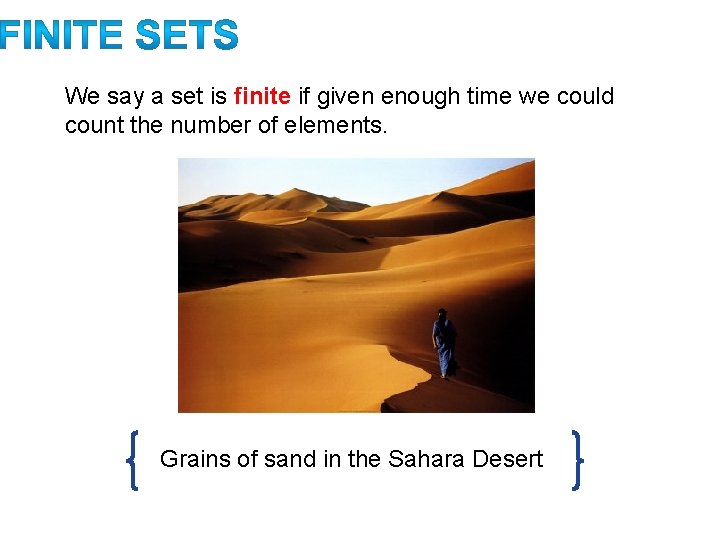
We say a set is finite if given enough time we could count the number of elements. Grains of sand in the Sahara Desert
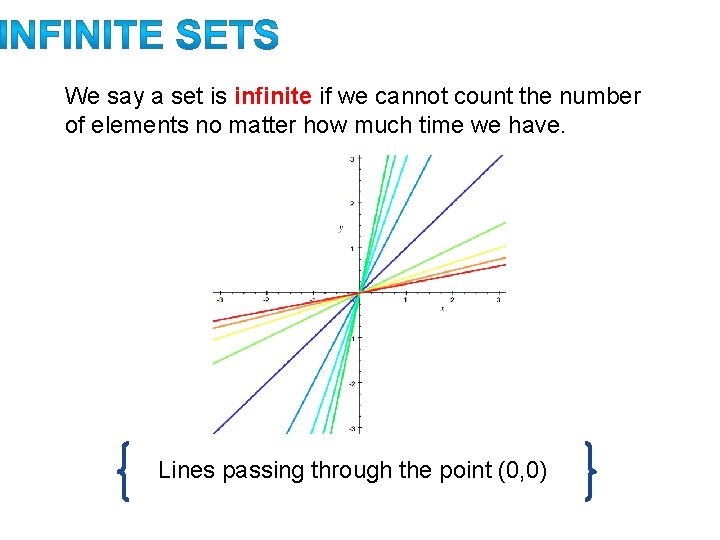
We say a set is infinite if we cannot count the number of elements no matter how much time we have. Lines passing through the point (0, 0)
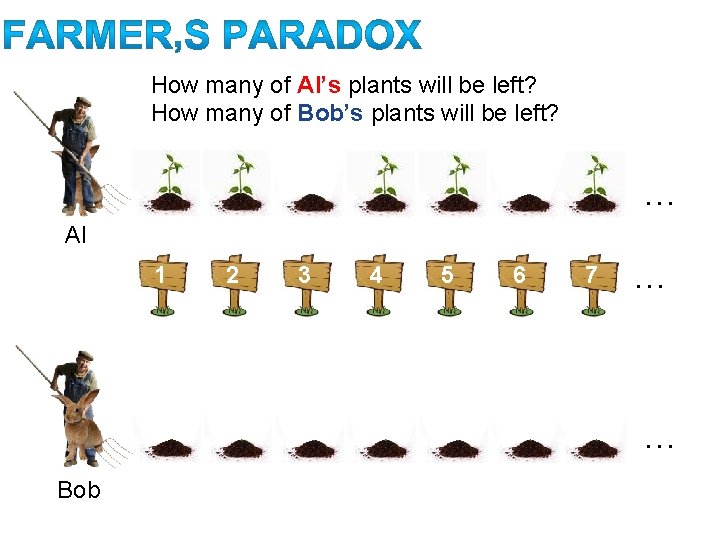
How many of Al’s plants will be left? How many of Bob’s plants will be left? … Al 1 2 3 4 5 6 7 … … Bob
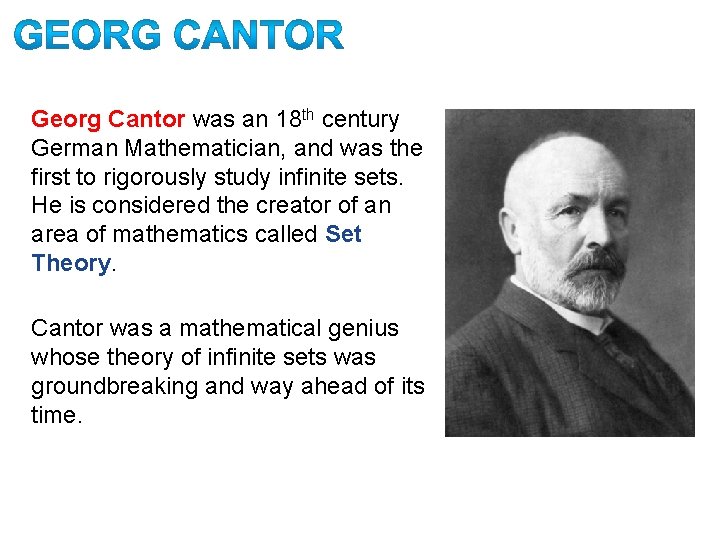
Georg Cantor was an 18 th century German Mathematician, and was the first to rigorously study infinite sets. He is considered the creator of an area of mathematics called Set Theory. Cantor was a mathematical genius whose theory of infinite sets was groundbreaking and way ahead of its time.
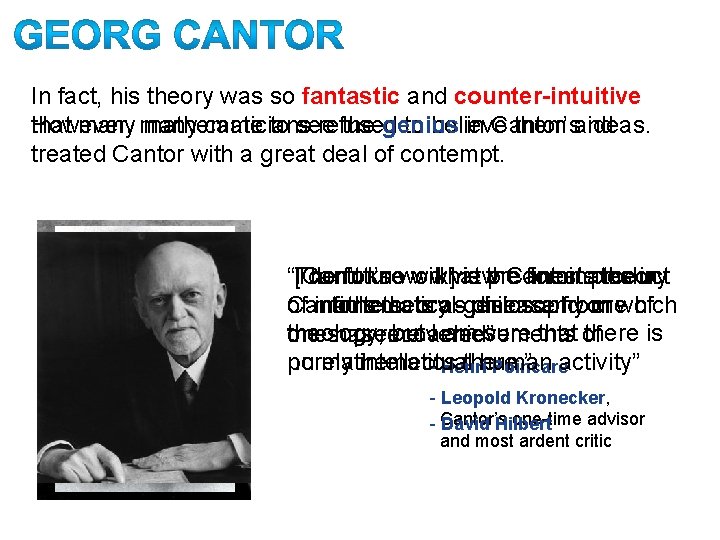
In fact, his theory was so fantastic and counter-intuitive that many mathematicians refused to believe them and However, came to see the genius in Cantor’s ideas. treated Cantor with a great deal of contempt. “I don’t know what predominates in “The future will view Cantor’s theory “[Cantor’s work] is the finest product Cantor's theory philosophy or which of infinite sets as-genius disease from mathematical and one of theology, but achievements I am sure that of there is one has recovered” the supreme no mathematics there. ” purely intellectual human - Henri Poincareactivity” - Leopold Kronecker, one-time advisor - Cantor’s David Hilbert aand most ardent critic
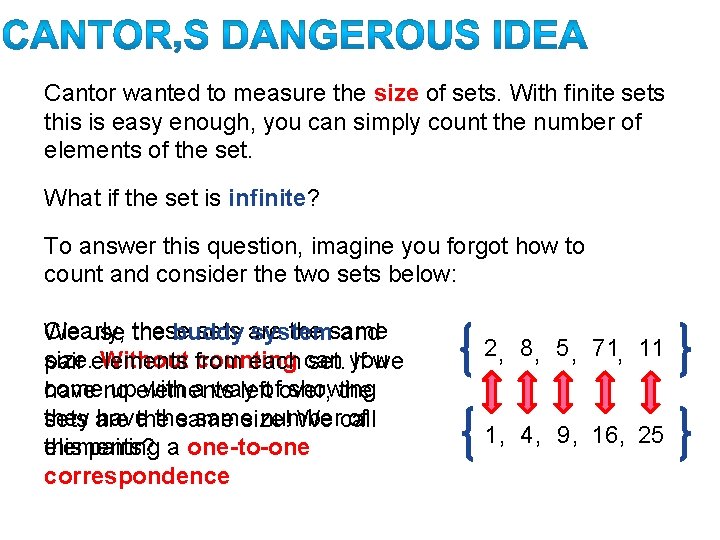
Cantor wanted to measure the size of sets. With finite sets this is easy enough, you can simply count the number of elements of the set. What if the set is infinite? To answer this question, imagine you forgot how to count and consider the two sets below: Clearly, sets are the same We use the buddy system and size. elements Without from counting pair each can set. you If we comeno upelements with a way showing have leftofover, they are have the same number of sets the same size! We call elements? this pairing a one-to-one correspondence 2, 8, 5 , 71, 11 1 , 4 , 9 , 16 , 25
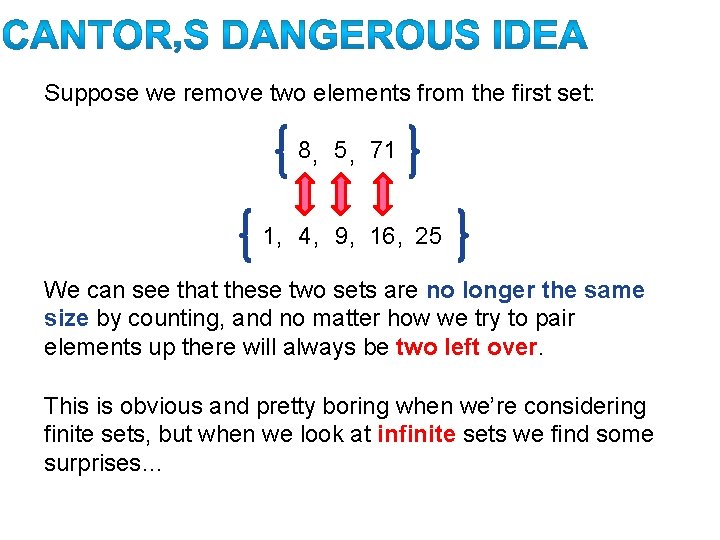
Suppose we remove two elements from the first set: 8, 5 , 71 1 , 4 , 9 , 16 , 25 We can see that these two sets are no longer the same size by counting, and no matter how we try to pair elements up there will always be two left over. This is obvious and pretty boring when we’re considering finite sets, but when we look at infinite sets we find some surprises…
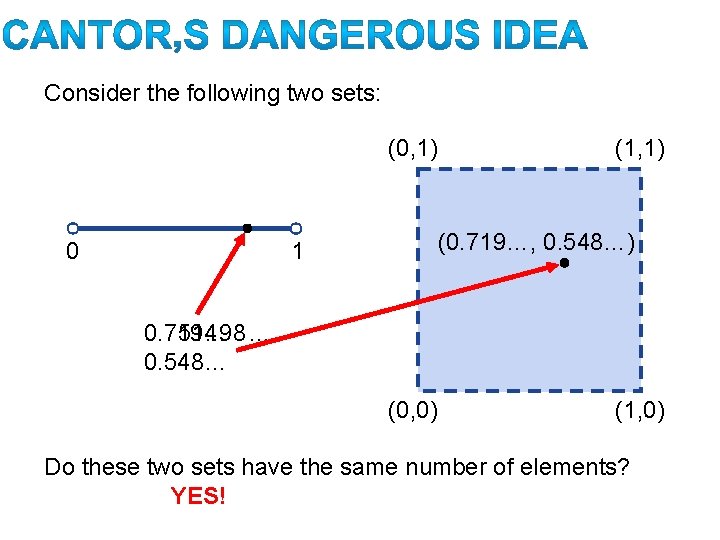
Consider the following two sets: (0, 1) 0 (1, 1) (0. 719…, 0. 548…) 1 … 0. 7 514 98… 0. 719… 0. 548… (0, 0) (1, 0) Do these two sets have the same number of elements? YES!
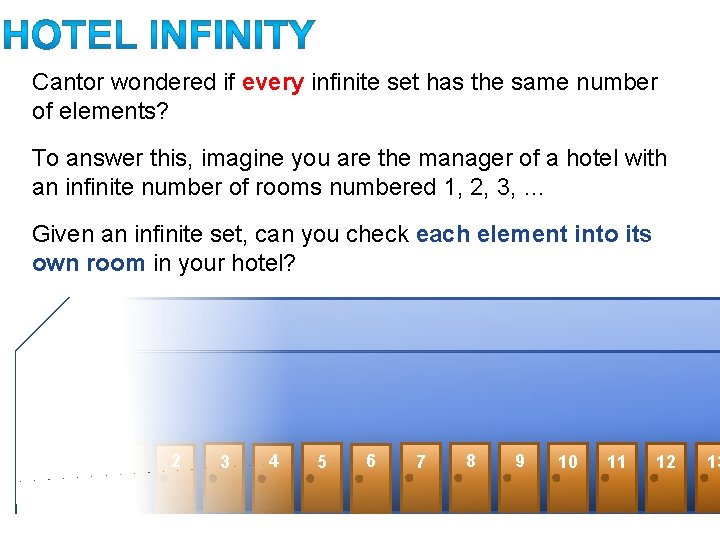
Cantor wondered if every infinite set has the same number of elements? To answer this, imagine you are the manager of a hotel with an infinite number of rooms numbered 1, 2, 3, … Given an infinite set, can you check each element into its own room in your hotel? 1 2 3 4 5 6 7 8 9 10 11 12 13
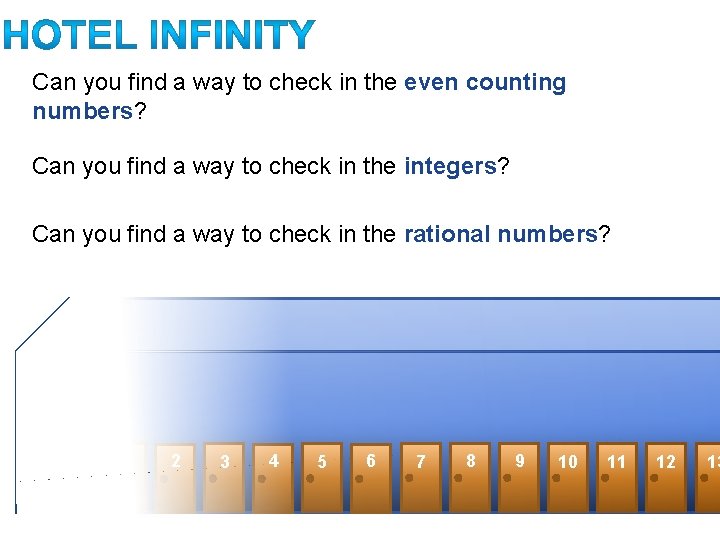
Can you find a way to check in the even counting numbers? Can you find a way to check in the integers? Can you find a way to check in the rational numbers? 1 2 3 4 5 6 7 8 9 10 11 12 13
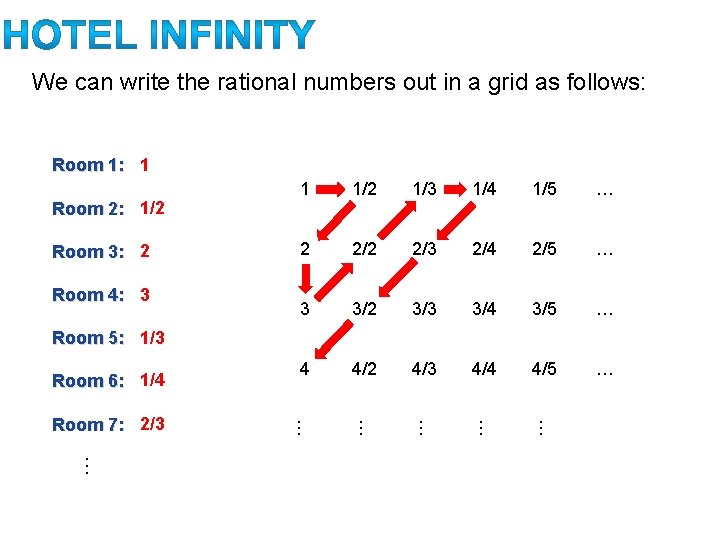
We can write the rational numbers out in a grid as follows: Room 1: 1 Room 2: 1/2 Room 3: 2 Room 4: 3 1 1/2 1/3 1/4 1/5 … 2 2/3 2/4 2/5 … 3 3/2 3/3 3/4 3/5 … 4 4/2 4/3 4/4 4/5 … … Room 7: 2/3 … Room 6: 1/4 … Room 5: 1/3 …
This means that the set of even counting numbers, integers, and rational numbers all have the SAME number of elements! But we still haven’t answered our question of whether or not every infinite set has the same number of elements. It turns out that this is not the case! The set of real numbers cannot be checked into our infinite hotel.
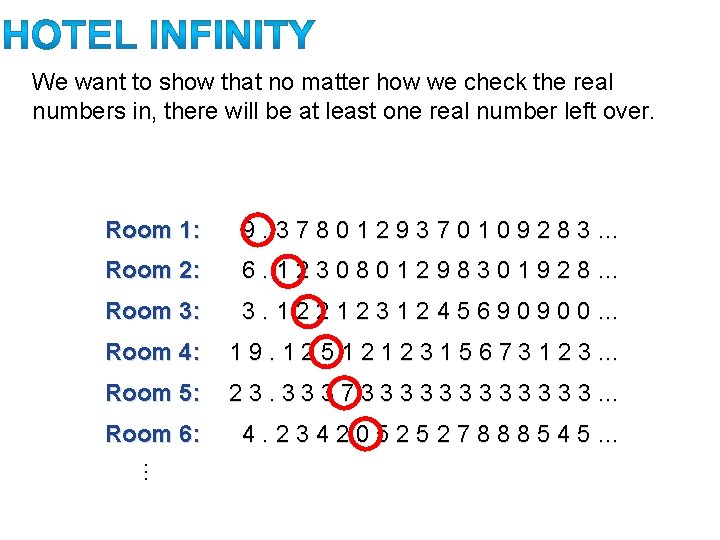
We want to show that no matter how we check the real numbers in, there will be at least one real number left over. 8. 01461… Room 1: 9. 3780129370109283… Room 2: 6. 1230801298301928… Room 3: 3. 1221231245690900… Room 4: 19. 1251212315673123… Room 5: 23. 3337333333… Room 6: 4. 2342052527888545… …
How many more irrational numbers are there than rationals? If you were to randomly choose a real number the probability that it is rational is 0! The probability that it is irrational is 1!
- Slides: 16