
A Servicebased Model for Customer Intelligence in the
A Service-based Model for Customer Intelligence in the Age of Big Data Nguyen Anh Khoa Dam Thang Le Dinh William Menvielle
Outline • Introduction • Theoretical Backgrounds • Service-based Customer Intelligence Model • Conclusion and Future Work 2
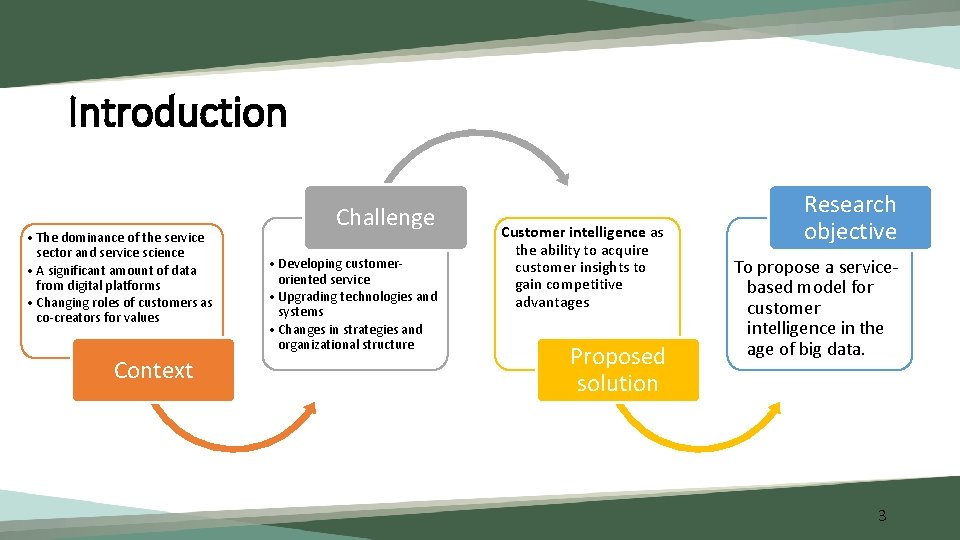
Introduction • The dominance of the service sector and service science • A significant amount of data from digital platforms • Changing roles of customers as co-creators for values Context Challenge • Developing customeroriented service • Upgrading technologies and systems • Changes in strategies and organizational structure Customer intelligence as the ability to acquire customer insights to gain competitive advantages Proposed solution Research objective To propose a servicebased model for customer intelligence in the age of big data. 3
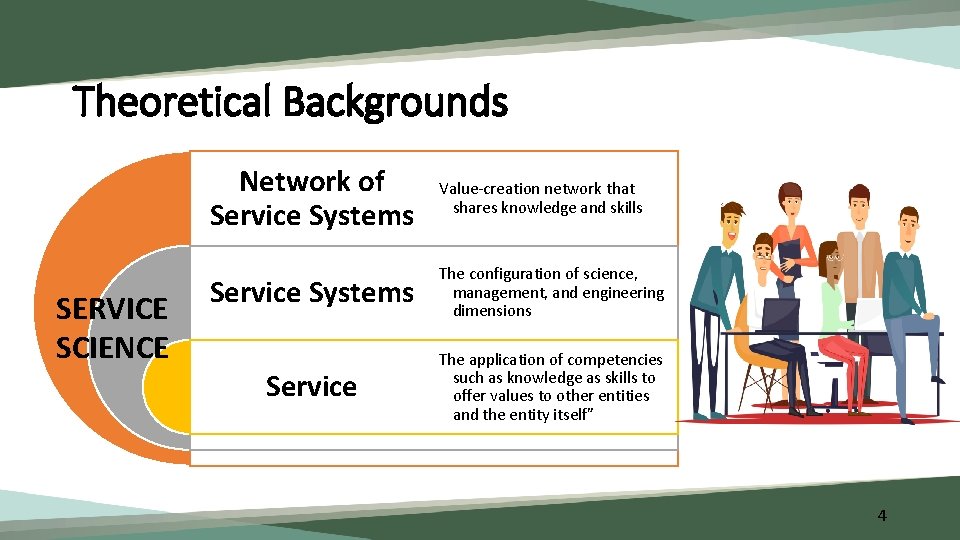
Theoretical Backgrounds SERVICE SCIENCE Network of Service Systems Value-creation network that shares knowledge and skills Service Systems The configuration of science, management, and engineering dimensions Service The application of competencies such as knowledge as skills to offer values to other entities and the entity itself” 4
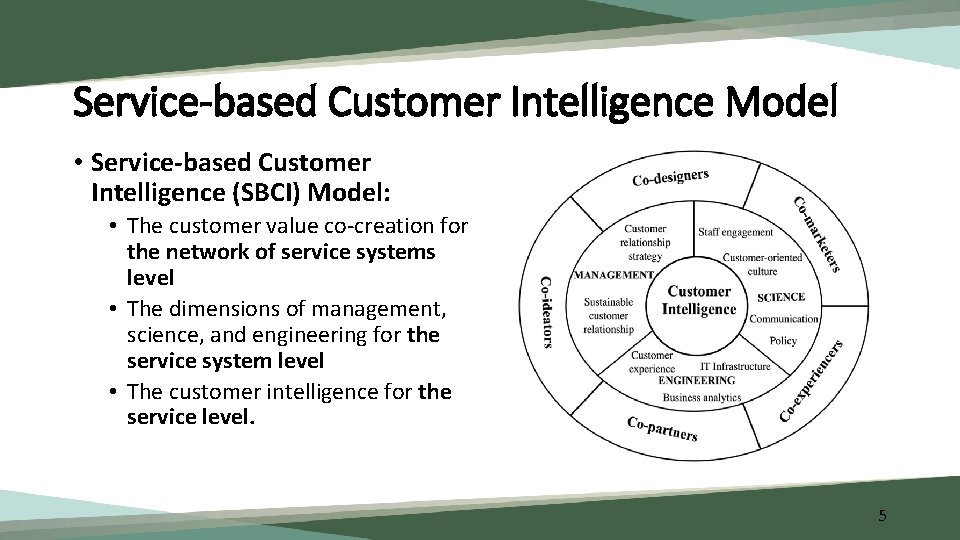
Service-based Customer Intelligence Model • Service-based Customer Intelligence (SBCI) Model: • The customer value co-creation for the network of service systems level • The dimensions of management, science, and engineering for the service system level • The customer intelligence for the service level. 5
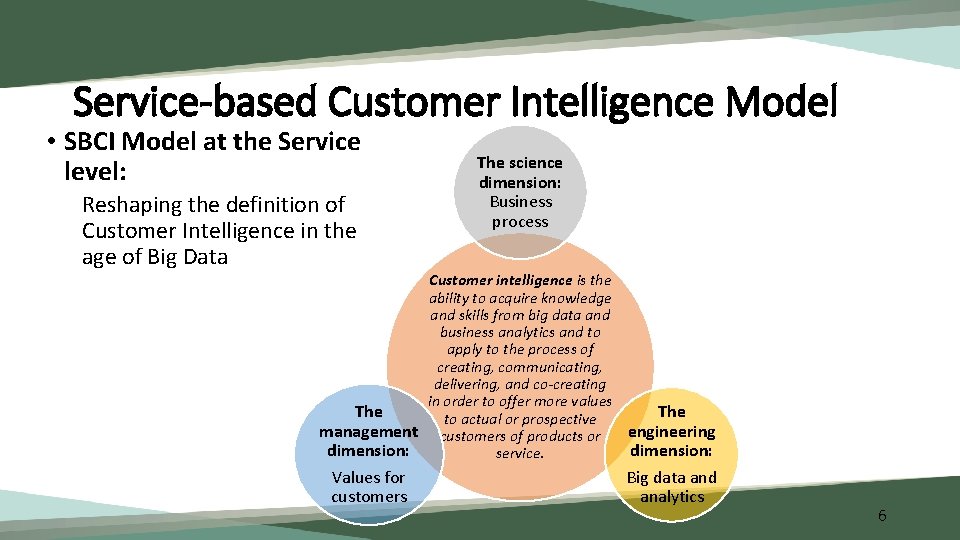
Service-based Customer Intelligence Model • SBCI Model at the Service level: Reshaping the definition of Customer Intelligence in the age of Big Data The science dimension: Business process Customer intelligence is the ability to acquire knowledge and skills from big data and business analytics and to apply to the process of creating, communicating, delivering, and co-creating in order to offer more values The to actual or prospective management customers of products or engineering dimension: service. Values for customers Big data and analytics 6
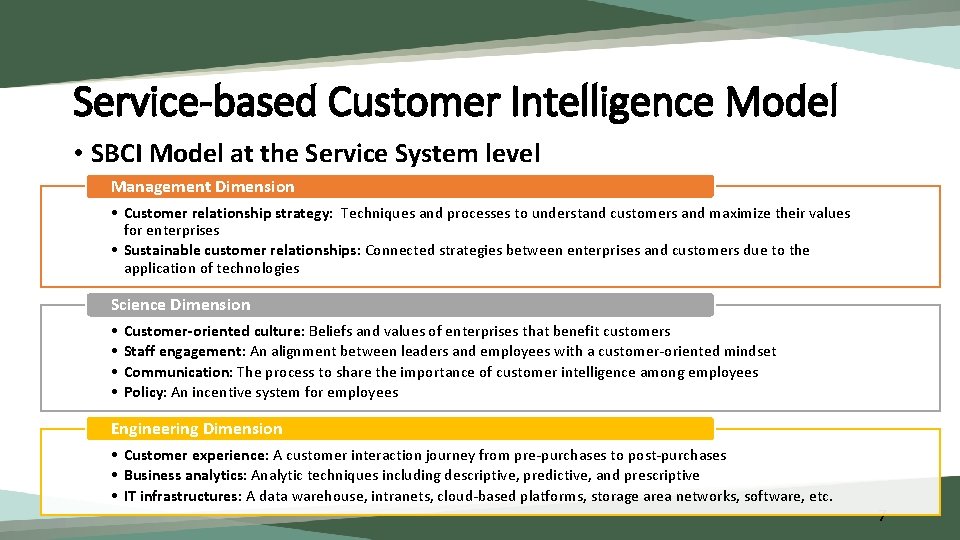
Service-based Customer Intelligence Model • SBCI Model at the Service System level Management Dimension • Customer relationship strategy: Techniques and processes to understand customers and maximize their values for enterprises • Sustainable customer relationships: Connected strategies between enterprises and customers due to the application of technologies Science Dimension • • Customer-oriented culture: Beliefs and values of enterprises that benefit customers Staff engagement: An alignment between leaders and employees with a customer-oriented mindset Communication: The process to share the importance of customer intelligence among employees Policy: An incentive system for employees Engineering Dimension • Customer experience: A customer interaction journey from pre-purchases to post-purchases • Business analytics: Analytic techniques including descriptive, predictive, and prescriptive • IT infrastructures: A data warehouse, intranets, cloud-based platforms, storage area networks, software, etc. 7
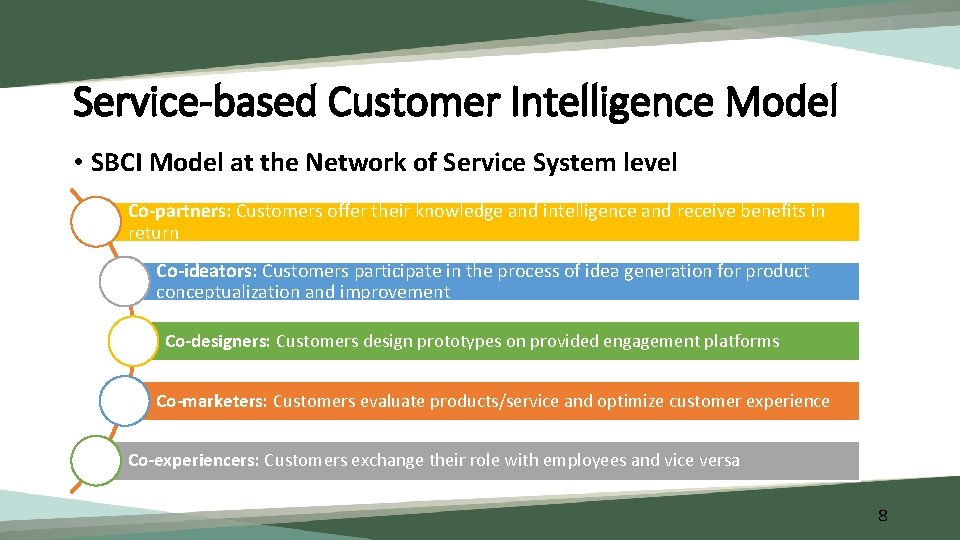
Service-based Customer Intelligence Model • SBCI Model at the Network of Service System level Co-partners: Customers offer their knowledge and intelligence and receive benefits in return Co-ideators: Customers participate in the process of idea generation for product conceptualization and improvement Co-designers: Customers design prototypes on provided engagement platforms Co-marketers: Customers evaluate products/service and optimize customer experience Co-experiencers: Customers exchange their role with employees and vice versa 8
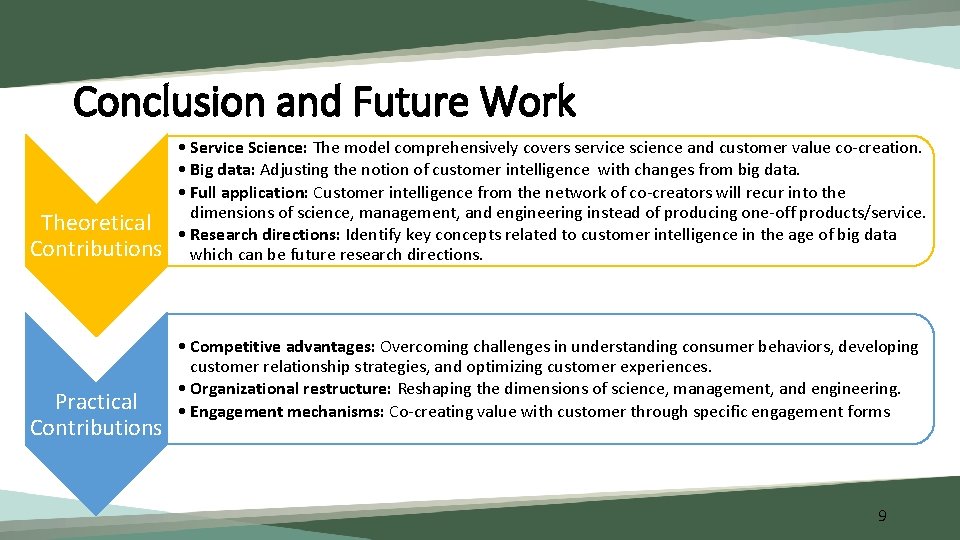
Conclusion and Future Work Theoretical Contributions Practical Contributions • Service Science: The model comprehensively covers service science and customer value co-creation. • Big data: Adjusting the notion of customer intelligence with changes from big data. • Full application: Customer intelligence from the network of co-creators will recur into the dimensions of science, management, and engineering instead of producing one-off products/service. • Research directions: Identify key concepts related to customer intelligence in the age of big data which can be future research directions. • Competitive advantages: Overcoming challenges in understanding consumer behaviors, developing customer relationship strategies, and optimizing customer experiences. • Organizational restructure: Reshaping the dimensions of science, management, and engineering. • Engagement mechanisms: Co-creating value with customer through specific engagement forms 9
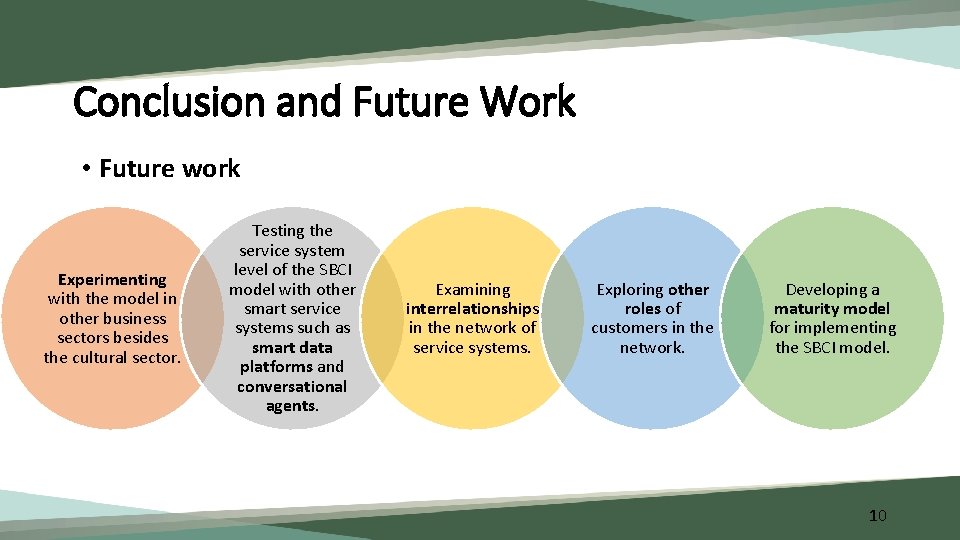
Conclusion and Future Work • Future work Experimenting with the model in other business sectors besides the cultural sector. Testing the service system level of the SBCI model with other smart service systems such as smart data platforms and conversational agents. Examining interrelationships in the network of service systems. Exploring other roles of customers in the network. Developing a maturity model for implementing the SBCI model. 10
Reference Anshari, M. , Almunawar, M. N. , Lim, S. A. , and Al-Mudimigh, A. 2019. "Customer Relationship Management and Big Data Enabled: Personalization & Customization of Services, " Applied Computing and Informatics: 94), p. 101. Burrell, L. 2018. "Co-Creating the Employee Experience, " Harvard Business Review). Chen, H. , Chiang, R. H. L. , and Storey, V. C. 2012. "Business Intelligence and Analytics: From Big Data to Big Impact, " MIS Quarterly (36), pp. 1165 -1188. France, S. L. , and Ghose, S. 2019. "Marketing Analytics: Methods, Practice, Implementation, and Links to Other Fields, " Expert Systems with Applications (119), pp. 456475. Frow, P. , Nenonen, S. , Payne, A. , and Storbacka, K. 2015. "Managing Co‐Creation Design: A Strategic Approach to Innovation, " British Journal of Management (26: 3), pp. 463 -483. Libert, B. , Wind, Y. J. , and Beck, M. 2015. "What Apple, Lending Club, and Airbnb Know About Collaborating with Customers, " Havard Business Review). Nambisan, S. 2010. "Virtual Customer Environments: It-Enabled Customer Co-Innovation and Value Co-Creation, " in Information Technology and Product Development. Springer, pp. 109 -127. Ramaswamy, V. , and Ozcan, K. 2018. "What Is Co-Creation? An Interactional Creation Framework and Its Implications for Value Creation, " Journal of Business Research (84), pp. 196 -205. Ramaswamy, V. , and Ozcan, K. 2019. "Digitalized Interactive Platforms: Turning Goods and Services into Retail Co-Creation Experiences, " NIM Marketing Intelligence Review (11: 1), pp. 18 -23. Rawson, A. , Duncan, E. , and Jones, C. 2013. "The Truth About Customer Experience, " Harvard Business Review). Russo-Spena, T. , and Mele, C. 2012. "“Five Co-S” in Innovating: A Practice-Based View, " Journal of Service Management (23: 4), pp. 527 -553. Siggelkow, N. , and Terwiesch, C. 2019. "The Age of Continuous Connection, " Harvard Business Review). Tabrizi, B. , Lam, E. , Girard, K. , and Irvin, V. 2019. "Digital Transformation Is Not About Technology, " Harvard Business Review). Wamba, S. F. , Gunasekaran, A. , Akter, S. , Ren, S. J. -f. , Dubey, R. , and Childe, S. 2017. "Big Data Analytics and Firm Performance: Effects of Dynamic Capabilities, " Journal of Business Research (70), pp. 356 -365. Yohn, D. L. 2018. "6 Ways to Build a Customer-Centric Culture, " Havard Business Review). Zhang, J. Z. , Watson IV, G. F. , and Palmatier, R. W. 2018. "Customer Relationships Evolve-So Must Your Crm Strategy, " MIT Sloan Management Review (59: 3), pp. 1 -7. 11
- Slides: 11