
A Sentence Interaction Network for Modeling Dependence between
A Sentence Interaction Network for Modeling Dependence between Sentences Aiting LIU
Abstract • prior studies : paid less attention on interactions between sentences. • In this work : propose a Sentence Interaction Network (SIN) for modeling the complex interactions between two sentences.
Introduction • influence : each word in one sentence may potentially influence every word in another sentence in some degree. • information flows : real-valued vectors describing how words and phrases interact with each other. given two sentences s 1 and s 2, for every word xt in s 1, for every word xτ in s 2 • Example : • candidate interaction state : the “influence” of xτ to xt ; the “information flow” from xτ to xt. • interaction state for xt : summing over all the “candidate interaction states”, represents the influence of the whole sentence s 2 to word xt. • When feeding the “interaction state” and the word embedding together into Recurrent Neural Network (with Long Short-Time Memory unit in our model), we obtain a sentence vector with context information encoded. We also add a convolution layer on the word embeddings so that interactions between phrases can also be modeled.
Related Work (1) • Sentence modeling: first represent each word as a realvalued vector (Mikolov et al. , 2010; Pennington et al. , 2014) , and then compose word vectors into a sentence vector. • Recurrent Neural Network (RNN) (Elman, 1990; Mikolov et al. , 2010) introduces a hidden state to represent contexts, and repeatedly feed the hidden state and word embeddings to the network to update the context representation. RNN suffers from gradient vanishing and exploding problems which limit the length of reachable context.
Related Work (2) • RNN with Long Short-Time Memory Network unit (LSTM) (Hochreiter and Schmidhuber, 1997; Gers, 2001) solves such problems by introducing a “memory cell” and “gates” into the network. • Recursive Neural Network (Socher et al. , 2013; Qian et al. , 2015) and LSTM over tree structures (Zhu et al. , 2015; Tai et al. , 2015) are able to utilize some syntactic information for sentence modeling. • Kim (2014) proposed a Convolutional Neural Network (CNN) for sentence classification which models a sentence in multiple granularities.
Related Work (3) • Sentence pair modeling : first project the sentences to two sentence vectors separately with sentence modeling methods, and then feed these two vectors into other classifiers for classification (Tai et al. , 2015; Yu et al. , 2014; Yang et al. , 2015). The drawback of such methods is that separately modeling the two sentences is unable to capture the complex sentence interactions.
Related Work (4) • Socher et al. (2011) model the two sentences with Recursive Neural Networks (Unfolding Recursive Autoencoders), and then feed similarity scores between words and phrases (syntax tree nodes) to a CNN with dynamic pooling to capture sentence interactions. • Hu et al. (2014) first create an “interaction space” (matching score matrix) by feeding word and phrase pairs into a multilayer perceptron (MLP), and then apply CNN to such a space for interaction modeling. • Yin et al. (2015) proposed an Attention based Convolutional Neural Network (ABCNN) for sentence pair modeling. ABCNN introduces an attention matrix between the convolution layers of the two sentences, and feed the matrix back to CNN to model sentence interactions. • There also some methods that make use of rich lexical semantic features for sentence pair modeling (Yih et al. , 2013; Yang et al. , 2015), but these methods can not be easily adapted to different tasks.
Related Work (5) • context modeling : • Hermann et al. (2015) proposed a LSTM-based method for reading comprehension. Their model is able to effectively utilize the context (given by a document) to answer questions. • Ghosh et al. (2016) proposed a Contextual LSTM (CLSTM) which introduces a topic vector into LSTM for context modeling. The topic vector in CLSTM is computed according to those already seen words, and therefore reflects the underlying topic of the current word.
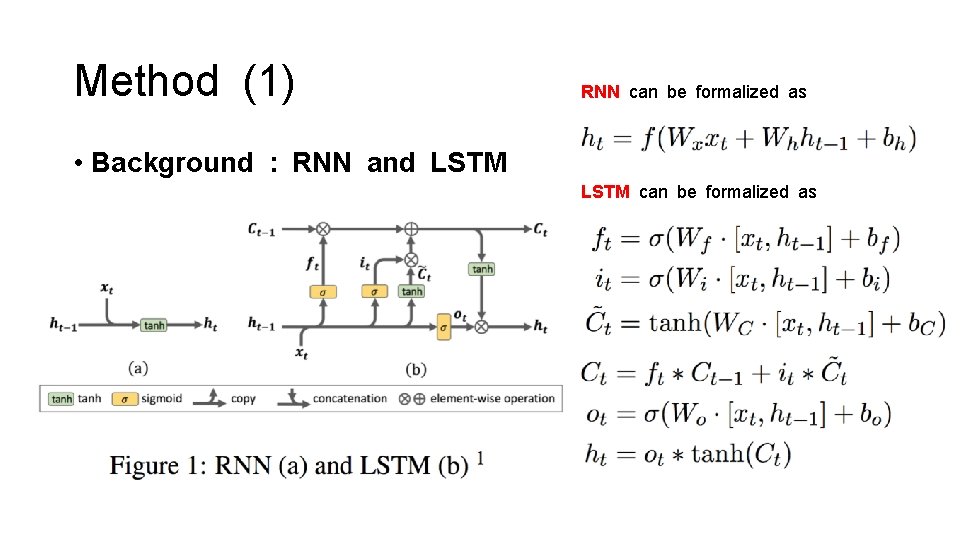
Method (1) RNN can be formalized as • Background : RNN and LSTM can be formalized as
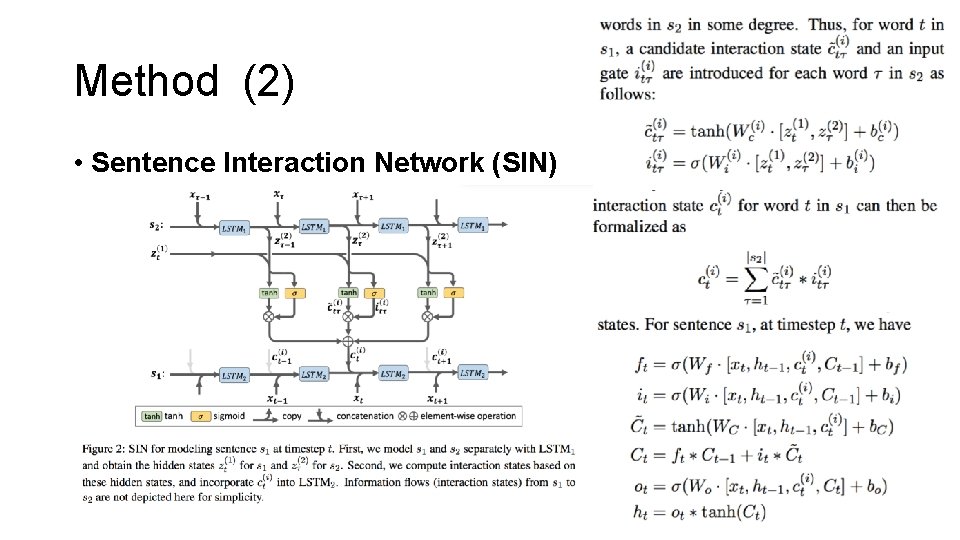
Method (2) • Sentence Interaction Network (SIN)
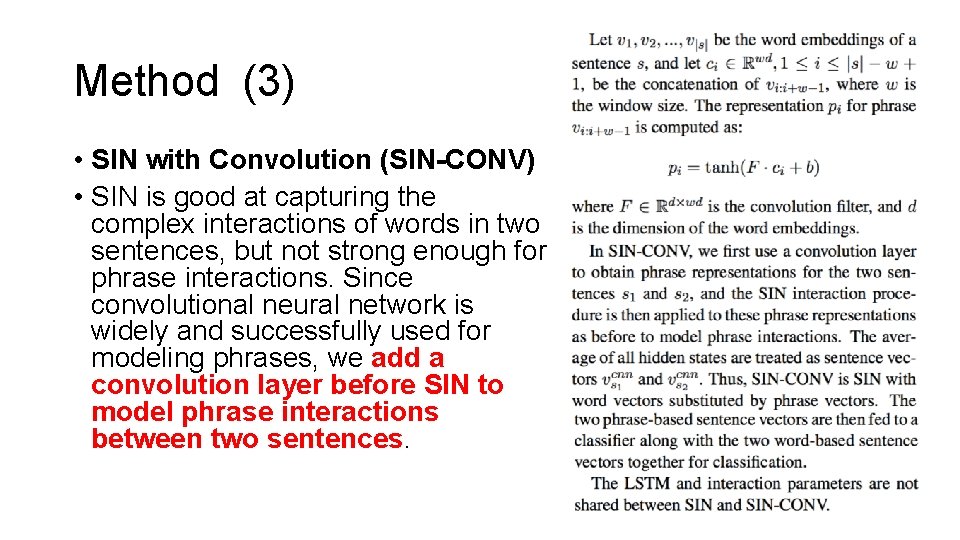
Method (3) • SIN with Convolution (SIN-CONV) • SIN is good at capturing the complex interactions of words in two sentences, but not strong enough for phrase interactions. Since convolutional neural network is widely and successfully used for modeling phrases, we add a convolution layer before SIN to model phrase interactions between two sentences.
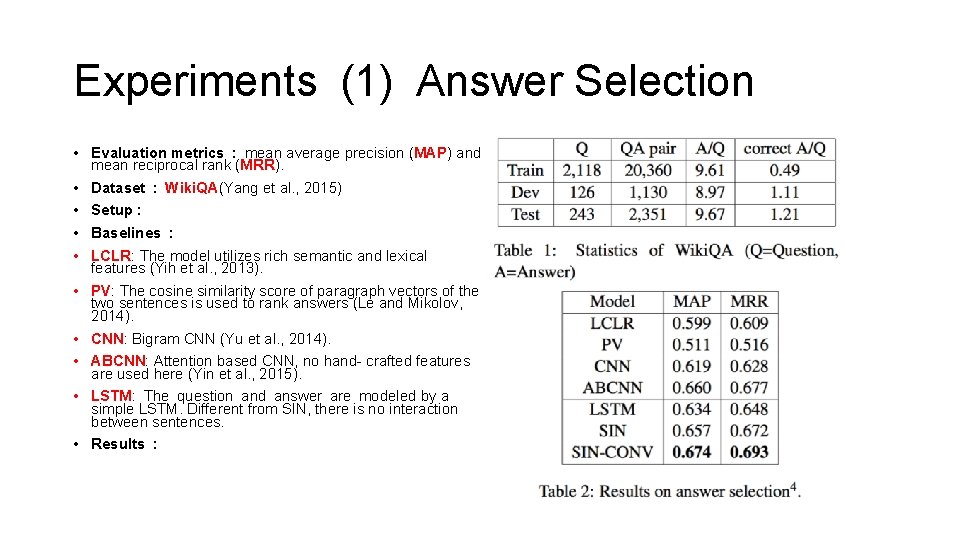
Experiments (1) Answer Selection • Evaluation metrics : mean average precision (MAP) and mean reciprocal rank (MRR). • Dataset : Wiki. QA(Yang et al. , 2015) • Setup : • Baselines : • LCLR: The model utilizes rich semantic and lexical features (Yih et al. , 2013). • PV: The cosine similarity score of paragraph vectors of the two sentences is used to rank answers (Le and Mikolov, 2014). • CNN: Bigram CNN (Yu et al. , 2014). • ABCNN: Attention based CNN, no hand- crafted features are used here (Yin et al. , 2015). • LSTM: The question and answer are modeled by a simple LSTM. Different from SIN, there is no interaction between sentences. • Results :
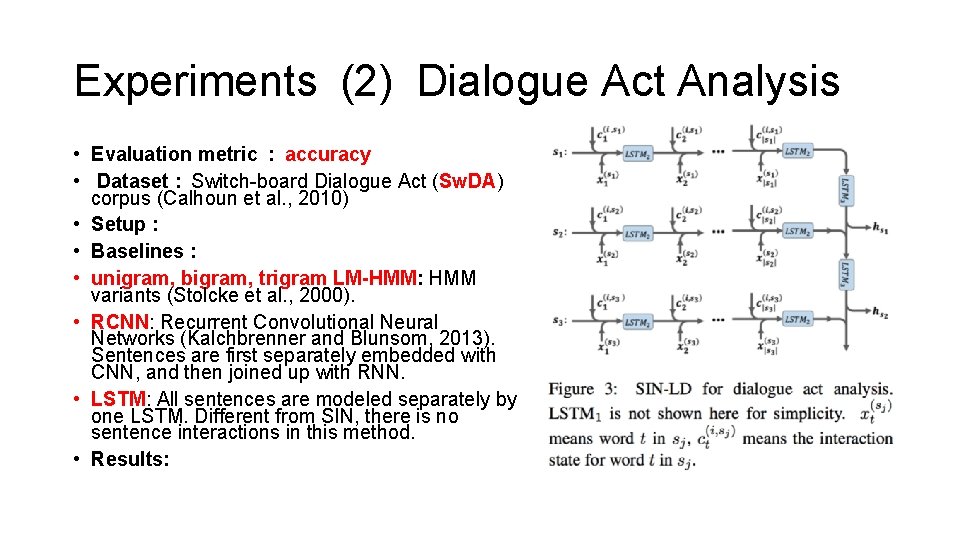
Experiments (2) Dialogue Act Analysis • Evaluation metric : accuracy • Dataset : Switch-board Dialogue Act (Sw. DA) corpus (Calhoun et al. , 2010) • Setup : • Baselines : • unigram, bigram, trigram LM-HMM: HMM variants (Stolcke et al. , 2000). • RCNN: Recurrent Convolutional Neural Networks (Kalchbrenner and Blunsom, 2013). Sentences are first separately embedded with CNN, and then joined up with RNN. • LSTM: All sentences are modeled separately by one LSTM. Different from SIN, there is no sentence interactions in this method. • Results:
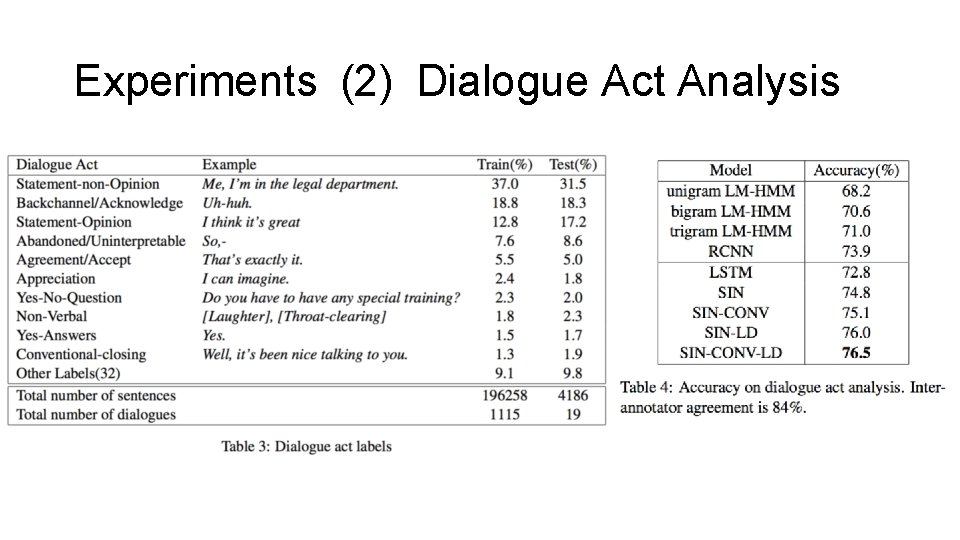
Experiments (2) Dialogue Act Analysis
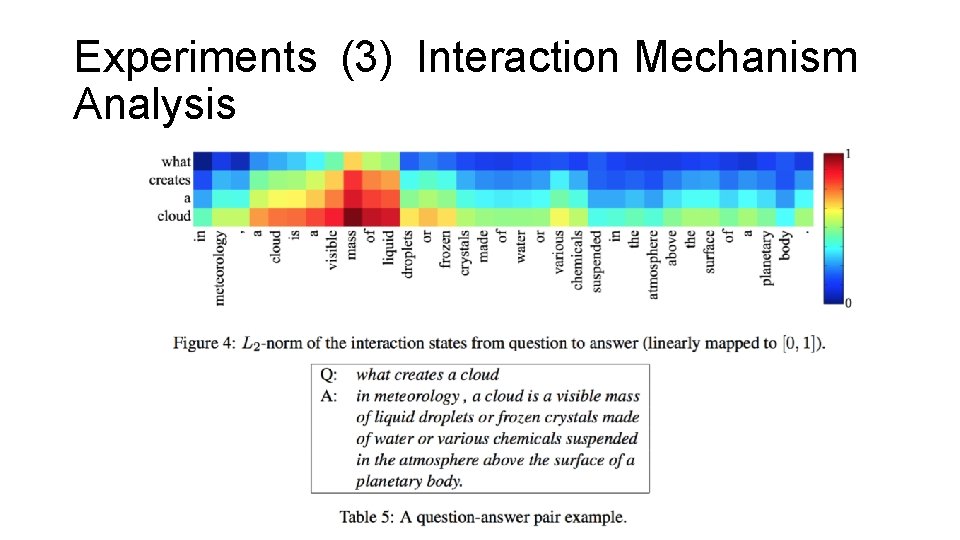
Experiments (3) Interaction Mechanism Analysis

THANKS
- Slides: 16