
A sensorimotor account of vision and visual consciousness

- Slides: 25
A sensorimotor account of vision and visual consciousness J. KEVIN O’REGAN AND ALVA NOË
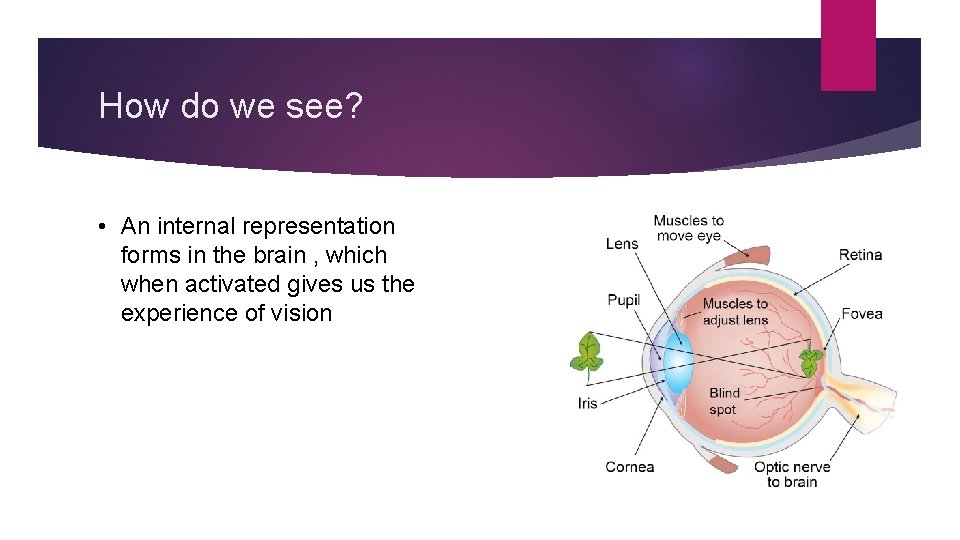
How do we see? • An internal representation forms in the brain , which when activated gives us the experience of vision
Questions about theory ? Origin of Experience ? Difference in felt quality ? Why and how do different neuro transmitters provide different experiences ? Is Muller’s concept of specific nerve energy satisfactory
Sensorimotor Contingency Theory Vision is considered as a mode of exploration of the world, that is mediated by knowledge which is the sensorimotor contingencies Experience of seeing = Mastering the laws of sensorimotor contingencies Sensorimotor Contingencies can be categorized : 1) Induced by Visual apparatus 2) Determined by Visual attributes
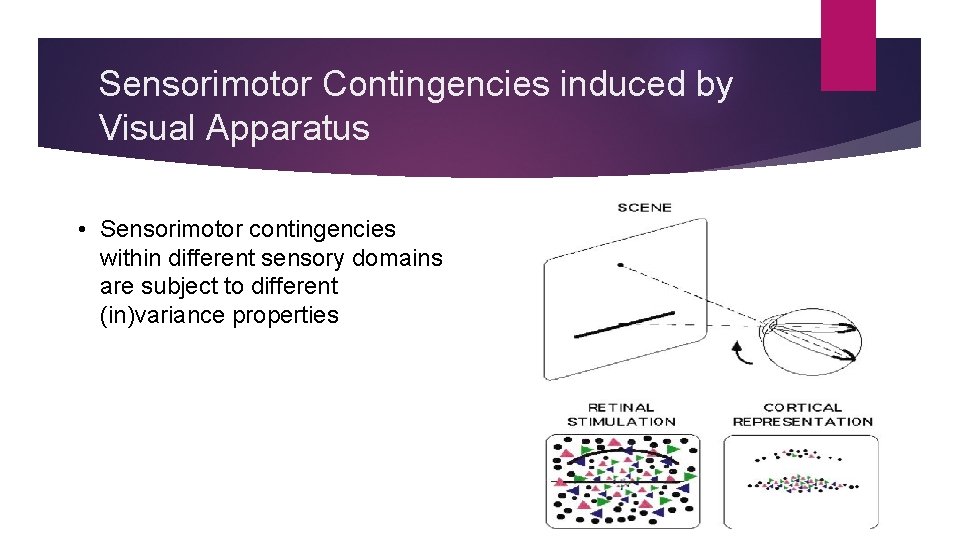
Sensorimotor Contingencies induced by Visual Apparatus • Sensorimotor contingencies within different sensory domains are subject to different (in)variance properties
Sensorimotor Contingencies determined by visual attributes Ways of sampling a 3 D object through visual exploration differs from the rest The idea suggested here is that “visual quality of shape is precisely the set of all potential distortions that the shape undergoes when it is moves relative to us, or when we move relative to it. ” Infinite set Laws can be extracted which describe the set
Sensation and Perception Psychologists have tried to distinguish between Sensation and Perception Sensation is the way senses are affected by stimuli Perception is the result of categorization of events and objects in the environment The two different classes of sensorimotor contingencies relate to the same
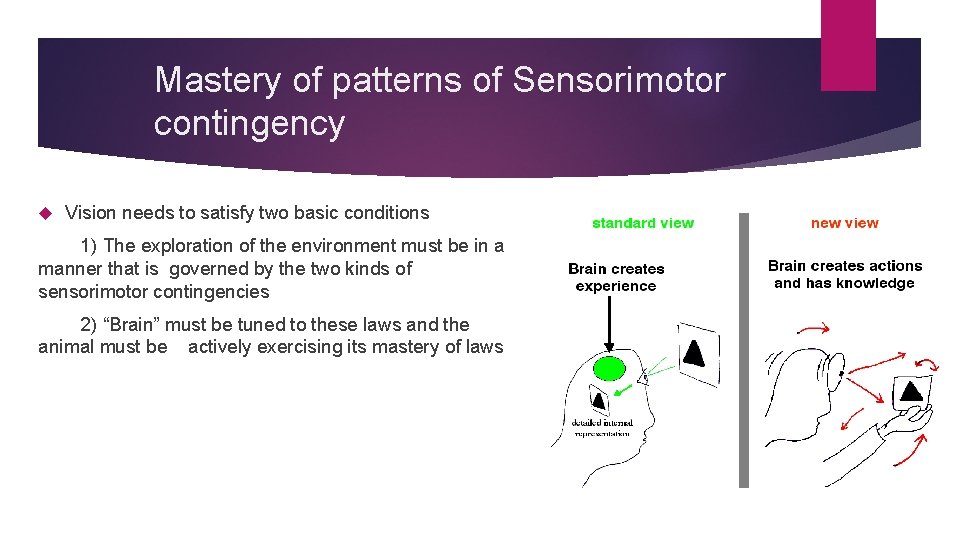
Mastery of patterns of Sensorimotor contingency Vision needs to satisfy two basic conditions 1) The exploration of the environment must be in a manner that is governed by the two kinds of sensorimotor contingencies 2) “Brain” must be tuned to these laws and the animal must be actively exercising its mastery of laws
Visual Awareness Exploring environment according to sensorimotor contingencies AND active exercise of mastery of the laws Integration of this mastery with thought or action-guidance The above actions put together constitutes seeing Matter of degree
Refinements of the view Vision requires knowledge of sensorimotor contingencies By knowledge , it means practical knowledge and not propositional knowledge Mastery of laws of sensorimotor contingencies must be exercised now
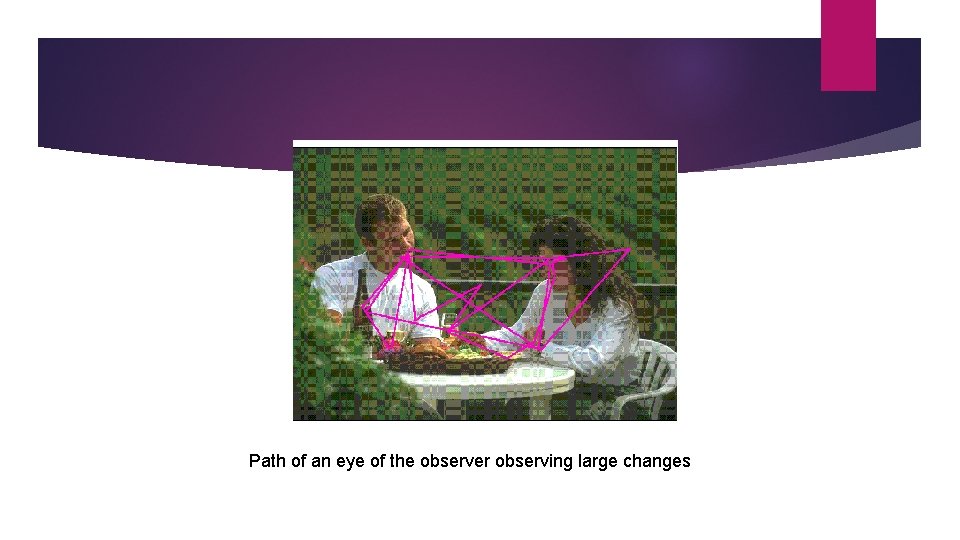
World as an outside memory According to the current theory visual experience does not arise due to an internal representation of the world activated in the areas of brain It is a mode of exploring activity involving practical knowledge of current possible behaviors and associated sensory consequences Seeing Everything How do we have the impression of continually seeing “everything” when only a small fragment of the world is actually seen? Ø You can potentially direct your attention to it Vividness through transients Ø Any change will grab the attention in no time
Path of an eye of the observer observing large changes
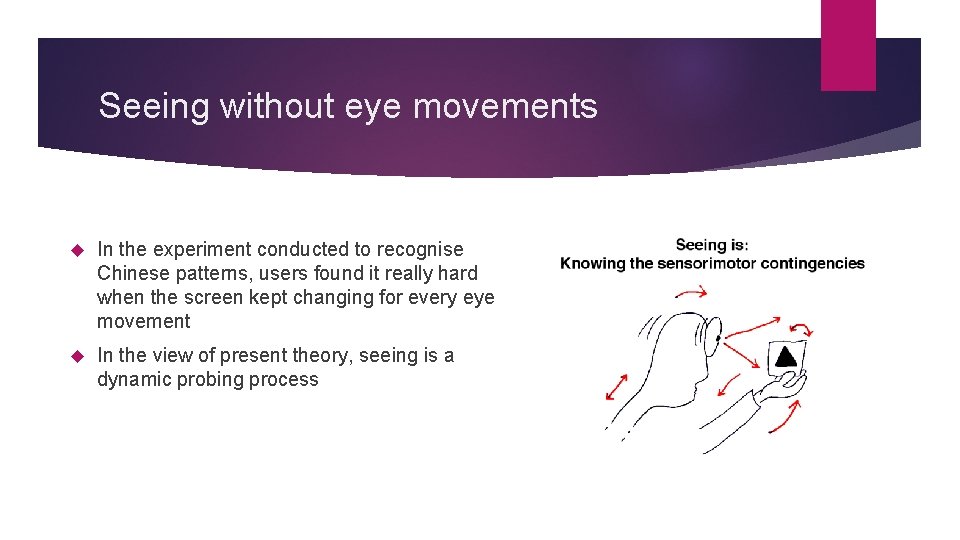
Seeing without eye movements In the experiment conducted to recognise Chinese patterns, users found it really hard when the screen kept changing for every eye movement In the view of present theory, seeing is a dynamic probing process
Objects behind us and partially occluded objects When objects are behind us or in a box , knowledge we have does not include certain visual aspects , say blinking or moving the eyes , will modify the sensations Seeing is not directly linked to having a retinal image , but to being able to manipulate the retinal image
Empirical Data Extra Retinal Signal Most experiments have the assumption about an internal representation, like a panoramic internal screen , into which successive snapshots of the world are inserted Data concur to show that extra retinal signal exists , but it is very inaccurate Trans- saccadic fusion Conclusion of this part is consistent with the present theory The problem of visual stability is not a problem Seeing does not require to compensate for the effects produced by eye shifts World as an outside memory
Empirical Data (contd…) Saccadic suppression Not a problem Filling in the blind spot Not a problem as well, it is just an extreme case of retinal non homogeneity, i. e. a sensorimotor contingency
Empirical Data (contd. . ) Inversion of the visual world Experiments conducted in which observer wears an apparatus that inverts the image. Explained naturally by the present theory Inattentional Amnesia Only when the observer attends to something will he or she be aware of seeing it
Empirical Data (Contd. . )
Empirical Data (contd…) In experience with TVSS it is only when the observer is allowed to move the camera the identification becomes possible and that he begins to “see” Visual experience could be obtained by other sensory channels when the brain extracts the same invariants in the structure of sensorimotor contingencies Fact that stimulus is provided by the skin is irrelevant, provided that the stimulation obeys the sensorimotor laws
Empirical Data (contd. . ) Remote Tactile sensing Facial vision of the blind
Visual Consciousness Can be categorised into two: 1) Transitive visual Consciousness 2) Visual Consciousness in general
Qualia and Explanatory Gap Qualia is an illusion Qualia doesn’t exist : difference in the qualitative character of perceptual experience correspond to the difference in the character of relevant sensorimotor contingencies There is no explanatory gap at all
Visual Neuroscience Neural activity by itself does not produce experience Contributes to experience as enabling mastery and exercise of the laws of sensory motor contingencies Role of brain in vision and consciousness Brain as an element in a system , and not a seat of vision and consciousness by itself
Conclusion A new framework for vision and visual consciousness Vision as an exploratory activity mediated by knowledge Visual consciousness is not a special kind of brain state. It is something we do
THANK YOU DISCUSSION TIME …. . !