
A SEMIAUTOMATED COMBINATION OF CHIRPEDPULSE AND CAVITY FOURIER
A SEMI-AUTOMATED COMBINATION OF CHIRPED-PULSE AND CAVITY FOURIER TRANSFORM MICROWAVE SPECTROSCOPY Kyle N. Crabtree, Department of Chemistry, The University of California, Davis Marie-Aline Martin-Drumel and Michael C. Mc. Carthy, Harvard-Smithsonian Center for Astrophysics Sydney A. Gaster, Taylor M. Hall, Deondre L. Parks, and Gordon G. Brown, Coker College
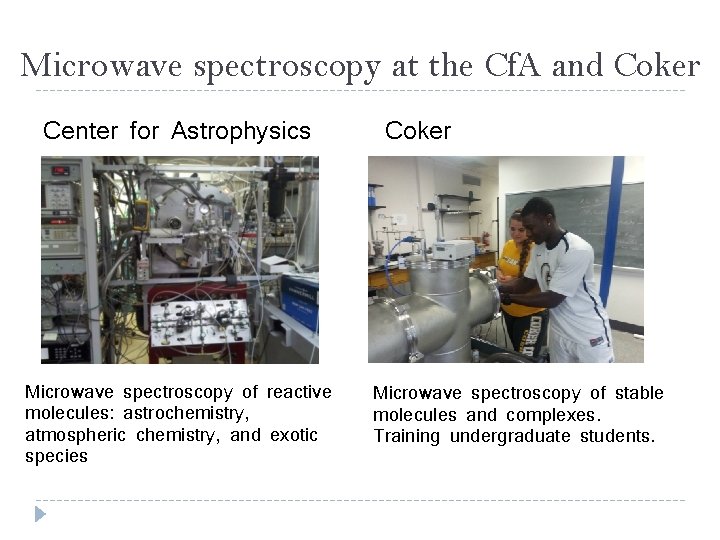
Microwave spectroscopy at the Cf. A and Coker Center for Astrophysics Microwave spectroscopy of reactive molecules: astrochemistry, atmospheric chemistry, and exotic species Coker Microwave spectroscopy of stable molecules and complexes. Training undergraduate students.
Analysis and Assignment of Microwave Spectra At research institutions: a “bottleneck” in experimental process At teaching institutions: a challenge for undergraduate students Two approaches to simplify analysis and assignment: Computational Autofit – Steve Shipman (NCF) and Brooks Pate (UVA) Evolutionary Algorithm – Leo Meerts (Radboud University) Experimental Semi-automated Combination of CP-FTMW and c-FTMW spectroscopies (this talk)
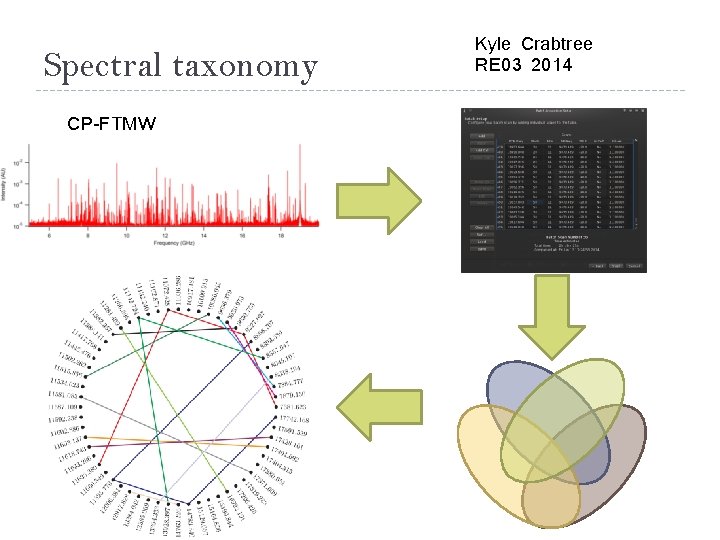
Spectral taxonomy CP-FTMW Kyle Crabtree RE 03 2014
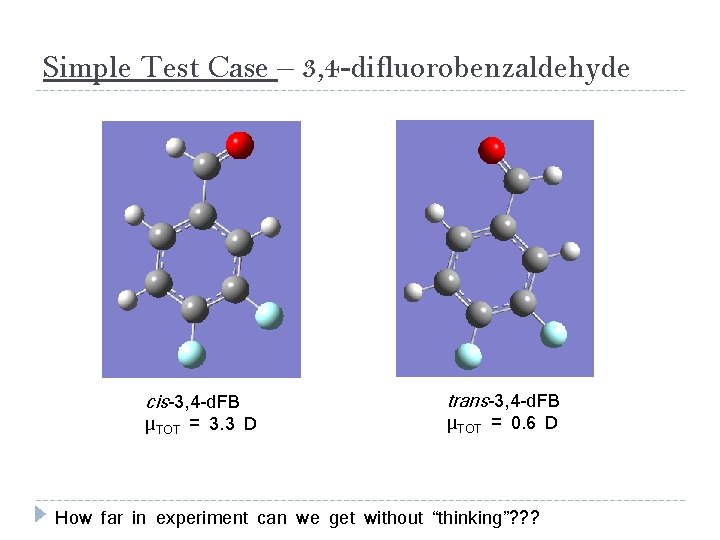
Simple Test Case – 3, 4 -difluorobenzaldehyde cis-3, 4 -d. FB μTOT = 3. 3 D trans-3, 4 -d. FB μTOT = 0. 6 D How far in experiment can we get without “thinking”? ? ?
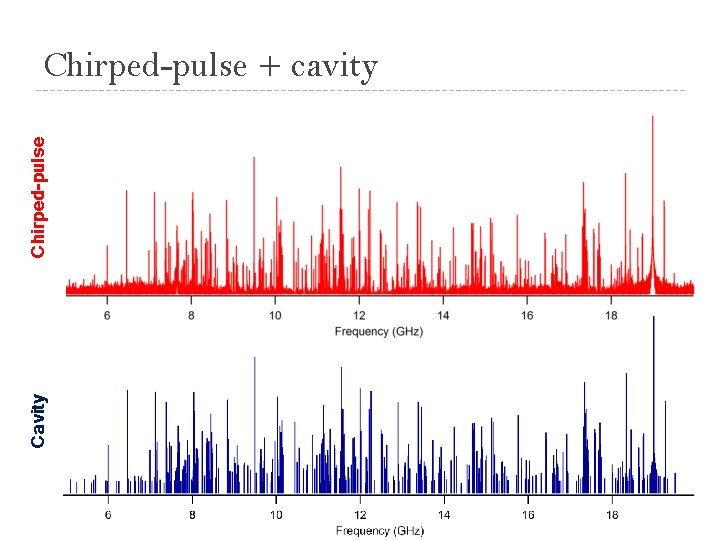
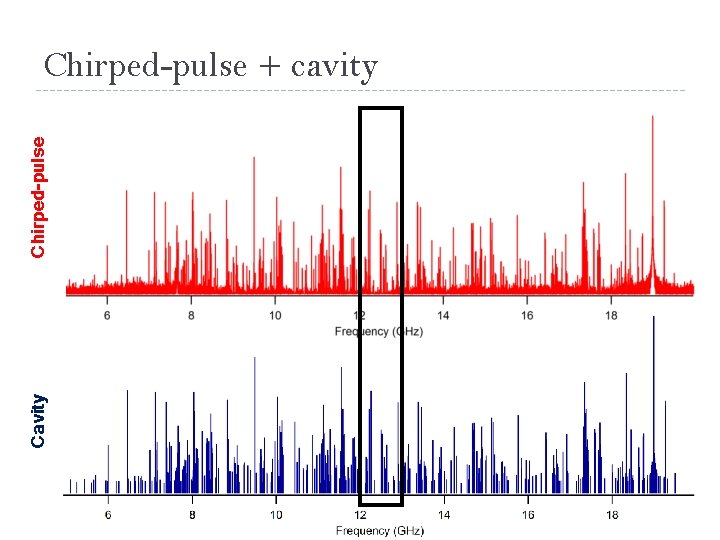
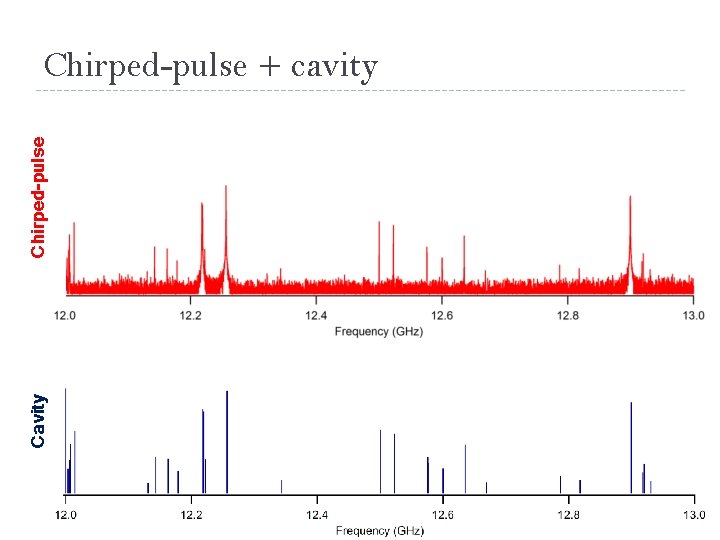
Semi-Automated Combination of Cavity and CP -FTMW Spectroscopy Measure CP-FTMW spectrum (8 – 18 GHz) Deep averaging (> 1 M shots) Use cavity-FTMW spectroscopy to aid analysis Check lines at various attenuations High-resolution measurement Information regarding dipole moment of conformer Double-resonance experiments Discover connectivity of transitions Aid in assignment of quantum numbers
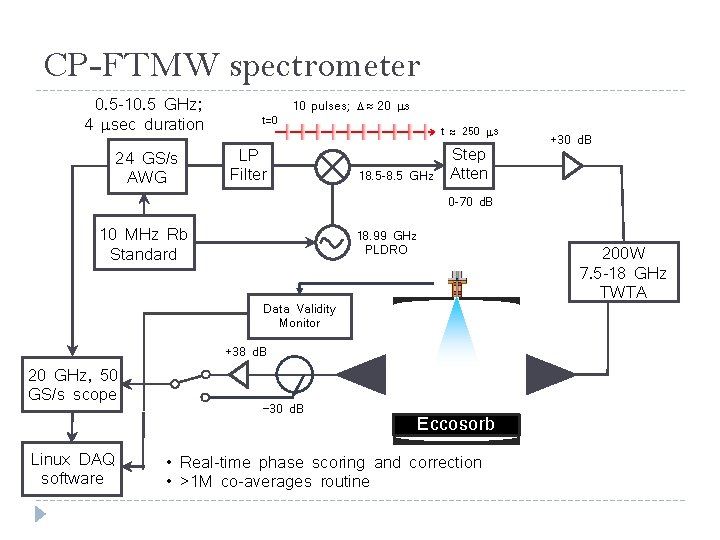
CP-FTMW spectrometer 0. 5 -10. 5 GHz; 4 msec duration 24 GS/s AWG t=0 10 pulses; D 20 ms LP Filter t 250 ms 18. 5 -8. 5 GHz Step Atten +30 d. B 0 -70 d. B 10 MHz Rb Standard 18. 99 GHz PLDRO Data Validity Monitor 20 GHz, 50 GS/s scope Linux DAQ software +38 d. B − 30 d. B Eccosorb • Real-time phase scoring and correction • >1 M co-averages routine 200 W 7. 5 -18 GHz TWTA
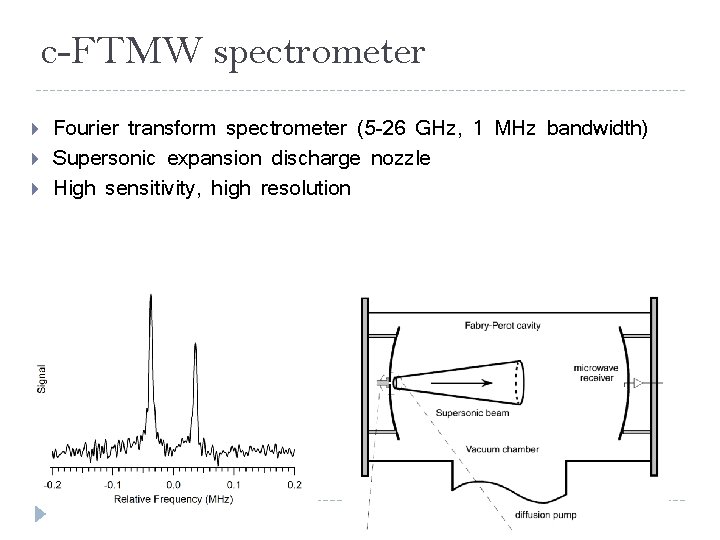
c-FTMW spectrometer Fourier transform spectrometer (5 -26 GHz, 1 MHz bandwidth) Supersonic expansion discharge nozzle High sensitivity, high resolution
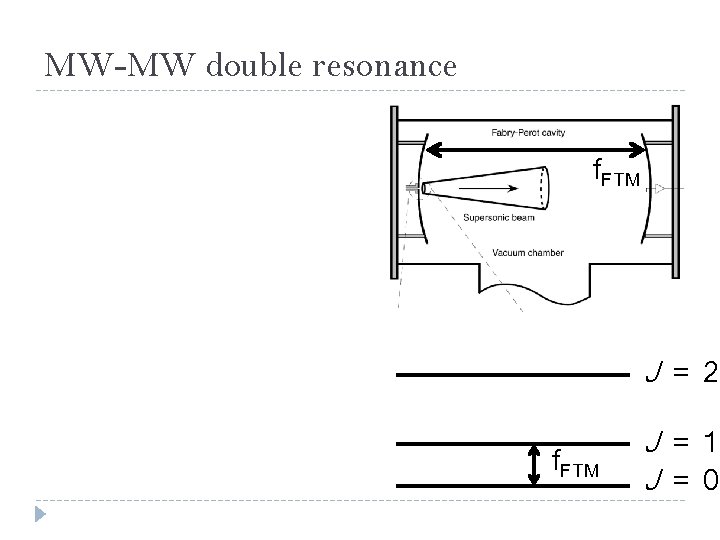
MW-MW double resonance f. FTM J = 2 f. FTM J = 1 J = 0
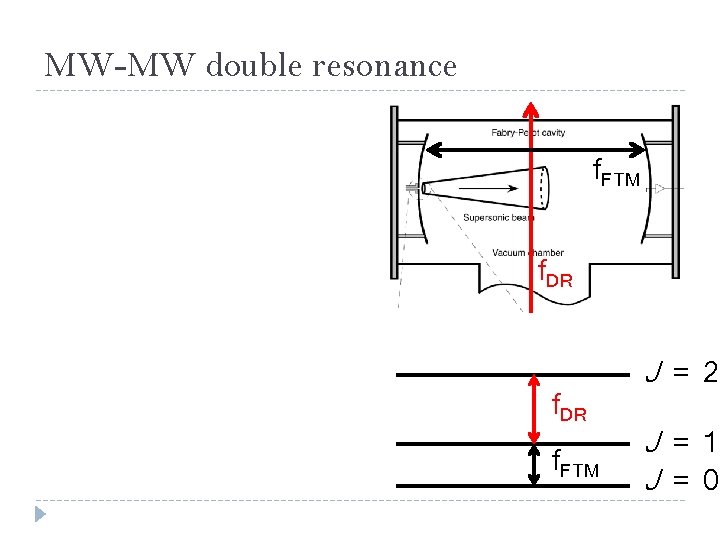
MW-MW double resonance f. FTM f. DR f. FTM J = 2 J = 1 J = 0
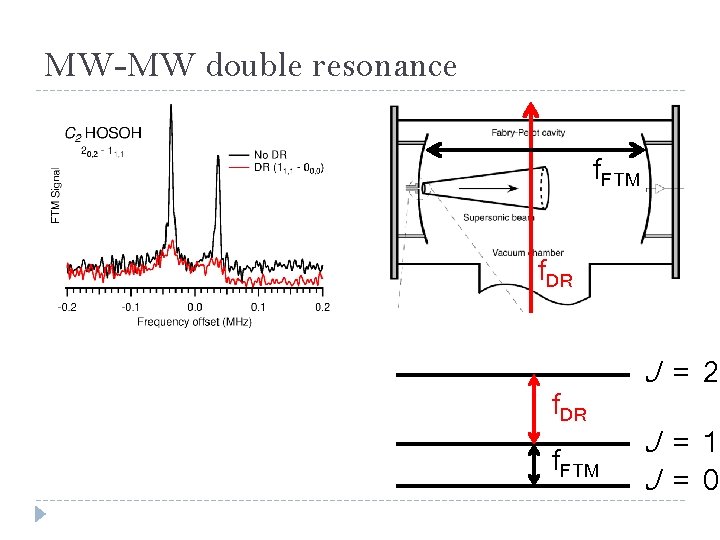
MW-MW double resonance f. FTM f. DR f. FTM J = 2 J = 1 J = 0
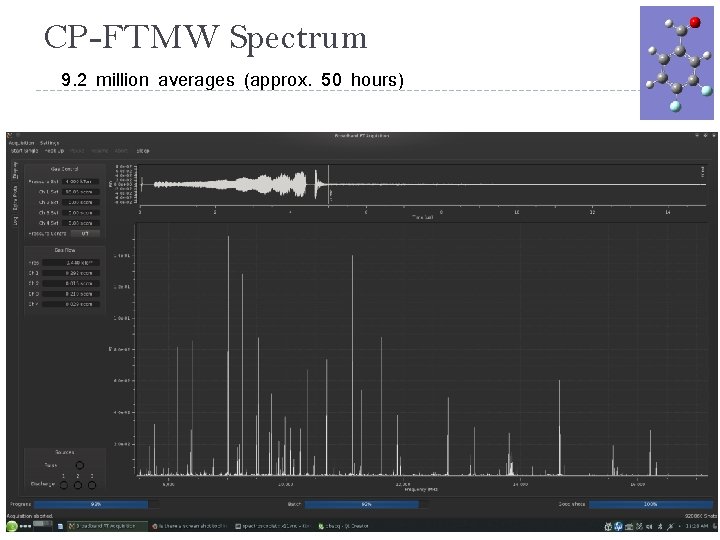
CP-FTMW Spectrum 9. 2 million averages (approx. 50 hours)
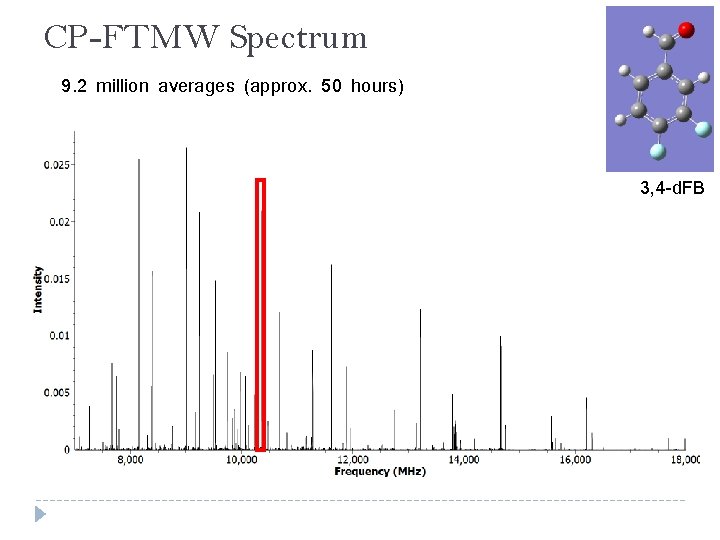
CP-FTMW Spectrum 9. 2 million averages (approx. 50 hours) 3, 4 -d. FB
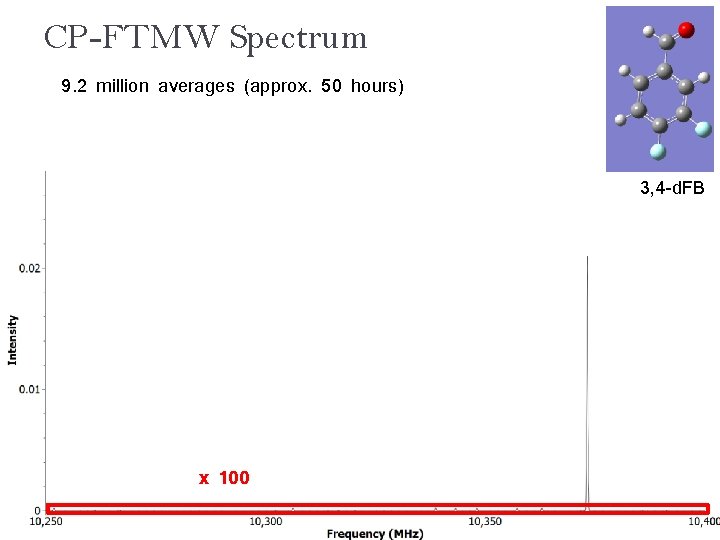
CP-FTMW Spectrum 9. 2 million averages (approx. 50 hours) 3, 4 -d. FB x 100
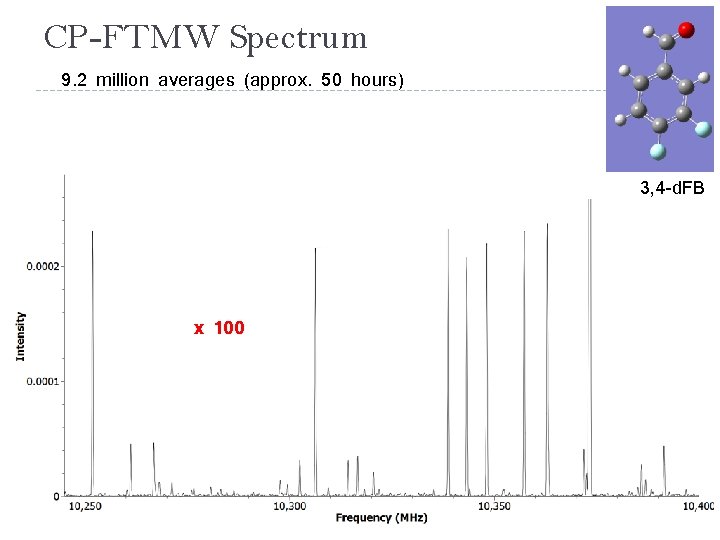
CP-FTMW Spectrum 9. 2 million averages (approx. 50 hours) 3, 4 -d. FB x 100 18 O
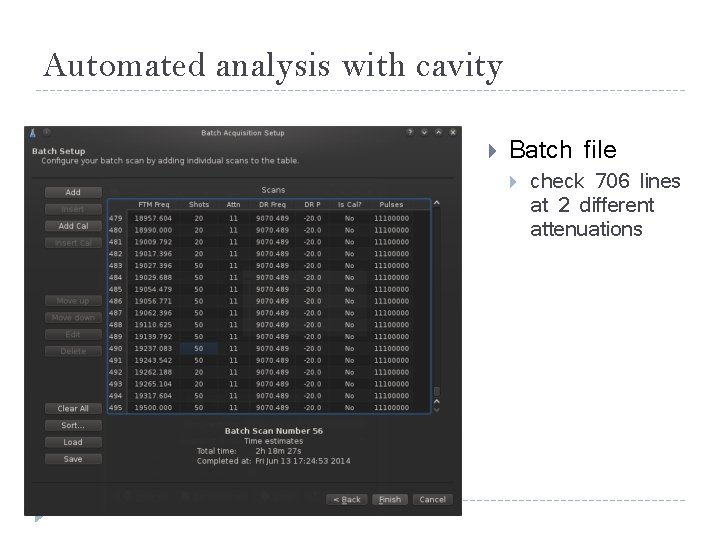
Automated analysis with cavity Batch file check 706 lines at 2 different attenuations
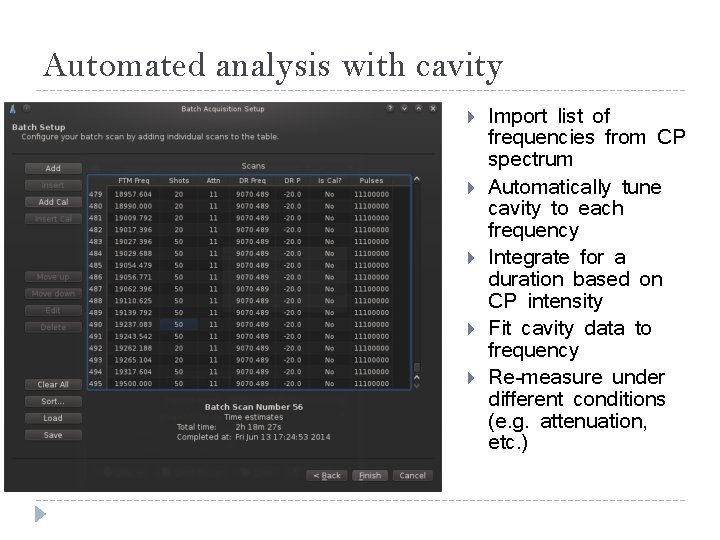
Automated analysis with cavity Import list of frequencies from CP spectrum Automatically tune cavity to each frequency Integrate for a duration based on CP intensity Fit cavity data to frequency Re-measure under different conditions (e. g. attenuation, etc. )
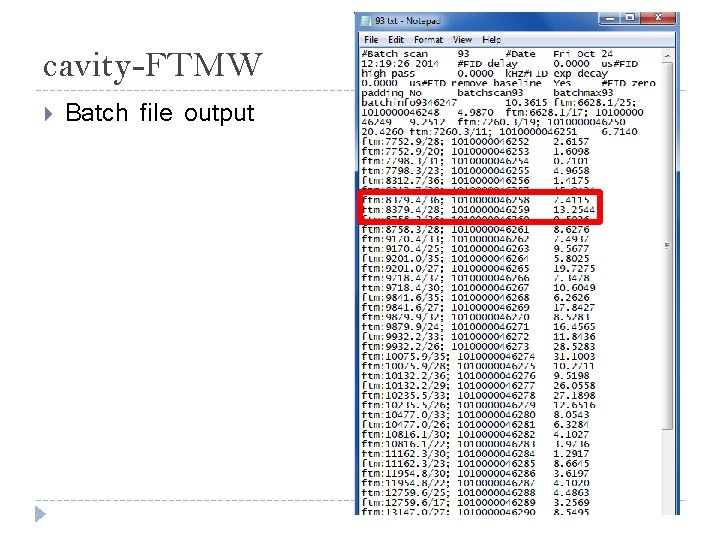
cavity-FTMW Batch file output
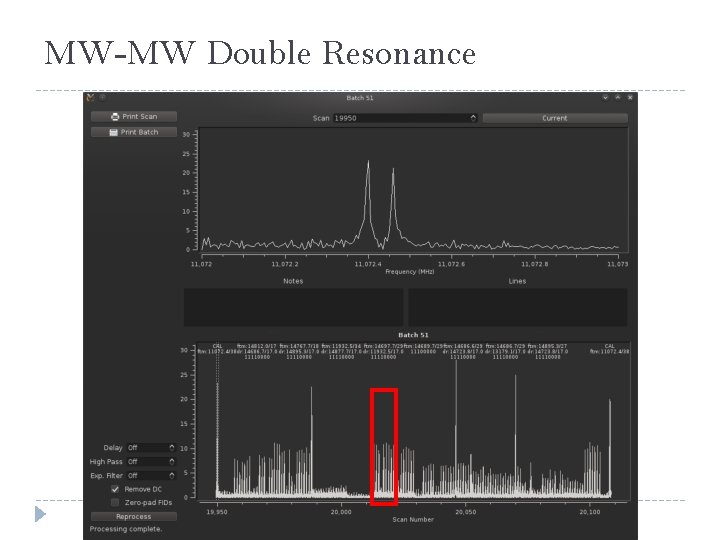
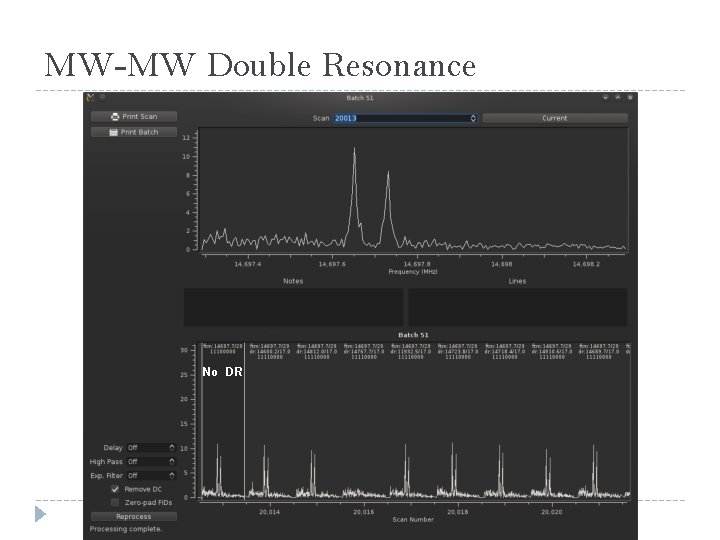
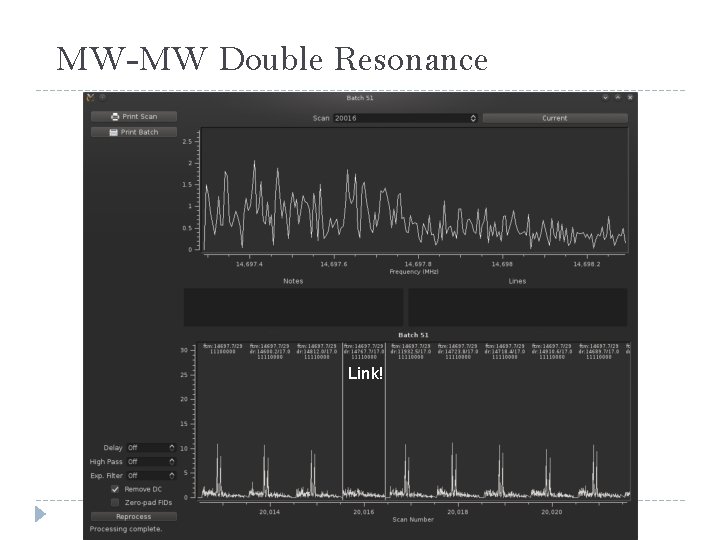
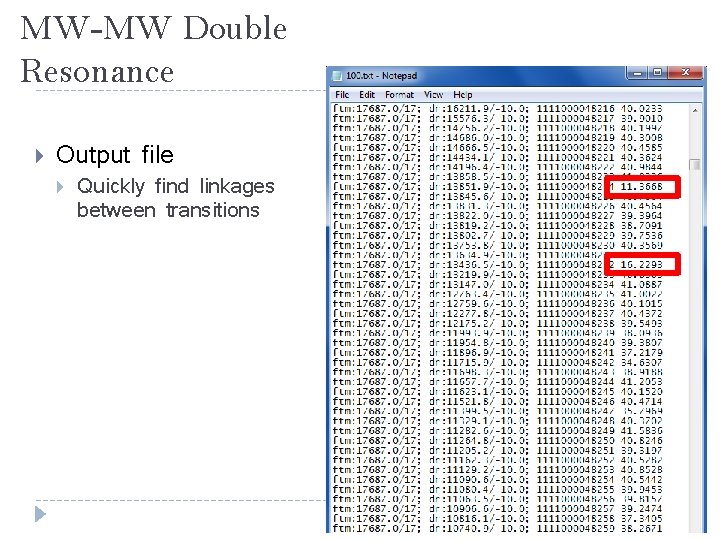
MW-MW Double Resonance Picked the 119 most intense lines in spectrum Created “batch” file to measure DR linkages between all possible combinations ~12 hours measurement time
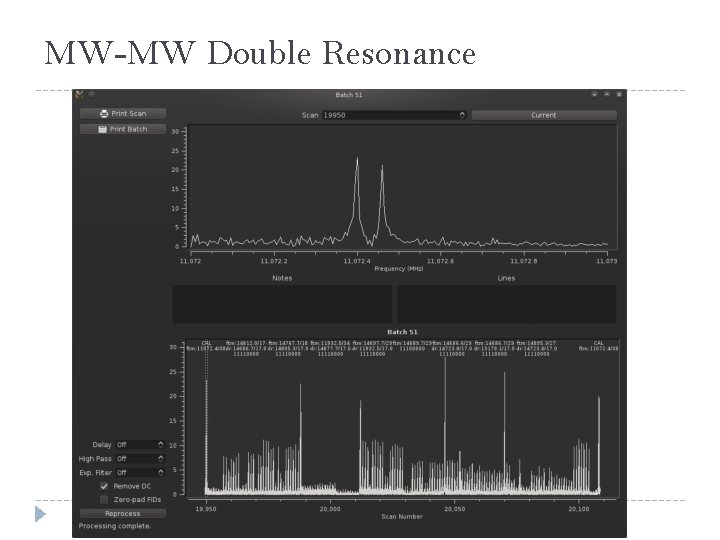
MW-MW Double Resonance
MW-MW Double Resonance
MW-MW Double Resonance No DR
MW-MW Double Resonance Link!
MW-MW Double Resonance Output file Quickly find linkages between transitions
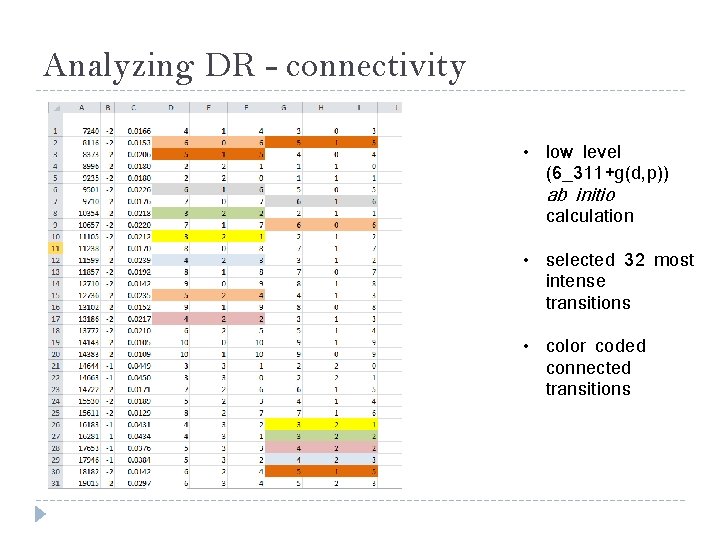
Analyzing DR - connectivity • low level (6_311+g(d, p)) ab initio calculation • selected 32 most intense transitions • color coded connected transitions
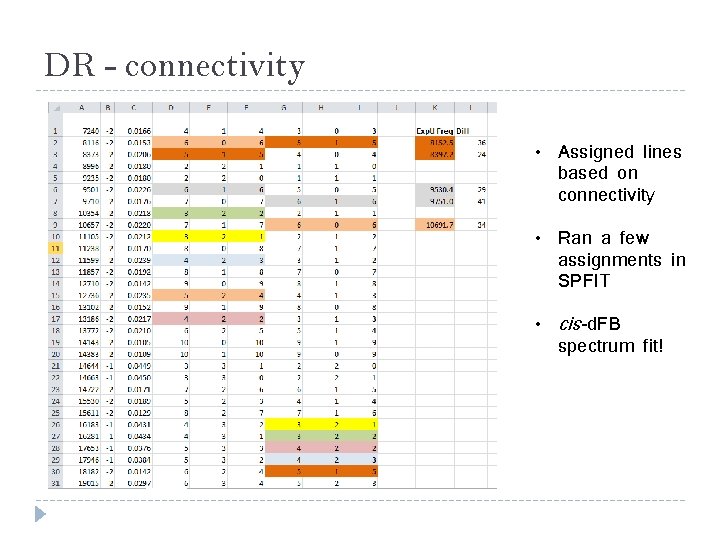
DR - connectivity • Assigned lines based on connectivity • Ran a few assignments in SPFIT • cis-d. FB spectrum fit!
trans -d. FB assignment Subtracted all cis-d. FB lines from spectrum Picked the 45 most intense lines remaining Performed double-resonance batch on the “trans” lines Found links and assigned spectrum
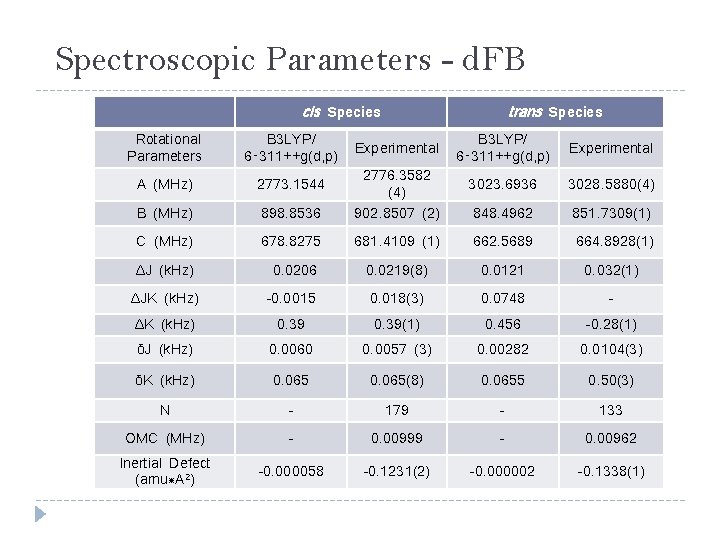
Spectroscopic Parameters - d. FB cis Species 28 trans Species Rotational Parameters B 3 LYP/ 6‑ 311++g(d, p) Experimental A (MHz) 2773. 1544 B (MHz) 898. 8536 2776. 3582 (4) 902. 8507 (2) 3023. 6936 3028. 5880(4) 848. 4962 851. 7309(1) C (MHz) 678. 8275 681. 4109 (1) 662. 5689 664. 8928(1) ΔJ (k. Hz) 0. 0206 0. 0219(8) 0. 0121 0. 032(1) ΔJK (k. Hz) -0. 0015 0. 018(3) 0. 0748 - ΔK (k. Hz) 0. 39(1) 0. 456 -0. 28(1) δJ (k. Hz) 0. 0060 0. 0057 (3) 0. 00282 0. 0104(3) δK (k. Hz) 0. 065(8) 0. 0655 0. 50(3) N - 179 - 133 OMC (MHz) - 0. 00999 - 0. 00962 Inertial Defect (amu*A 2) -0. 000058 -0. 1231(2) -0. 000002 -0. 1338(1) Experimental
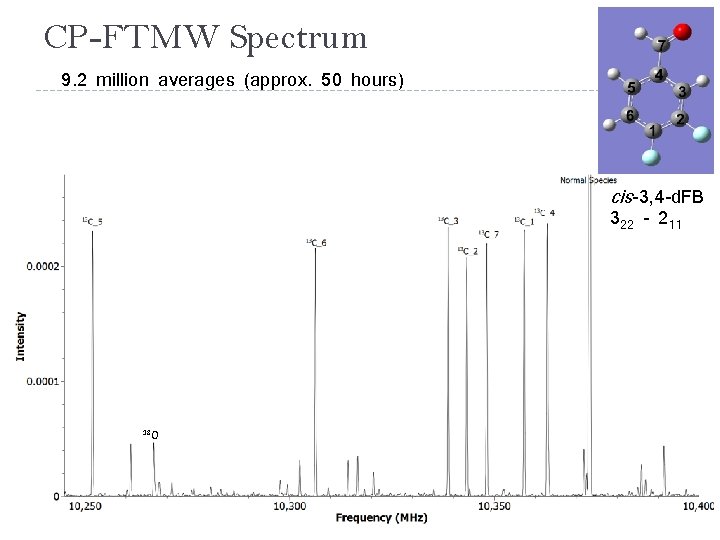
CP-FTMW Spectrum 9. 2 million averages (approx. 50 hours) cis-3, 4 -d. FB 322 - 211 18 O
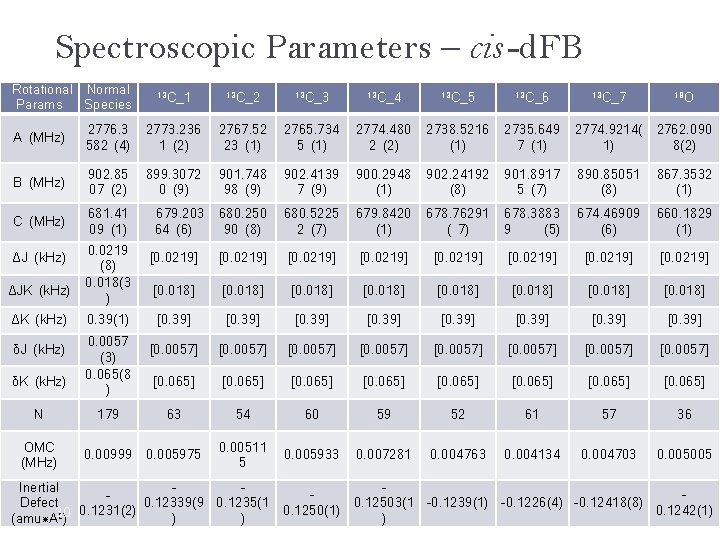
Rotational and Distortion Constants of 3, 4 -difluorobenzaldehyde Spectroscopic Parameters – cis -d. FB Rotational Normal Params Species 13 C_1 13 C_2 13 C_3 13 C_4 13 C_5 13 C_6 13 C_7 18 O A (MHz) 2776. 3 582 (4) 2773. 236 1 (2) 2767. 52 23 (1) 2765. 734 5 (1) 2774. 480 2 (2) 2738. 5216 (1) 2735. 649 7 (1) 2774. 9214( 1) 2762. 090 8(2) B (MHz) 902. 85 07 (2) 899. 3072 0 (9) 901. 748 98 (9) 902. 4139 7 (9) 900. 2948 (1) 902. 24192 (8) 901. 8917 5 (7) 890. 85051 (8) 867. 3532 (1) C (MHz) 681. 41 09 (1) 679. 203 64 (6) 680. 250 90 (8) 680. 5225 2 (7) 679. 8420 (1) 678. 76291 ( 7) 678. 3883 9 (5) 674. 46909 (6) 660. 1829 (1) [0. 0219] [0. 018] [0. 39] [0. 0057] [0. 065] [0. 065] ΔJ (k. Hz) ΔJK (k. Hz) ΔK (k. Hz) δJ (k. Hz) δK (k. Hz) 0. 0219 (8) 0. 018(3 ) 0. 39(1) 0. 0057 (3) 0. 065(8 ) N 179 63 54 60 59 52 61 57 36 OMC (MHz) 0. 00999 0. 005975 0. 00511 5 0. 005933 0. 007281 0. 004763 0. 004134 0. 004703 0. 005005 Inertial Defect 0. 12339(9 0. 1235(1 0. 1231(2) 30 2 (amu*A ) ) ) 0. 12503(1 -0. 1239(1) -0. 1226(4) -0. 12418(8) 0. 1250(1) 0. 1242(1) )
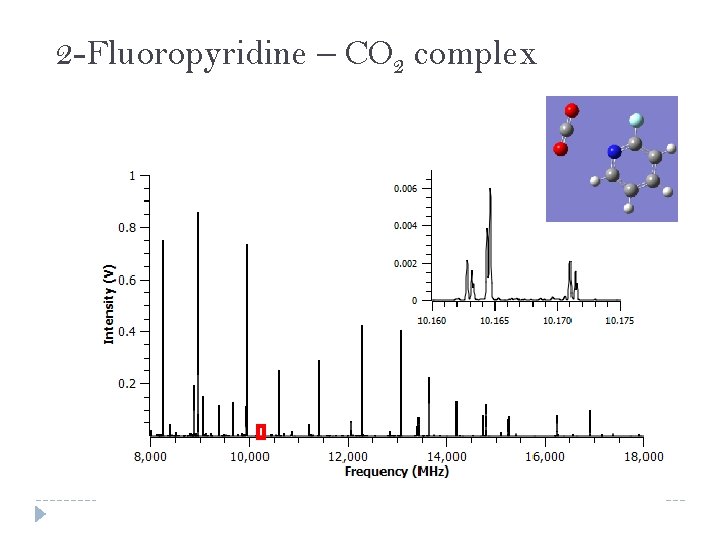
2 -Fluoropyridine – CO 2 complex
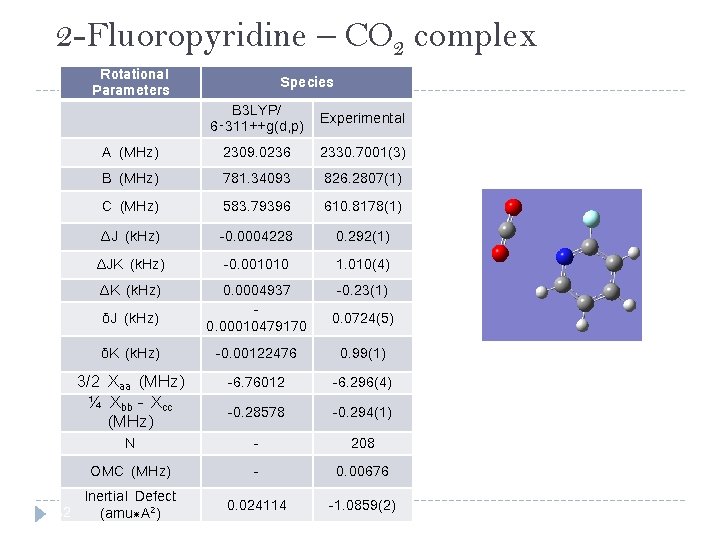
2 -Fluoropyridine – CO 2 complex Rotational Parameters Species B 3 LYP/ 6‑ 311++g(d, p) Experimental A (MHz) 2309. 0236 2330. 7001(3) B (MHz) 781. 34093 826. 2807(1) C (MHz) 583. 79396 610. 8178(1) ΔJ (k. Hz) -0. 0004228 0. 292(1) ΔJK (k. Hz) -0. 001010 1. 010(4) ΔK (k. Hz) 0. 0004937 0. 00010479170 -0. 23(1) δJ (k. Hz) 0. 0724(5) δK (k. Hz) -0. 00122476 0. 99(1) 3/2 Χaa (MHz) ¼ Χbb – Χcc (MHz) -6. 76012 -6. 296(4) -0. 28578 -0. 294(1) N - 208 OMC (MHz) - 0. 00676 0. 024114 -1. 0859(2) Inertial Defect 32 (amu*A 2)
Future Work c-FTMW Spectroscopy Software upgrades Search for isotopologues of trans-d. FB and 2 -Fpyr-CO 2 Fully automate transition from CP-FTMW to c-FTMW experiments Algorithm for translating DR data into spectral assignments Coker College Spectroscopy Group Implement c-FTMW spectroscopy to complement CP-FTMW spectroscopy
Thanks Mike Mc. Carthy Laboratory Marie-Aline Martin-Drumel Carrie Womack Paul Antonucci Coker students Sydney A. Gaster Taylor M. Hall Deondre L. Parks

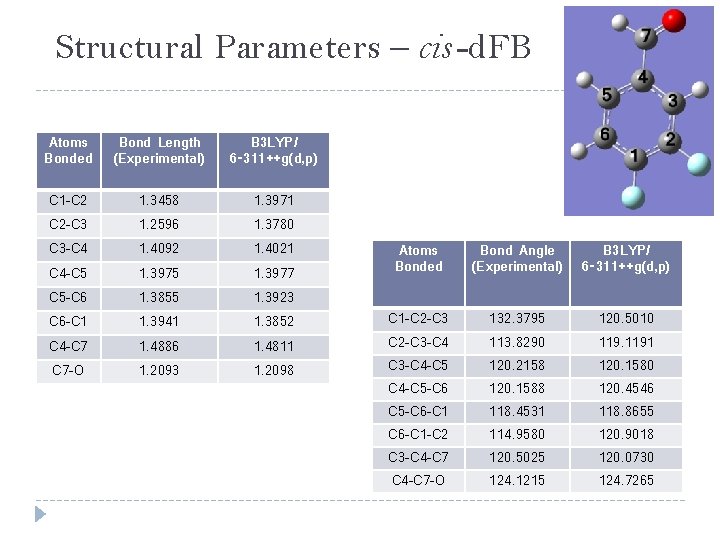
Structural Parameters – cis -d. FB Atoms Bonded Bond Length (Experimental) B 3 LYP/ 6‑ 311++g(d, p) C 1 -C 2 1. 3458 1. 3971 C 2 -C 3 1. 2596 1. 3780 C 3 -C 4 1. 4092 1. 4021 C 4 -C 5 1. 3977 C 5 -C 6 1. 3855 1. 3923 C 6 -C 1 1. 3941 1. 3852 C 4 -C 7 1. 4886 1. 4811 C 7 -O 1. 2093 1. 2098 Atoms Bonded Bond Angle (Experimental) B 3 LYP/ 6‑ 311++g(d, p) C 1 -C 2 -C 3 132. 3795 120. 5010 C 2 -C 3 -C 4 113. 8290 1191 C 3 -C 4 -C 5 120. 2158 120. 1580 C 4 -C 5 -C 6 120. 1588 120. 4546 C 5 -C 6 -C 1 118. 4531 118. 8655 C 6 -C 1 -C 2 114. 9580 120. 9018 C 3 -C 4 -C 7 120. 5025 120. 0730 C 4 -C 7 -O 124. 1215 124. 7265
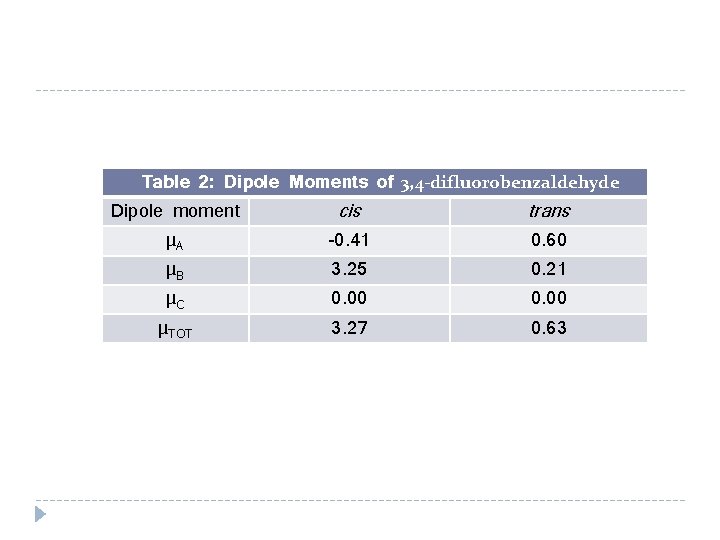
Table 2: Dipole Moments of 3, 4 -difluorobenzaldehyde Dipole moment cis trans 3. 25 0. 21 μA -0. 41 μC 0. 00 μB μTOT 3. 27 0. 60 0. 00 0. 63
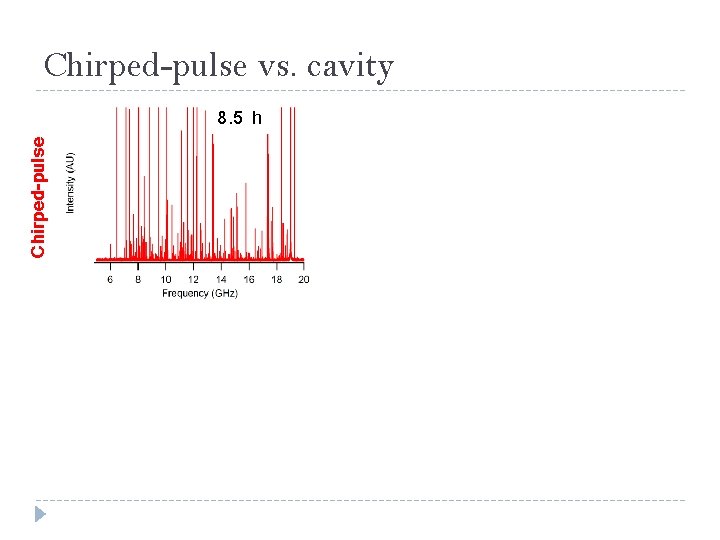
Chirped-pulse vs. cavity Chirped-pulse 8. 5 h
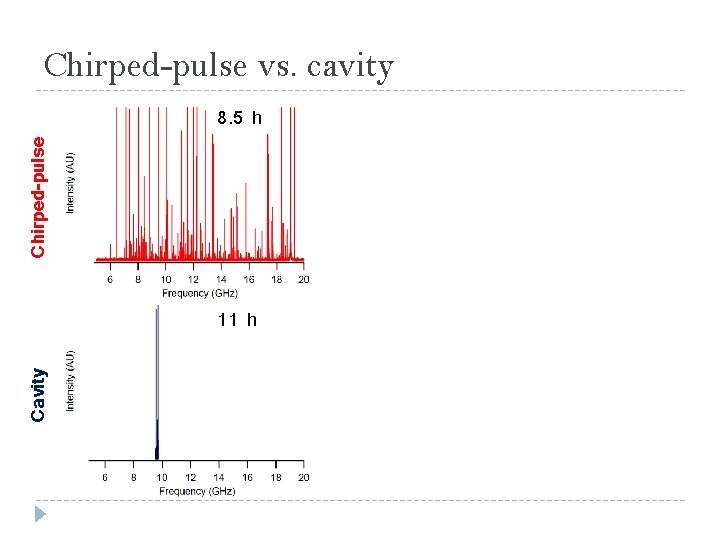
Chirped-pulse vs. cavity Chirped-pulse 8. 5 h Cavity 11 h
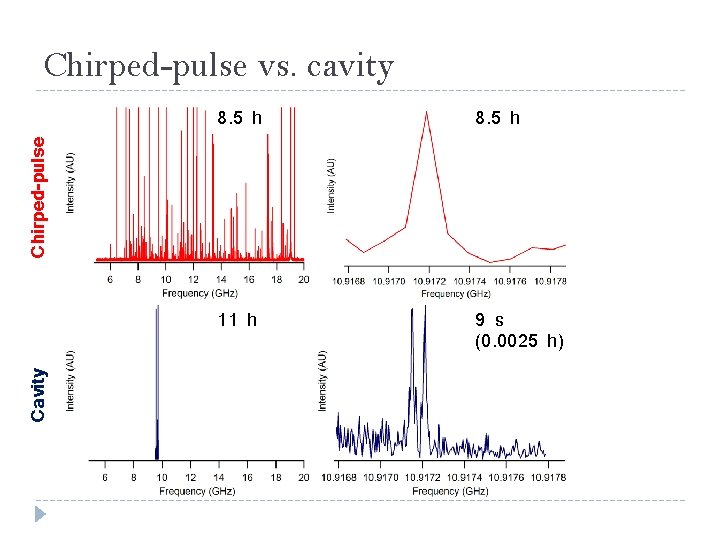
Chirped-pulse vs. cavity 8. 5 h 11 h 9 s (0. 0025 h) Cavity Chirped-pulse 8. 5 h
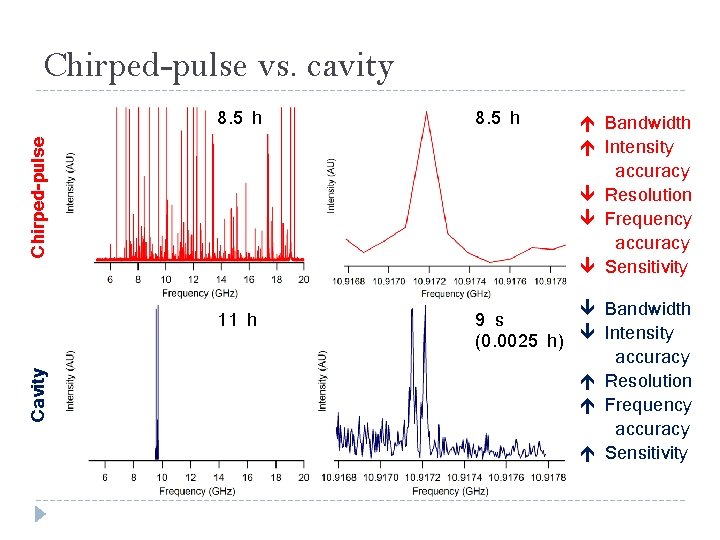
Chirped-pulse vs. cavity Chirped-pulse 8. 5 h Cavity 11 h 8. 5 h Bandwidth Intensity accuracy Resolution Frequency accuracy Sensitivity Bandwidth 9 s (0. 0025 h) Intensity accuracy Resolution Frequency accuracy Sensitivity
Cavity Chirped-pulse + cavity
Cavity Chirped-pulse + cavity
Cavity Chirped-pulse + cavity
- Slides: 44