
A Sediment Transport Model for Incising Gullies On
- Slides: 2
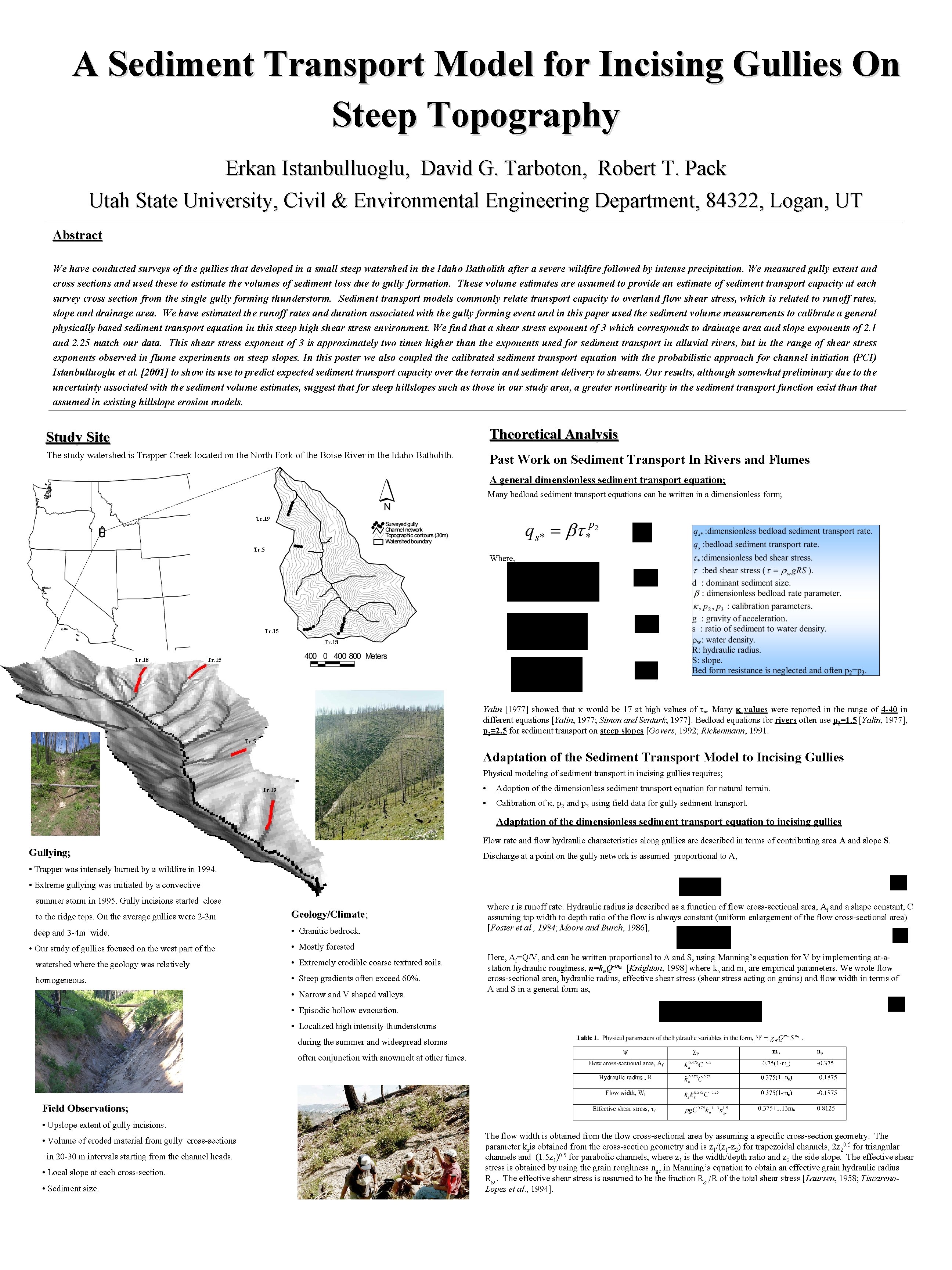
A Sediment Transport Model for Incising Gullies On Steep Topography Erkan Istanbulluoglu, David G. Tarboton, Robert T. Pack Utah State University, Civil & Environmental Engineering Department, 84322, Logan, UT Abstract We have conducted surveys of the gullies that developed in a small steep watershed in the Idaho Batholith after a severe wildfire followed by intense precipitation. We measured gully extent and cross sections and used these to estimate the volumes of sediment loss due to gully formation. These volume estimates are assumed to provide an estimate of sediment transport capacity at each survey cross section from the single gully forming thunderstorm. Sediment transport models commonly relate transport capacity to overland flow shear stress, which is related to runoff rates, slope and drainage area. We have estimated the runoff rates and duration associated with the gully forming event and in this paper used the sediment volume measurements to calibrate a general physically based sediment transport equation in this steep high shear stress environment. We find that a shear stress exponent of 3 which corresponds to drainage area and slope exponents of 2. 1 and 2. 25 match our data. This shear stress exponent of 3 is approximately two times higher than the exponents used for sediment transport in alluvial rivers, but in the range of shear stress exponents observed in flume experiments on steep slopes. In this poster we also coupled the calibrated sediment transport equation with the probabilistic approach for channel initiation (PCI) Istanbulluoglu et al. [2001] to show its use to predict expected sediment transport capacity over the terrain and sediment delivery to streams. Our results, although somewhat preliminary due to the uncertainty associated with the sediment volume estimates, suggest that for steep hillslopes such as those in our study area, a greater nonlinearity in the sediment transport function exist than that assumed in existing hillslope erosion models. Study Site Theoretical Analysis The study watershed is Trapper Creek located on the North Fork of the Boise River in the Idaho Batholith. Past Work on Sediment Transport In Rivers and Flumes A general dimensionless sediment transport equation; Many bedload sediment transport equations can be written in a dimensionless form; Tr. 19 Tr. 5 Where, Tr. 15 Tr. 18 Tr. 15 Yalin [1977] showed that would be 17 at high values of t*. Many k values were reported in the range of 4 -40 in different equations [Yalin, 1977; Simon and Senturk; 1977]. Bedload equations for rivers often use p 2=1. 5 [Yalin, 1977], p 2 2. 5 for sediment transport on steep slopes [Govers, 1992; Rickenmann, 1991. Tr. 5 Adaptation of the Sediment Transport Model to Incising Gullies Physical modeling of sediment transport in incising gullies requires; Tr. 19 • Adoption of the dimensionless sediment transport equation for natural terrain. • Calibration of , p 2 and p 3 using field data for gully sediment transport. Adaptation of the dimensionless sediment transport equation to incising gullies Flow rate and flow hydraulic characteristics along gullies are described in terms of contributing area A and slope S. Gullying; Discharge at a point on the gully network is assumed proportional to A, • Trapper was intensely burned by a wildfire in 1994. • Extreme gullying was initiated by a convective summer storm in 1995. Gully incisions started close to the ridge tops. On the average gullies were 2 -3 m Geology/Climate; deep and 3 -4 m wide. • Granitic bedrock. • Our study of gullies focused on the west part of the where r is runoff rate. Hydraulic radius is described as a function of flow cross-sectional area, Af and a shape constant, C assuming top width to depth ratio of the flow is always constant (uniform enlargement of the flow cross-sectional area) [Foster et al , 1984; Moore and Burch, 1986], • Mostly forested watershed where the geology was relatively • Extremely erodible coarse textured soils. homogeneous. • Steep gradients often exceed 60%. • Narrow and V shaped valleys. Here, Af=Q/V, and can be written proportional to A and S, using Manning’s equation for V by implementing at-astation hydraulic roughness, n=kn. Q-mn [Knighton, 1998] where kn and mn are empirical parameters. We wrote flow cross-sectional area, hydraulic radius, effective shear stress (shear stress acting on grains) and flow width in terms of A and S in a general form as, • Episodic hollow evacuation. • Localized high intensity thunderstorms during the summer and widespread storms often conjunction with snowmelt at other times. Field Observations; • Upslope extent of gully incisions. • Volume of eroded material from gully cross-sections in 20 -30 m intervals starting from the channel heads. • Local slope at each cross-section. • Sediment size. The flow width is obtained from the flow cross-sectional area by assuming a specific cross-section geometry. The parameter ksis obtained from the cross-section geometry and is z 1/(z 1 -z 2) for trapezoidal channels, 2 z 20. 5 for triangular channels and (1. 5 z 1)0. 5 for parabolic channels, where z 1 is the width/depth ratio and z 2 the side slope. The effective shear stress is obtained by using the grain roughness ngc in Manning’s equation to obtain an effective grain hydraulic radius Rgc. The effective shear stress is assumed to be the fraction Rgc/R of the total shear stress [Laursen, 1958; Tiscareno. Lopez et al. , 1994].
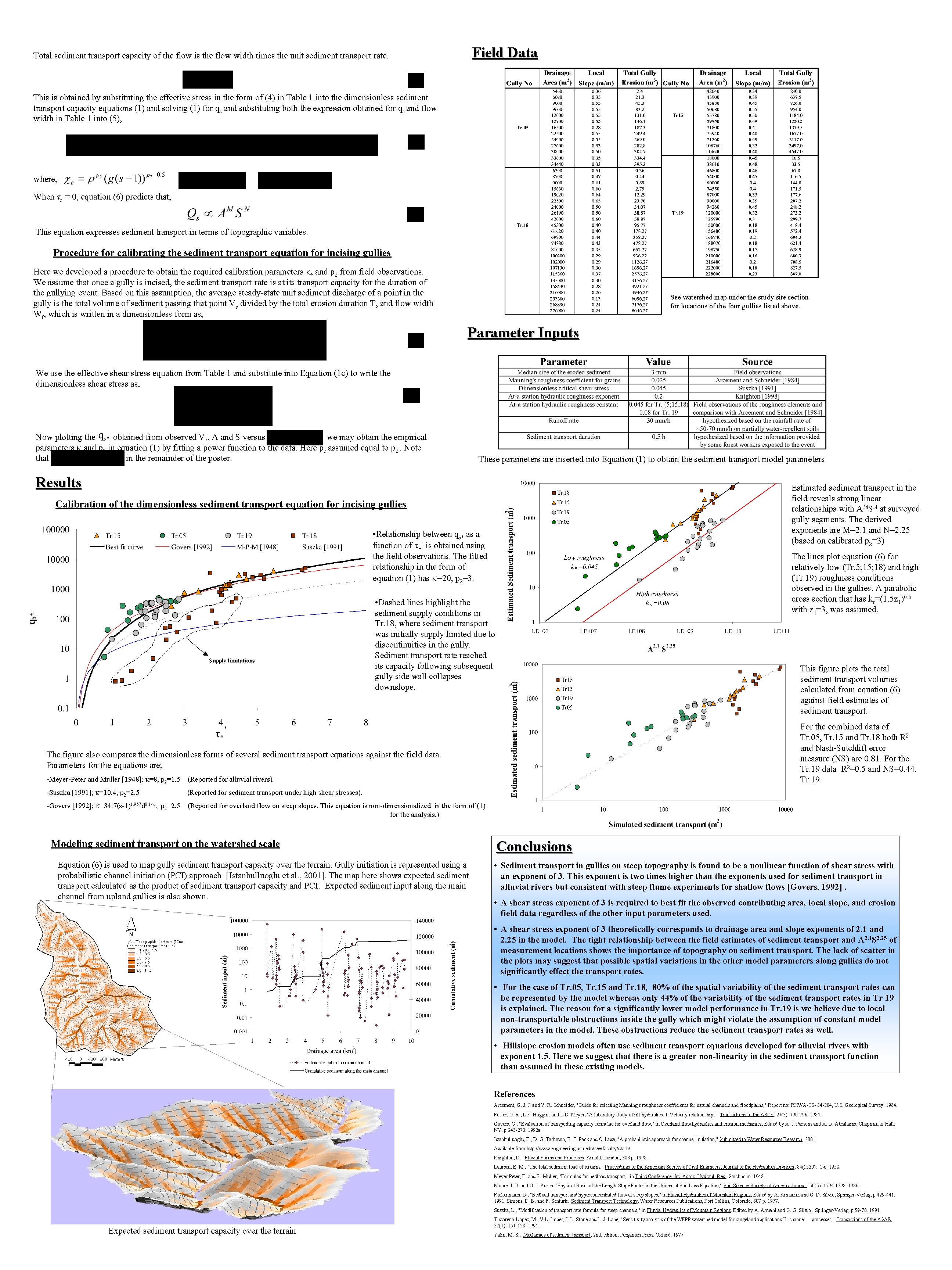
Field Data Total sediment transport capacity of the flow is the flow width times the unit sediment transport rate. This is obtained by substituting the effective stress in the form of (4) in Table 1 into the dimensionless sediment transport capacity equations (1) and solving (1) for qs and substituting both the expression obtained for qs and flow width in Table 1 into (5), where, When τc = 0, equation (6) predicts that, This equation expresses sediment transport in terms of topographic variables. Procedure for calibrating the sediment transport equation for incising gullies Here we developed a procedure to obtain the required calibration parameters , and p 2 from field observations. We assume that once a gully is incised, the sediment transport rate is at its transport capacity for the duration of the gullying event. Based on this assumption, the average steady-state unit sediment discharge of a point in the gully is the total volume of sediment passing that point Vs divided by the total erosion duration T, and flow width Wf, which is written in a dimensionless form as, See watershed map under the study site section for locations of the four gullies listed above. Parameter Inputs We use the effective shear stress equation from Table 1 and substitute into Equation (1 c) to write the dimensionless shear stress as, Now plotting the obtained from observed Vs, A and S versus we may obtain the empirical parameters and p 2 in equation (1) by fitting a power function to the data. Here p 3 assumed equal to p 2. Note that in the remainder of the poster. These parameters are inserted into Equation (1) to obtain the sediment transport model parameters Results Estimated sediment transport in the field reveals strong linear relationships with AMSN at surveyed gully segments. The derived exponents are M=2. 1 and N=2. 25 (based on calibrated p 2=3) Calibration of the dimensionless sediment transport equation for incising gullies • Relationship between qs* as a function of t*’ is obtained using the field observations. The fitted relationship in the form of equation (1) has =20, p 2=3. The lines plot equation (6) for relatively low (Tr. 5; 18) and high (Tr. 19) roughness conditions observed in the gullies. A parabolic cross section that has ks=(1. 5 z 1)0. 5 with z 1=3, was assumed. • Dashed lines highlight the sediment supply conditions in Tr. 18, where sediment transport was initially supply limited due to discontinuities in the gully. Sediment transport rate reached its capacity following subsequent gully side wall collapses downslope. This figure plots the total sediment transport volumes calculated from equation (6) against field estimates of sediment transport. For the combined data of Tr. 05, Tr. 15 and Tr. 18 both R 2 and Nash-Sutchlift error measure (NS) are 0. 81. For the Tr. 19 data R 2=0. 5 and NS=0. 44. Tr. 19. The figure also compares the dimensionless forms of several sediment transport equations against the field data. Parameters for the equations are; -Meyer-Peter and Muller [1948]; =8, p 2=1. 5 (Reported for alluvial rivers). -Suszka [1991]; =10. 4, p 2=2. 5 (Reported for sediment transport under high shear stresses). -Govers [1992]; =34. 7(s-1)1. 957 d 0. 146, p 2=2. 5 (Reported for overland flow on steep slopes. This equation is non-dimensionalized in the form of (1) for the analysis. ) Modeling sediment transport on the watershed scale Equation (6) is used to map gully sediment transport capacity over the terrain. Gully initiation is represented using a probabilistic channel initiation (PCI) approach [Istanbulluoglu et al. , 2001]. The map here shows expected sediment transport calculated as the product of sediment transport capacity and PCI. Expected sediment input along the main channel from upland gullies is also shown. Conclusions • Sediment transport in gullies on steep topography is found to be a nonlinear function of shear stress with an exponent of 3. This exponent is two times higher than the exponents used for sediment transport in alluvial rivers but consistent with steep flume experiments for shallow flows [Govers, 1992]. • A shear stress exponent of 3 is required to best fit the observed contributing area, local slope, and erosion field data regardless of the other input parameters used. • A shear stress exponent of 3 theoretically corresponds to drainage area and slope exponents of 2. 1 and 2. 25 in the model. The tight relationship between the field estimates of sediment transport and A 2. 1 S 2. 25 of measurement locations shows the importance of topography on sediment transport. The lack of scatter in the plots may suggest that possible spatial variations in the other model parameters along gullies do not significantly effect the transport rates. • For the case of Tr. 05, Tr. 15 and Tr. 18, 80% of the spatial variability of the sediment transport rates can be represented by the model whereas only 44% of the variability of the sediment transport rates in Tr 19 is explained. The reason for a significantly lower model performance in Tr. 19 is we believe due to local non-transportable obstructions inside the gully which might violate the assumption of constant model parameters in the model. These obstructions reduce the sediment transport rates as well. • Hillslope erosion models often use sediment transport equations developed for alluvial rivers with exponent 1. 5. Here we suggest that there is a greater non-linearity in the sediment transport function than assumed in these existing models. References Arcement, G. J. J. and V. R. Schneider, "Guide for selecting Manning's roughness coefficients for natural channels and floodplains, " Report no: RHWA-TS- 84 -204, U. S. Geological Survey. 1984. Foster, G. R. , L. F. Huggins and L. D. Meyer, "A labaratory study of rill hydraulics: I. Velocity relationships, " Transactions of the ASCE, 27(3): 790 -796. 1984. Govers, G. , "Evaluation of transporting capacity formulae for overland flow, " in Overland flow hydraulics and erosion mechanics, Edited by A. J. Parsons and A. D. Abrahams, Chapman & Hall, NY, p. 243 -273. 1992 a. Istanbulluoglu, E. , D. G. Tarboton, R. T. Pack and C. Luse, "A probabilistic approach for channel initiation, " Submitted to Water Resources Research. 2001. Available from http: //www. engineering. usu. edu/cee/faculty/dtarb/ Knighton, D. , Fluvial Forms and Processes, Arnold, London, 383 p. 1998. Laursen, E. M. , "The total sediment load of streams, " Proceedings of the American Society of Civil Engineers, Journal of the Hydraulics Division, 84(1530): 1 -6. 1958. Meyer-Peter, E. and R. Muller, "Formulas for bedload transport, " in Third Conference, Int. Assoc. Hydraul. Res. , Stockholm. 1948. Moore, I. D. and G. J. Burch, "Physical Basis of the Length-Slope Factor in the Universal Soil Loss Equation, " Soil Science Society of America Journal, 50(5): 1294 -1298. 1986. Rickenmann, D. , "Bedload transport and hyperconcentrated flow at steep slopes, " in Fluvial Hydraulics of Mountain Regions, Edited by A. Armanini and G. D. Silvio, Springer-Verlag, p. 429 -441. 1991. Simons, D. B. and F. Senturk, Sediment Transport Technology, Water Resources Publications, Fort Collins, Colorado, 807 p. 1977. Suszka, L. , "Modification of transport rate formula for steep channels, " in Fluvial Hydraulics of Mountain Regions, Edited by A. Armani and G. G. Silvio, Springer-Verlag, p. 59 -70. 1991. Expected sediment transport capacity over the terrain Tiscareno-Lopez, M. , V. L. Lopes, J. L. Stone and L. J. Lane, "Sensitivity analysis of the WEPP watershed model for rangeland applications II. channel 37(1): 151 -158. 1994. Yalin, M. S. , Mechanics of sediment transport, 2 nd. edition, Pergamon Press, Oxford. 1977. processes, " Transactions of the ASAE,