
A Scientific Approach to Research and Innovation Governance
- Slides: 23
A Scientific Approach to Research and Innovation Governance: the Case of HUMANIST Network of Excellence Jean-Pierre Médevielle Deputy General Manager INRETS France medevielle@inrets. fr Dr. Loïc Courtot Europe Research Transport France loic. courtot@acies. fr
The aim of this presentation • To revisit the experience of the FP 6 Network of Excellence from the innovation science viewpoint • To do around the HUMANIST NOE case (e-safety and Intelligent Car Initiatives NOE) • To draw some conclusions for the future especially for focused research dedicated to transport research and innovation governance and excellence, especially for other transnational research networks. 1
NOE FP 6 instrument reminder → The two innovations of FP 6 have been two new instruments: • Integrated projects (big collaborative RDT projects such as PREVENT, AIDE, aimed at solving the problem of finding solutions including demonstrations) • Networks of Excellence Has a first aim to fight the fragmentation of the European Research Area, by creating scientific critical mass around a relevant scientific or technical domain, and through an EC funded 4 years long process the so called Joint Program of Activities, to prepare an integrated and sustainable Virtual Centre of Excellence 2
General overview of HUMANIST No. E (I) The main goals of HUMANIST No. E - Human Centred Design for Information Society Technology The Key issue of HUMANIST No. E is to promote Human Centred Design for ITS • To design and assess ITS according to identified users' needs and requirements • To ensure the acceptability and safety of these systems • To detect and limit the potential drawbacks of their implementation and dissemination • To support mobility and to improve road safety through new Information and Communication Technology 3
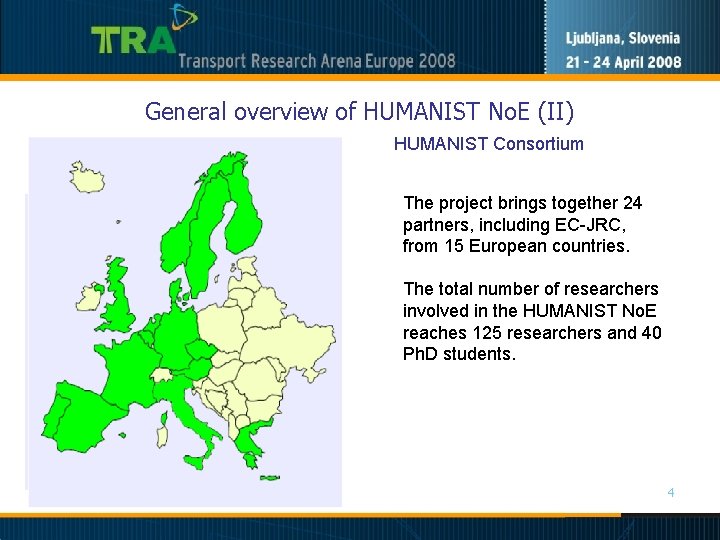
General overview of HUMANIST No. E (II) HUMANIST Consortium The project brings together 24 partners, including EC-JRC, from 15 European countries. The total number of researchers involved in the HUMANIST No. E reaches 125 researchers and 40 Ph. D students. 4
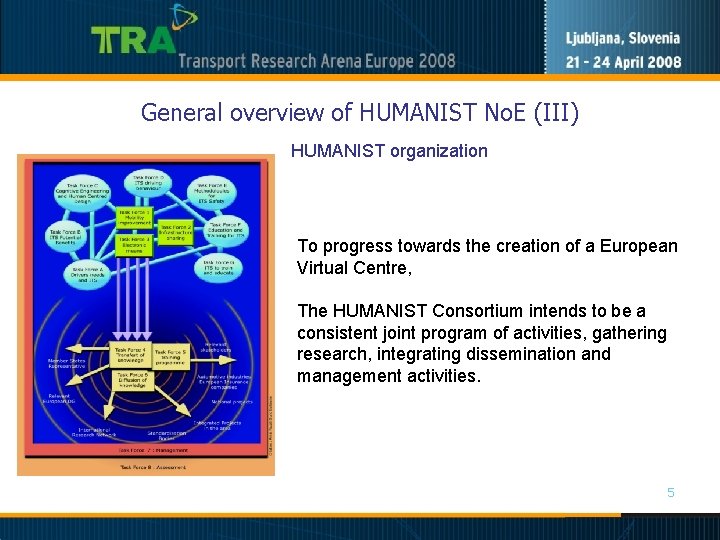
General overview of HUMANIST No. E (III) HUMANIST organization To progress towards the creation of a European Virtual Centre, The HUMANIST Consortium intends to be a consistent joint program of activities, gathering research, integrating dissemination and management activities. 5
HUMANIST main process scientific outcomes (I) • A new scientist generation training and education format through the creation of a virtual European doctorate school, immersion, exchange and visit, and tandem learning (multidisciplinary approach). • - The succeeding Ph. D are finding positions not only with academic (universities and RTOS) but also industry (automotive and ICT) • An interesting access to research infrastructure through an exchange and visit program of senior and post doc. 6
HUMANIST main process scientific outcomes (II) • Experiment and observation legal and ethical rules deliverable applicable to HUMANIST domain • Training issues - Multimedia tool - Training for professionals (trial and test approach of the content, the format and the business model) 7
HUMANIST main process scientific outcomes (III) • Stakeholders interaction for relevance excellence All of the tools, including innovative formats have been tested. A new format of proactive stakeholders forum (May 2005 and April 2008) Many scientific seminars, workshops open to the stakeholders made with other European projects. Dissemination of the results and outcomes to: • e-safety and intelligent car Working Groups and ERTRAC • Industry and public bodies scientists or chief scientists. 8
HUMANIST main process scientific outcomes (IV) - Discussion of ideas of new thematic projects with the same type of stakeholders - Participation to numerous conferences - Setting up of a new approach of open international conference Stakeholders are keen to have a regular cycle in the future of HUMANIST stakeholder forums and conferences. 9
HUMANIST governance and management • The introduction of new and innovative methods and practices to involve in a common project for today and the future all together. • The invention of this « new how » is the result of discussion on the coupling of scientific and thematic issues and their management and governance in the perspective of innovation through the internal International Scientific Advisory Board recommendations composed of academic and industry and public bodies innovation and research experts of the specific domains of HUMANIST. This explains that even if HUMANIST is composed of academic people (U and RTOs) main outcomes are transferable or comparable to other stakeholders concern in a global view of research and innovation management and governance. 10
HUMANIST Virtual Centre of Excellence (I) The BPIS preparation I (Task force 8) Two years long process March 2006 - March 2008 1 step: Discussion involving scientists and executive on four scenarios and taking care of no more EC ad hoc funding. Conducting to: - a highly integrating scenario with few members (4 or 5) - a quasi loose scenario with all members (23) 11
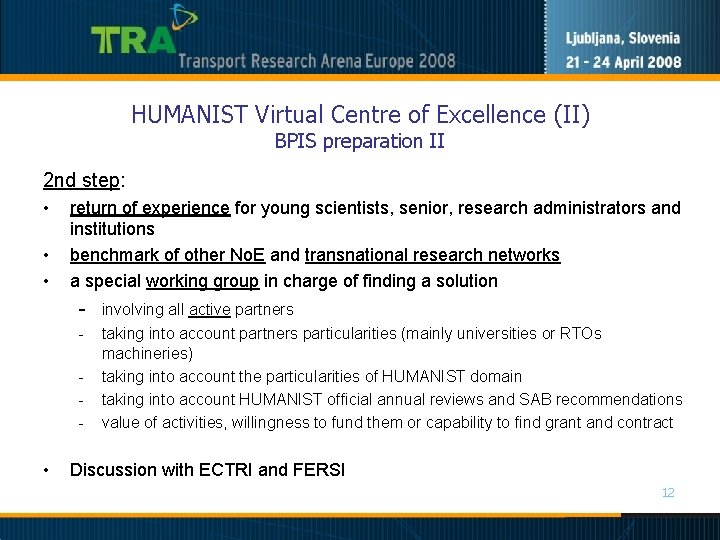
HUMANIST Virtual Centre of Excellence (II) BPIS preparation II 2 nd step: • • • return of experience for young scientists, senior, research administrators and institutions benchmark of other No. E and transnational research networks a special working group in charge of finding a solution - • involving all active partners taking into account partners particularities (mainly universities or RTOs machineries) taking into account the particularities of HUMANIST domain taking into account HUMANIST official annual reviews and SAB recommendations value of activities, willingness to fund them or capability to find grant and contract Discussion with ECTRI and FERSI 12
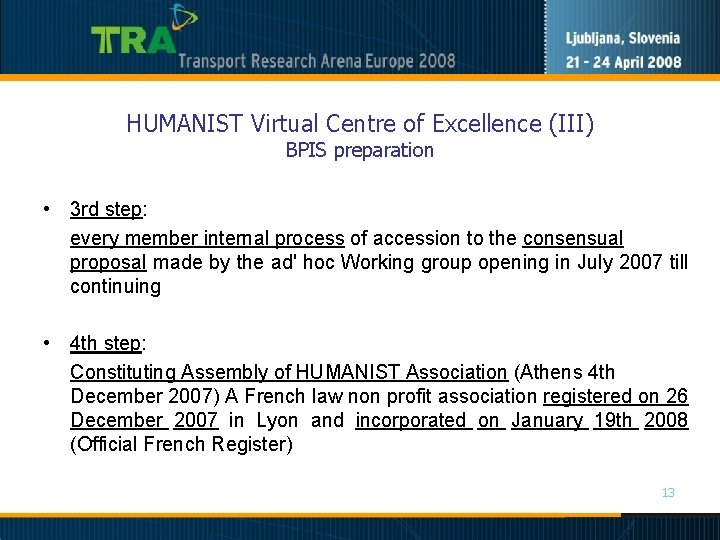
HUMANIST Virtual Centre of Excellence (III) BPIS preparation • 3 rd step: every member internal process of accession to the consensual proposal made by the ad' hoc Working group opening in July 2007 till continuing • 4 th step: Constituting Assembly of HUMANIST Association (Athens 4 th December 2007) A French law non profit association registered on 26 December 2007 in Lyon and incorporated on January 19 th 2008 (Official French Register) 13
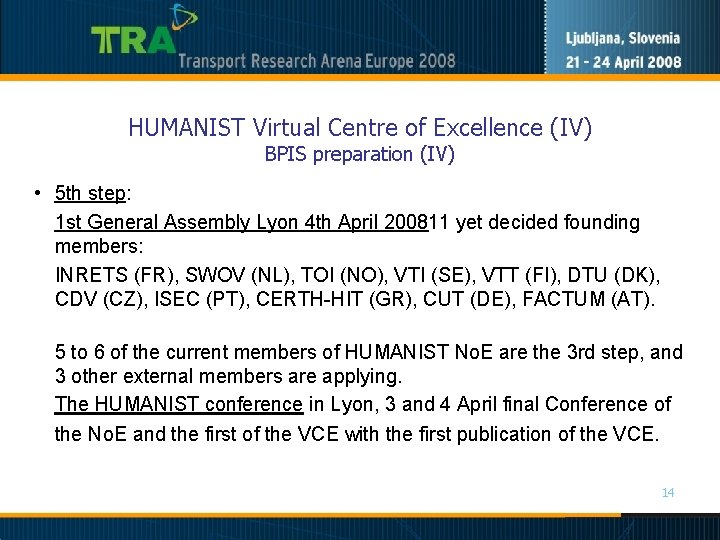
HUMANIST Virtual Centre of Excellence (IV) BPIS preparation (IV) • 5 th step: 1 st General Assembly Lyon 4 th April 200811 yet decided founding members: INRETS (FR), SWOV (NL), TOI (NO), VTI (SE), VTT (FI), DTU (DK), CDV (CZ), ISEC (PT), CERTH-HIT (GR), CUT (DE), FACTUM (AT). 5 to 6 of the current members of HUMANIST No. E are the 3 rd step, and 3 other external members are applying. The HUMANIST conference in Lyon, 3 and 4 April final Conference of the No. E and the first of the VCE with the first publication of the VCE. 14
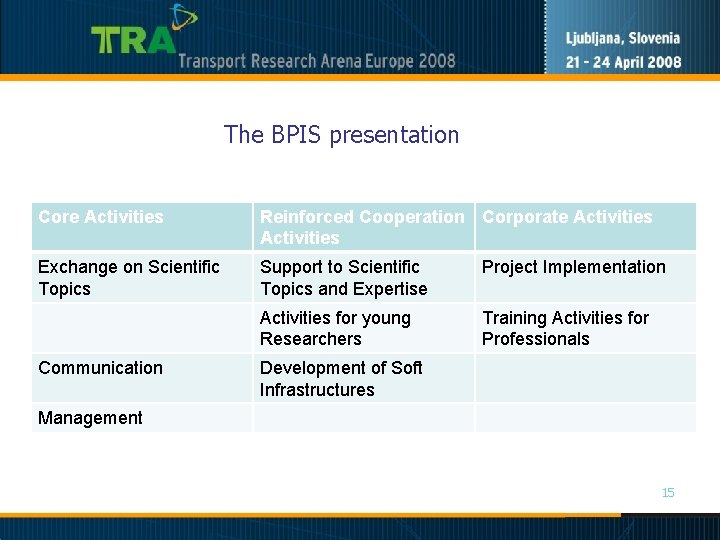
The BPIS presentation Core Activities Reinforced Cooperation Corporate Activities Exchange on Scientific Topics Support to Scientific Topics and Expertise Project Implementation Activities for young Researchers Training Activities for Professionals Communication Development of Soft Infrastructures Management 15
Work Programme for the first year (I) • The General Assembly takes place on April 3 rd 2008 in Lyon and decides of the first year activities (May 2008 to May 2009) and fees. • Core business – Support to scientific topics and scientific experience • new research Task Forces are made definitive before July • Preparation of the next conference 2010 Berlin – Communication • Transfer of mark • new logo • new website – Management and Cooperation with the JRC (FP 7) 16
Work Programme for the first year (II) • Reinforced cooperation activities – Transfer of the HUMANIST CWE – Actions towards young researchers • Marie curie ITN proposal • Summer school • Other Activities – Involvement in infrastructure projects I 3 – Other FRDP projects 17
HUMANIST approach for structuring research and innovation • A new way of performing research and innovation - Confronting and melting the various European scientific and education cultures - Searching for scientific excellence and relevance - Reaching a common process of governance and management At the end preparing the focus research institutions of the 21 st century and finding a common process of governance and management relevant not only to the institutions partners but also the scientists, the research administrations and the young scientists open to its environment 18
HUMANIST approach for structuring research and innovation • Challenging scientific excellence by networking and process oriented activities of all its constituents and globally. One of the indicators is the attractiveness on the international level of the conference. • Challenging the excellence of relevance by an innovation process by interacting with stakeholders: – other academics in Europe and in the world – industry, automotive, ICT, … – public authorities and agencies (policy making or research and innovation policy making). 19
HUMANIST approach for structuring research and innovation • Challenging the governance and management excellence by a process oriented organization, the interaction with stakeholders of research and innovation (public bodies and industry) and the definition of sets of indicators (traditional and innovative) • Attaining a real critical mass. • Providing and testing a new way to education and training the new scientist generation 20
Conclusion Based on this new approach of research and innovation governance, the main outcome of the HUMANIST No. E is to define an adequate process and organization to provide a locus whereby all the actors involved in the creation of scientific knowledge interact and debate, and then obtain innovative results and create international excellence. So far, the critical mass reached by HUMANIST renders the Network visible at the European and International levels, and the outcome on governance seems to be the premises of a competitive advantage on the international level. 21
THANK YOU FOR YOUR ATTENTION 22