
A Scale to Measure Mathematical Resilience in Year
- Slides: 17
A Scale to Measure Mathematical Resilience in Year 1 Children Katie Baker Supervisory Team: Julia Carroll, Emma Vardy, Donna-Lynn Shepherd, Clare Wood bakerk 11@uni. coventry. ac. uk
What I’m going to talk about: • Why I developed the scale • The stages of scale development • Worrying insights • Some statistics on MR in young children
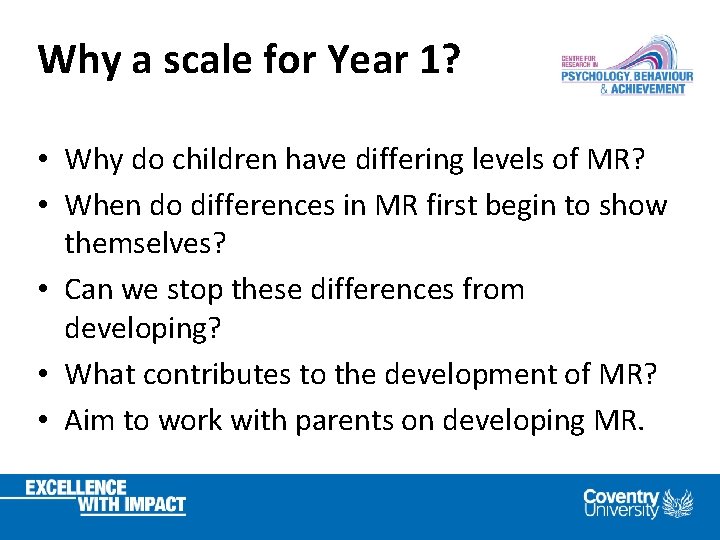
Why a scale for Year 1? • Why do children have differing levels of MR? • When do differences in MR first begin to show themselves? • Can we stop these differences from developing? • What contributes to the development of MR? • Aim to work with parents on developing MR.
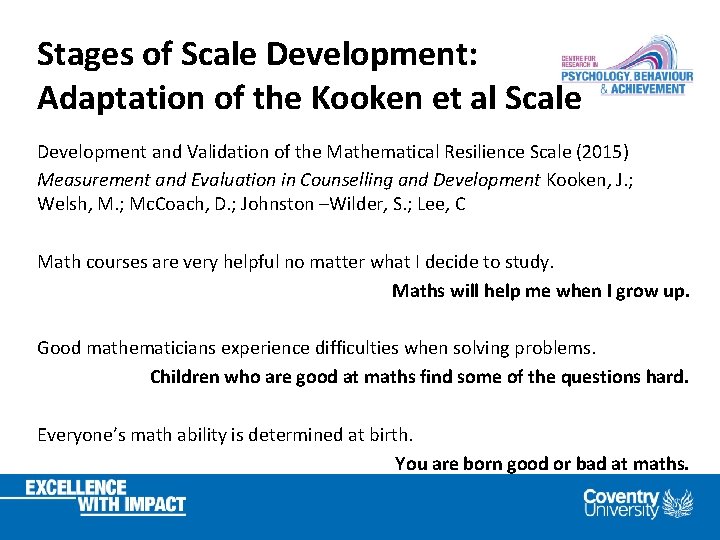
Stages of Scale Development: Adaptation of the Kooken et al Scale Development and Validation of the Mathematical Resilience Scale (2015) Measurement and Evaluation in Counselling and Development Kooken, J. ; Welsh, M. ; Mc. Coach, D. ; Johnston –Wilder, S. ; Lee, C Math courses are very helpful no matter what I decide to study. Maths will help me when I grow up. Good mathematicians experience difficulties when solving problems. Children who are good at maths find some of the questions hard. Everyone’s math ability is determined at birth. You are born good or bad at maths.
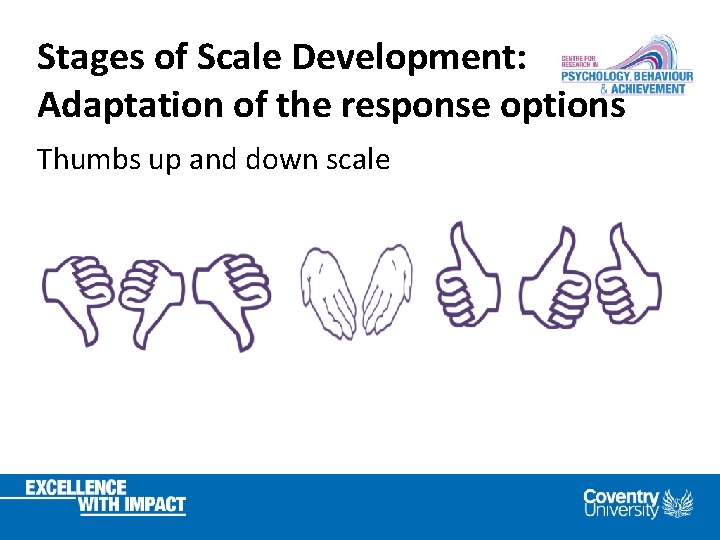
Stages of Scale Development: Adaptation of the response options Thumbs up and down scale
Stages of Scale Development: Cognitive Interviewing Concurrent Verbal Probing Comprehension/interpretation probes – e. g. What do the words ‘in a good maths group’ mean to you? Paraphrasing – Participants were asked to put the item into their own words. General Probes a)Why did you choose that answer b) Was that easy or difficult to answer? c) Did you understand what that meant? Caspar, R. A. ; Lessler, J. T. ; Willis, G. B. (1999) Cognitive Interviewing: A How to Guide
Stages of Scale Development: Is the scale reliable? • n = 322 • 15 items retained. • Cronbach’s Alpha (measure of how closely connected items are) =. 775 (values >. 7 acceptable)
Stages of Scale Development: Is the scale valid over time? • n=255 • Between 4 and 8 weeks later • Wilcoxan Signed Rank Test • No significant difference in the Scale Total.
Worrying Insights • What maths is • Can you get better at maths?
Findings and Thoughts for the Future
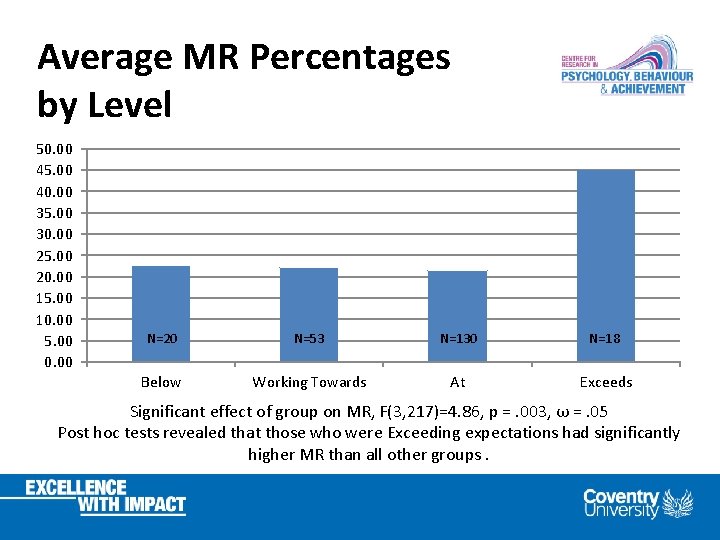
Average MR Percentages by Level 50. 00 45. 00 40. 00 35. 00 30. 00 25. 00 20. 00 15. 00 10. 00 5. 00 0. 00 N=20 N=53 N=130 N=18 Below Working Towards At Exceeds Significant effect of group on MR, F(3, 217)=4. 86, p =. 003, ω =. 05 Post hoc tests revealed that those who were Exceeding expectations had significantly higher MR than all other groups.
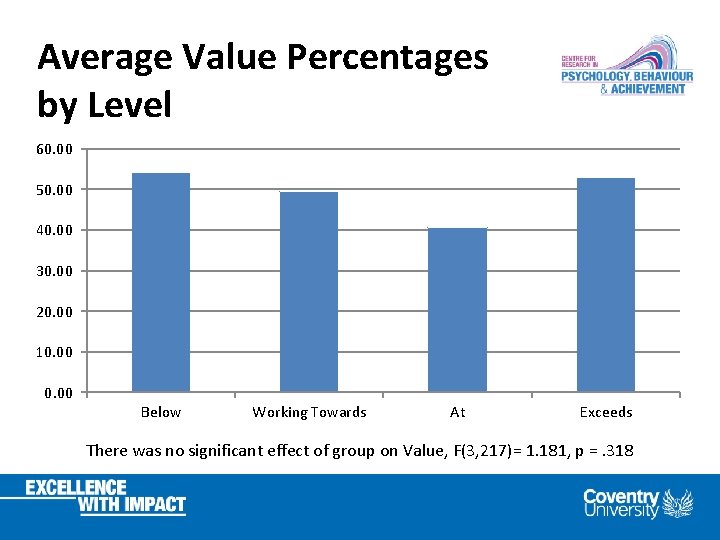
Average Value Percentages by Level 60. 00 50. 00 40. 00 30. 00 20. 00 10. 00 Below Working Towards At Exceeds There was no significant effect of group on Value, F(3, 217)= 1. 181, p =. 318
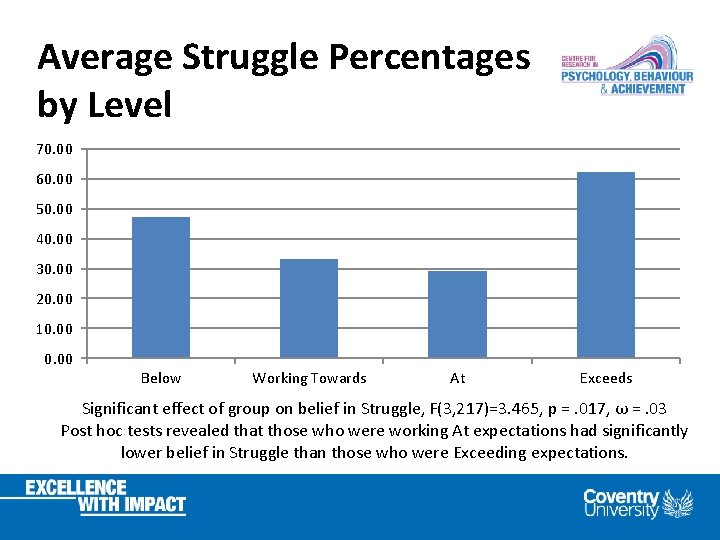
Average Struggle Percentages by Level 70. 00 60. 00 50. 00 40. 00 30. 00 20. 00 10. 00 Below Working Towards At Exceeds Significant effect of group on belief in Struggle, F(3, 217)=3. 465, p =. 017, ω =. 03 Post hoc tests revealed that those who were working At expectations had significantly lower belief in Struggle than those who were Exceeding expectations.
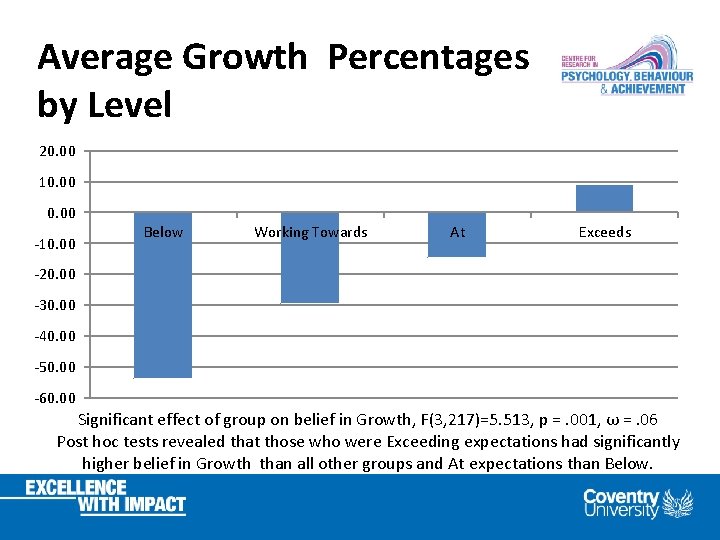
Average Growth Percentages by Level 20. 00 10. 00 -10. 00 Below Working Towards At Exceeds -20. 00 -30. 00 -40. 00 -50. 00 -60. 00 Significant effect of group on belief in Growth, F(3, 217)=5. 513, p =. 001, ω =. 06 Post hoc tests revealed that those who were Exceeding expectations had significantly higher belief in Growth than all other groups and At expectations than Below.
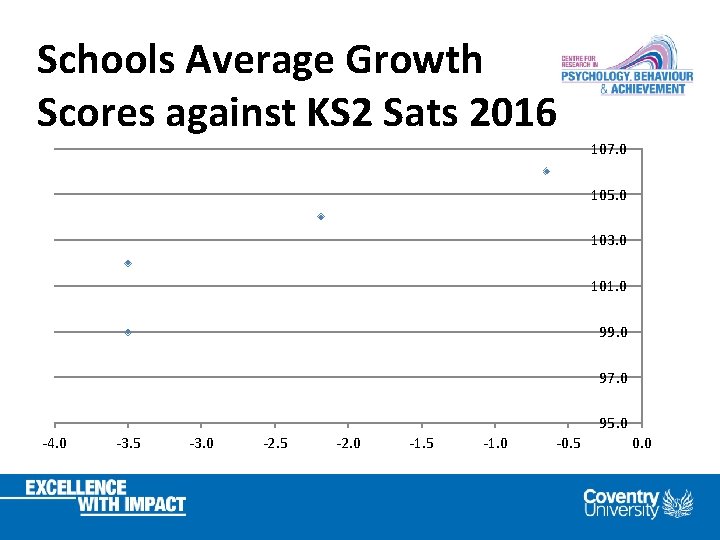
Schools Average Growth Scores against KS 2 Sats 2016 107. 0 105. 0 103. 0 101. 0 99. 0 97. 0 95. 0 -4. 0 -3. 5 -3. 0 -2. 5 -2. 0 -1. 5 -1. 0 -0. 5 0. 0
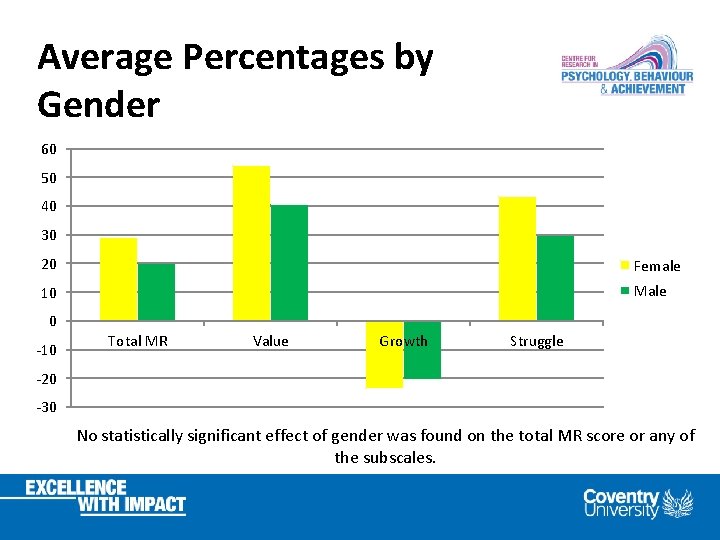
Average Percentages by Gender 60 50 40 30 20 Female 10 Male 0 -10 Total MR Value Growth Struggle -20 -30 No statistically significant effect of gender was found on the total MR score or any of the subscales.
My Details