
A Royal Colony Chapter 6 South Carolina History




- Slides: 49
A Royal Colony Chapter 6 South Carolina History
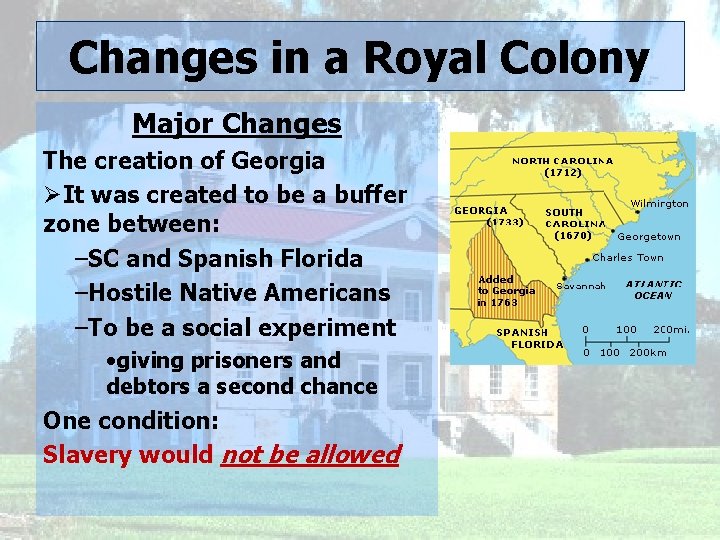
Changes in a Royal Colony Major Changes The creation of Georgia ØIt was created to be a buffer zone between: –SC and Spanish Florida –Hostile Native Americans –To be a social experiment • giving prisoners and debtors a second chance One condition: Slavery would not be allowed
• What were the two concerns South Carolina had about the creation of Georgia?
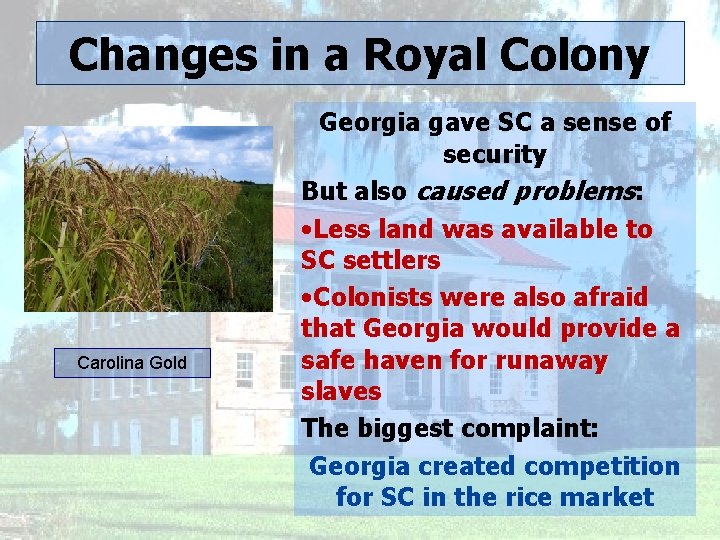
Changes in a Royal Colony Carolina Gold Georgia gave SC a sense of security But also caused problems: • Less land was available to SC settlers • Colonists were also afraid that Georgia would provide a safe haven for runaway slaves The biggest complaint: Georgia created competition for SC in the rice market
• Define mercantilism
Mercantilism MER can til ism ~An economic policy ~Through mercantilism, the mother country tries to get rich off its colonies HOW? • By exporting more products than it imports England was trying to get rich by selling more goods than it was buying from the colonies
• How did England use mercantilism?
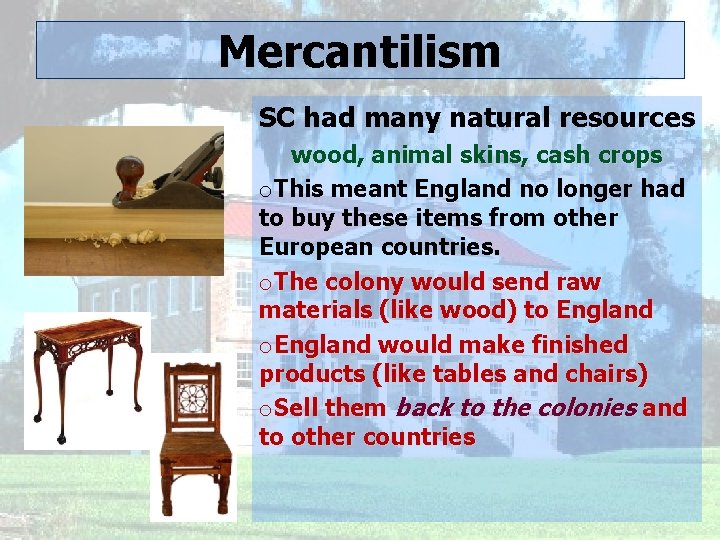
Mercantilism SC had many natural resources wood, animal skins, cash crops o. This meant England no longer had to buy these items from other European countries. o. The colony would send raw materials (like wood) to England o. England would make finished products (like tables and chairs) o. Sell them back to the colonies and to other countries
• What did England do that made South Carolina rich off rice?
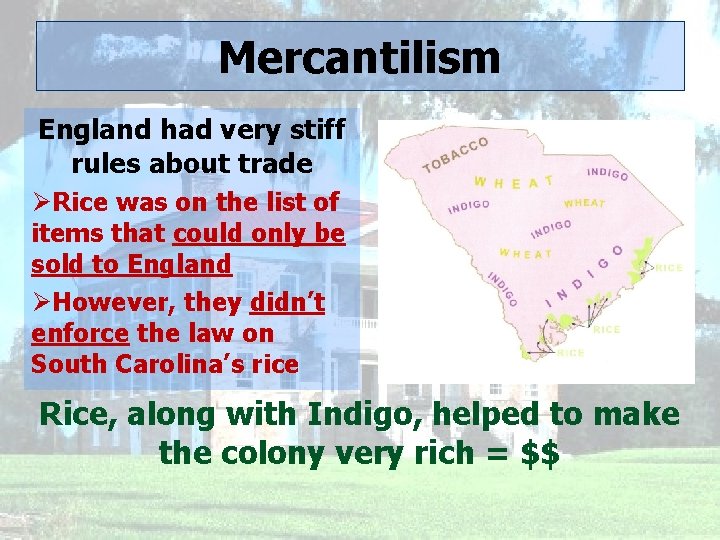
Mercantilism England had very stiff rules about trade ØRice was on the list of items that could only be sold to England ØHowever, they didn’t enforce the law on South Carolina’s rice Rice, along with Indigo, helped to make the colony very rich = $$
• What was England doing that made Eliza Pinckney, and other planters, want to grow indigo? • How did Eliza Lucas Pinckney contribute to South Carolina’s economy?
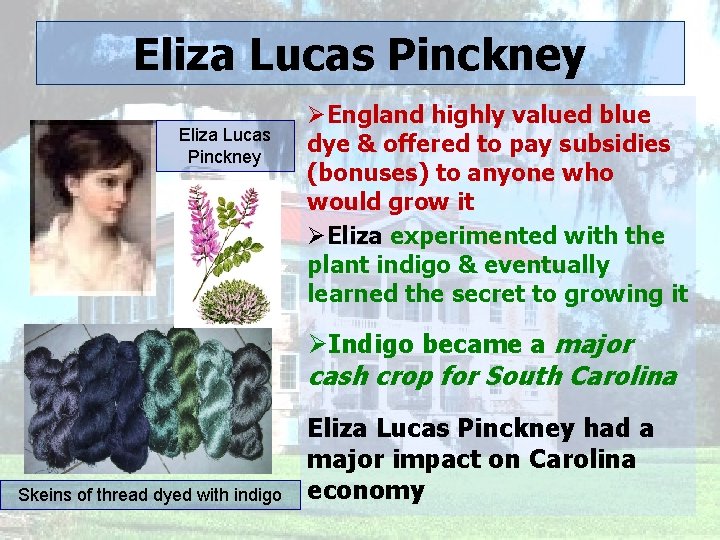
Eliza Lucas Pinckney ØEngland highly valued blue dye & offered to pay subsidies (bonuses) to anyone who would grow it ØEliza experimented with the plant indigo & eventually learned the secret to growing it ØIndigo became a major cash crop for South Carolina Skeins of thread dyed with indigo Eliza Lucas Pinckney had a major impact on Carolina economy
• Who were the first Africans to come to America and with whom did they come? • What increased the need/demand for slave labor in South Carolina?
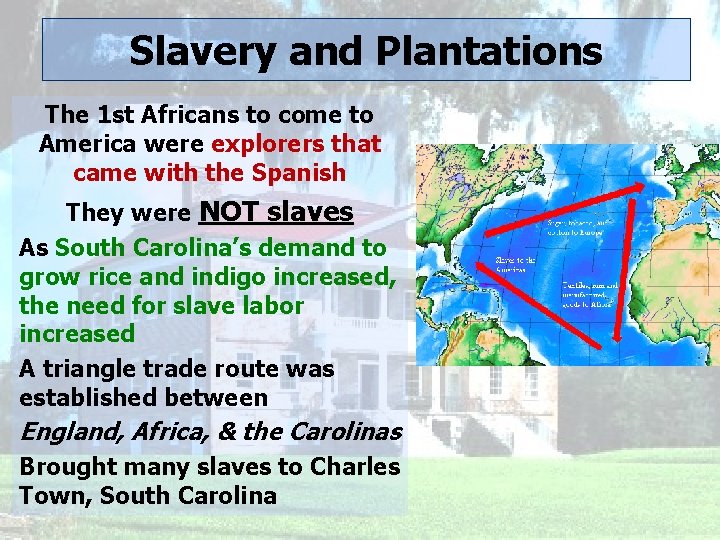
Slavery and Plantations The 1 st Africans to come to America were explorers that came with the Spanish They were NOT slaves As South Carolina’s demand to grow rice and indigo increased, the need for slave labor increased A triangle trade route was established between England, Africa, & the Carolinas Brought many slaves to Charles Town, South Carolina
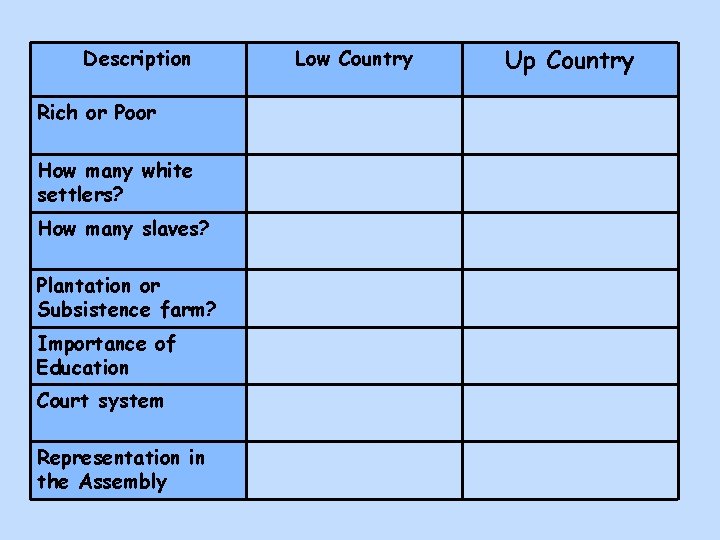
Description Rich or Poor How many white settlers? How many slaves? Plantation or Subsistence farm? Importance of Education Court system Representation in the Assembly Low Country Up Country
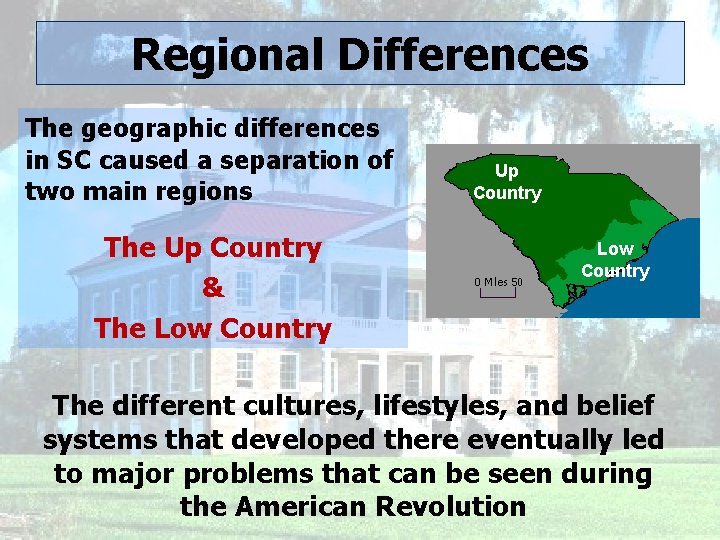
Regional Differences The geographic differences in SC caused a separation of two main regions The Up Country & The Low Country Up Country Low Country The different cultures, lifestyles, and belief systems that developed there eventually led to major problems that can be seen during the American Revolution
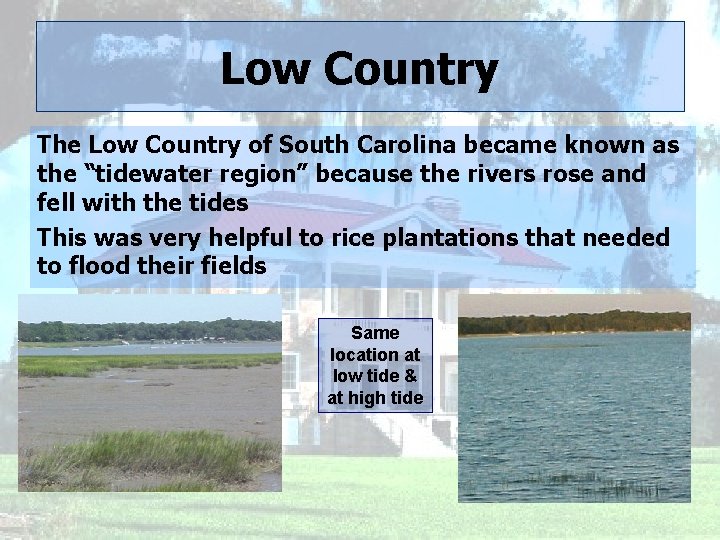
Low Country The Low Country of South Carolina became known as the “tidewater region” because the rivers rose and fell with the tides This was very helpful to rice plantations that needed to flood their fields Same location at low tide & at high tide
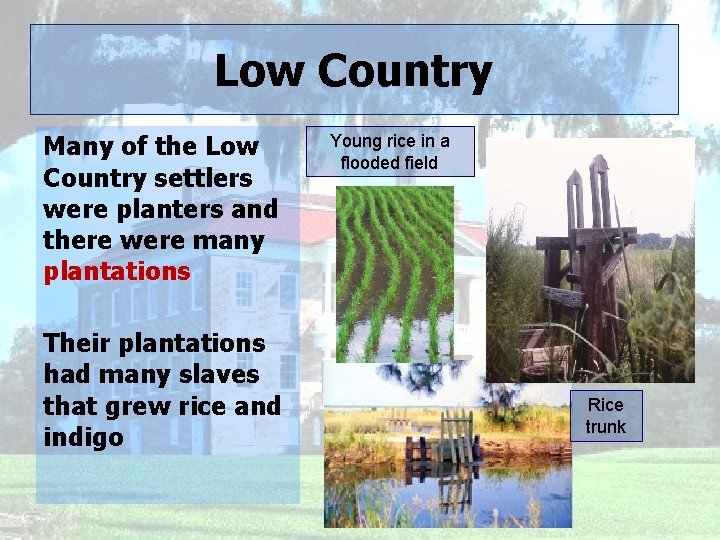
Low Country Many of the Low Country settlers were planters and there were many plantations Their plantations had many slaves that grew rice and indigo Young rice in a flooded field Rice trunk
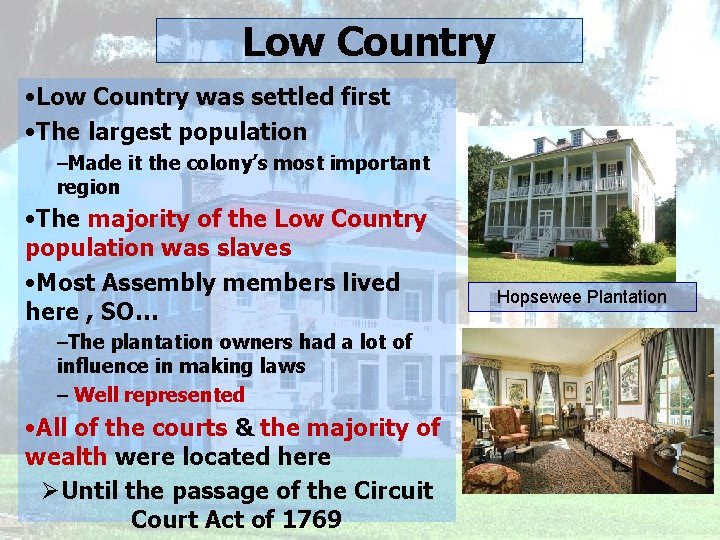
Low Country • Low Country was settled first • The largest population –Made it the colony’s most important region • The majority of the Low Country population was slaves • Most Assembly members lived here , SO… –The plantation owners had a lot of influence in making laws – Well represented • All of the courts & the majority of wealth were located here ØUntil the passage of the Circuit Court Act of 1769 Hopsewee Plantation
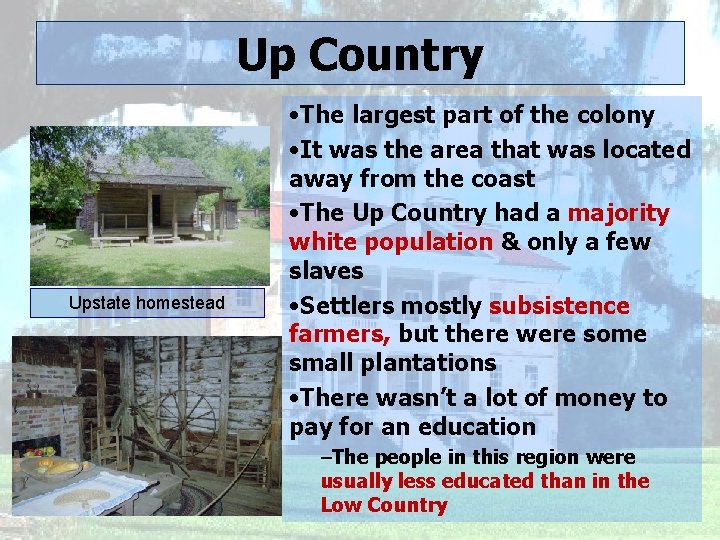
Up Country Upstate homestead • The largest part of the colony • It was the area that was located away from the coast • The Up Country had a majority white population & only a few slaves • Settlers mostly subsistence farmers, but there were some small plantations • There wasn’t a lot of money to pay for an education –The people in this region were usually less educated than in the Low Country
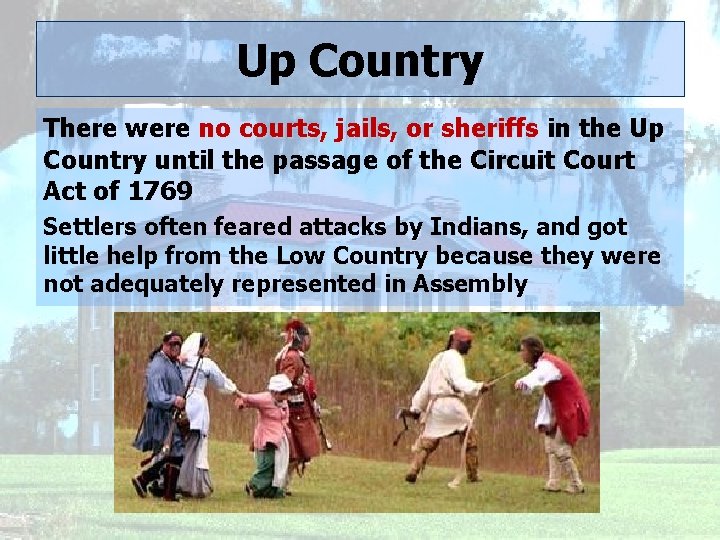
Up Country There were no courts, jails, or sheriffs in the Up Country until the passage of the Circuit Court Act of 1769 Settlers often feared attacks by Indians, and got little help from the Low Country because they were not adequately represented in Assembly
• Three reasons children in SC did not attend school • Slave owners did not want slaves educated because…
Colonial Education According to the colonial leaders of SC, the parents were responsible for education –There was something called a “free school” but students had to pay a tuition to go 3 main reasons that SC children didn’t go to school 1. Were no free schools where children needed them 2. Parents could not afford tuition or simply needed the children at home 3. Parents did not value education could not read or write themselves Slave owners did not want slaves to be educated –Felt education could lead to revolts
• Who were the Regulators? • Why did the Regulator movement start?
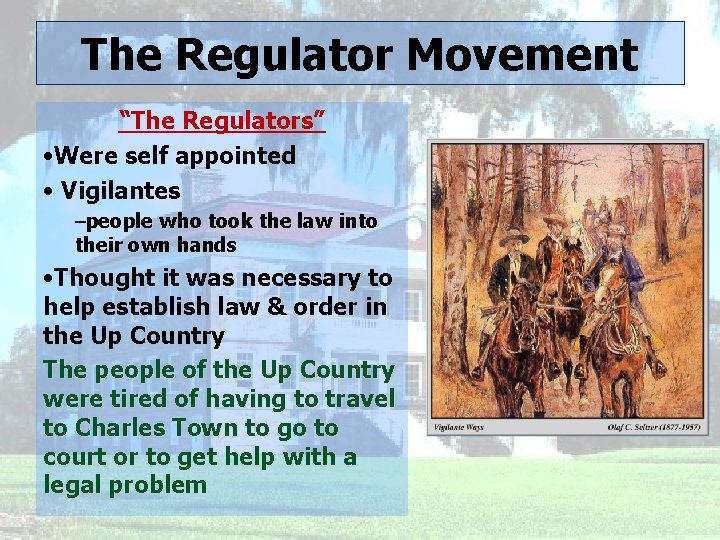
The Regulator Movement “The Regulators” • Were self appointed • Vigilantes –people who took the law into their own hands • Thought it was necessary to help establish law & order in the Up Country The people of the Up Country were tired of having to travel to Charles Town to go to court or to get help with a legal problem
• Two reasons that the Regulator Movement did not work in the long run.
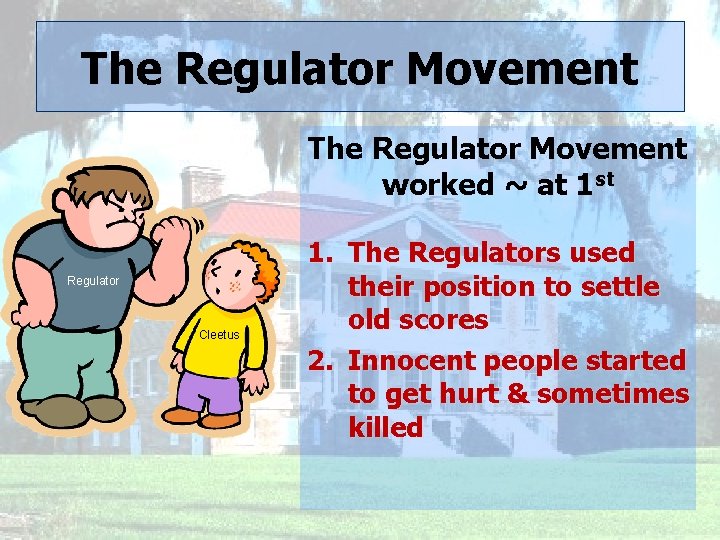
The Regulator Movement worked ~ at 1 st Regulator Cleetus 1. The Regulators used their position to settle old scores 2. Innocent people started to get hurt & sometimes killed
Circuit Court Act of 1769 1. 2. 3. 4.
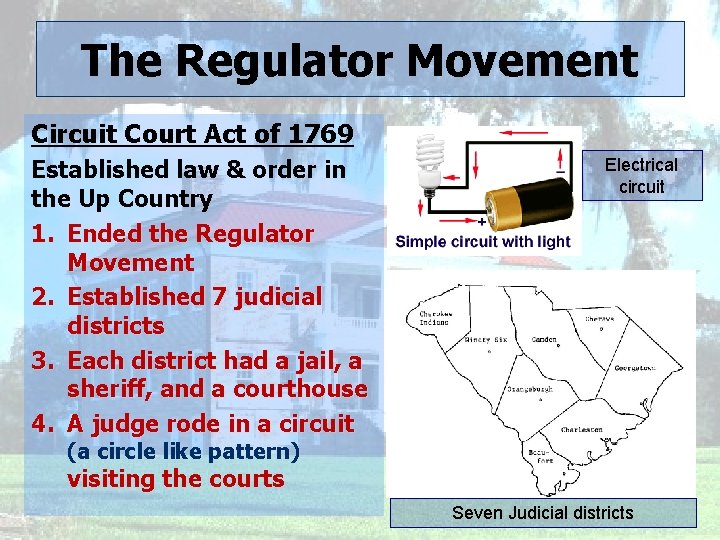
The Regulator Movement Circuit Court Act of 1769 Established law & order in the Up Country 1. Ended the Regulator Movement 2. Established 7 judicial districts 3. Each district had a jail, a sheriff, and a courthouse 4. A judge rode in a circuit Electrical circuit (a circle like pattern) visiting the courts Seven Judicial districts
• The Cherokee had the best relationships with the colonists. • This relationship between the Cherokee & Colonists became strained when…
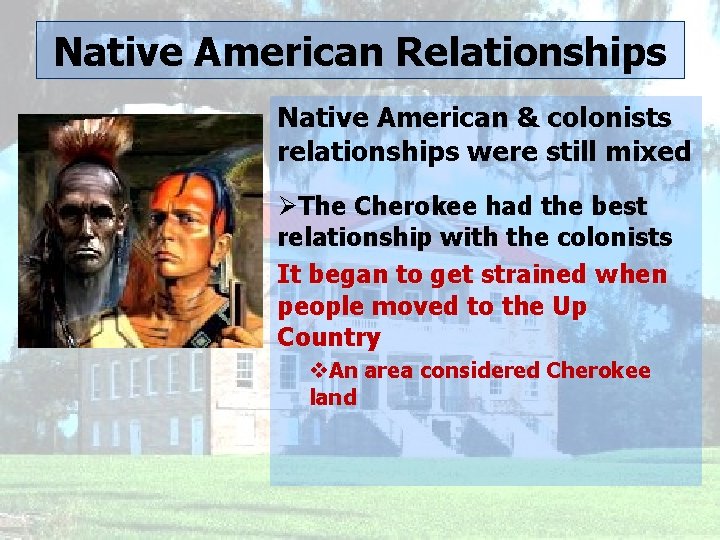
Native American Relationships Native American & colonists relationships were still mixed ØThe Cherokee had the best relationship with the colonists It began to get strained when people moved to the Up Country v. An area considered Cherokee land
• What happened to the Catawba population?
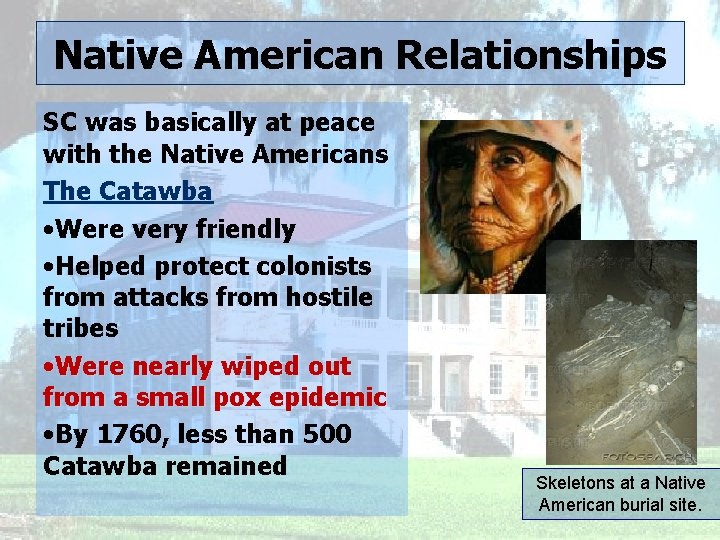
Native American Relationships SC was basically at peace with the Native Americans The Catawba • Were very friendly • Helped protect colonists from attacks from hostile tribes • Were nearly wiped out from a small pox epidemic • By 1760, less than 500 Catawba remained Skeletons at a Native American burial site.
• What did France do that caused England to want to sign a treaty with the Cherokee?
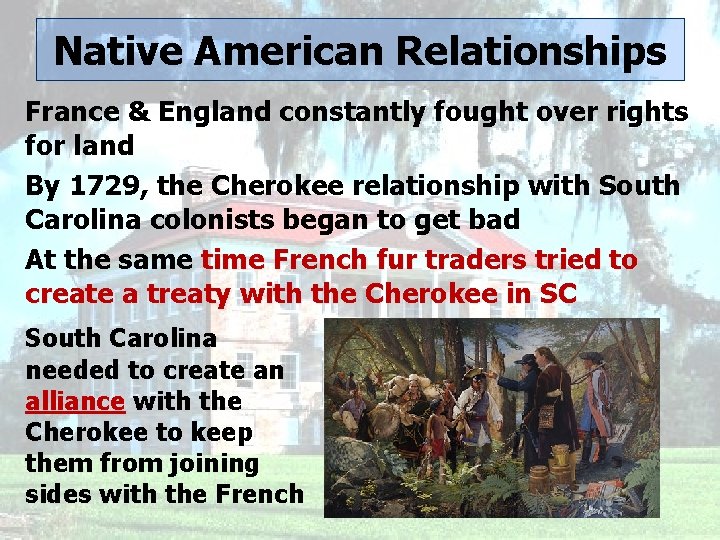
Native American Relationships France & England constantly fought over rights for land By 1729, the Cherokee relationship with South Carolina colonists began to get bad At the same time French fur traders tried to create a treaty with the Cherokee in SC South Carolina needed to create an alliance with the Cherokee to keep them from joining sides with the French
• When the Cherokee signed a treaty with Sir Alexander Cuming, to what did they think they agreed? • To what did England think they agreed?
Native American Relationships Sir Alexander Cuming • Went to talk with the Cherokee –He actually created a misunderstanding As Sir Alexander Cuming spoke lighting flashed in the sky. • He persuaded the Cherokee to enter into a treaty • The Cherokee thought that they were now allies with the British & that they were still equals • The British thought the Native Americans were now subjects of the King of England
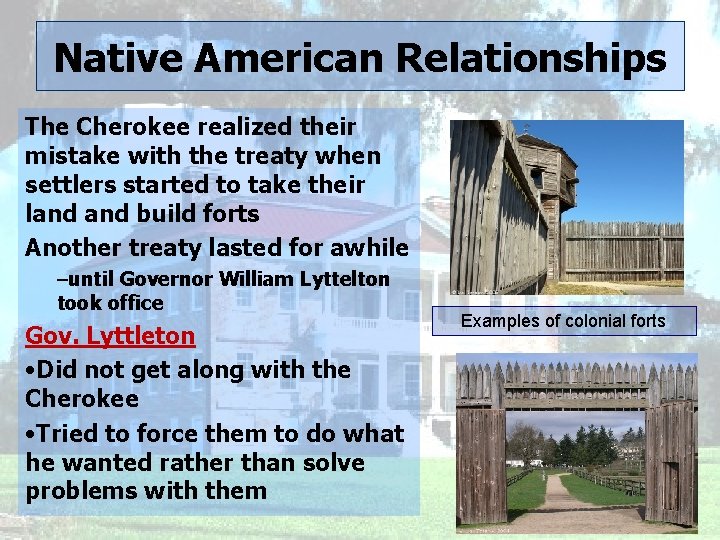
Native American Relationships The Cherokee realized their mistake with the treaty when settlers started to take their land build forts Another treaty lasted for awhile –until Governor William Lyttelton took office Gov. Lyttleton • Did not get along with the Cherokee • Tried to force them to do what he wanted rather than solve problems with them Examples of colonial forts
• What did Gov. William Lyttleton do that directly caused the Cherokee War? 1 2 3 4
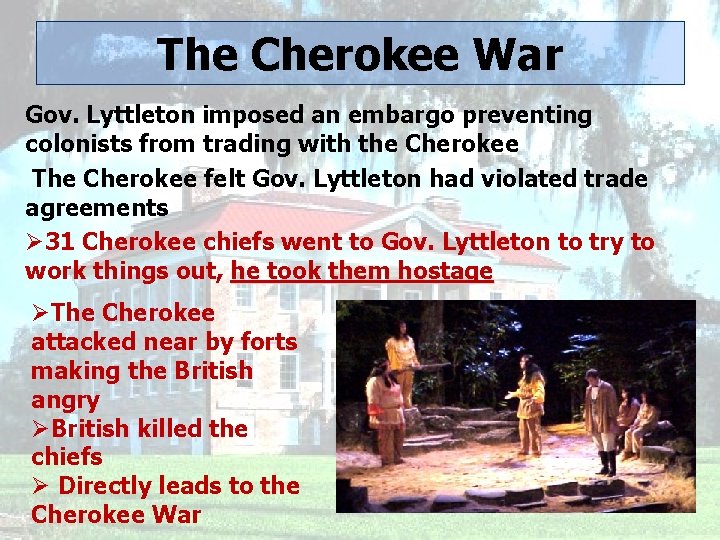
The Cherokee War Gov. Lyttleton imposed an embargo preventing colonists from trading with the Cherokee The Cherokee felt Gov. Lyttleton had violated trade agreements Ø 31 Cherokee chiefs went to Gov. Lyttleton to try to work things out, he took them hostage ØThe Cherokee attacked near by forts making the British angry ØBritish killed the chiefs Ø Directly leads to the Cherokee War
• What other was occurring at the same time as the Cherokee War?
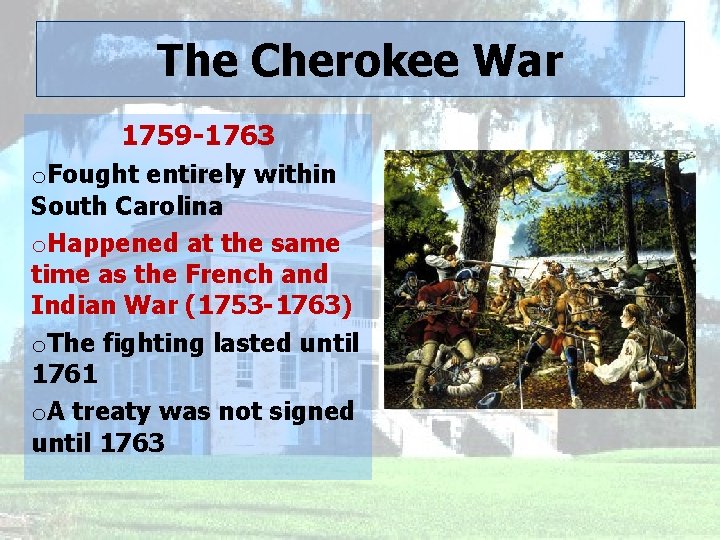
The Cherokee War 1759 -1763 o. Fought entirely within South Carolina o. Happened at the same time as the French and Indian War (1753 -1763) o. The fighting lasted until 1761 o. A treaty was not signed until 1763
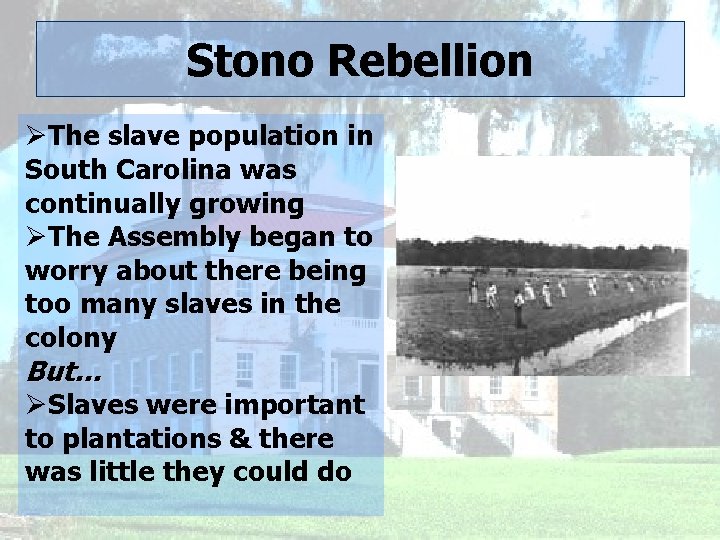
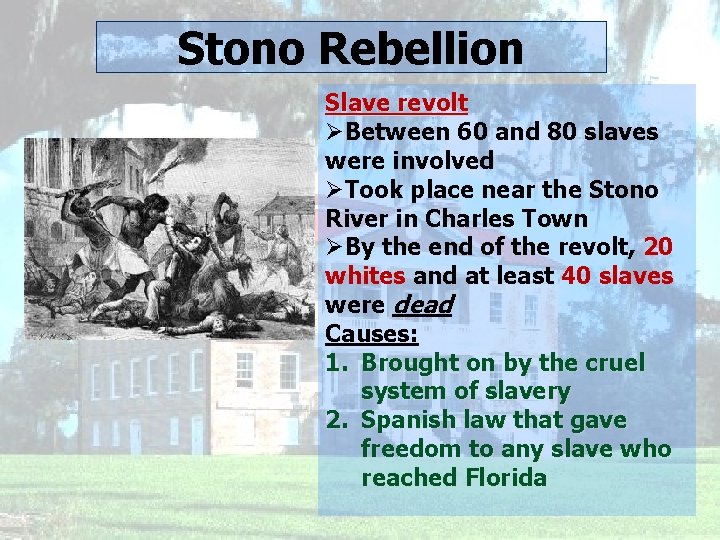
Stono Rebellion ØThe slave population in South Carolina was continually growing ØThe Assembly began to worry about there being too many slaves in the colony But… ØSlaves were important to plantations & there was little they could do
• What was the Stono Rebellion? • Two Causes of the Stono Rebellion 1 2
Stono Rebellion Slave revolt ØBetween 60 and 80 slaves were involved ØTook place near the Stono River in Charles Town ØBy the end of the revolt, 20 whites and at least 40 slaves were dead Causes: 1. Brought on by the cruel system of slavery 2. Spanish law that gave freedom to any slave who reached Florida
The Slave Codes were created as a result of the Stono Rebellion. • The Slave Codes … > >
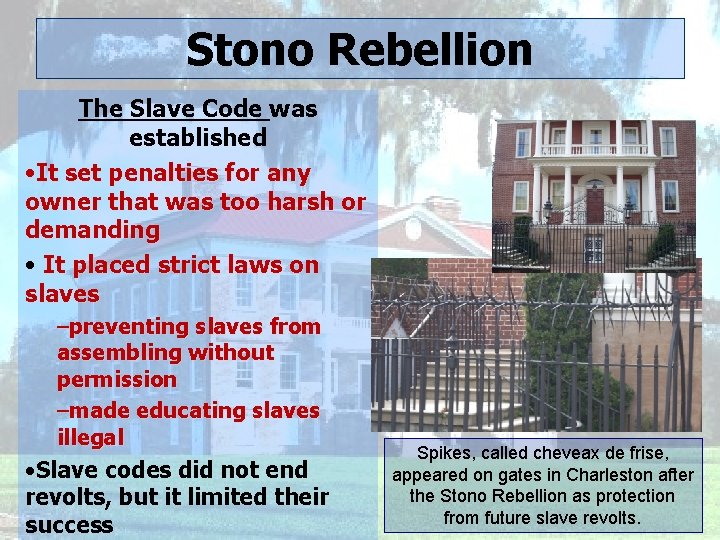
Stono Rebellion The Slave Code was established • It set penalties for any owner that was too harsh or demanding • It placed strict laws on slaves –preventing slaves from assembling without permission –made educating slaves illegal • Slave codes did not end revolts, but it limited their success Spikes, called cheveax de frise, appeared on gates in Charleston after the Stono Rebellion as protection from future slave revolts.
• Why did the population of South Carolina continue to grow even though there was disease and war?
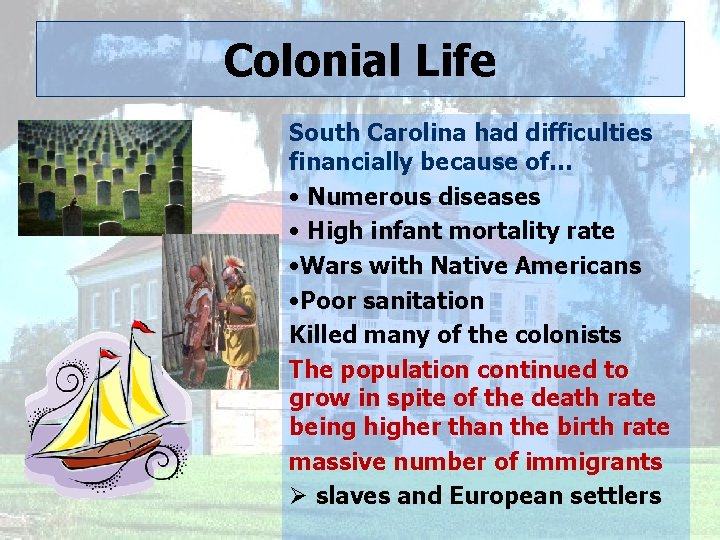
Colonial Life South Carolina had difficulties financially because of… • Numerous diseases • High infant mortality rate • Wars with Native Americans • Poor sanitation Killed many of the colonists The population continued to grow in spite of the death rate being higher than the birth rate massive number of immigrants Ø slaves and European settlers