
A Roadmap for Meeting Institutional Retention Goals Helping


- Slides: 72
A Roadmap for Meeting Institutional Retention Goals & Helping More Students Succeed ACT Enrollment Planners Conference, Chicago, IL July 20, 2006
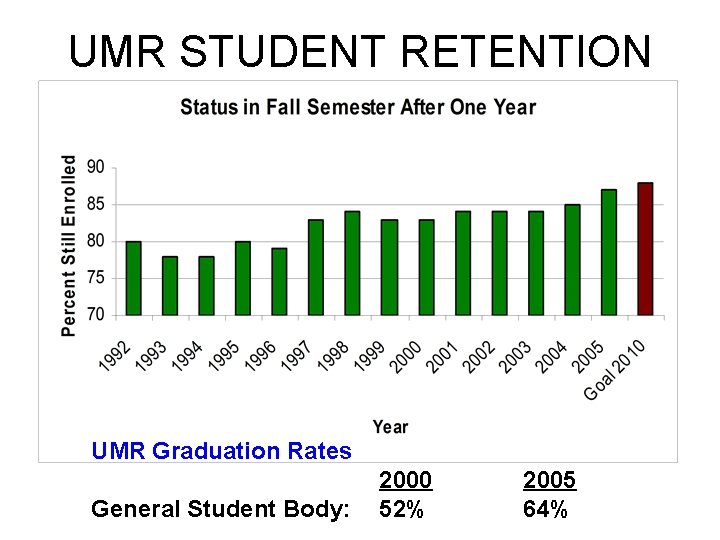
UMR STUDENT RETENTION UMR Graduation Rates General Student Body: 2000 52% 2005 64%
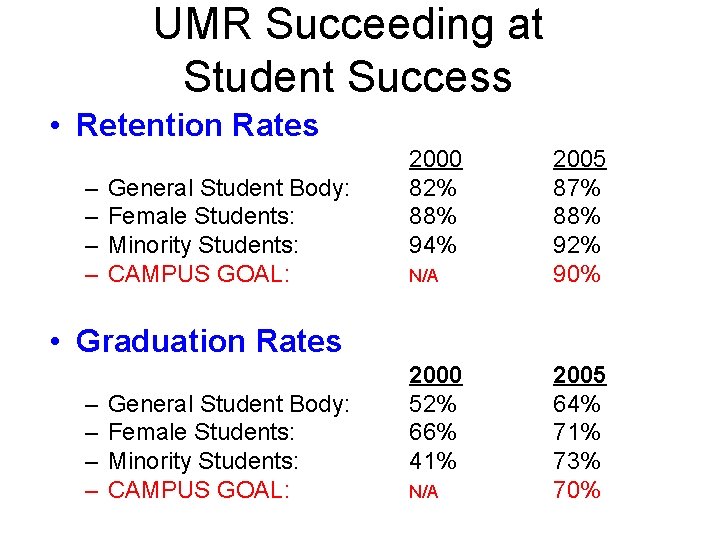
UMR Succeeding at Student Success • Retention Rates – – General Student Body: Female Students: Minority Students: CAMPUS GOAL: 2000 82% 88% 94% N/A 2005 87% 88% 92% 90% • Graduation Rates – – General Student Body: Female Students: Minority Students: CAMPUS GOAL: 2000 52% 66% 41% N/A 2005 64% 71% 73% 70%
Background on Building the Student Retention and Graduation Plan
Executive Primer on Student Persistence and Retention • Retention rates commonly measure the percentage of freshmen that re-enroll the next academic year as sophomores. The primary reason that retention rates, along with graduation rates, are important is that retention rates are perceived as indicators of academic quality and student success. • In addition to retention, persistence, a student's continuation behavior leading to a desired goal, helps describe processes related to student goal achievement. • Generalizations about retention can be misleading because each school is dynamically unique in terms of academic emphasis and culture. Retention issues can be further complicated because of the necessity to understand students' educational goals in assessing whether leaving school is a negative or positive decision. ADAPTED FROM: DANA Center Retention Report, 1998
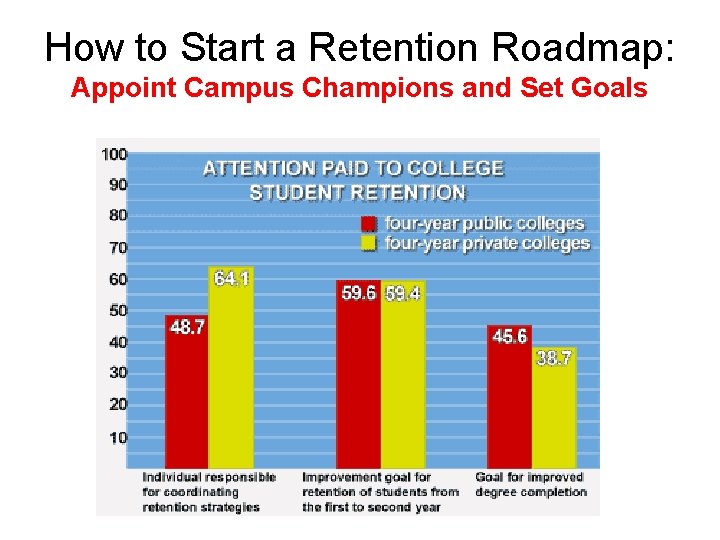
How to Start a Retention Roadmap: Appoint Campus Champions and Set Goals
ACT’s 2006 Retention Recommendations: “colleges (should) create a structured, comprehensive retention program geared to assist students as they make the transition to college life. ” 1. Designate a visible, senior-level individual on campus to coordinate retention activities. 2. Analyze student characteristics and needs and then implement a formal retention program that best meets those needs and the needs of the institution. 3. Take an integrated approach to retention efforts that incorporates both academic and non-academic factors. 4. Implement an early-alert assessment and monitoring system to identify students at risk of dropping out. SOURCE: ACT Retention Research Report, 2006 http: //www. act. org/path/policy/pdf/college_retention. pdf
DANA CENTER RETENTION REPORT, 1998 1. Typically four-year schools have higher retention rates than do two-year schools. 2. In general, studies indicate that financial aid helps increase persistence for students who need and receive financial aid. 3. Studies indicate that certain student populations, such as older students, African Americans and Hispanics, students who work more than 30 hours weekly, and first generation college students often have persistence problems. 4. According to research studies, a few factors that influence persistence include the intent to persist, institutional and student commitment, college grades, high school academic experience, and social and academic integration. 5. Schools can improve retention rates by more accurately determining when and why students withdraw. Having more up-to-date information could help administrators determine better strategies for increasing retention rates. 6. Recommend increasing retention rates by encouraging schools to develop and implement their unique retention plans and by strengthening freshmen-year instruction.
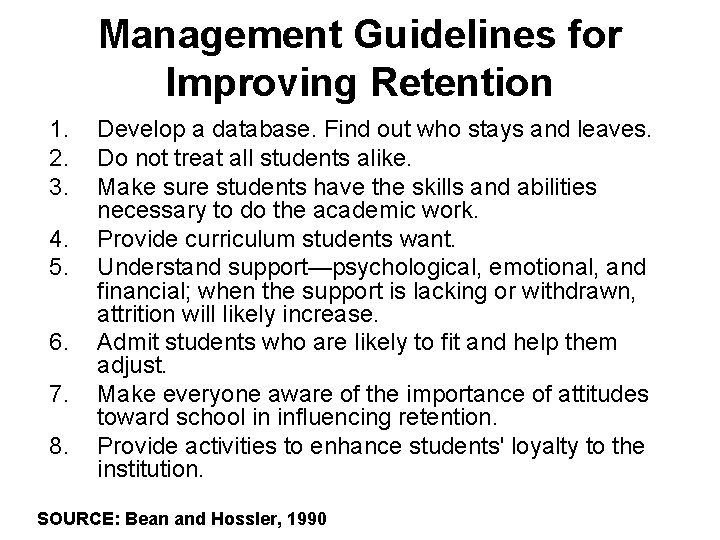
Management Guidelines for Improving Retention 1. 2. 3. 4. 5. 6. 7. 8. Develop a database. Find out who stays and leaves. Do not treat all students alike. Make sure students have the skills and abilities necessary to do the academic work. Provide curriculum students want. Understand support—psychological, emotional, and financial; when the support is lacking or withdrawn, attrition will likely increase. Admit students who are likely to fit and help them adjust. Make everyone aware of the importance of attitudes toward school in influencing retention. Provide activities to enhance students' loyalty to the institution. SOURCE: Bean and Hossler, 1990
How Did We Do It?
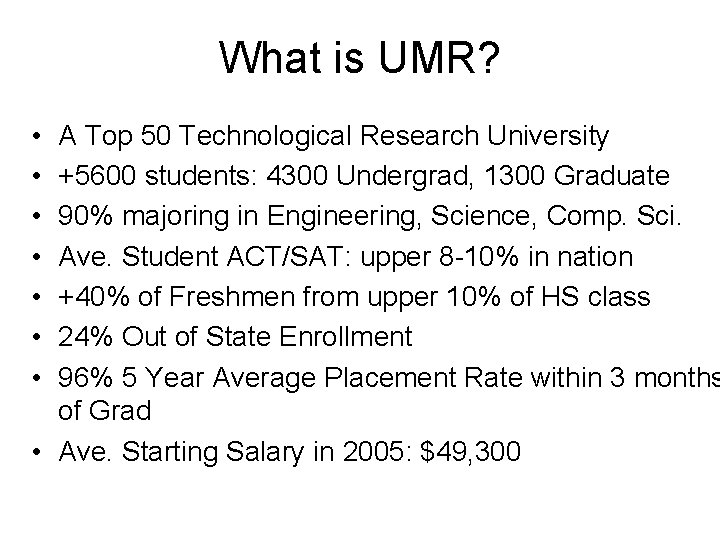
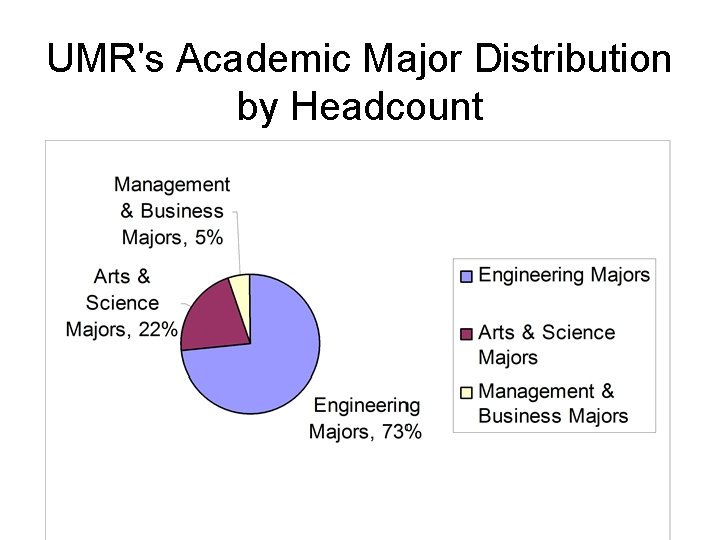
What is UMR? • • A Top 50 Technological Research University +5600 students: 4300 Undergrad, 1300 Graduate 90% majoring in Engineering, Science, Comp. Sci. Ave. Student ACT/SAT: upper 8 -10% in nation +40% of Freshmen from upper 10% of HS class 24% Out of State Enrollment 96% 5 Year Average Placement Rate within 3 months of Grad • Ave. Starting Salary in 2005: $49, 300
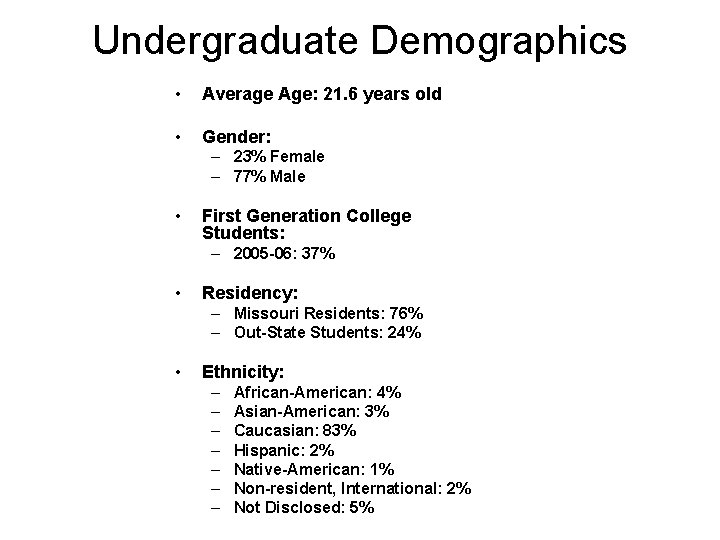
Undergraduate Demographics • Average Age: 21. 6 years old • Gender: – 23% Female – 77% Male • First Generation College Students: – 2005 -06: 37% • Residency: – Missouri Residents: 76% – Out-State Students: 24% • Ethnicity: – – – – African-American: 4% Asian-American: 3% Caucasian: 83% Hispanic: 2% Native-American: 1% Non-resident, International: 2% Not Disclosed: 5%
UMR's Academic Major Distribution by Headcount
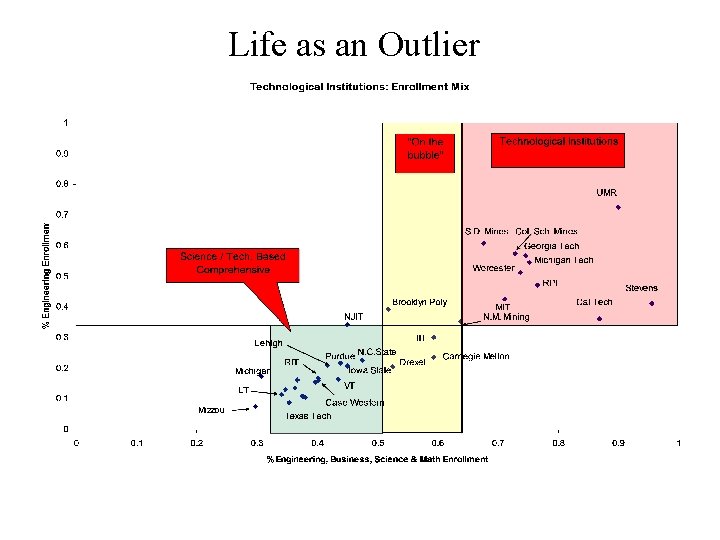
Life as an Outlier
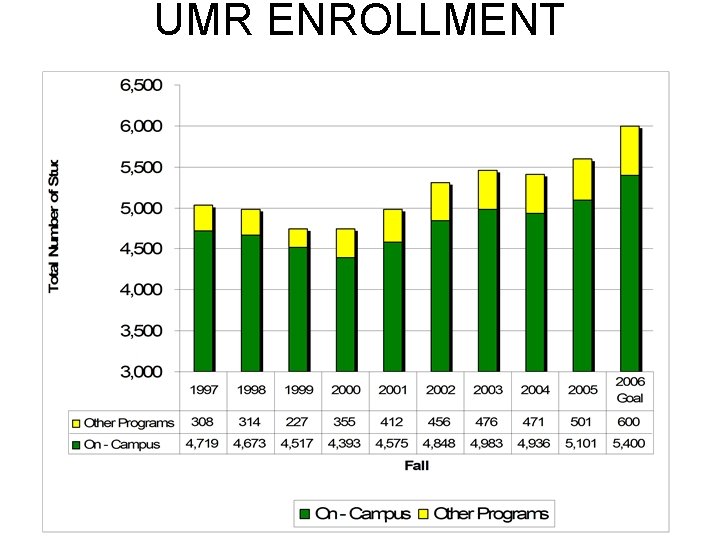
UMR ENROLLMENT
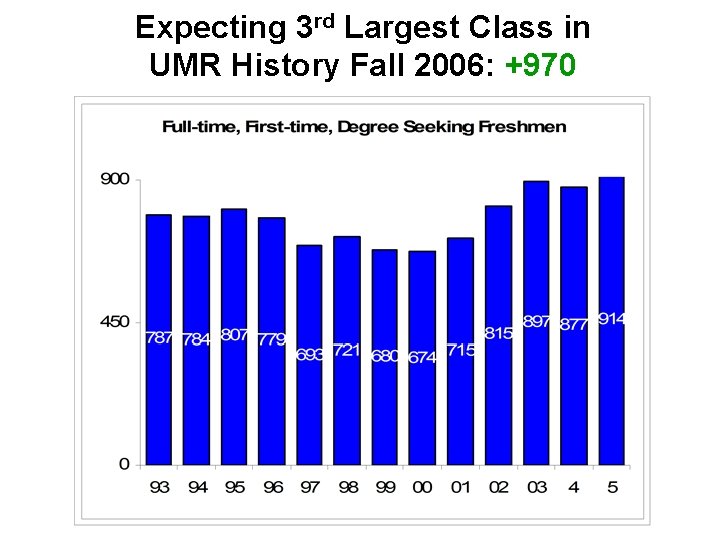
Expecting 3 rd Largest Class in UMR History Fall 2006: +970
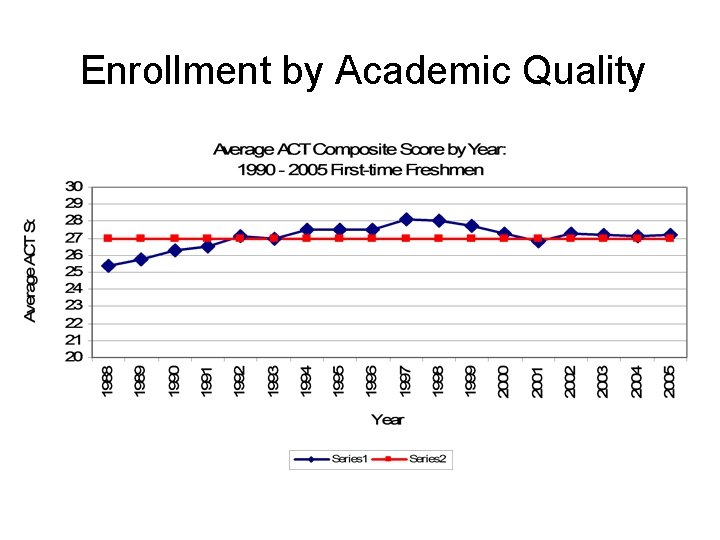
Enrollment by Academic Quality
UMR’s Key Performance Indicators and Instruments for Retention Audit • • • Freshmen to sophomore persistence rate Six-year graduation rate Students leaving identified on early warning system Withdraw surveys & interviews Non-returning follow-up telephone surveys Freshman academic profile, specifically GPA, course work completed, and ACT/SAT scores. • Student satisfaction levels • Faculty evaluations • Stop-out Rate: Students who withdraw and return SOURCE: UMR Retention Committee and Enrollment Development Team Recommendations, 2000 -2002
BENCHMARKING: Did UMR Have a Retention Problem?
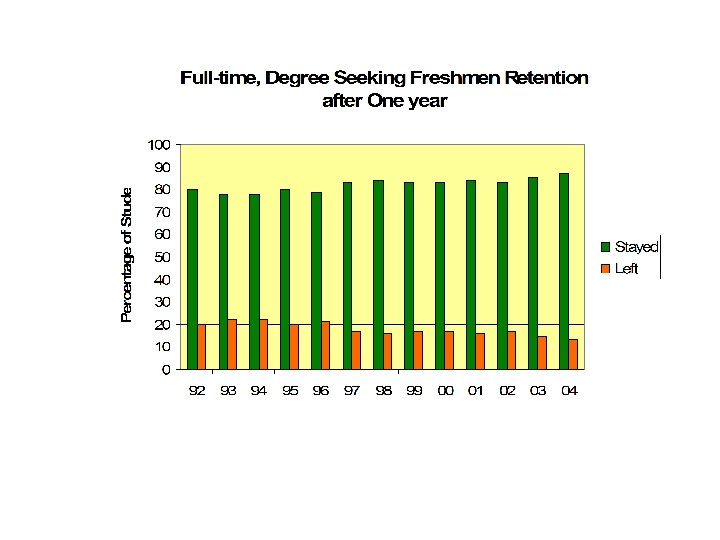
UMR Compared to National Data • UMR: 13% “drop out” rate after the first year • 23. 8% “drop out” rate for public Ph. D. granting institutions (July 2001 ACT National Collegiate Dropout and Graduation Rates report) • 18. 6% “drop out” rate for “selective” institutions (average ACT 22 -27) (July 2001 ACT National Collegiate Dropout and Graduation Rates report) • 31% of all students enrolled in science, mathematics, engineering and technology either transferred to a non-SMET degree or dropped out of school completely. (September 2001 Center for Institutional Data Exchange and Analysis) • 13. 4% of students at the participating institutions ranked as highly selective (ACT>24) dropped out. This number is lower than UMR’s dropout rate. (September 2001 Center for Institutional Data Exchange and Analysis)
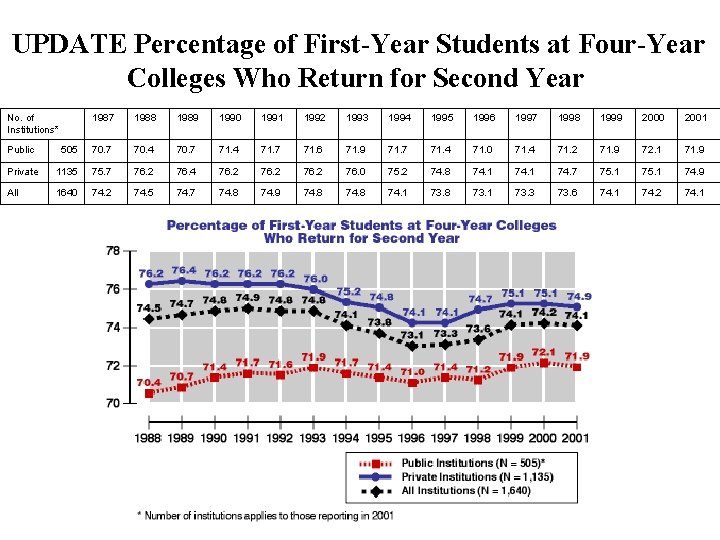
UPDATE Percentage of First-Year Students at Four-Year Colleges Who Return for Second Year No. of Institutions* 1987 1988 1989 1990 1991 1992 1993 1994 1995 1996 1997 1998 1999 2000 2001 Public 505 70. 7 70. 4 70. 7 71. 4 71. 7 71. 6 71. 9 71. 7 71. 4 71. 0 71. 4 71. 2 71. 9 72. 1 71. 9 Private 1135 75. 7 76. 2 76. 4 76. 2 76. 0 75. 2 74. 8 74. 1 74. 7 75. 1 74. 9 All 1640 74. 2 74. 5 74. 7 74. 8 74. 9 74. 8 74. 1 73. 8 73. 1 73. 3 73. 6 74. 1 74. 2 74. 1
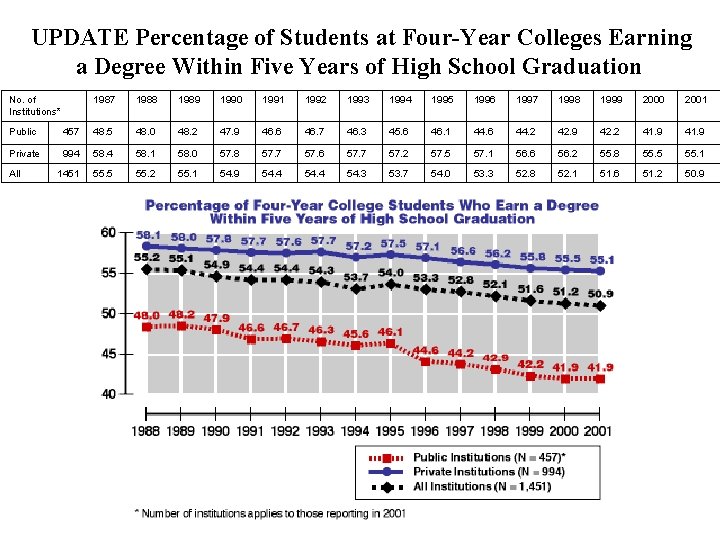
UPDATE Percentage of Students at Four-Year Colleges Earning a Degree Within Five Years of High School Graduation No. of Institutions* 1987 1988 1989 1990 1991 1992 1993 1994 1995 1996 1997 1998 1999 2000 2001 Public 457 48. 5 48. 0 48. 2 47. 9 46. 6 46. 7 46. 3 45. 6 46. 1 44. 6 44. 2 42. 9 42. 2 41. 9 Private 994 58. 1 58. 0 57. 8 57. 7 57. 6 57. 7 57. 2 57. 5 57. 1 56. 6 56. 2 55. 8 55. 5 55. 1 1451 55. 5 55. 2 55. 1 54. 9 54. 4 54. 3 53. 7 54. 0 53. 3 52. 8 52. 1 51. 6 51. 2 50. 9 All
INSTITUTIONAL REASEARCH TRACKING Who is leaving?
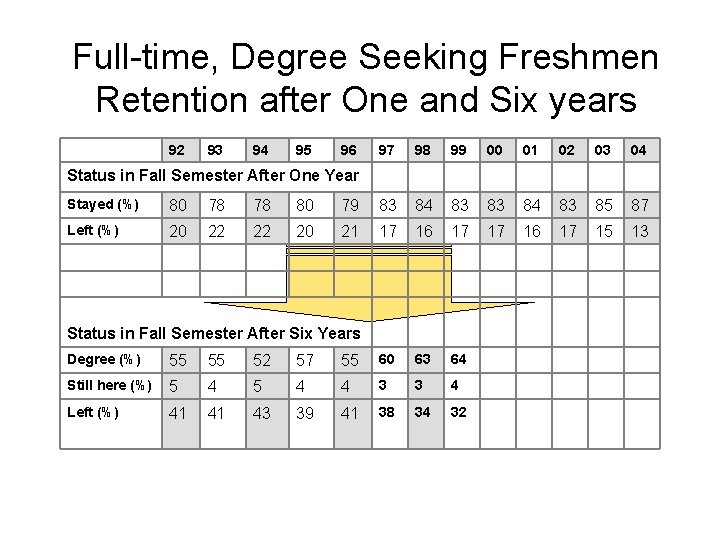
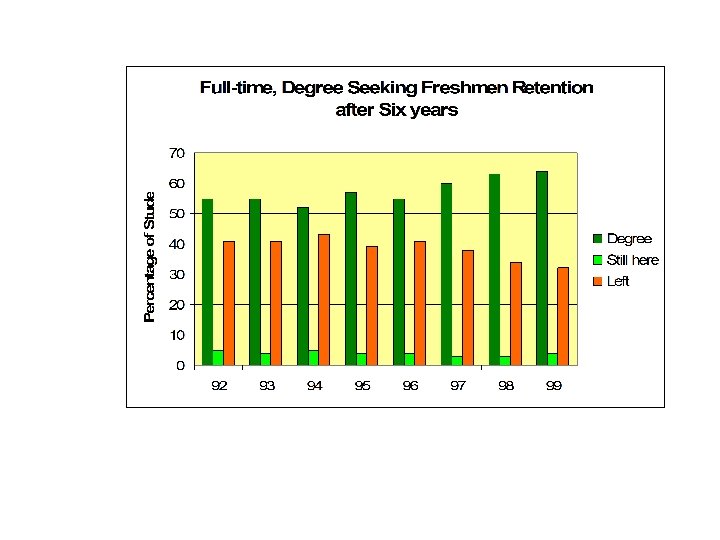
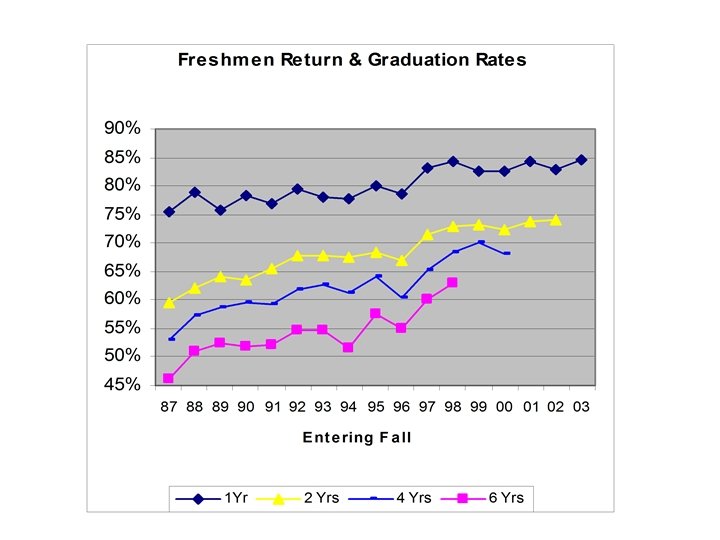
Full-time, Degree Seeking Freshmen Retention after One and Six years 92 93 94 95 96 97 98 99 00 01 02 03 04 Status in Fall Semester After One Year Stayed (%) 80 78 78 80 79 83 84 83 85 87 Left (%) 20 22 22 20 21 17 16 17 15 13 Status in Fall Semester After Six Years Degree (%) 55 55 52 57 55 60 63 64 Still here (%) 5 4 4 3 3 4 Left (%) 41 41 43 39 41 38 34 32
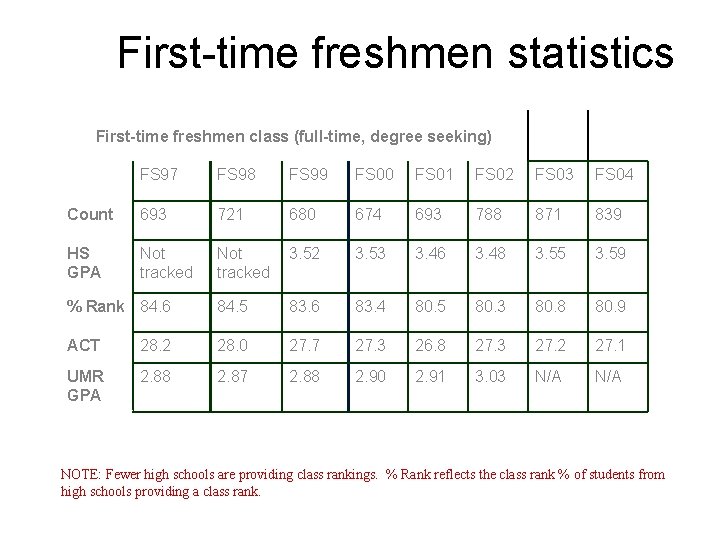
First-time freshmen statistics First-time freshmen class (full-time, degree seeking) FS 97 FS 98 FS 99 FS 00 FS 01 FS 02 FS 03 FS 04 Count 693 721 680 674 693 788 871 839 HS GPA Not tracked 3. 52 3. 53 3. 46 3. 48 3. 55 3. 59 % Rank 84. 6 84. 5 83. 6 83. 4 80. 5 80. 3 80. 8 80. 9 ACT 28. 2 28. 0 27. 7 27. 3 26. 8 27. 3 27. 2 27. 1 UMR GPA 2. 88 2. 87 2. 88 2. 90 2. 91 3. 03 N/A NOTE: Fewer high schools are providing class rankings. % Rank reflects the class rank % of students from high schools providing a class rank.
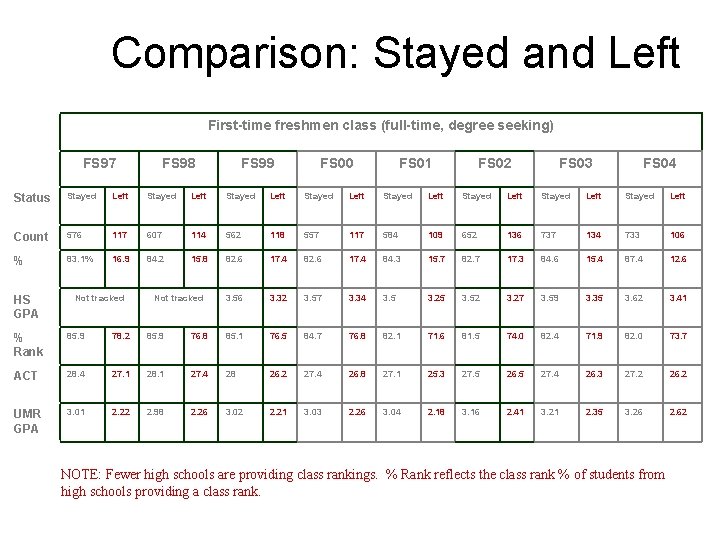
Comparison: Stayed and Left First-time freshmen class (full-time, degree seeking) FS 97 FS 98 FS 99 FS 00 FS 01 FS 02 FS 03 FS 04 Status Stayed Left Stayed Left Count 576 117 607 114 562 118 557 117 584 109 652 136 737 134 733 106 % 83. 1% 16. 9 84. 2 15. 8 82. 6 17. 4 84. 3 15. 7 82. 7 17. 3 84. 6 15. 4 87. 4 12. 6 3. 56 3. 32 3. 57 3. 34 3. 5 3. 25 3. 52 3. 27 3. 59 3. 35 3. 62 3. 41 HS GPA Not tracked % Rank 85. 9 78. 2 85. 9 76. 8 85. 1 76. 5 84. 7 76. 8 82. 1 71. 6 81. 5 74. 0 82. 4 71. 9 82. 0 73. 7 ACT 28. 4 27. 1 28. 1 27. 4 28 26. 2 27. 4 26. 8 27. 1 25. 3 27. 5 26. 5 27. 4 26. 3 27. 2 26. 2 UMR GPA 3. 01 2. 22 2. 98 2. 26 3. 02 2. 21 3. 03 2. 26 3. 04 2. 18 3. 16 2. 41 3. 21 2. 35 3. 26 2. 62 NOTE: Fewer high schools are providing class rankings. % Rank reflects the class rank % of students from high schools providing a class rank.
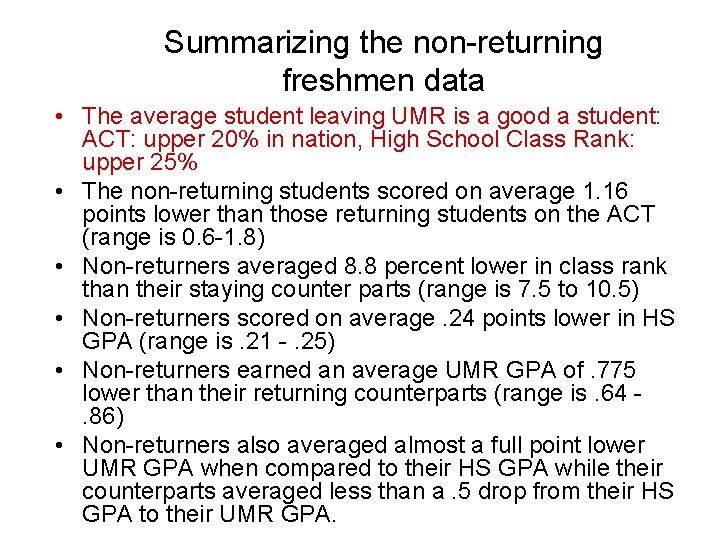
Summarizing the non-returning freshmen data • The average student leaving UMR is a good a student: ACT: upper 20% in nation, High School Class Rank: upper 25% • The non-returning students scored on average 1. 16 points lower than those returning students on the ACT (range is 0. 6 -1. 8) • Non-returners averaged 8. 8 percent lower in class rank than their staying counter parts (range is 7. 5 to 10. 5) • Non-returners scored on average. 24 points lower in HS GPA (range is. 21 -. 25) • Non-returners earned an average UMR GPA of. 775 lower than their returning counterparts (range is. 64. 86) • Non-returners also averaged almost a full point lower UMR GPA when compared to their HS GPA while their counterparts averaged less than a. 5 drop from their HS GPA to their UMR GPA.
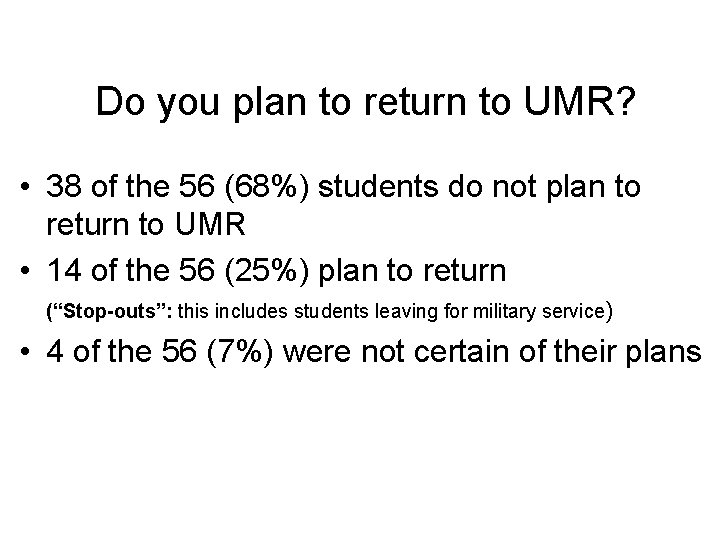
Do you plan to return to UMR? • 38 of the 56 (68%) students do not plan to return to UMR • 14 of the 56 (25%) plan to return (“Stop-outs”: this includes students leaving for military service) • 4 of the 56 (7%) were not certain of their plans
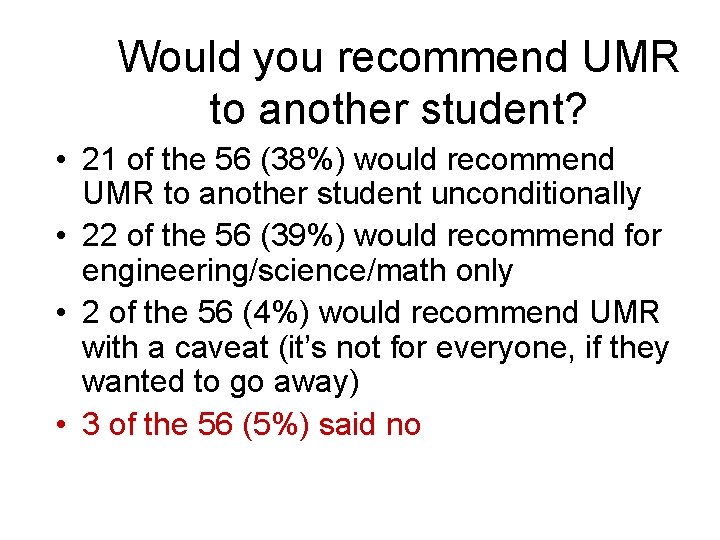
Would you recommend UMR to another student? • 21 of the 56 (38%) would recommend UMR to another student unconditionally • 22 of the 56 (39%) would recommend for engineering/science/math only • 2 of the 56 (4%) would recommend UMR with a caveat (it’s not for everyone, if they wanted to go away) • 3 of the 56 (5%) said no
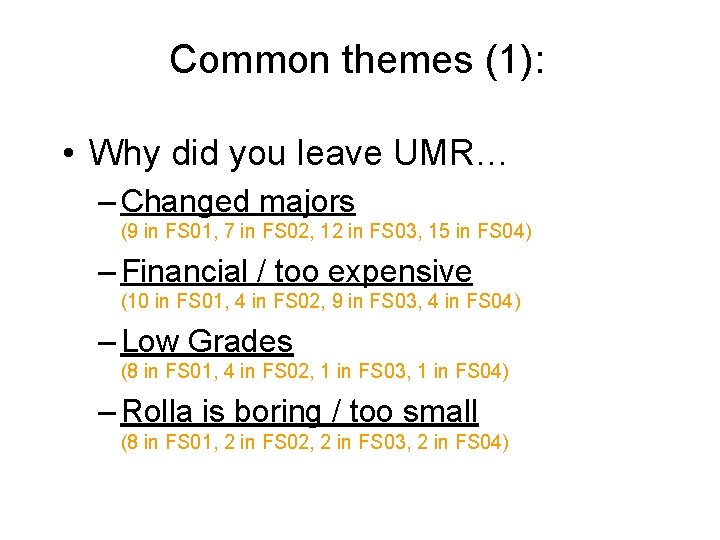
Common themes (1): • Why did you leave UMR… – Changed majors (9 in FS 01, 7 in FS 02, 12 in FS 03, 15 in FS 04) – Financial / too expensive (10 in FS 01, 4 in FS 02, 9 in FS 03, 4 in FS 04) – Low Grades (8 in FS 01, 4 in FS 02, 1 in FS 03, 1 in FS 04) – Rolla is boring / too small (8 in FS 01, 2 in FS 02, 2 in FS 03, 2 in FS 04)
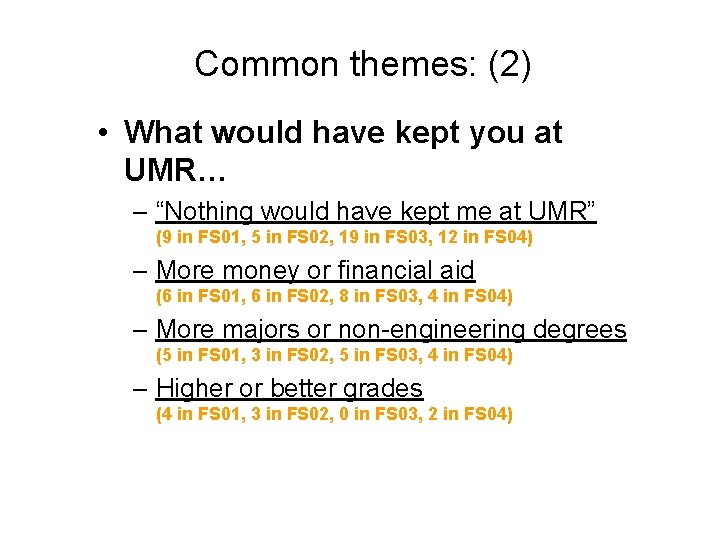
Common themes: (2) • What would have kept you at UMR… – “Nothing would have kept me at UMR” (9 in FS 01, 5 in FS 02, 19 in FS 03, 12 in FS 04) – More money or financial aid (6 in FS 01, 6 in FS 02, 8 in FS 03, 4 in FS 04) – More majors or non-engineering degrees (5 in FS 01, 3 in FS 02, 5 in FS 03, 4 in FS 04) – Higher or better grades (4 in FS 01, 3 in FS 02, 0 in FS 03, 2 in FS 04)
Improving Student Success Retention Strategies STRATEGIC PLAN GOAL: 67 -70% Graduation Rate
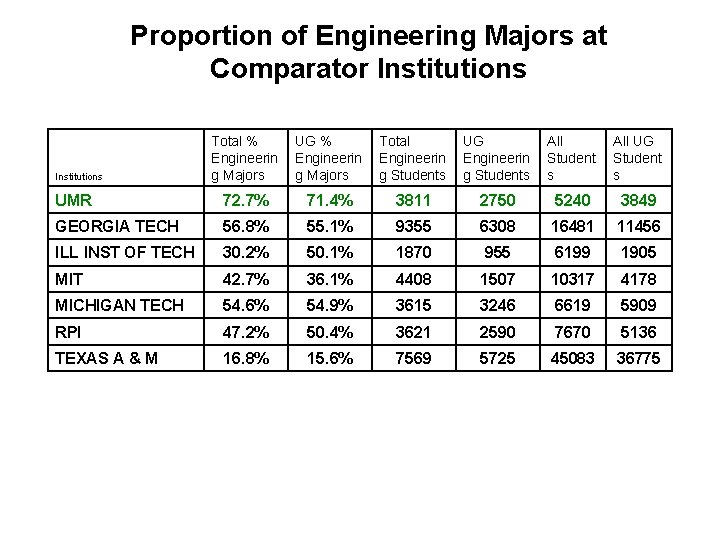
Proportion of Engineering Majors at Comparator Institutions Total % Engineerin g Majors UG % Engineerin g Majors Total Engineerin g Students UG Engineerin g Students All Student s All UG Student s UMR 72. 7% 71. 4% 3811 2750 5240 3849 GEORGIA TECH 56. 8% 55. 1% 9355 6308 16481 11456 ILL INST OF TECH 30. 2% 50. 1% 1870 955 6199 1905 MIT 42. 7% 36. 1% 4408 1507 10317 4178 MICHIGAN TECH 54. 6% 54. 9% 3615 3246 6619 5909 RPI 47. 2% 50. 4% 3621 2590 7670 5136 TEXAS A & M 16. 8% 15. 6% 7569 5725 45083 36775 Institutions
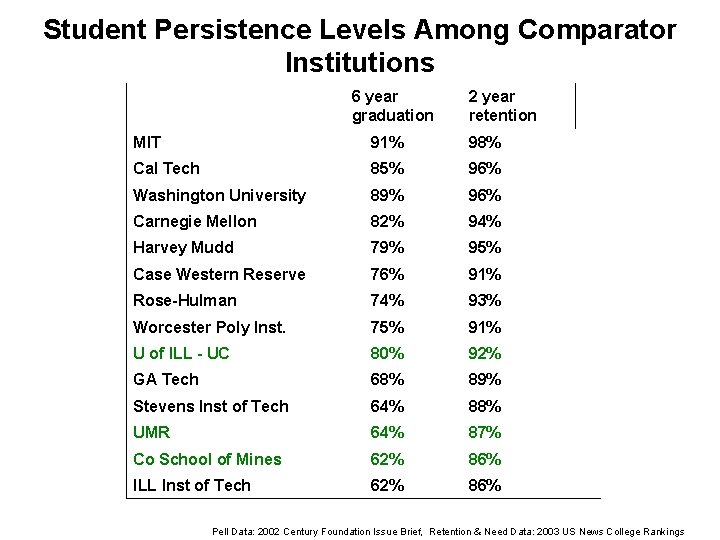
Student Persistence Levels Among Comparator Institutions 6 year graduation 2 year retention MIT 91% 98% Cal Tech 85% 96% Washington University 89% 96% Carnegie Mellon 82% 94% Harvey Mudd 79% 95% Case Western Reserve 76% 91% Rose-Hulman 74% 93% Worcester Poly Inst. 75% 91% U of ILL - UC 80% 92% GA Tech 68% 89% Stevens Inst of Tech 64% 88% UMR 64% 87% Co School of Mines 62% 86% ILL Inst of Tech 62% 86% Pell Data: 2002 Century Foundation Issue Brief, Retention & Need Data: 2003 US News College Rankings
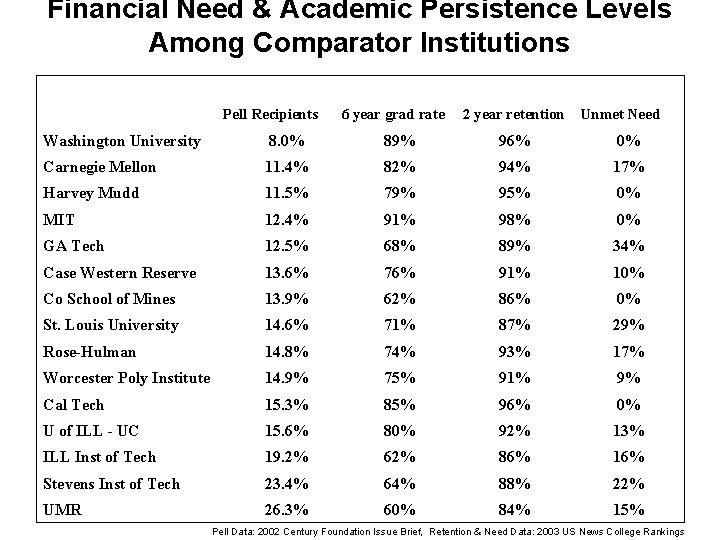
Financial Need & Academic Persistence Levels Among Comparator Institutions Pell Recipients 6 year grad rate 2 year retention Unmet Need Washington University 8. 0% 89% 96% 0% Carnegie Mellon 11. 4% 82% 94% 17% Harvey Mudd 11. 5% 79% 95% 0% MIT 12. 4% 91% 98% 0% GA Tech 12. 5% 68% 89% 34% Case Western Reserve 13. 6% 76% 91% 10% Co School of Mines 13. 9% 62% 86% 0% St. Louis University 14. 6% 71% 87% 29% Rose-Hulman 14. 8% 74% 93% 17% Worcester Poly Institute 14. 9% 75% 91% 9% Cal Tech 15. 3% 85% 96% 0% U of ILL - UC 15. 6% 80% 92% 13% ILL Inst of Tech 19. 2% 62% 86% 16% Stevens Inst of Tech 23. 4% 64% 88% 22% UMR 26. 3% 60% 84% 15% Pell Data: 2002 Century Foundation Issue Brief, Retention & Need Data: 2003 US News College Rankings
Private college graduation rates Public college graduation rates UMR graduation rate UMR receiving Pell Public FTE receiving Pell Private FTE receiving Pell ADAPTED FROM: John B. Lee, “Everything’s Up, “the Greentree Gazette, March 2003 DATA SOURCE: National average data from NCAA 2001 Division I IPED data
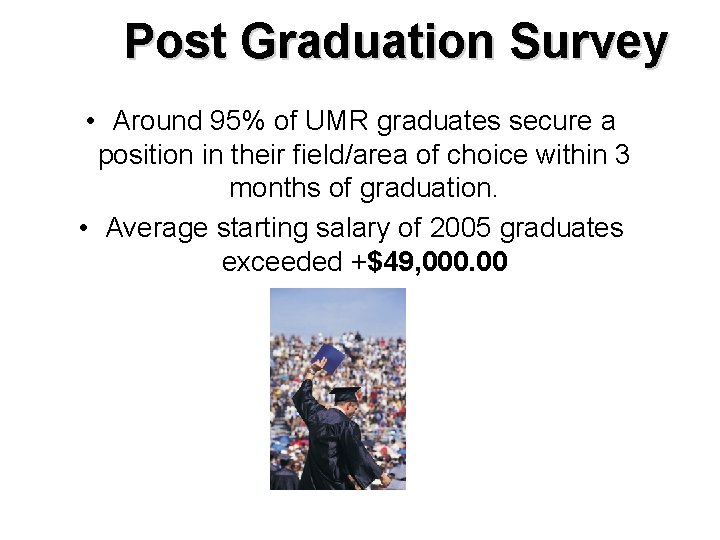
Post Graduation Survey • Around 95% of UMR graduates secure a position in their field/area of choice within 3 months of graduation. • Average starting salary of 2005 graduates exceeded +$49, 000. 00
What We Learned Must focus on: • Student-friendly policies, • Improving systems & practices that impede general student persistence inside and outside of the classroom
Primary Student Fears • Flunking out of college • Not making friends
Successful Students/Graduates Recommendations for New Students • Go to Class • Learn to Study • Ask for Help
Key Understandings • There is no Magic Bullet – Retention programs must be designed to meet student needs and have an academic success focus • Retention programs must be multi-faceted • Do not ignore Socio-Economic Factors • Quick Improvements can be made by examining Processes and Points of Student Action • Need a true team effort: IR, Academic Programs, Student Affairs, Enrollment Management, etc
Policy/System Changes to Improve Retention/Graduation UMR’s “Low Hanging Fruit” 1. 2. 3. 4. 5. Early Warning System Report Incomplete grade time limit change Repeat course GPA adjustment policy Scholarship Reinstatement Policy All BS degree programs reduced to between 124 to 128 hours 6. Added 3 degree programs most often requested by existing students: Business, IST, Technical Communication 7. Create better understanding of faculty and student expectations. Actively embrace the “social norming” concept. 8. Address group building (making friends) and study skills (not flunking out) in all orientation and opening week activities
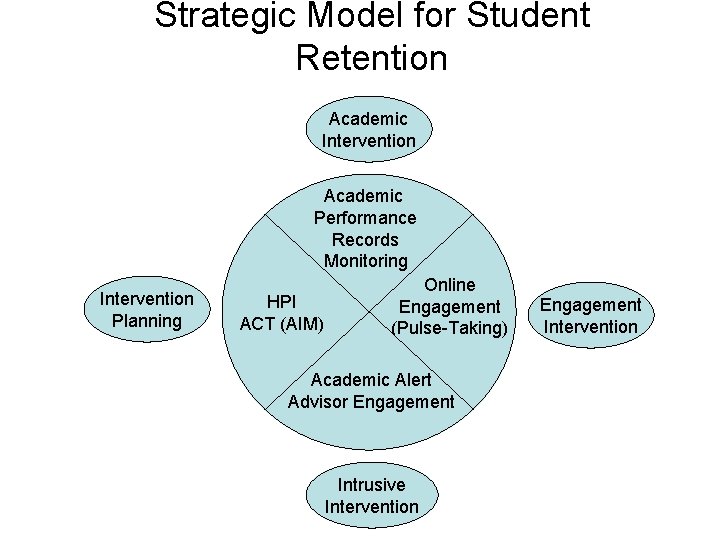
ONGOING RETENTION STRATEGIES • Use the HPI to better identify “at-risk” UMR students for early alert and intervention • Improve the delivery and communication of student support services • Better connect students to campus resources and activities by further implementing an electronic communication and surveying system • Continue the retention audit and data collection process.
• ACT Policy Report, The Role of Academic and Non-Academic Factors in Improving College Retention, indicates that many colleges' retention efforts are too narrowly focused. • Academic help alone is not enough to keep many students in school. These students also need individual support to feel connected to the campus community. Colleges, however, may focus on only academic or non-academic support, rather than both.
IMPROVING BEYOND THE AUDIT & LOW HANGING FRUIT A Long-Term Roadmap to Improving Student Success: An Implementation of the Critical Best Practices for UMR Students
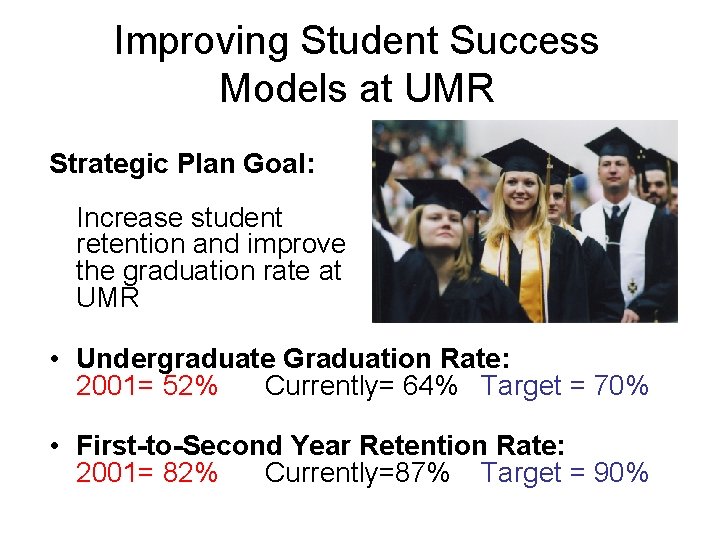
Improving Student Success Models at UMR Strategic Plan Goal: Increase student retention and improve the graduation rate at UMR • Undergraduate Graduation Rate: 2001= 52% Currently= 64% Target = 70% • First-to-Second Year Retention Rate: 2001= 82% Currently=87% Target = 90%
Undergraduate & Graduate Studies • Actions: How are we going to achieve these goals? • Continually improve the educational environment • Continually enhance the learning outcomes of students
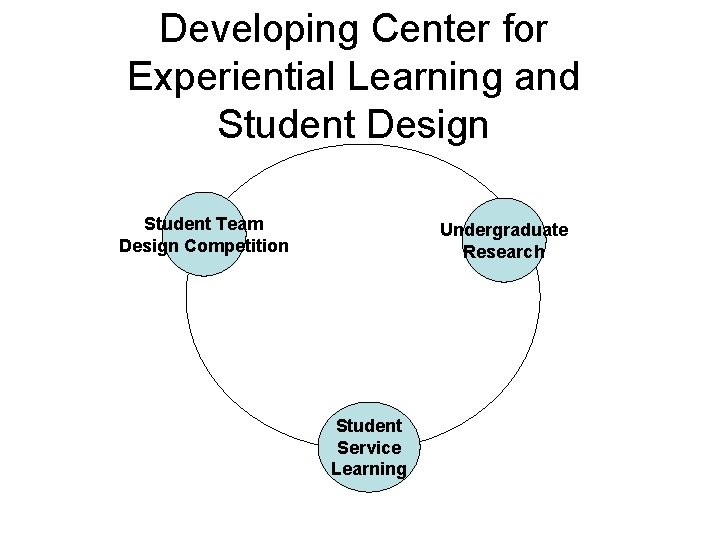
Student Retention & Graduation Strategies 1. Revised UMR Advising Program Focus on faculty development for student formal and developmental advising, advisor recognition and advising program evaluation 2. Learning Communities & First Year Experience Programs Focus to address student academic skills development and social engagement through group student life oriented events 3. Experiential Learning Focus to promote greater campus-wide “learning by doing” student engagement through undergraduate research, service learning, and student design project participation
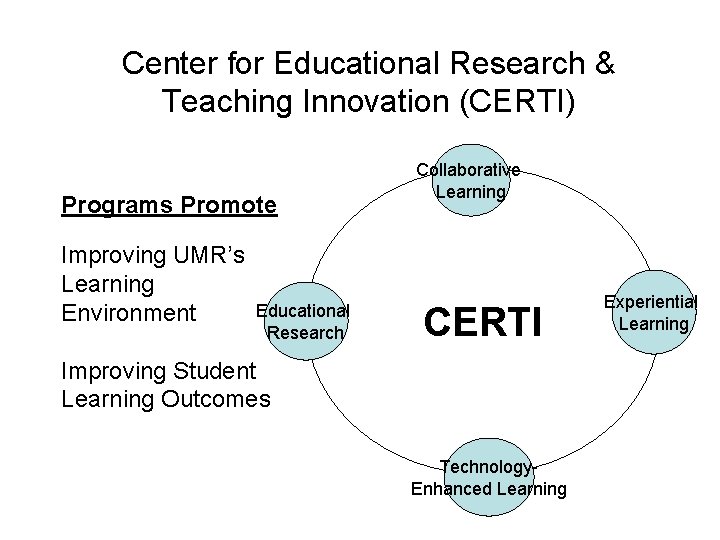
Student Retention & Graduation Strategies, cont. . 4. Strategic Retention Intervention Focus on a rapid response “Academic Alert System”, on-line student communication system, advisor engagement and more quantitative knowledge of UMR student strengths 5. Center for Educational Research and Teaching Innovation (CERTI) Focus to address improving the UMR learning environment and student learning outcomes through collaborative learning, experiential learning, technology enhanced learning and educational research practices 6. Pre-College Transition Program Focus to promote greater student preparation to meet student and UMR academic expectations through a 3 -week intense course – Hit the Ground Running (HGR)
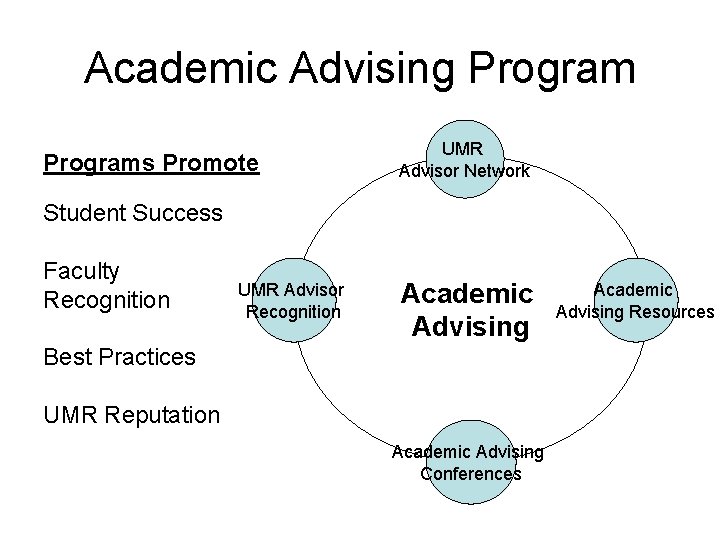
Academic Advising Programs Promote UMR Advisor Network Student Success Faculty Recognition UMR Advisor Recognition Academic Advising Best Practices UMR Reputation Academic Advising Conferences Academic Advising Resources
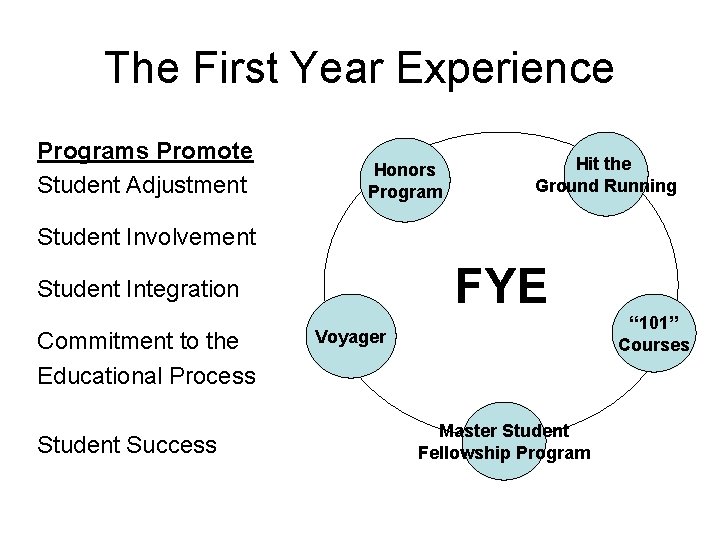
The First Year Experience Programs Promote Student Adjustment Honors Program Hit the Ground Running Student Involvement FYE Student Integration Commitment to the Educational Process Student Success Voyager Master Student Fellowship Program “ 101” Courses
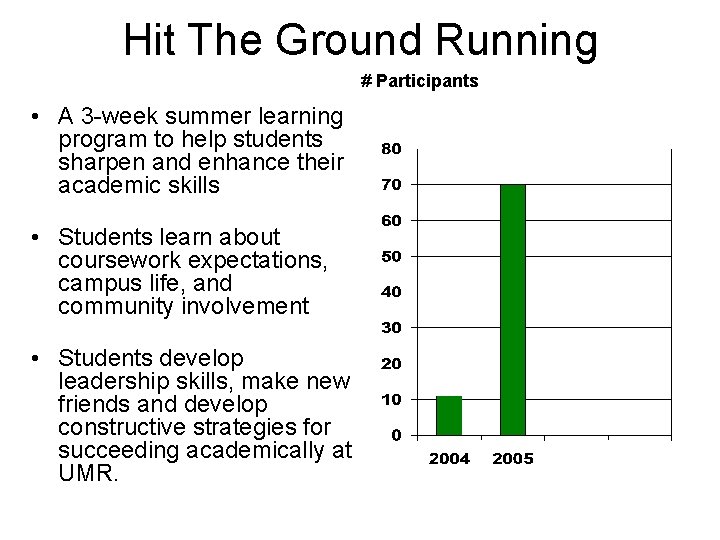
Hit The Ground Running # Participants • A 3 -week summer learning program to help students sharpen and enhance their academic skills • Students learn about coursework expectations, campus life, and community involvement • Students develop leadership skills, make new friends and develop constructive strategies for succeeding academically at UMR.
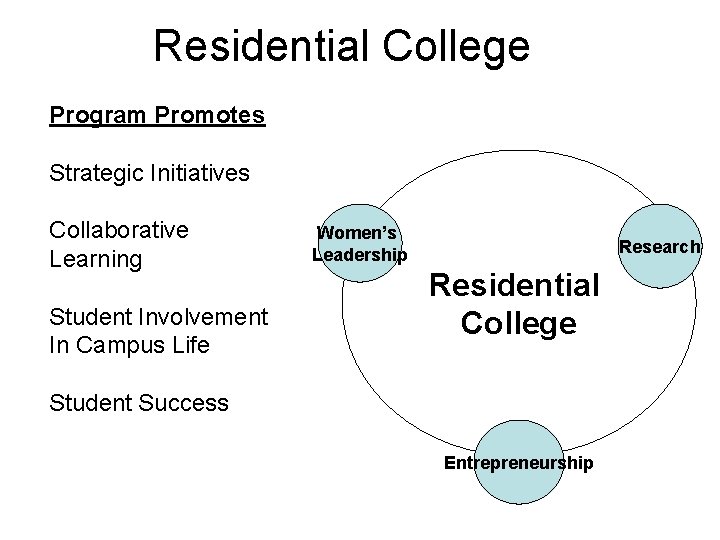
Residential College Program Promotes Strategic Initiatives Collaborative Learning Student Involvement In Campus Life Women’s Leadership Research Residential College Student Success Entrepreneurship
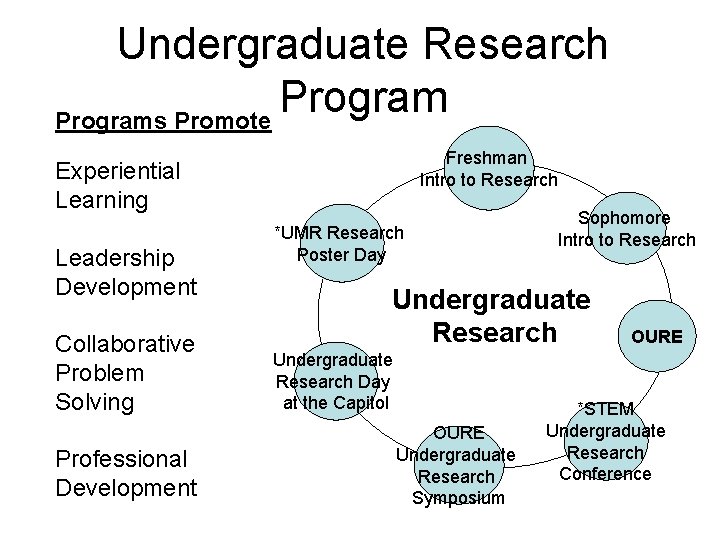
Undergraduate Research Programs Promote Freshman Intro to Research Experiential Learning Leadership Development Collaborative Problem Solving Professional Development *UMR Research Poster Day Sophomore Intro to Research Undergraduate Research Day at the Capitol OURE Undergraduate Research Symposium OURE *STEM Undergraduate Research Conference
Developing Center for Experiential Learning and Student Design Student Team Design Competition Undergraduate Research Student Service Learning
Center for Educational Research & Teaching Innovation (CERTI) Programs Promote Improving UMR’s Learning Environment Educational Research Collaborative Learning CERTI Improving Student Learning Outcomes Technology. Enhanced Learning Experiential Learning
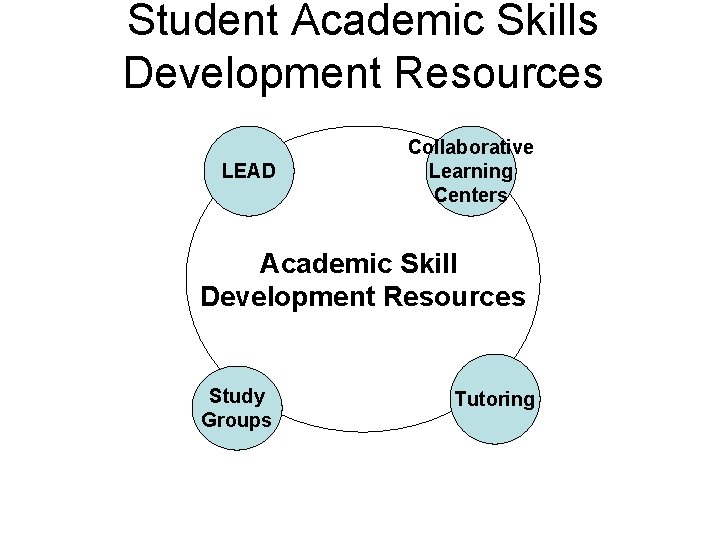
Student Academic Skills Development Resources LEAD Collaborative Learning Centers Academic Skill Development Resources Study Groups Tutoring
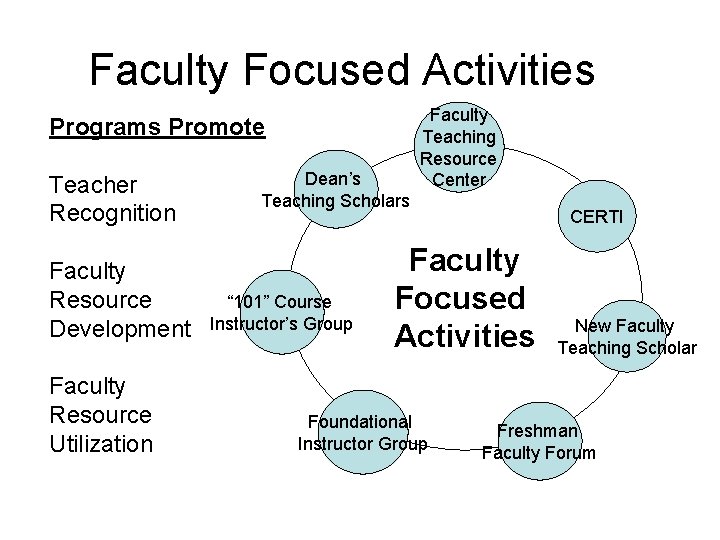
Faculty Focused Activities Programs Promote Teacher Recognition Faculty Resource Development Faculty Resource Utilization Dean’s Teaching Scholars “ 101” Course Instructor’s Group Faculty Teaching Resource Center CERTI Faculty Focused Activities Foundational Instructor Group New Faculty Teaching Scholar Freshman Faculty Forum
Strategic Model for Student Retention Academic Intervention Academic Performance Records Monitoring Intervention Planning HPI ACT (AIM) Online Engagement (Pulse-Taking) Academic Alert Advisor Engagement Intrusive Intervention Engagement Intervention
UGS Program Updates • UGSmonthly – On Line Newsletter (http: //campus. umr. edu/ugs/)
Questions? Dr. Harvest Collier Vice Provost for Undergraduate and Graduate Studies University of Missouri-Rolla hcollier@umr. edu 573 -341 -4390 Jay W. Goff Dean of Enrollment Management University of Missouri – Rolla goffjw@umr. edu 573 -341 -4378
ACT Report References ACT. (1997). ACT Assessment technical manual. Iowa City, IA: Author. ACT. (2002). ACT Assessment user handbook. Iowa City, IA: Author. Adelman, C. (1999). Answers in the tool box: Academic intensity, attendance patterns, and bachelor’s degree attainment. Washington, DC: U. S. Department of Education. Asera, R. (1998). Supporting student persistence. Black Issues in Higher Education, 15(10), 104. Barfield, M. A. , & Beaulieu, L. J. (1999). The changing nature of work in the south: The polarization of tomorrow’s workforce. Mississippi State, MS: Mississippi State University, Southern Rural Development Center. Barefoot, B. , Fidler, D. , Gardner, J. , Moore, P. , & Roberts, M. (1999). A natural linkage: The first-year seminar and the learning community. In J. H. Levine (Ed. ), Learning communities: New structures, new partnerships for learning (Monograph No. 26) (pp. 77 -86). Columbia, SC: University of South Carolina, National Resource Center for the First-Year Experience and Students in Transition. Bean, J. P. (1980). Dropouts and turnover: The synthesis and test of a causal model of student attrition. Research in Higher Education, 12(2), 155 -187. Bean, J. P. (1983). The application of a model of turnover in work organizations to the student attrition process. Review of Higher Education, 6(2), 129 -148. Bean, J. P. (1985). Interaction effects based on class level in an explanatory model of college student dropout syndrome. American Educational Research Journal, 22(1), 35 -64. Belgarde M. J. , & Lo. Re, R. K. (2003). The retention/intervention study of Native American undergraduates at the University of New Mexico. Journal of College Student Retention: Research, Theory & Practice, 5(2), 175 -203. Braxton, J. M. (Ed. ). (2000). Reworking the student departure puzzle. Nashville, TN: Vanderbilt University Press. Braxton, J. M. , & Mc. Clendon, S. A. (2002). The fostering of student integration and retention through institutional practice. Journal of College Student Retention: Research, Theory & Practice, 3(1), 57 -71. Braxton, J. M. , Hirschy, A. S. , & Mc. Clendon, S. A. (2004). Understanding and reducing college student departure. ASHE-ERIC Higher Education Report, 30(3). Cabrera, A. F. , Casteneda, M. B. , Nora, A. , & Hengstler, D. (1992). The convergence between two theories of college persistence. Journal of College Student Development, 63(2), 143 -164. Cabrera, A. F. , Nora, A. , & Castaneda, M. B. (1993). College persistence: Structural equations modeling test of an integrated model of student retention. Journal of Higher Education, 64(2), 123 -139.
ACT Report References, Cont. Carnevale, A. , & Desrochers, D. (2003). Standards for what? The economic roots of K– 16 reform. Princeton, NJ: Educational Testing Service. Chenoweth, K. (1999). HBCUs tackle the knotty problem of retention. Black Issues in Higher Education, 15(26), 38 -41. Collinson, M. (1999). The new complexion of retention services. Black Issues in Higher Education, 15(26), 34 -37. Colton, G. M. , Connor, U. J. , Jr. , Shultz, E. L. , & Easter, L. M. (1999). Fighting attrition: One freshman year program that targets academic progress and retention for at-risk students. Journal of College Student Retention: Research, Theory & Practice, 1(2), 147 -162. Congos, D. H. , & Schoeps, N. (2003). Inside Supplemental Instruction (SI): One model of what happens that improves grades and retention revisited. Journal of Student Centered Learning, 1(13), 159 -170. Covington, M. V. (2000). Goal theory, motivation, and school achievement: An integrative review. Annual Review of Psychology, 51, 171 -200. Dervarics, C. , & Roach, R. (2000). Fortifying the federal presence in retention. Black Issues in Higher Education, 17(3), 20 -25. Dweck, C. S. (1999). Self-theories: Their role in motivation, personality, and development. Philadelphia: Taylor & Francis. Eccles, J. S. , & Wigfield, A. (2002). Motivational beliefs, values, and goals. Annual Review of Psychology, 53, 109 -132. Education Commission of the States. (2004). Completion. Denver, CO: Author. [http: //www. ecs. org/html/issue. asp? issueid=182&subissue. ID=0] Fidler, P. P. (1991). Relationship of freshman orientation seminars to sophomore return rates. Journal of the Freshman Year Experience, 3(1), 7 -38. Fletcher, J. (1998). A study of factors affecting advancement and graduation for engineering students. Unpublished doctoral dissertation, Auburn University, Auburn. Flowers, J. (1998). Improving female enrollment in Tech Ed. The Technology Teacher, 58(2), 21 -25. Fries-Britt, S. , & Turner, B. (2001). Facing stereotypes: A case study of black students on a white campus. Journal of College Student Development, 42(5), 420 -429. Fries-Britt, S. , & Turner, B. (2002). Uneven stories: Successful black collegians at a black and a white campus. The Review of Higher Education, 25(3), 315 -330. Gloria, A. , & Robinson-Kurpius, S. E. (2001). Influences of self-beliefs, social support, and comfort in the university environment on the academic nonpersistence decisions of American Indian undergraduates. Cultural Diversity and Ethnic Minority Psychology, 7(1), 88 -102.
ACT Report References, Cont. Good, J. , Halpin, G. , & Halpin, G. (2002). Retaining black students in engineering: Do minority programs have a longitudinal impact? Journal of College Student Retention: Research, Theory & Practice, 3(4), 351 -364. Gore, P. A. , Jr. , Leuwerke, W. C. , & Turley, S. E. (in press). A psychometric study of the College Self-Efficacy Inventory. Journal of College Student Retention: Research, Theory & Practice. Habley, W. R. (Ed. ). (2004). The status of academic advising: Findings from the ACT sixth national survey (Monograph No. 10). Manhattan, KS: National Academic Advising Association. Harvey, W. B. (2003). Minorities in higher education: 2002 -2003 annual status report. Washington, DC: American Council on Education. Hecker, D. E. (2004, February). Occupational Employment Projections to 2012. Monthly Labor Review, 127(2). Hensen, K. A. , & Shelley, M. C. , III. (2003). The impact of Supplemental Instruction: Results from a large, public midwestern university. Journal of College Student Development, 44(2), 250 -259. Holmes, S. L. , Ebbers, L. H. , Robinson, D. C. , & Mugenda, A. G. (2000). Validating African American students at predominantly white institutions. Journal of College Student Retention: Research, Theory & Practice, 2(1), 41 -58. Hossler, D. , & Vesper, N. (1993). An exploratory study of factors associated with parental savings for postsecondary education. Journal of Higher Education, 64(2), 140 -164. Huffman, T. (2001). Resistance theory and transculturation hypothesis as explanations of college attrition and persistence among culturally traditional American Indian students. Journal of American Indian Education, 40(3), 123. Hurd, H. (2000). Staying power: Colleges work to improve retention rates. Black Issues in Higher Education, 17(18), 4246. Hurte, V. J. (2002, October 24). Mentoring: The forgotten retention tool. Black Issues in Higher Education, 19(18), 49. Ishitani, T. , & Des. Jardins, S. (2002). A longitudinal investigation of dropout from college in the United States. Journal of College Student Retention: Research, Theory & Practice, 4(2), 173 -201. Johnson, J. L. (2000). Learning communities and special efforts in the retention of university students: What works, what doesn’t, and is the return worth the investment? Journal of College Student Retention: Research, Theory & Practice, 2(3), 219 -238. Karp, R. , & Logue, R. (2002). Retention initiative for unscheduled sophomores and unscheduled readmits. Journal of College Student Retention: Research, Theory & Practice, 4(2), 147 -172.
ACT Report References, Cont. Kennedy, P. W. , Sheckley, B. G. , & Kehrhahn, M. T. (2000, May). The dynamic nature of student persistence: Influence of interactions between student attachment, academic adaptation, and social adaptation. Paper presented at the Annual Meeting of the Association for Institutional Research, Cincinnati, OH. Kern, C. W. , Fagley, N. S. , & Miller, P. M. (1998). Correlates of college retention and GPA: Learning and study strategies, testwiseness, attitudes, and ACT. Journal of College Counseling, 1(1), 26 -34. Landry, C. C. (2002). Retention of women and people of color: Unique challenges and institutional responses. Journal of College Student Retention: Research, Theory & Practice, 4(1), 1 -13. Mangold, W. D. , Bean, L. G. , Adams, D. J. , Schwab, W. A. , & Lynch, S. M. (2003). Who goes who stays: An assessment of the effect of a freshman mentoring and unit registration program on college persistence. Journal of College Student Retention: Research, Theory & Practice, 4(2), 95 -122. Martin, W. E. , Jr. (1998). Review of the College Adjustment Scales. In J. C. Impara & B. S. Plake (Eds. ), The Thirteenth Mental Measurements Yearbook. (pp. 274 -277). Lincoln, NE: Buros Institute of Mental Measurements. Noel, L. , Levitz, R. , & Saluri, D. (1985). Increasing student retention: Effective programs and practices for reducing dropout rate. San Francisco: Jossey-Bass. Nora, A. (1993). Two-year colleges and minority students’ educational aspirations: Help or hindrance? Higher Education: Handbook of Theory and Research, 9, 212 -247. O’Brien, C. , & Shedd, J. (2001, February). Getting through college: Voices of lowincome and minority students in New England. Washington, DC: The Institute for Higher Education Policy. Ogden, P. , Thompson, D. , & Russell, A. (2003). Supplemental Instruction: Short and long-term impact. Journal of Developmental Education, 26(3), 2 -10. Padgett, V. R. , & Reid, J. F. , Jr. (2003). Five year evaluation of the Student Diversity Program: A Retrospective quasiexperiment. Journal of College Student Retention: Research, Theory & Practice, 4(2), 135 -145. Pathways to College Network. (2004). A shared agenda: A leadership challenge to improve college access and success. Boston: Author. Ramirez, G. M. (1997, Fall). Supplemental Instruction: The long-term impact. Journal of Developmental Education, 21(1), 2 -10. Rendon, L. (1992). From the barrio to the academy: Revelations of a Mexican American “scholarship girl. ” New Directions for Community College, 80, 55 -64. Rinn, M. (1995, September 1). Surviving the first year of college. Hispanic Outlook in Higher Education, 6(1), 11 -13. Roach, R. (1997). Retention pacesetter: University of Virginia. Black Issues in Higher Education, 14(20), 35.
ACT Report References, Cont. Roach, R. (1999). Succeeding on white campuses. Black Issues in Higher Education, 15(26), 42 -43. Robbins, S. B. , Davenport, M. , Anderson, J. , Kliewer, W. , Ingram, K. , & Smith, N. (2003). The role of motivation and self-regulatory behaviors on first-year college adjustment. Unpublished manuscript. Iowa City, IA: ACT. Robbins, S. B. , Lauver, K. , Le, H. , Davis, D. , Langley, R. , & Carlstrom, A. (2004). Do psychosocial and study skill factors predict college outcomes? A meta-analysis. Psychological Bulletin, 130(2), 261 -288. Rodriguez, R. (1997). Learning to live a warrior’s life. Black Issues in Higher Education, 14(20), 38 -40. Schnell, C. A. , & Doetkott, C. D. (2003). First year seminars produce long-term impact. Journal of College Student Retention: Research, Theory & Practice, 4(4), 377 -391. Schnell, C. A. , Seashore Louis, K. , & Doetkott, C. (2003). The first-year seminar as a means of improving college graduation rates. Journal of the First-Year Experience and Students in Transition, 15(1), 53 -75. Sedlacek, W. E. & Adams-Gaston, J. (1992). Predicting the academic success of student athletes using SAT and noncognitive variables. Journal of Counseling & Development, 70(6), 724 -727. Solberg, V, Gusavac, N. , Hamann, T. , Felch, J. , Johnson, J. , Lamborn, S. , & Torres, J. (1998). The Adaptive Success Identity Plan (ASIP): A career intervention for college students. The Career Development Quarterly, 47(1), 48 -95. Stage, F. K. (1988). University attrition: LISREL with logistic regression for the persistence criterion. Research in Higher Education, 29(4), 343 -357. Swanson, M. (2003). Interview with Dorothy S. Fidler, founding editor of the Journal of the First-Year Experience and Students in Transition, 15(1), 9 -18. Tatum, B. D. (1997). “Why are all the black kids sitting together in the cafeteria? ” and other conversations about race. New York: Basic Books. Tatum. B. D. (2004, April 2). Building a road to a diverse society. The Chronicle of Higher Education, B 7. Ting, S. R. (1997). A report of the factor analysis of the First-Year Student Survey. Raleigh, NC: North Carolina State University. Ting, S. R. , & Robinson, T. L. (1998). First-year academic success: A prediction combining cognitive and psychosocial variables for Caucasian and African American Students. Journal of College Student Development, 39(6), 599 -610. Tinto, V. (1975). Dropout from higher education: A theoretical synthesis of recent research. Review of Educational Research, 45(1), 89 -125. Tinto, V. (1993). Leaving college: Rethinking the cause and cures of student attrition. Chicago: University of Chicago.
ACT Report References, Cont. Tinto, V. (1997). Classrooms as communities: Exploring the educational character of student persistence. Journal of Higher Education, 68(6), 599 -623. Tracey, T. J. , & Sedlacek, W. E. (1984). Noncognitive variables in predicting academic success by race. Measurement and Evaluation in Guidance, 16(4), 171 -178. Tracey, T. J. , & Sedlacek, W. E. (1989). Factor structure of the Non-Cognitive Questionnaire—revised across samples of black and white college students. Educational and Psychological Measurement, 49(3), 637 -648. Tucker, J. (1999). Tinto’s model and successful college transitions. Journal of College Student Retention: Research, Theory & Practice, 1(2), 163 -175. U. S. Census Bureau. (2001). Profile of the foreign-born population of the United States: 2000. Washington, DC: Author. U. S. Census Bureau. (2002). Statistical abstract of the United States: The national data book. 2002. Washington, DC: Author. U. S. Department of Education. (2001). Digest of education statistics, 2000. Washington, DC: U. S. Department of Education, National Center for Educational Statistics. U. S. Department of Education. (2002). Descriptive summary of 1995 -96 beginning postsecondary students: Six years later. Washington, DC: U. S. Department of Education, National Center for Educational Statistics. U. S. Department of Education. (2003). The condition of education 2003. Washington DC: U. S. Department of Education, National Center for Educational Statistics. U. S. Department of Labor. (2000). The Outlook for College Graduates, 1998 -2000. In Getting ready pays off! Washington, DC: U. S. Department of Labor, Bureau of Labor Statistics. Wyckoff, S. (1998). Retention theories in higher education: Implications for institutional practice. Recruitment and Retention in Higher Education, 12(2), 2 -7.
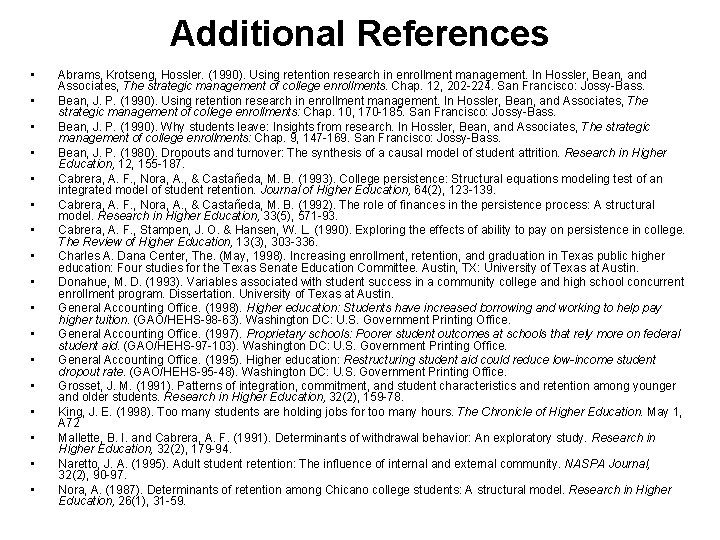
Additional References • • • • • Abrams, Krotseng, Hossler. (1990). Using retention research in enrollment management. In Hossler, Bean, and Associates, The strategic management of college enrollments. Chap. 12, 202 -224. San Francisco: Jossy-Bass. Bean, J. P. (1990). Using retention research in enrollment management. In Hossler, Bean, and Associates, The strategic management of college enrollments: Chap. 10, 170 -185. San Francisco: Jossy-Bass. Bean, J. P. (1990). Why students leave: Insights from research. In Hossler, Bean, and Associates, The strategic management of college enrollments: Chap. 9, 147 -169. San Francisco: Jossy-Bass. Bean, J. P. (1980). Dropouts and turnover: The synthesis of a causal model of student attrition. Research in Higher Education, 12, 155 -187. Cabrera, A. F. , Nora, A. , & Castañeda, M. B. (1993). College persistence: Structural equations modeling test of an integrated model of student retention. Journal of Higher Education, 64(2), 123 -139. Cabrera, A. F. , Nora, A. , & Castañeda, M. B. (1992). The role of finances in the persistence process: A structural model. Research in Higher Education, 33(5), 571 -93. Cabrera, A. F. , Stampen, J. O. & Hansen, W. L. (1990). Exploring the effects of ability to pay on persistence in college. The Review of Higher Education, 13(3), 303 -336. Charles A. Dana Center, The. (May, 1998). Increasing enrollment, retention, and graduation in Texas public higher education: Four studies for the Texas Senate Education Committee. Austin, TX: University of Texas at Austin. Donahue, M. D. (1993). Variables associated with student success in a community college and high school concurrent enrollment program. Dissertation. University of Texas at Austin. General Accounting Office. (1998). Higher education: Students have increased borrowing and working to help pay higher tuition. (GAO/HEHS-98 -63). Washington DC: U. S. Government Printing Office. General Accounting Office. (1997). Proprietary schools: Poorer student outcomes at schools that rely more on federal student aid. (GAO/HEHS-97 -103). Washington DC: U. S. Government Printing Office. General Accounting Office. (1995). Higher education: Restructuring student aid could reduce low-income student dropout rate. (GAO/HEHS-95 -48). Washington DC: U. S. Government Printing Office. Grosset, J. M. (1991). Patterns of integration, commitment, and student characteristics and retention among younger and older students. Research in Higher Education, 32(2), 159 -78. King, J. E. (1998). Too many students are holding jobs for too many hours. The Chronicle of Higher Education. May 1, A 72 Mallette, B. I. and Cabrera, A. F. (1991). Determinants of withdrawal behavior: An exploratory study. Research in Higher Education, 32(2), 179 -94. Naretto, J. A. (1995). Adult student retention: The influence of internal and external community. NASPA Journal, 32(2), 90 -97. Nora, A. (1987). Determinants of retention among Chicano college students: A structural model. Research in Higher Education, 26(1), 31 -59.
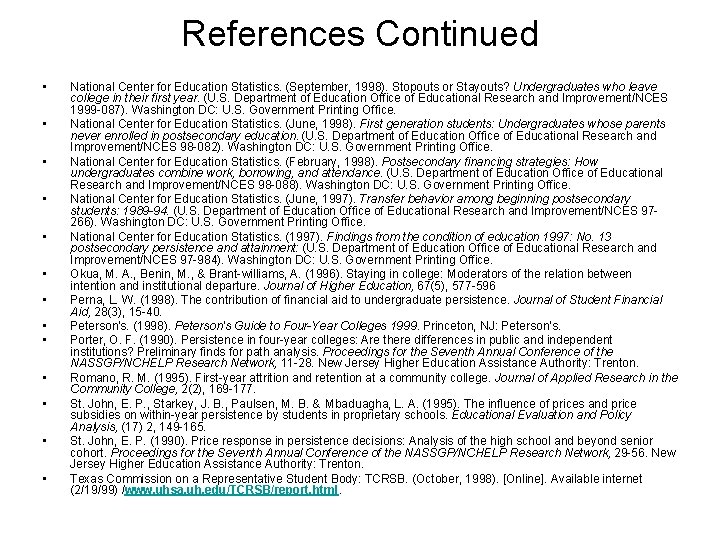
References Continued • • • • National Center for Education Statistics. (September, 1998). Stopouts or Stayouts? Undergraduates who leave college in their first year. (U. S. Department of Education Office of Educational Research and Improvement/NCES 1999 -087). Washington DC: U. S. Government Printing Office. National Center for Education Statistics. (June, 1998). First generation students: Undergraduates whose parents never enrolled in postsecondary education. (U. S. Department of Education Office of Educational Research and Improvement/NCES 98 -082). Washington DC: U. S. Government Printing Office. National Center for Education Statistics. (February, 1998). Postsecondary financing strategies: How undergraduates combine work, borrowing, and attendance. (U. S. Department of Education Office of Educational Research and Improvement/NCES 98 -088). Washington DC: U. S. Government Printing Office. National Center for Education Statistics. (June, 1997). Transfer behavior among beginning postsecondary students: 1989 -94. (U. S. Department of Education Office of Educational Research and Improvement/NCES 97266). Washington DC: U. S. Government Printing Office. National Center for Education Statistics. (1997). Findings from the condition of education 1997: No. 13 postsecondary persistence and attainment: (U. S. Department of Education Office of Educational Research and Improvement/NCES 97 -984). Washington DC: U. S. Government Printing Office. Okua, M. A. , Benin, M. , & Brant-williams, A. (1996). Staying in college: Moderators of the relation between intention and institutional departure. Journal of Higher Education, 67(5), 577 -596 Perna, L. W. (1998). The contribution of financial aid to undergraduate persistence. Journal of Student Financial Aid, 28(3), 15 -40. Peterson's. (1998). Peterson's Guide to Four-Year Colleges 1999. Princeton, NJ: Peterson's. Porter, O. F. (1990). Persistence in four-year colleges: Are there differences in public and independent institutions? Preliminary finds for path analysis. Proceedings for the Seventh Annual Conference of the NASSGP/NCHELP Research Network, 11 -28. New Jersey Higher Education Assistance Authority: Trenton. Romano, R. M. (1995). First-year attrition and retention at a community college. Journal of Applied Research in the Community College, 2(2), 169 -177. St. John, E. P. , Starkey, J. B. , Paulsen, M. B. & Mbaduagha, L. A. (1995). The influence of prices and price subsidies on within-year persistence by students in proprietary schools. Educational Evaluation and Policy Analysis, (17) 2, 149 -165. St. John, E. P. (1990). Price response in persistence decisions: Analysis of the high school and beyond senior cohort. Proceedings for the Seventh Annual Conference of the NASSGP/NCHELP Research Network, 29 -56. New Jersey Higher Education Assistance Authority: Trenton. Texas Commission on a Representative Student Body: TCRSB. (October, 1998). [Online]. Available internet (2/19/99) /www. uhsa. uh. edu/TCRSB/report. html.