
A Road map for Mobile Computing in Software
A Road map for Mobile Computing in Software Engineering Korimilli Padma Priya
Outline Working Definitions Forms of mobility - Physical mobility - Logical mobility - Mobility paradigms - Points of distinction Roadmap - Coordination - Middleware - A research framework Conclusions
Working Definitions Software Engineering is a discipline that studies - Software artifacts - Processes as (approximate) guarantors of software quality - People as producers of software Mobile Computing entails the study of systems in which computational components may change location
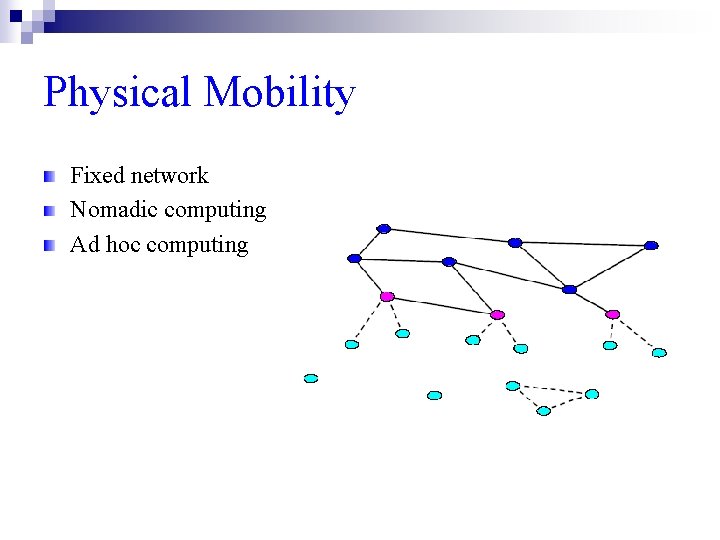
Physical Mobility Fixed network Nomadic computing Ad hoc computing

Design Issues Technological Limitations - Frequent disconnections - Unpredictable movement - Asymmetric bandwidth - Limited resources - Short battery life Exploiting spatial knowledge Exploiting movement profile Reasoning about behavior Connectivity maintenance Adaptation Standardization
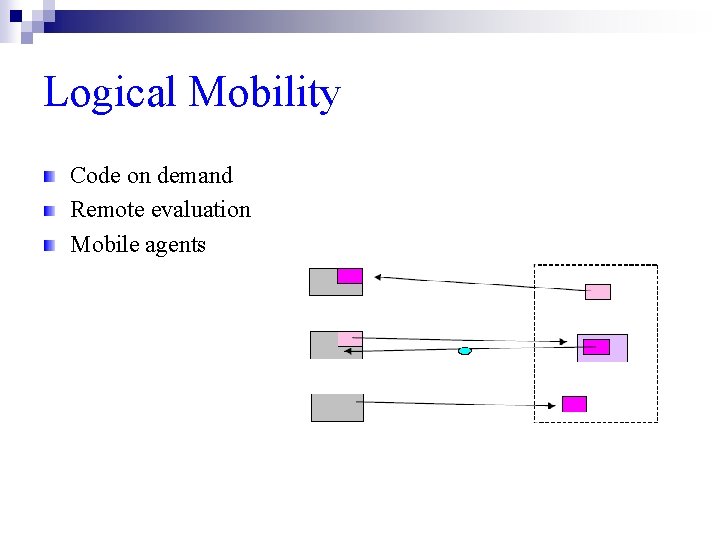
Logical Mobility Code on demand Remote evaluation Mobile agents
Logical Mobility Trends Code on demand is popular - Java is the dominant technology Mobile code languages are losing ground Mobile agent systems tend to discover old problems Middleware is growing in practical importance - Java/RMI and Jini
Points of Distinction Unit of mobility - Blurring of physical and logical - Relation to the unit of execution - Fine-grained mobility Treatment of location and space - Cartesian coordinates - Host or process id - Complex evolving spaces Context definition - Location affects context - Coordination affects context
Context Definition Location management Discovery Clustering Security Local versus distributed Quality assessment Transparency Transitivity
Coordination Advantage Coordination is a design strategy that promotes a high degree of separation between - Computation - Communication In the mobile context a coordination perspective fosters - Decoupling among mobile units - Open system programming
Coordination Challenges Fundamental assumptions - Window of vulnerability - Eventuality of encounter - Pattern of movement and behavior Guarantees - Strong atomicity - Transaction scope - Weak consistency Response to change - Event processing - Reactive programming
Middleware rests above the operating system and provides developers with specialized mechanisms and services in a highly integrated fashion Recognized advantages - Higher levels of abstraction - Domain specialization - Syntax of exiting language - Ready to use and easy to adopt
Conclusions Mobility - Provides intellectual excitement - Challenges old assumptions - Offers great opportunities for research - Demands new kinds of solutions - Requires an integrative research strategy
- Slides: 13