
A REVIEW ON ENERGY FROM BIOMASS NON CONVENTIONAL
A REVIEW ON ENERGY FROM BIOMASS (NON CONVENTIONAL ENERGY SOURCES)
Importance of non-conventional sources of energy: 1. The non-conventional sources of energy are abundant in nature 2. These are renewable resources. The non-conventional sources of energy can be renewed with minimum effort and money. 3. Non-conventional sources of energy are pollution-free and eco -friendly
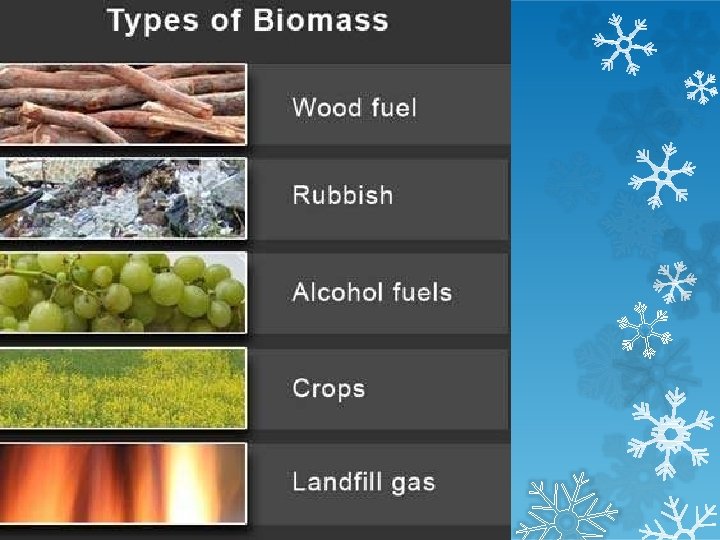
Bio-Energy • Bioenergy is renewable energy made available from materials derived from biological sources. • Biomass is any organic material, may include wood, wood waste, straw, manure, sugar cane and many other byproducts from a variety of agricultural processes.
Biomass is organic matter produced by plants – terrestrial and aquatic – and their derivatives. It includes 1. Forest crops and residues 2. Crops specially grown in ‘energy farms’ for their energy content 3. Animal manure
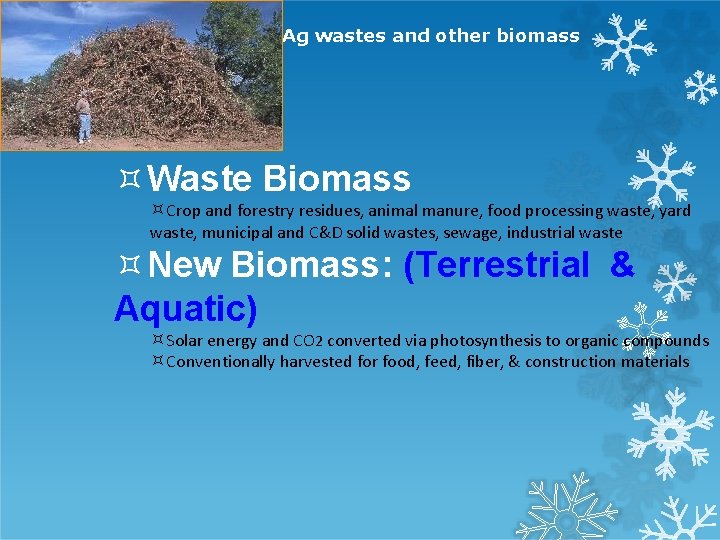
Ag wastes and other biomass Waste Biomass Crop and forestry residues, animal manure, food processing waste, yard waste, municipal and C&D solid wastes, sewage, industrial waste New Biomass: (Terrestrial & Aquatic) Solar energy and CO 2 converted via photosynthesis to organic compounds Conventionally harvested for food, feed, fiber, & construction materials
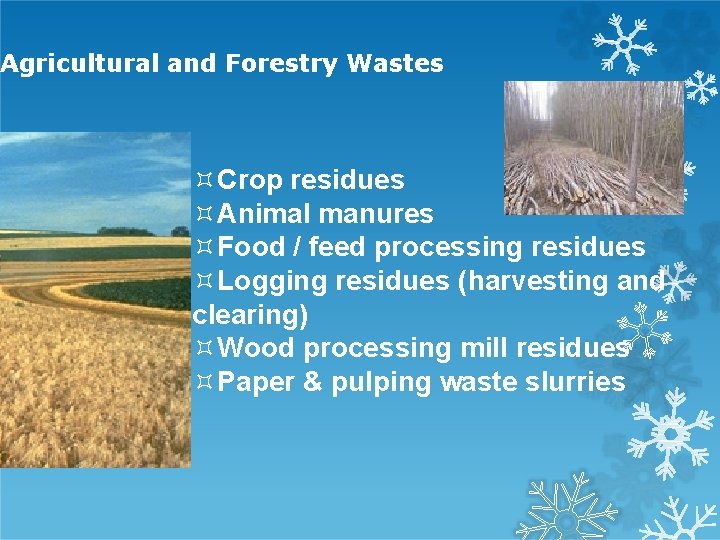
Agricultural and Forestry Wastes Crop residues Animal manures Food / feed processing residues Logging residues (harvesting and clearing) Wood processing mill residues Paper & pulping waste slurries
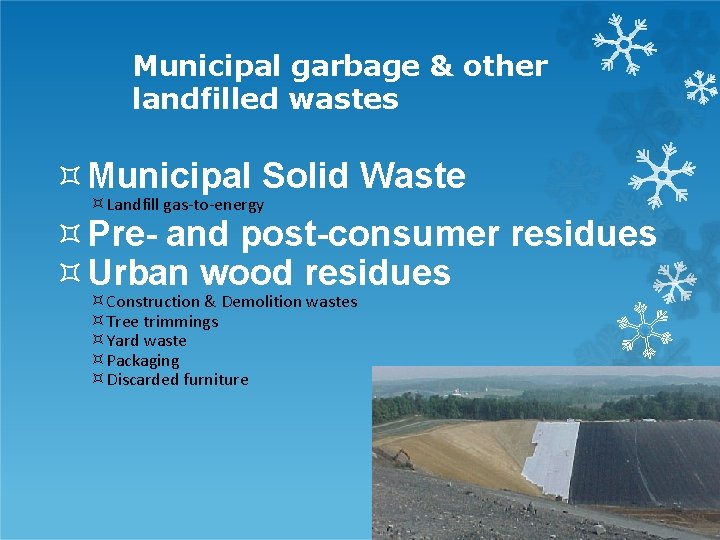
Municipal garbage & other landfilled wastes Municipal Solid Waste Landfill gas-to-energy Pre- and post-consumer residues Urban wood residues Construction & Demolition wastes Tree trimmings Yard waste Packaging Discarded furniture
Biomass Energy • • Biomass continues to account for an estimated 1/3 rd of primary energy use, while in the poorest counties up to 90% of all energy is supplied by biomass Biomass energy, or bio energy is the conversion of biomass (organic material originating from plants, trees, and crops and essentially the collection and storage of the sun’s energy through photosynthesis) into useful forms of energy such as heat, electricity, and liquid fuels
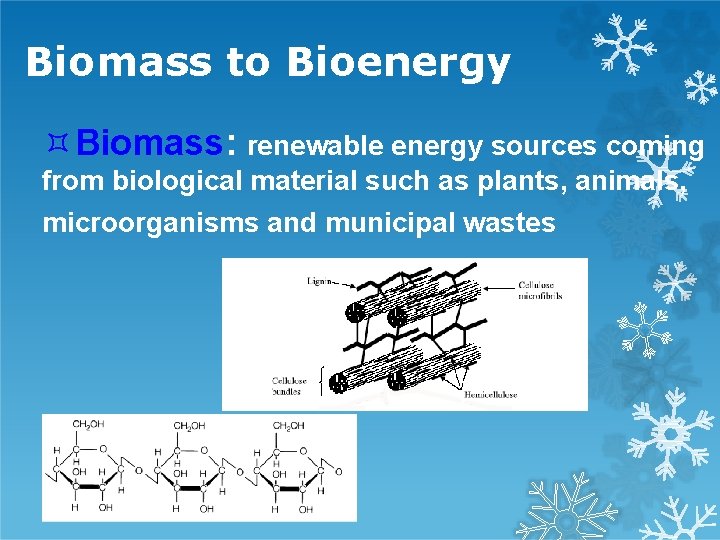
Biomass to Bioenergy Biomass: renewable energy sources coming from biological material such as plants, animals, microorganisms and municipal wastes
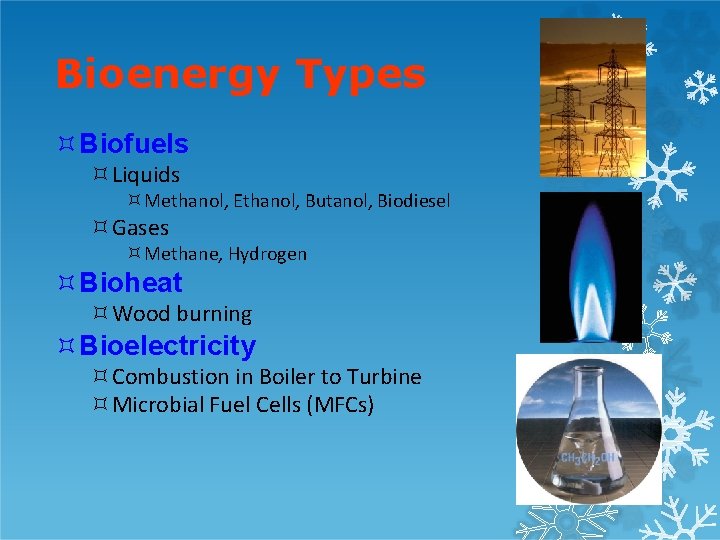
Bioenergy Types Biofuels Liquids Methanol, Ethanol, Butanol, Biodiesel Gases Methane, Hydrogen Bioheat Wood burning Bioelectricity Combustion in Boiler to Turbine Microbial Fuel Cells (MFCs)
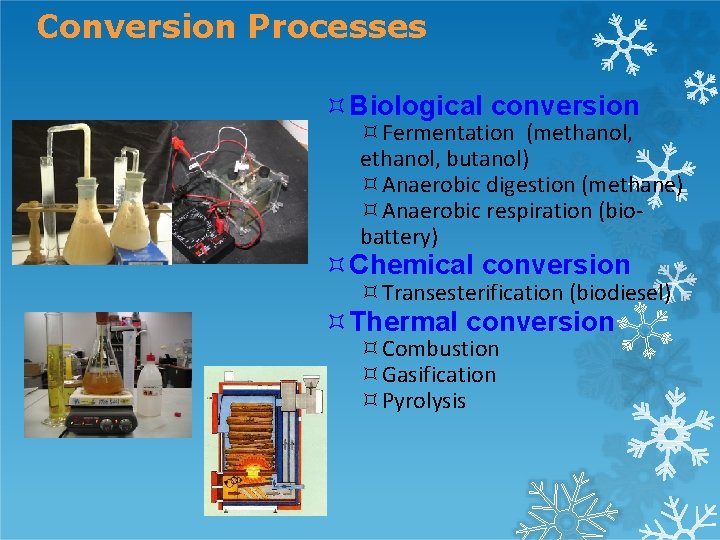
Conversion Processes Biological conversion Fermentation (methanol, butanol) Anaerobic digestion (methane) Anaerobic respiration (biobattery) Chemical conversion Transesterification (biodiesel) Thermal conversion Combustion Gasification Pyrolysis
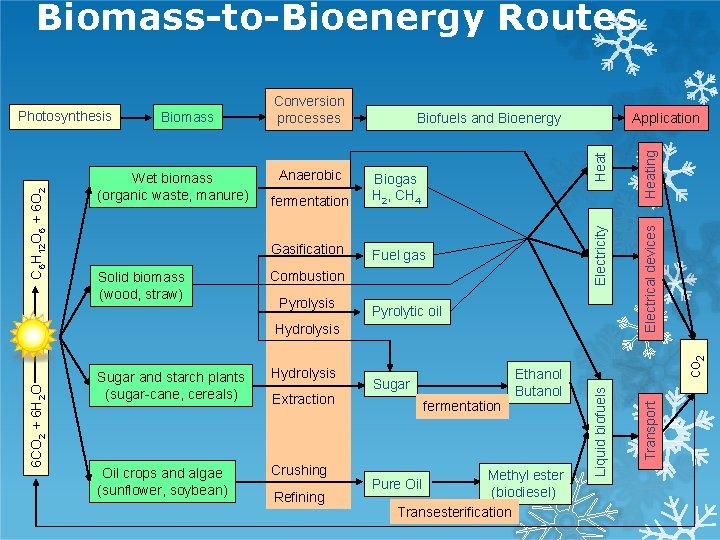
Biomass-to-Bioenergy Routes Gasification Fuel gas Combustion Pyrolysis Pyrolytic oil Hydrolysis Oil crops and algae (sunflower, soybean) Crushing Extraction Refining Ethanol Butanol Sugar fermentation Methyl ester (biodiesel) Transesterification Pure Oil co 2 Sugar and starch plants (sugar-cane, cereals) Liquid biofuels 6 CO 2 + 6 H 2 O Hydrolysis Heating fermentation Biogas H 2, CH 4 Electrical devices Solid biomass (wood, straw) Anaerobic Application Transport Wet biomass (organic waste, manure) Biofuels and Bioenergy Heat Biomass Electricity C 6 H 12 O 6 + 6 O 2 Photosynthesis Conversion processes
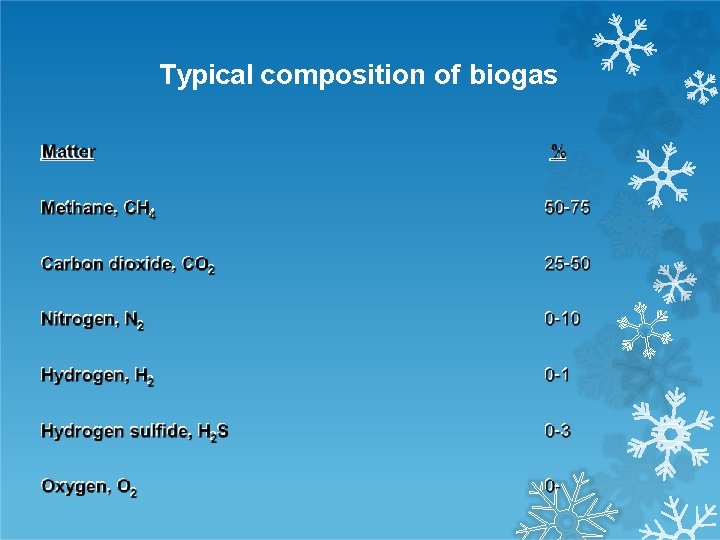
Typical composition of biogas Matter % Methane, CH 4 50 -75 Carbon dioxide, CO 2 25 -50 Nitrogen, N 2 0 -10 Hydrogen, H 2 0 -1 Hydrogen sulfide, H 2 S 0 -3 Oxygen, O 2 0 -
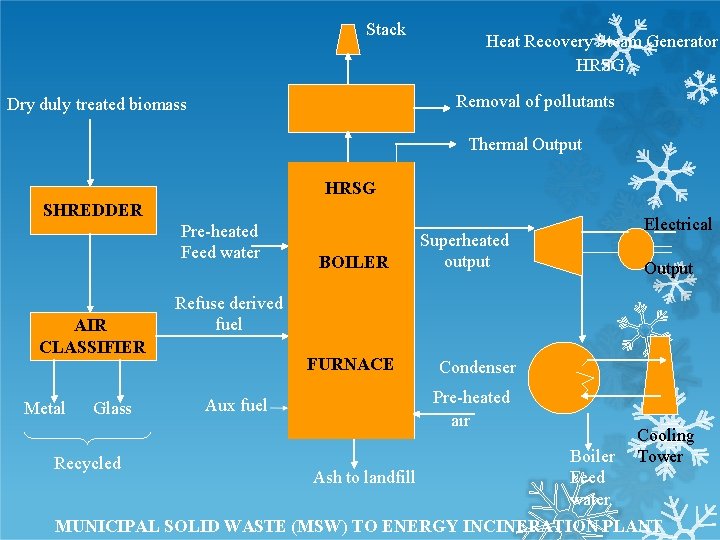
Stack Heat Recovery Steam Generator HRSG Removal of pollutants Dry duly treated biomass Thermal Output HRSG SHREDDER Pre-heated Feed water AIR CLASSIFIER Metal Glass BOILER Superheated output Electrical Output Refuse derived fuel FURNACE Aux fuel Condenser Pre-heated air Cooling Tower Boiler Ash to landfill Feed water MUNICIPAL SOLID WASTE (MSW) TO ENERGY INCINERATION PLANT Recycled
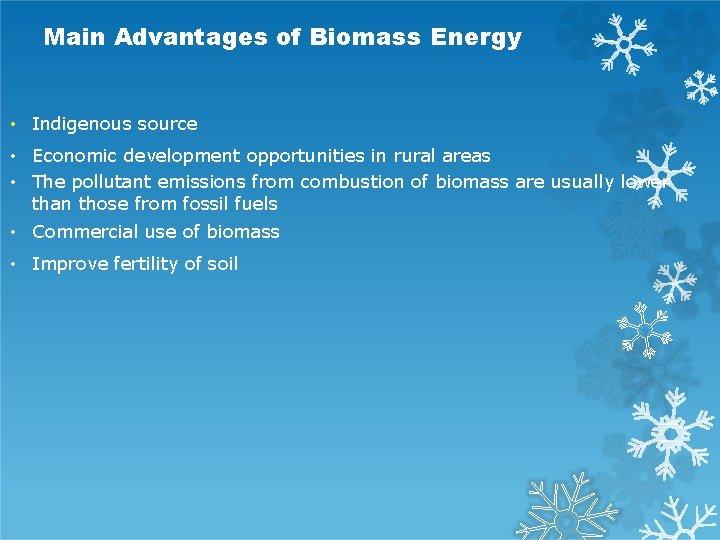
Main Advantages of Biomass Energy • Indigenous source • Economic development opportunities in rural areas • The pollutant emissions from combustion of biomass are usually lower than those from fossil fuels • Commercial use of biomass • Improve fertility of soil
Environmental Advantages • Renewable resource • Reduces landfills • Protects clean water supplies • Reduces acid rain and smog • Reduces greenhouse gases • Carbon dioxide • Methane
Disadvantages of Biomass Energy • It is dispersed and land intensive as a source • It is often of low energy density • It is labour intensive and the cost of collecting large quantities for commercial application is significant
Fuel Properties of Biogas Calorific Value 60% Methane : 22. 350 to 24. 22 MJ/m 3. Without CO 2 : 33. 525 to 35. 390 MJ/m 3. Octane rating without CO 2 : 130 Octane rating with CO 2 : 110 Ignition temperature : 6500 C Air to methane ratio for complete Combustion (by volume) : 10 to 1 Explosive limits to air (by volume) : 5 to 15
Applications
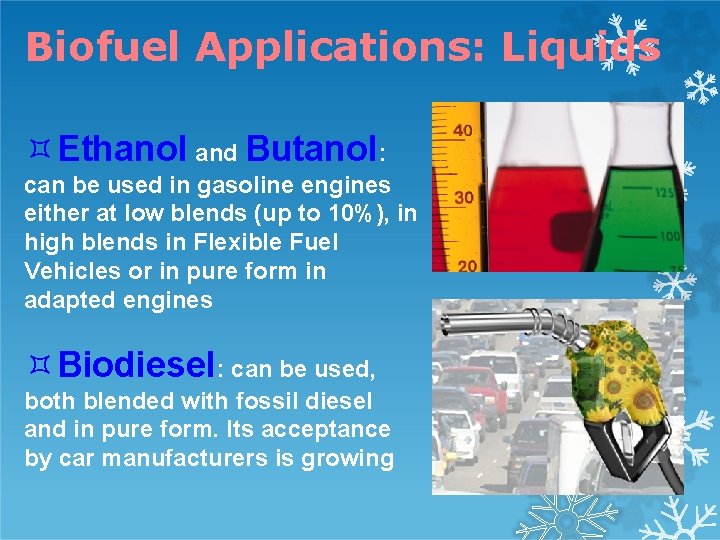
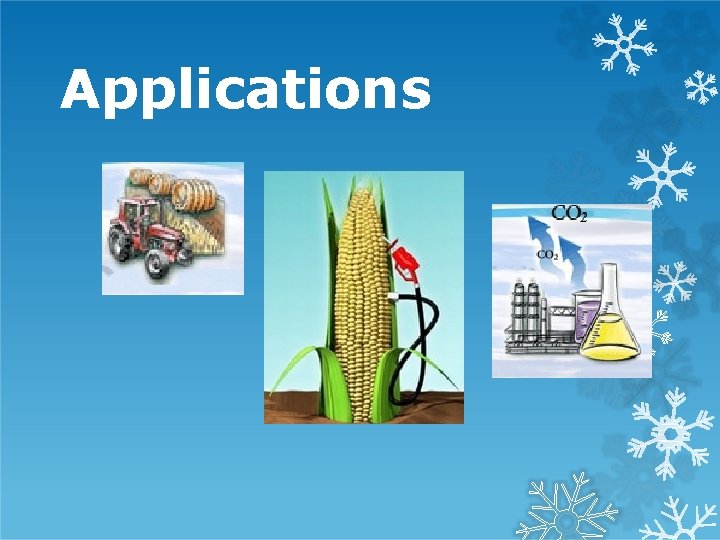
Biofuel Applications: Liquids Ethanol and Butanol: can be used in gasoline engines either at low blends (up to 10%), in high blends in Flexible Fuel Vehicles or in pure form in adapted engines Biodiesel: can be used, both blended with fossil diesel and in pure form. Its acceptance by car manufacturers is growing
Why Butanol? More similar to gasoline than ethanol Butanol can: Be transported via existing pipelines (ethanol cannot) Fuel engines designed for use with gasoline without modification (ethanol cannot) Produced from biomass (biobutanol) as well as petroleum (petrobutanol) Toxicity issues (no worse than gasoline)
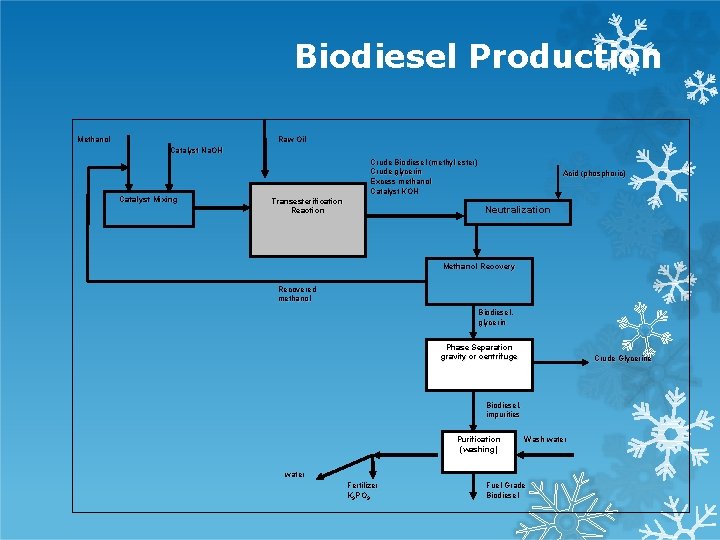
Biodiesel Production Methanol Raw Oil Catalyst Na. OH Catalyst Mixing Crude Biodiesel (methyl ester) Crude glycerin Excess methanol Catalyst KOH Transesterification Reaction Acid (phosphoric) Neutralization Methanol Recovery Recovered methanol Biodiesel, glycerin Phase Separation gravity or centrifuge Crude Glycerine Biodiesel, impurities Purification (washing) Wash water Fertilizer K 3 PO 3 Fuel Grade Biodiesel
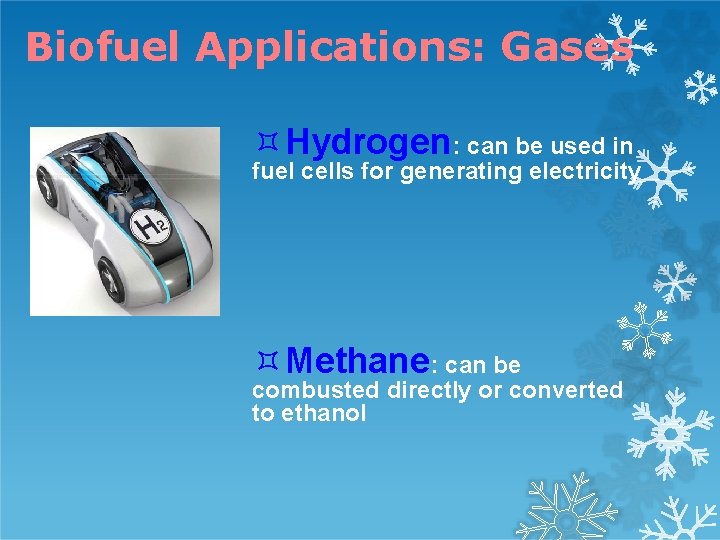
Biofuel Applications: Gases Hydrogen: can be used in fuel cells for generating electricity Methane: can be combusted directly or converted to ethanol
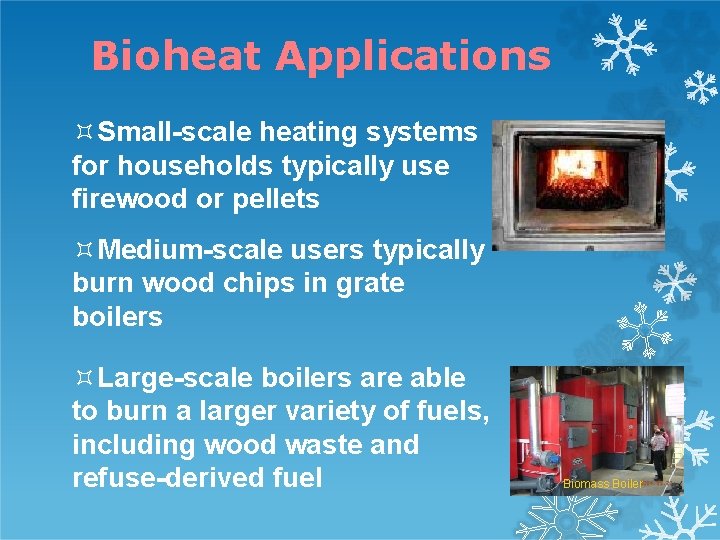
Bioheat Applications Small-scale heating systems for households typically use firewood or pellets Medium-scale users typically burn wood chips in grate boilers Large-scale boilers are able to burn a larger variety of fuels, including wood waste and refuse-derived fuel Biomass Boiler
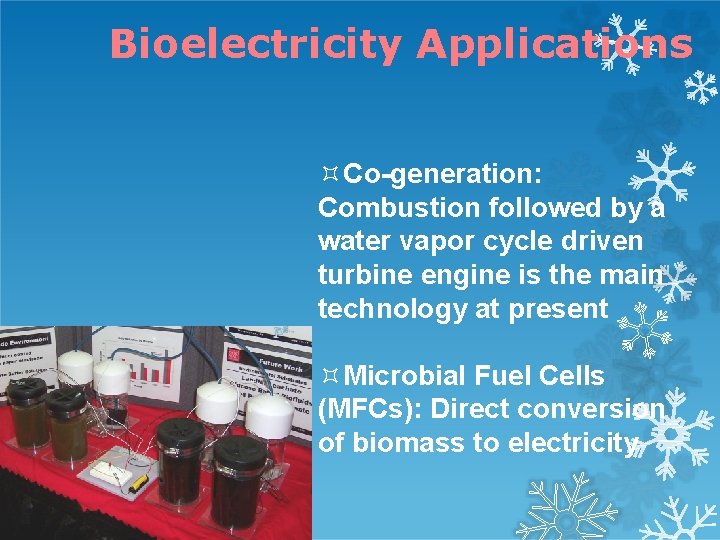
Bioelectricity Applications Co-generation: Combustion followed by a water vapor cycle driven turbine engine is the main technology at present Microbial Fuel Cells (MFCs): Direct conversion of biomass to electricity
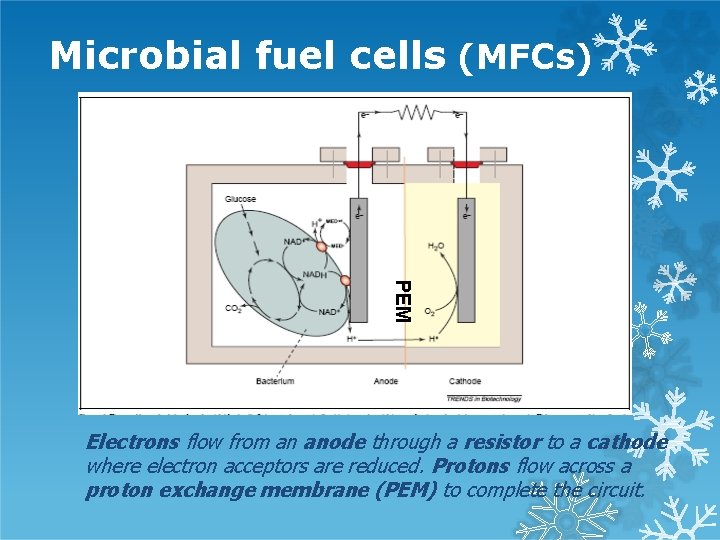
Microbial fuel cells (MFCs) PEM Electrons flow from an anode through a resistor to a cathode where electron acceptors are reduced. Protons flow across a proton exchange membrane (PEM) to complete the circuit.
Bio-electro-chemical devices Bacteria as biocatalysts convert the biomass “fuel” directly to electricity Oxidation-Reduction reaction switches from normal electron acceptor (e. g. , O 2, nitrate, sulfate) to a solid electron acceptor: Graphite anode It’s all about REDOX CHEMISTRY!
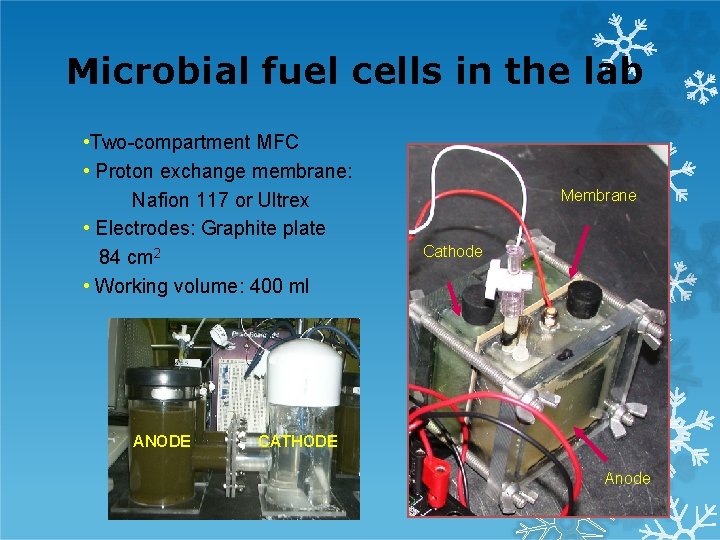
Microbial fuel cells in the lab • Two-compartment MFC • Proton exchange membrane: Nafion 117 or Ultrex • Electrodes: Graphite plate 84 cm 2 • Working volume: 400 ml ANODE Membrane Cathode CATHODE Anode
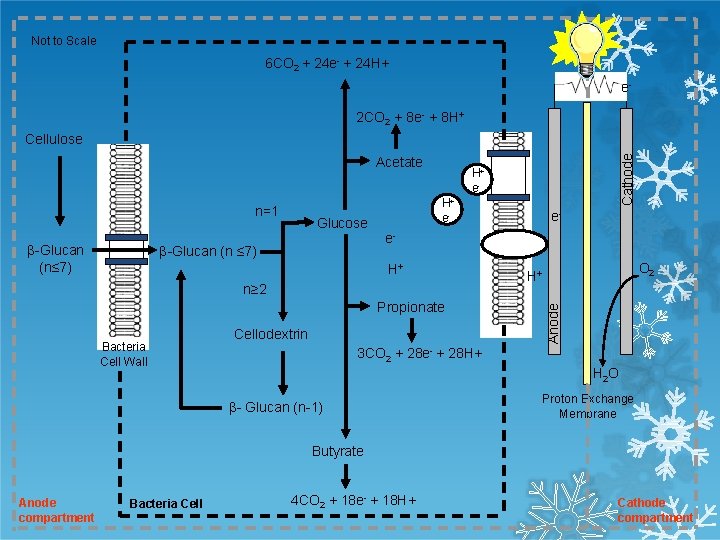
Not to Scale 6 CO 2 + 24 e- + 24 H+ ee- 2 CO 2 + 8 e- + 8 H+ Acetate β-Glucan (n≤ 7) Glucose β-Glucan (n ≤ 7) H+ e- e. H+ n≥ 2 Propionate Bacteria Cell Wall e- Cellodextrin O 2 H+ Anode n=1 Cathode Cellulose 3 CO 2 + 28 e- + 28 H+ H 2 O β- Glucan (n-1) Proton Exchange Membrane Butyrate Anode compartment Bacteria Cell 4 CO 2 + 18 e- + 18 H+ Cathode compartment

Thank You
- Slides: 31