
A REVIEW OF FEATURE SELECTION METHODS WITH APPLICATIONS

- Slides: 12
A REVIEW OF FEATURE SELECTION METHODS WITH APPLICATIONS Alan Jović, Karla Brkić, Nikola Bogunović E-mail: {alan. jovic, karla. brkic, nikola. bogunovic}@fer. hr Faculty of Electrical Engineering and Computing, University of Zagreb Department of Electronics, Microelectronics, Computer and Intelligent Systems
CONTENT Motivation Problem statement Classification of FS methods Application domains Conclusion
MOTIVATION Data pre-processing often requires feature set reduction � Too many features for modeling tools to find the optimal model � Feature set may not fit into memory (for big datasets, streaming features) � A lot of features may be irrelevant or redundant Few available review papers available on the subject � Mostly focused on specific topics (e. g. classification, clustering) � Application domains are not discussed in detail
PROBLEM STATEMENT Effectively, there are four classes of features: � Strongly relevant – cannot be removed without affecting the original conditional target distribution, necessary for optimal model � Weakly relevant, but not redundant – may or may not be necessary for optimal model � Irrelevant – not necessary to include, do not affect original conditional target distribution � Redundant – can be completely replaced with a set of other features such that the target distribution is not disturbed (redundancy is always inspected in multivariate case) Goal: develop methods to keep only strongly and weakly relevant features, remove all the rest
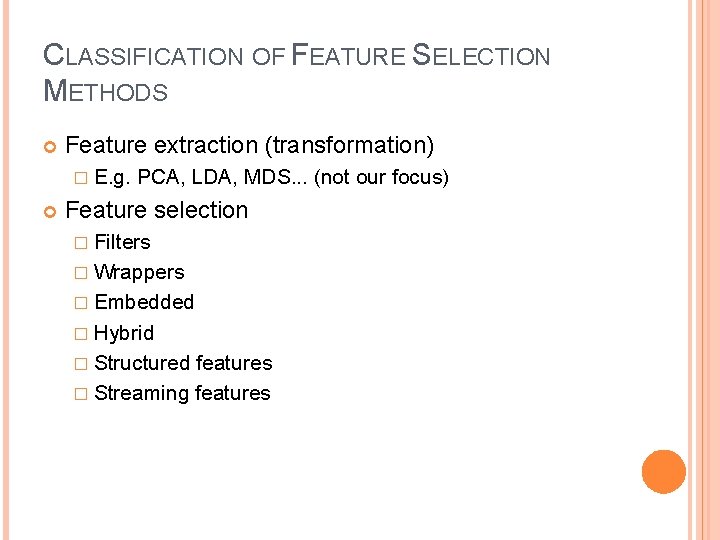
CLASSIFICATION OF FEATURE SELECTION METHODS Feature extraction (transformation) � E. g. PCA, LDA, MDS. . . (not our focus) Feature selection � Filters � Wrappers � Embedded � Hybrid � Structured features � Streaming features
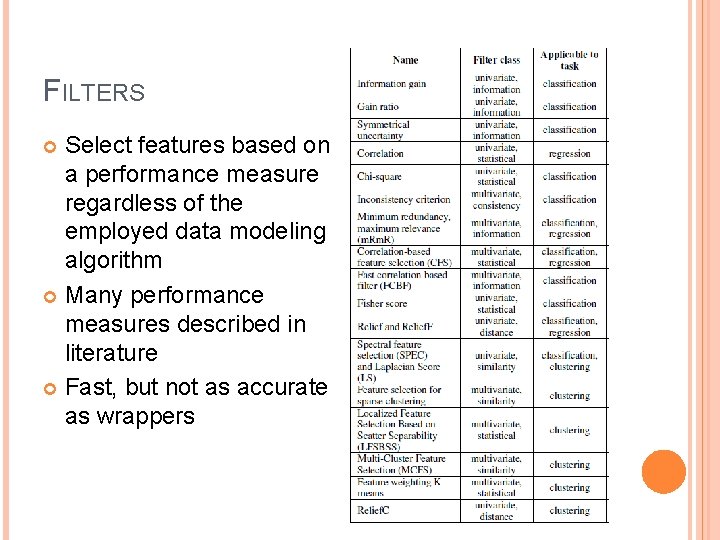
FILTERS Select features based on a performance measure regardless of the employed data modeling algorithm Many performance measures described in literature Fast, but not as accurate as wrappers
WRAPPERS Consider feature subsets by the quality of performance of a modeling algorithm, which is taken as a black box evaluator. The evaluation is repeated for each feature subset Very slow, highly accurate Dependent on the modeling algorithm, may introduce bias
EMBEDDED METHODS Perform feature selection during the modeling algorithm's execution. The methods are embedded in the algorithm either as its normal or extended functionality. Also biased for the modeling algorithm E. g. CART, C 4. 5, random forest, multinomial logistic regression, Lasso. . .
HYBRID METHODS Combine the best properties of filters and wrappers. Usual approach: � First, a filter method is used in order to reduce the feature space dimension space, possibly obtaining several candidate subsets. � Then, a wrapper is employed to find the best candidate subset. Highly used in recent years � E. g. fuzzy random forest feature selection, hybrid genetic algorithms, mixed gravitational search algorithm. . .
STRUCTURED AND STREAMING FEATURES Structured feature selection methods suppose that an internal structure (dependency) exists between features (groups, trees, graphs. . . ) � Algorithms are mostly based on Lasso regularization Streaming features selection methods assume that unknown number and size of features arrives into the dataset periodically and needs to be considered or rejected for model construction � Many approaches in recent years, particularly popular for modeling text messages in social networking � E. g. Grafting algorithm, Alpha-Investing algorithm, OSFS algorithm
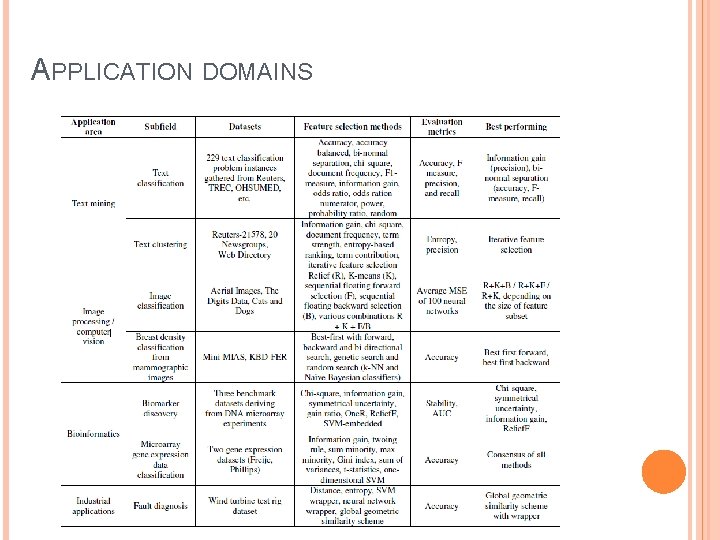
APPLICATION DOMAINS
CONCLUSIONS OF THE REVIEW Hybrid FS methods, particularly concerning the methodologies based on evolutionary computation heuristic algorithms such as swarm intelligence based and various genetic algorithms show the best results Filters based on information theory and wrappers based on greedy stepwise approaches also seem to show great results. Application of FS methods is imporant in areas such as bioinformatics, image processing, industrial applications and text mining where high-dimensional feature spaces are present – the application areas are mostly drivers for development of advanced FS methodologies